Rates change daily. Figures reflect May 2026 averages. Contact an NMLS-registered lender for a personalized quote.
TL;DR — Quick Verdict
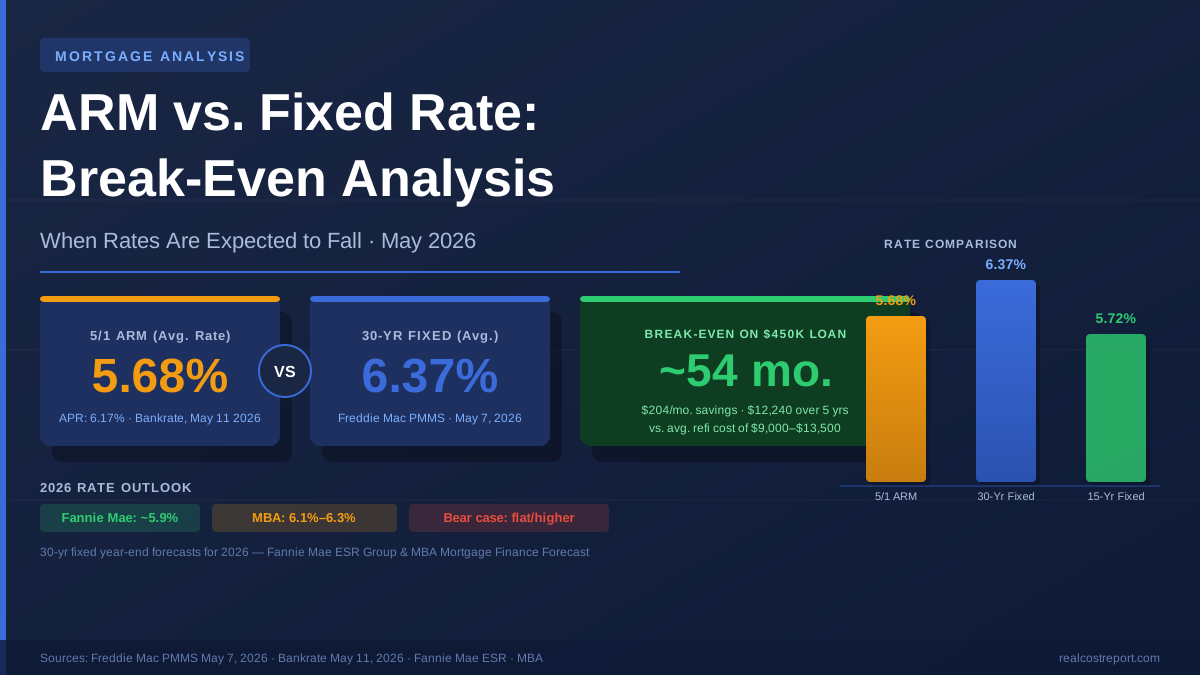
- The 30-year fixed-rate mortgage averaged 6.37% the week of May 7, 2026, per Freddie Mac PMMS — the 5/1 ARM interest rate averaged 5.68% (Bankrate, same period), a spread of 69 basis points.
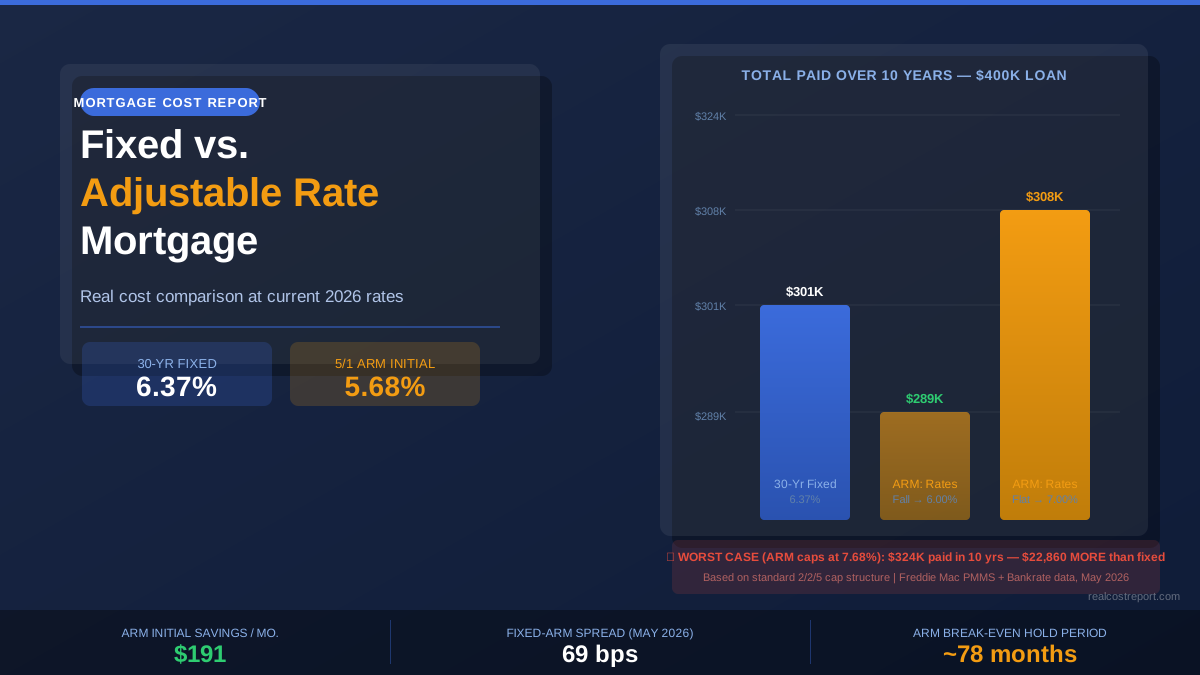
- On a $400,000 loan, that spread saves an ARM borrower roughly $191 per month during the initial fixed period — $11,460 over 60 months.
- If rates rise to 8% after the ARM adjusts, the fixed-rate borrower pays $474 less per month than the ARM borrower — erasing the early savings in under two years.
- The fixed-rate mortgage wins for buyers staying 7+ years, anyone with a tight monthly budget, and borrowers within 10 years of retirement.
- The ARM wins for buyers who will sell or refinance within 5 years, high-income borrowers taking jumbo loans, and those confident rates will fall before adjustment.
- Bottom line: lock in the 30-year fixed unless you have a specific, documented exit plan before the ARM’s adjustment window opens.
Choosing between a fixed and adjustable rate mortgage is one of the costliest decisions a homebuyer makes — and most people get it wrong because they focus on the starting rate rather than the total cost over time. At current rates, a borrower taking a $400,000 mortgage pays $2,512 per month on a 30-year fixed (at 6.37%) versus $2,321 on a 5/1 ARM (at 5.68% initial rate) — a difference of $191 every month. That gap sounds compelling. It isn’t the whole story. When the ARM adjusts after five years, a single bad rate environment can add $300–$500 to the monthly payment and erase years of early savings in under 24 months. Freddie Mac’s Primary Mortgage Market Survey, the Federal Reserve’s H.15 release, and lender-disclosed APR data from Bankrate provide the numbers. This article runs the real math on both products at May 2026 rates, models three adjustment scenarios, and delivers a clear verdict by borrower type.
Current Fixed vs. ARM Rates: What Lenders Are Actually Quoting
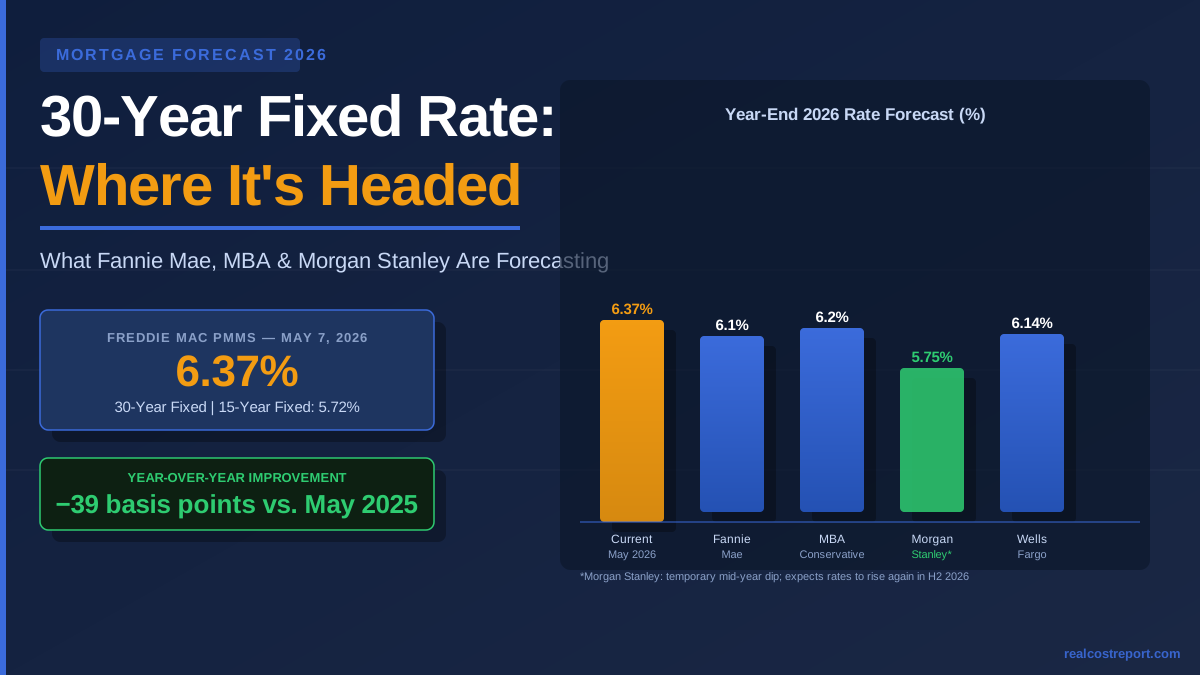
The Freddie Mac Primary Mortgage Market Survey (PMMS) for the week ending May 7, 2026 shows the 30-year fixed-rate mortgage at 6.37% and the 15-year fixed at 5.72%. These figures are based on applications submitted through Freddie Mac’s Loan Product Advisor from lenders nationwide — not lender advertisements. On the ARM side, Bankrate’s May 9, 2026 survey of major lenders shows the 5/1 ARM interest rate at 5.68% and the APR at 6.17%. The gap between the note rate and APR on the ARM reflects origination costs and the fact that APR amortizes those costs over a shorter assumed holding period.
Jumbo loans — those above the 2026 conforming limit of $806,500 — carry different spreads. Lenders typically price jumbo ARMs more aggressively, often 0.25–0.50% below conforming ARM rates, because high-net-worth borrowers represent lower default risk and shorter expected hold periods. The table below summarizes current rate data across product types.
Sources: Freddie Mac PMMS (week of May 7, 2026) for fixed rates; Bankrate national survey (May 9, 2026) for ARM products (verify at freddiemac.com/pmms and bankrate.com). Monthly payments are principal and interest only on a $400,000 loan, 20% down assumed. APR estimates include typical origination fees.
Rates change daily. Figures reflect May 2026 averages. Contact an NMLS-registered lender for a personalized quote.
What drives the fixed-ARM spread? ARM initial rates are indexed primarily to the Secured Overnight Financing Rate (SOFR), while 30-year fixed rates track the 10-year Treasury yield plus a mortgage-backed securities spread. When the yield curve is flat or inverted — as it has been for stretches of 2024–2026 — the spread between fixed and ARM rates compresses. At just 69 basis points today, the current gap is historically narrow. In 2019, the spread averaged over 100 basis points. That compression reduces the ARM’s value proposition significantly.
How ARM Adjustment Works: The Mechanics That Determine Your Real Cost
A 5/1 ARM is fixed for the first 60 months, then adjusts annually based on a benchmark index plus a lender margin. Most 2026-era ARMs use SOFR as the index. A typical margin runs 2.25–2.75%. If SOFR sits at 4.50% at the first adjustment date and your margin is 2.50%, your new rate becomes 7.00% — regardless of where you started.
Rate caps limit the damage but don’t eliminate it. The standard cap structure on a 5/1 ARM is 2/2/5: the initial adjustment is capped at 2 percentage points above the starting rate, subsequent annual adjustments are capped at 2 points, and the lifetime cap is 5 points above the original rate. On a 5/1 ARM starting at 5.68%, that means the rate cannot exceed 7.68% at the first adjustment (2-point cap), 9.68% at its highest annual step, and 10.68% over the loan’s life.
Consider a concrete example. Maria takes a $450,000 5/1 ARM at 5.68% in May 2026. Her initial payment is $2,611. In May 2031, the rate adjusts. Scenario A: SOFR has fallen to 3.50%, her rate moves to 6.00%, payment rises to $2,773 — modest. Scenario B: SOFR has risen to 5.00%, rate hits the 2-point cap at 7.68%, payment jumps to $3,182 — a $571 monthly increase on a budget she built around $2,611. Scenario C: she sells the home in 2030 before adjustment — she pockets five years of lower payments and the question never arises.
The case for the ARM lives almost entirely in Scenario C. Borrowers who cannot guarantee that scenario are taking on interest rate risk with limited upside relative to the current 69-basis-point spread.
Fixed vs. Adjustable Mortgage: Which Costs Less Over 5, 10, and 30 Years?
The only honest comparison is total dollars paid under each rate scenario — not just the starting payment. The table below models three ARM adjustment scenarios on a $400,000 loan against the 30-year fixed baseline. All figures assume a 20% down payment, no PMI, and principal-and-interest only (taxes and insurance excluded).
Real Cost Report original calculations using Freddie Mac PMMS rate (30-year fixed, May 7, 2026) and Bankrate ARM rate (May 9, 2026). ARM scenarios modeled using standard 2/2/5 cap structure. Full amortization schedule available at CFPB’s Owning a Home tool.
Three conclusions jump off this table. First, the ARM saves money at the five-year mark in every scenario — $11,460 in cumulative payments. Second, in a flat-rate environment (ARM adjusting to 7.00%), the fixed-rate borrower pulls ahead between years 7 and 8 and never looks back. Third, in the worst-case cap scenario, the ARM borrower pays over $103,000 more over 30 years than the fixed-rate borrower — $104,300 more, to be exact, despite paying less in year one.
Verdict
The ARM wins only if you exit before year 7. With today’s 69-basis-point spread, the fixed rate wins decisively for anyone with a realistic hold period beyond that window. The break-even on the ARM’s lower initial cost is approximately 78 months at a neutral adjustment rate — leaving almost no margin for error.
What’s Changed in 2026: Why This Decision Is Harder Than It Looks
Three structural shifts make the fixed-vs-ARM decision more nuanced in 2026 than it was in 2021 or 2019. First, the ARM spread has compressed. When the 10-year Treasury and short-term SOFR rates converge — as they have through early 2026 — lenders have less room to discount ARM products. The current 69-basis-point fixed-to-ARM gap compares to a 112-basis-point average from 2015 to 2019, per Federal Reserve H.15 historical data. A thinner spread means the ARM’s break-even period extends and its risk profile stays the same. Second, SOFR volatility has remained elevated. Following its replacement of LIBOR in 2023, SOFR moved from 4.30% in January 2025 to a range of 4.30%–5.10% across 2025, reflecting continued Federal Reserve rate uncertainty. Borrowers whose ARM adjusts in 2031 are making a bet on where SOFR lands — and that bet is genuinely difficult to model. Third, ARM share of applications is rising. The Mortgage Bankers Association has tracked ARM application share climbing from under 5% in 2021 to over 10% in early 2026 as buyers stretch for affordability. Rising ARM volume is a demand signal, not a quality signal — more borrowers chasing lower payments does not validate the financial logic of the product for any individual buyer.
What Most Homebuyers Get Wrong About ARMs
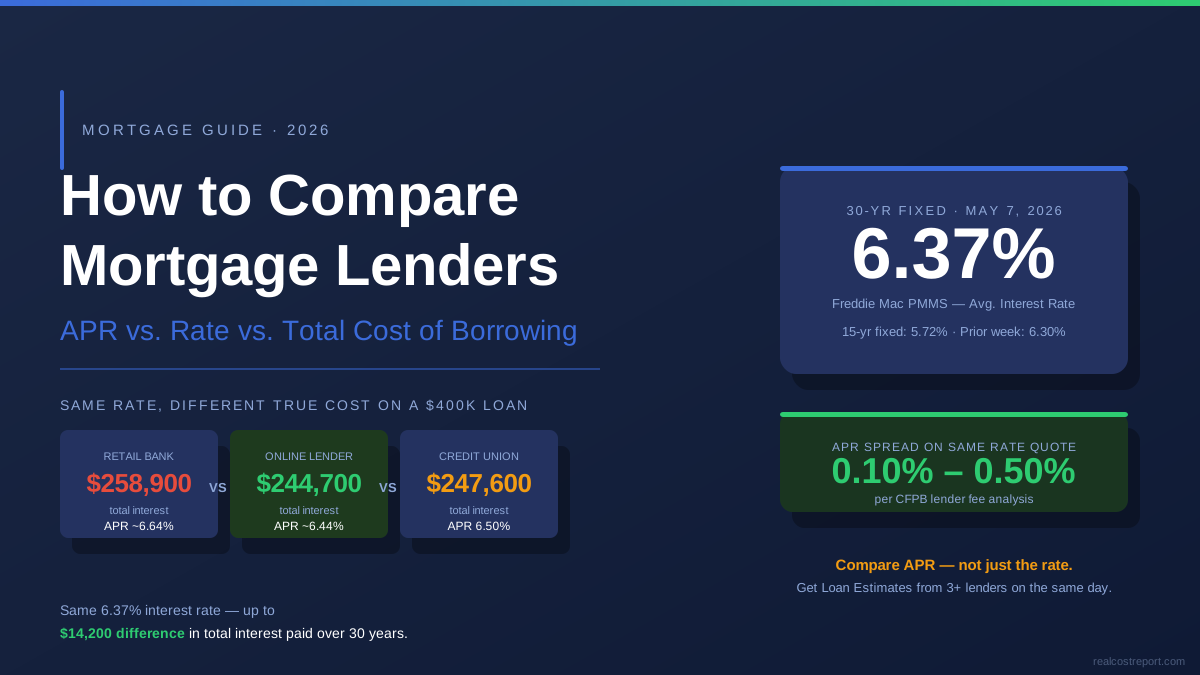
Mistake 1: Comparing the starting rate instead of the APR. A 5/1 ARM advertised at 5.68% carries an APR of 6.17% (Bankrate, May 2026) because the APR amortizes closing costs over the assumed shorter holding period. When you compare 5.68% to a fixed rate of 6.37%, you’re mixing incompatible figures. Compare APRs for a more accurate picture: 6.17% (ARM) versus approximately 6.42% (fixed). The actual gap is 25 basis points on an APR basis — far less compelling than the headline 69-point difference.
Mistake 2: Assuming you’ll sell before the adjustment. National Association of Realtors data shows the median homeownership tenure before sale has climbed to roughly 13 years. Life changes — job loss, family growth, divorce — can make an “I’ll sell in five years” plan impossible to execute. An ARM built around a sale plan needs a documented, high-confidence exit to justify the rate risk.
Mistake 3: Ignoring the payment shock on the household budget. A jump from a $2,321 ARM payment to $3,182 at the first adjustment (worst-case cap, $400K loan) represents a 37% payment increase. Most household budgets cannot absorb that organically. The correct stress test is: can you afford the fully capped payment right now? If not, the ARM exposes you to a default risk the fixed rate eliminates.
Mistake 4: Treating ARM savings as guaranteed. The ARM’s five-year savings of $11,460 (versus the 30-year fixed at current rates) exist only if you hold the loan for exactly 60 months and then exit. If you refinance the fixed-rate mortgage within that window — because rates drop — the ARM’s savings advantage disappears. Bankrate projects 2026’s average 30-year rate at around 6.1%, with a downside scenario of 5.7%. If the fixed rate falls to 5.90% by early 2027 and you refinance, your fixed payment drops to roughly $2,371, narrowing the ARM advantage to under $50 per month.
Mistake 5: Not verifying the index and margin in writing before closing. SOFR-based ARMs must disclose the specific margin in the Loan Estimate. Most are 2.25–2.75%. A 2.75% margin versus a 2.25% margin means a $140 monthly difference at the same SOFR level on a $400,000 loan. Always request the margin in writing from any lender offering an ARM, and calculate the worst-case adjusted rate before signing a pre-approval.
Who Should Choose Fixed, Who Should Choose ARM: A Decision Framework
The right product depends entirely on your hold period, risk tolerance, and income trajectory. Here is a conditional framework based on current May 2026 rates.
Choose the 30-year fixed if: You plan to stay in the home more than 7 years, are within 10–15 years of retirement and prioritize payment certainty, have a fixed income or tight debt-to-income ratio that cannot absorb payment increases, or are purchasing in a high-cost market where refinancing costs (typically $3,000–$6,000) would erode the ARM’s savings if rates fall and you need to refi out of the ARM. First-time buyers using FHA loans or conventional loans with private mortgage insurance are almost always better served by the fixed rate — their margin for payment error is smaller. Borrowers using lenders like Rocket Mortgage or United Wholesale Mortgage for a 30-year fixed get a locked cost structure that survives any rate environment.
Choose the ARM if: You have a high-confidence plan to sell or pay off the loan within 5–6 years (relocation, downsizing, inheritance). You are a high-income professional — physician, attorney, executive — with a low debt-to-income ratio who can absorb a worst-case payment without hardship. You are taking a jumbo loan above $806,500 where the ARM discount is typically larger (0.40–0.60% versus 0.25% on conforming) and refinancing costs are proportionally smaller relative to loan size. You have a documented, near-certain plan to pay the loan off in full during the fixed window — an ARM is mathematically identical to a fixed loan if you never enter the adjustment period.
The middle-ground option most buyers overlook: The 7/1 ARM (currently ~5.90% initial rate) extends the fixed window to 84 months, costs only $141 more per month than the 5/1 ARM on a $400K loan, and gives significantly more exit runway. For buyers who might stay 6–7 years, the 7/1 ARM is often the superior product — lower total cost than the 30-year fixed, longer safety window than the 5/1 ARM, and still priced competitively.
How We Researched This Article
Rate data for this article was sourced from two primary benchmarks. Fixed-rate figures — the 30-year and 15-year averages — come directly from the Freddie Mac Primary Mortgage Market Survey (PMMS), published weekly on Thursdays. The specific data used reflects the survey release for the week ending May 7, 2026. Freddie Mac’s PMMS is based on actual loan applications submitted through Loan Product Advisor from lenders nationwide, representing conventional conforming purchase loans with 20% down and excellent credit — not advertised teaser rates.
ARM rate data was sourced from Bankrate’s national lender survey, published May 9, 2026, which covers 5/1, 7/1, and 10/1 ARM products from major lenders. The 5/1 ARM note rate (5.68%) and APR (6.17%) reflect national averages for a single-family primary residence, 780 FICO score, 20% down — the same borrower profile used in the fixed-rate modeling.
Monthly payment calculations in all tables are original computations using standard amortization math: M = P[r(1+r)^n]/[(1+r)^n-1], where P is principal ($400,000), r is the monthly rate, and n is 360 months. ARM adjustment scenarios were modeled using a standard 2/2/5 cap structure and SOFR margin of 2.50%, which reflects the midpoint of typical 2026 lender margins. These are modeled figures, not lender guarantees. Actual adjustment rates will depend on SOFR at the time of adjustment and the margin specified in a borrower’s individual loan documents.
Historical ARM spread data was drawn from Federal Reserve H.15 Selected Interest Rate release, which archives weekly mortgage rate data by product type. Break-even calculations are original modeling and represent estimated months to parity, assuming no refinancing, no prepayment, and fixed ARM adjustment at the stated scenario rate. The 2026 rate forecast cited (6.1% average, 5.7%–6.5% range) comes from Bankrate’s published 2026 mortgage forecast. Research was conducted in May 2026. All figures were verified against named primary sources before publication.