Rates change daily. Figures reflect May 2026 averages sourced from the Freddie Mac Primary Mortgage Market Survey. Contact an NMLS-registered lender for a personalized rate quote.
TL;DR — Quick Verdict
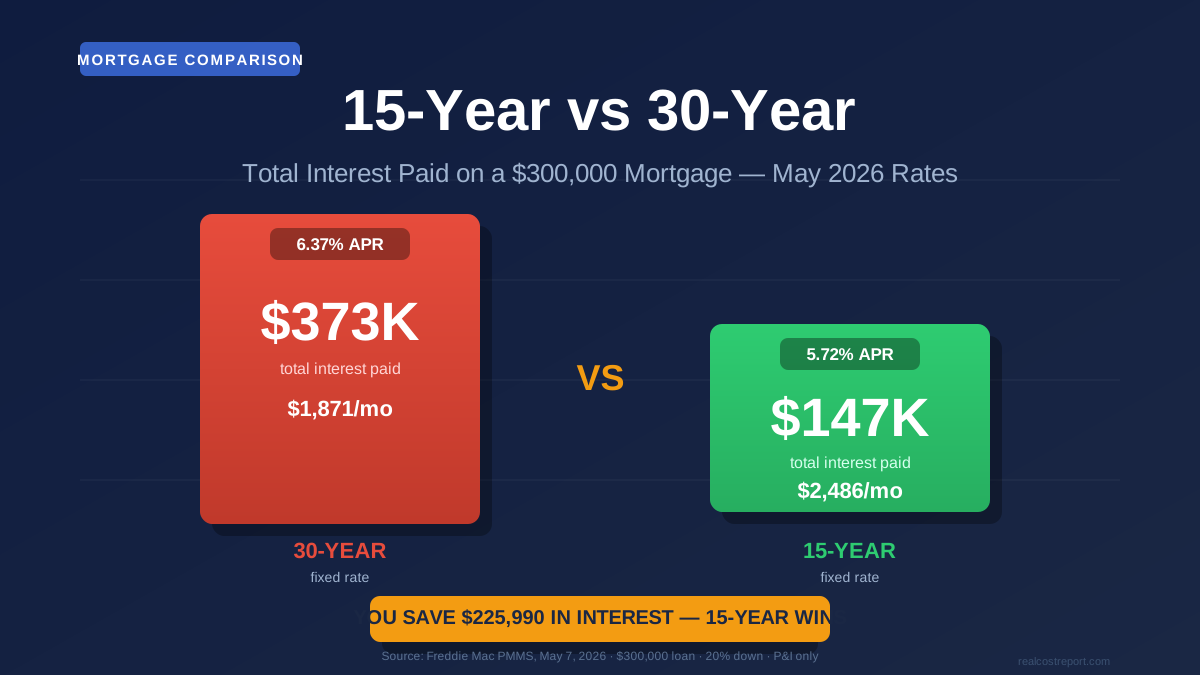
- At current Freddie Mac rates (30-year: 6.37%, 15-year: 5.72%), a $300,000 15-year mortgage saves $225,990 in total interest compared to the 30-year equivalent.
- The 15-year requires a $615/month higher payment on a $300K loan — a real cash-flow constraint that eliminates it for many buyers.
- The 30-year wins on monthly affordability; the 15-year wins on total cost, equity speed, and rate — by 65 basis points right now.
- At $450,000, the payment gap widens to $923/month and the interest savings climb to nearly $339,000.
- Refinancing from a 30-year to a 15-year mid-loan can capture most of the savings — but closing costs ($3,000–$6,000) must be weighed against your remaining timeline.
- Verdict: Choose the 15-year if your budget absorbs the higher payment and you plan to stay 10+ years. Choose the 30-year if cash-flow flexibility matters more than minimizing lifetime interest.
Borrowers who picked a 30-year mortgage over a 15-year on a $300,000 loan will pay an extra $225,990 in interest over the life of the loan — roughly the price of a second home in many U.S. markets. That gap is not a rounding error. It is the single most consequential number in the 15-year vs 30-year mortgage debate, and yet most buyers focus almost entirely on the monthly payment difference. According to Freddie Mac’s Primary Mortgage Market Survey for the week of May 7, 2026, the 30-year fixed rate sits at 6.37% while the 15-year fixed rate is 5.72% — a spread of 65 basis points that has held wider than historical norms throughout 2025 and into this year. Lenders including Wells Fargo and Rocket Mortgage are quoting within that range for well-qualified borrowers. This article works through the exact dollar math at both loan sizes, models the equity and break-even timelines, and names the scenarios where each term wins.
Current 15-Year vs 30-Year Mortgage Rates and What They Cost You
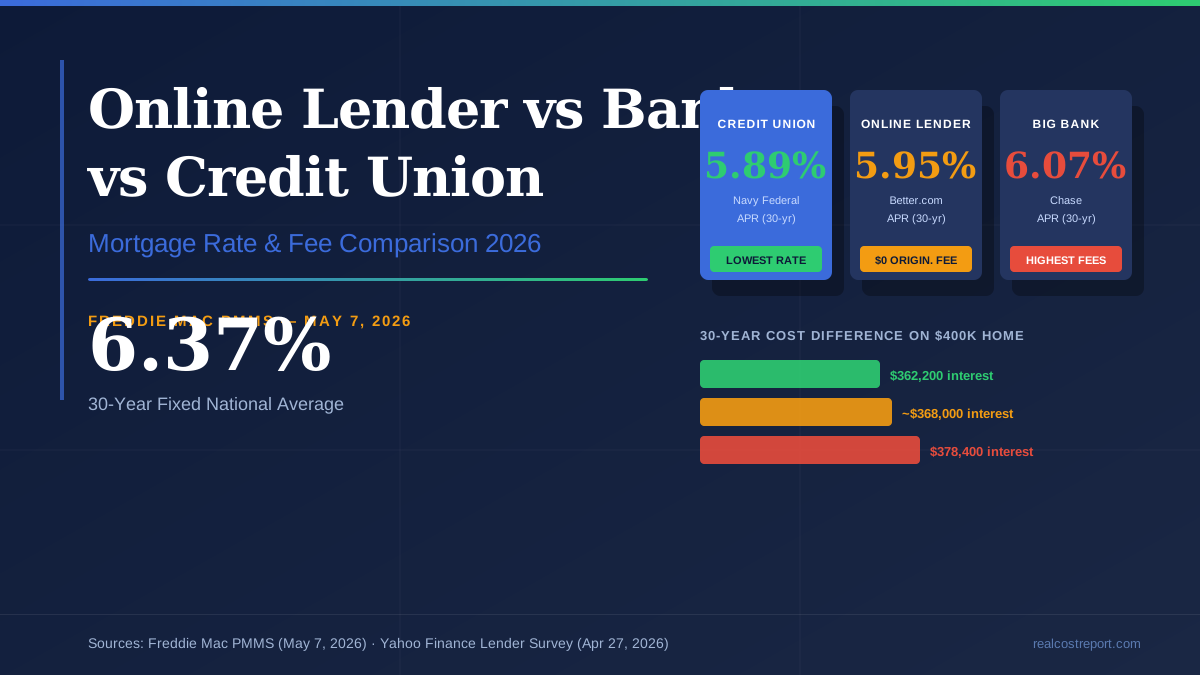
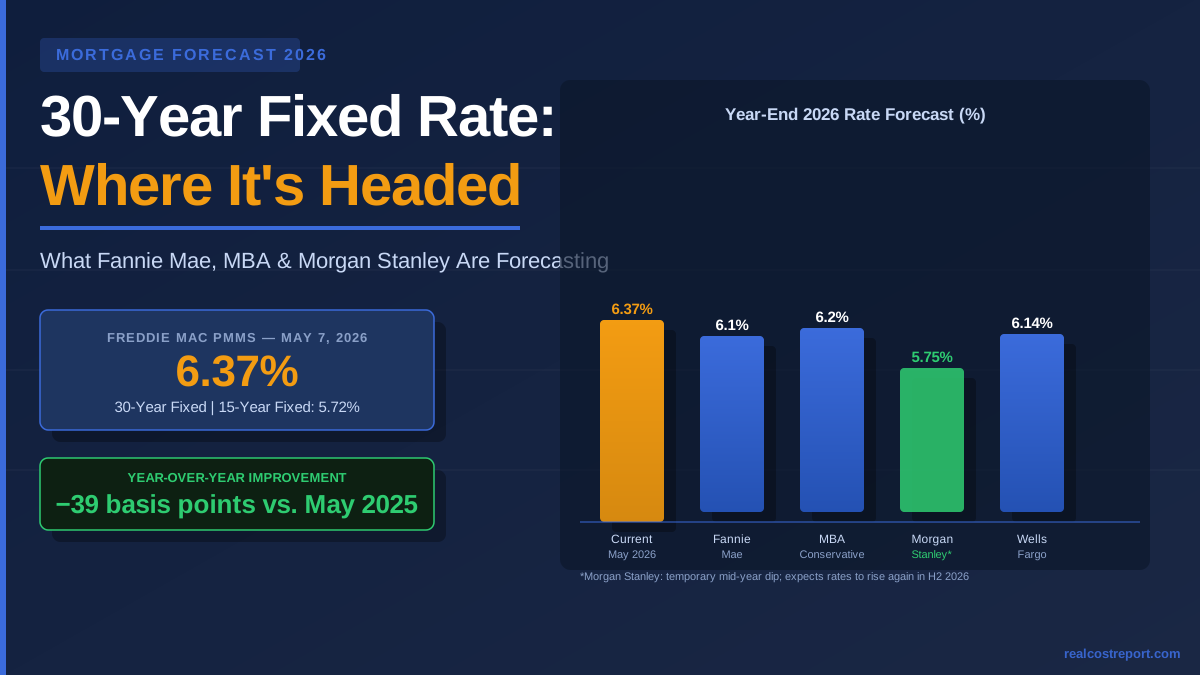
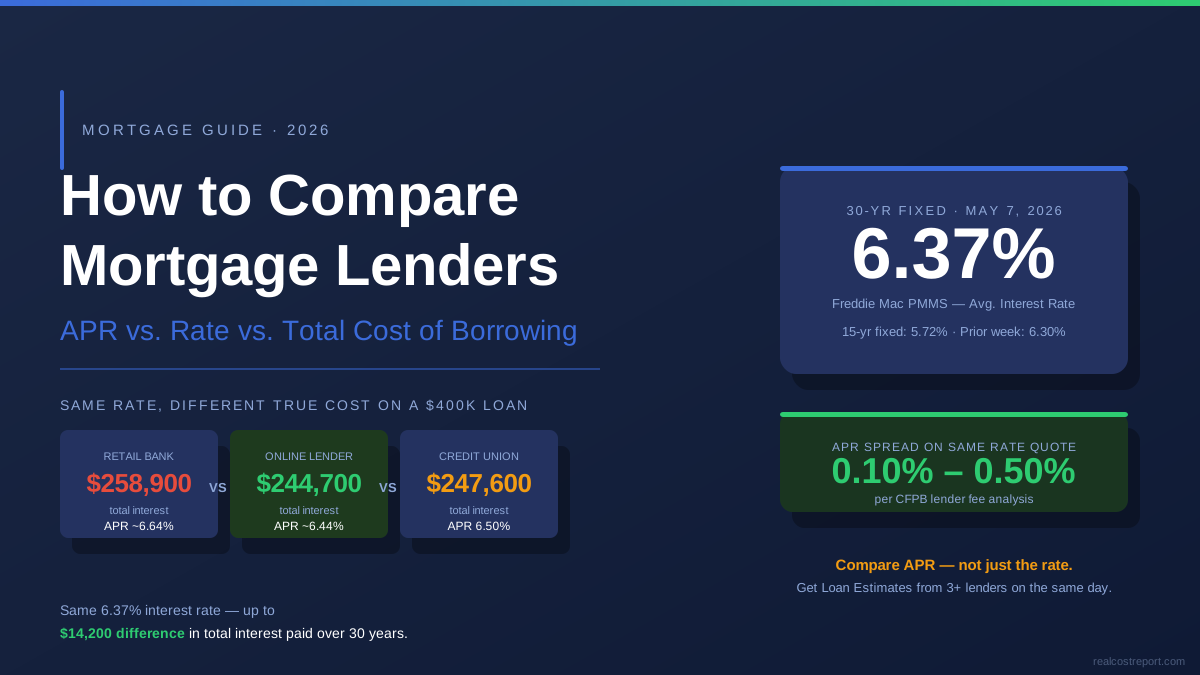
The Freddie Mac PMMS for May 7, 2026 puts the 30-year fixed at 6.37% and the 15-year fixed at 5.72%. These figures are based on applications submitted by borrowers with 20% down and excellent credit — the cleanest available benchmark. Individual lender APRs will differ based on credit score, loan size, and points paid.
The table below calculates the exact monthly payment, total amount paid, and total interest for a $300,000 and $450,000 loan at current rates. No origination fees or points are included — this is principal and interest only.
Source: Freddie Mac Primary Mortgage Market Survey, week of May 7, 2026 (verify at freddiemac.com/pmms). Calculations are principal and interest only; excludes taxes, insurance, and PMI.
Rates shown are sample averages. Your premium varies by risk profile, state, and lender.
The $615/month payment gap on a $300,000 loan is the number that decides most borrowers’ choice in practice. On a $450,000 loan, that gap widens to $922/month — an amount that pushes the 15-year out of reach for households whose debt-to-income ratio is already near a lender’s 43% ceiling. What the table also shows: the 15-year borrower pays 33% less total interest even after accounting for the higher monthly outlay, because they are paying off principal at roughly twice the speed from day one.
How Amortization Determines Who Wins — and When
The core mechanism behind the interest difference is amortization structure. On a 30-year loan at 6.37%, the first monthly payment of $1,871 on a $300,000 balance breaks down as approximately $1,593 in interest and only $278 toward principal. The lender collects nearly 85 cents of every dollar before the borrower builds any equity. That ratio flips only gradually — after 10 years, still less than 25% of each payment goes to principal.
The 15-year tells a different story. At 5.72%, the first payment of $2,486 splits into roughly $1,430 interest and $1,056 principal. The borrower pays down principal at 3.8× the rate of the 30-year equivalent from the very first payment.
The equity gap compounds quickly. After five years on a $300,000 loan:
Source: Author calculations based on Freddie Mac PMMS rates (May 7, 2026) using standard amortization formula. Figures rounded to nearest $1,000.
The equity difference at year five — $45,000 — represents real optionality: a 15-year borrower who needs to sell, refinance, or tap a home equity line of credit (HELOC) will do so from a meaningfully stronger position. For a borrower who bought in a flat or declining market, that equity cushion can be the difference between a clean sale and a short sale.
15-Year vs 30-Year Mortgage: Which Is Better for Your Situation?
This is not a one-size verdict. The right term depends on four variables: income stability, existing debt load, investment alternatives, and time horizon in the home.
Source: Real Cost Report analysis based on CFPB mortgage guidance (verify at consumerfinance.gov) and standard financial planning principles.
Verdict
The 15-year mortgage wins decisively for borrowers within 15–20 years of retirement who have stable income and no competing high-interest debt. The 30-year wins for early-career buyers with variable income, tight debt-to-income ratios, or a credible plan to invest the payment difference at returns exceeding the 5.72% rate. There is no universal answer — the spread in total interest cost is real, but so is the cash-flow constraint.
What Most Borrowers Get Wrong About the 15 vs 30 Decision
The math is straightforward. The mistakes most people make are behavioral and structural — not arithmetic.
Mistake 1: Assuming the 30-year with extra payments equals a 15-year. In theory, paying an extra $615/month on a 30-year loan should replicate the 15-year outcome. In practice, the rate is still 6.37% vs 5.72% — meaning you are paying 65 extra basis points on the entire outstanding balance for every month you carry the loan. A borrower who takes the 30-year at 6.37% and pays extra will still pay more interest than the 15-year borrower, because the underlying rate is higher. On a $300,000 loan, the rate difference alone costs approximately $42,000 in additional interest over a 15-year payoff period, even with identical principal reduction schedules. The consequence: this strategy only breaks even if you invest the rate-difference savings at returns above 6.37% — a harder hurdle than many assume.
Mistake 2: Ignoring the debt-to-income ceiling at pre-approval. Lenders cap DTI at 43% for most conventional loans (some Fannie Mae and Freddie Mac products allow up to 45–50% with compensating factors). A borrower earning $8,000/month gross with $600 in existing debt payments has $2,840 of mortgage headroom at 43% DTI. A $300,000 30-year mortgage at 6.37% needs $1,871. The 15-year needs $2,486 — but combined with the $600 existing debt, that’s $3,086, which exceeds the ceiling. The 30-year is not a preference in this case — it is the only option the lender will approve.
Mistake 3: Counting the mortgage interest deduction as a meaningful offset. The Tax Cuts and Jobs Act of 2017 raised the standard deduction to the point where only approximately 13% of taxpayers now itemize, per IRS Statistics of Income data (verify at irs.gov). For the majority of borrowers, the mortgage interest deduction provides zero tax benefit. Running the 30-year vs 15-year comparison assuming a full deduction inflates the true cost of the 30-year by overstating the after-tax benefit.
Mistake 4: Choosing the 15-year and depleting the emergency fund. The higher payment is non-negotiable every month. A borrower who stretches into a 15-year payment with three months of reserves instead of six takes on real default risk if income drops. The guaranteed interest savings of the 15-year are worth nothing if a missed payment triggers late fees, credit score damage, or foreclosure proceedings. Maintain six months of expenses in cash before committing to the higher payment.
Mistake 5: Not pricing the refinance option when rates are elevated. Borrowers taking a 30-year today at 6.37% in anticipation of refinancing to a 15-year when rates fall face closing costs of $3,000–$7,000 per refinance event, per CFPB data. Those costs reset the break-even clock. A borrower who refinances at year 5 into a new 15-year has effectively committed to a 20-year payoff — not 15 — while paying closing costs twice.
Is the 15-Year Mortgage Worth It? A Scenario Analysis
Three realistic buyer profiles illustrate when each term wins on the numbers — not in the abstract.
Scenario A — The pre-retiree couple, ages 52, buying a $375,000 home with 20% down ($300,000 loan). They have $12,000/month combined gross income, no other debt, and plan to retire at 67. A 30-year mortgage would still carry a balance at retirement. A 15-year at $2,486/month is 20.7% of gross income — well within the 28% front-end ratio guideline. They save $225,990 in interest, pay off the home at age 67, and enter retirement with no housing payment. The 15-year is the clear choice.
Scenario B — The freelance designer, age 34, buying a $500,000 home with 20% down ($400,000 loan). Income averages $9,500/month but varies month to month. A 15-year payment would be approximately $3,315/month — 34.9% of gross income in a good month, but dangerously high in a slow quarter. The 30-year at $2,494/month provides flexibility to pay extra when work is strong and hold minimum payments when it is not. The 30-year is appropriate here, and disciplined extra payments can close much of the gap.
Scenario C — The dual-income couple, ages 29, buying a $350,000 home with 20% down ($280,000 loan). Combined income is $14,000/month. They carry $600/month in student loan payments but have $80,000 in retirement accounts. Their employer matches 401(k) up to 6% of salary, and they are not maximizing contributions. The 15-year payment is $2,321/month — affordable by DTI standards. However, diverting $615 extra per month toward the mortgage rather than capturing employer 401(k) match represents a guaranteed 100% return forfeited. The correct sequence: maximize the 401(k) match first, then redirect any surplus toward the mortgage decision. Given their age and income trajectory, the 30-year with extra payments is likely optimal — but the analysis must be re-run annually as their income grows.
What’s Changed in 2026: Rate Spreads and Market Conditions
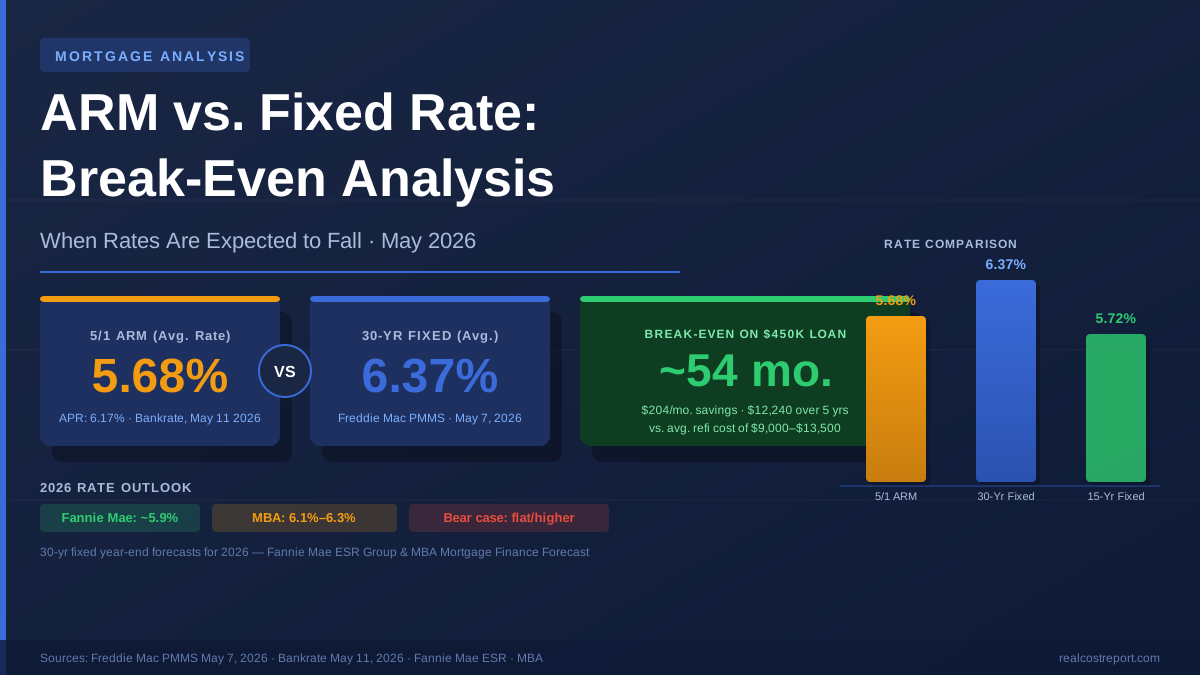
The 65-basis-point spread between the 30-year (6.37%) and 15-year (5.72%) as of May 2026 is wider than the historical average of 50–55 basis points, according to Freddie Mac PMMS historical data. This larger spread means the 15-year’s rate advantage is currently more pronounced than usual — which amplifies the total interest savings calculation above. A year ago, the 30-year averaged 6.76% and the 15-year averaged 5.89%, a spread of 87 basis points, so today’s spread is actually narrower than 2025’s peak differential.
Separately, Freddie Mac’s chief economist Sam Khater noted in the May 7, 2026 release that median new-home prices have fallen to their lowest level since July 2021, and that inventory is higher than in recent years — conditions that modestly ease affordability pressure for buyers. For borrowers who were previously priced out of the 15-year payment, a lower purchase price on the same home improves the likelihood that the 15-year fits within DTI limits. The MBA forecasts total mortgage originations of $2.2 trillion in 2026, an 8% increase over 2025, suggesting continued refinance activity that may give existing 30-year borrowers an opportunity to convert to a 15-year at lower rates later in the year if the Federal Reserve eases further.
How We Researched This Article
Rate data was sourced directly from the Freddie Mac Primary Mortgage Market Survey for the week ending May 7, 2026 — the most recent release at time of publication. The PMMS reflects rates on conventional, conforming, fully amortizing home purchase loans for borrowers with 20% down and excellent credit. It is the longest-running and most widely cited mortgage rate benchmark in the United States, published weekly since April 1971.
All payment and total interest calculations were performed using the standard mortgage amortization formula: M = P × [r(1+r)^n] / [(1+r)^n − 1], where P is principal, r is the monthly interest rate, and n is the number of payments. Loan sizes of $300,000 and $450,000 were selected to reflect median U.S. purchase loan amounts in 2026; figures for other loan sizes scale proportionally. Equity-at-year-5 estimates are modeled and represent rounded approximations — actual figures will vary by exact closing date and payment timing.
Debt-to-income guidance references the CFPB’s qualified mortgage DTI standards and Fannie Mae Selling Guide underwriting guidelines (verify at fanniemae.com). Tax deductibility data references IRS Statistics of Income (verify at irs.gov). Historical PMMS rate spread data was verified against the Freddie Mac PMMS archive (freddiemac.com/pmms/pmms_archives). Research was conducted in May 2026. Regional rate variations, lender overlays, and borrower-specific risk factors will affect actual quoted rates. Closing cost ranges cited in the FAQ reflect CFPB survey data and do not include prepaid items or escrow. All figures were verified against named primary sources before publication.