This article is for informational purposes only and does not constitute legal or financial advice; consult a licensed estate planning attorney before making decisions about trust structures.
TL;DR — Quick Verdict
- A revocable living trust typically costs $1,500–$3,500 to draft through an estate planning attorney; a testamentary trust embedded in a will costs $400–$1,200 upfront — but that gap reverses over time.
- Testamentary trusts require full probate every time, adding $5,000–$15,000+ in court and attorney fees depending on estate size and state; living trusts bypass probate entirely.
- Ongoing trustee fees (professional corporate trustees charge 0.5%–1.5% of assets annually) apply equally to both structures once funded and active.
- Living trusts win on total 20-year cost for estates above $300,000 in high-probate states like California, where statutory attorney fees alone can reach 4% of gross estate value.
- Testamentary trusts remain cost-competitive for estates under $150,000, single-state assets, or situations where the grantor wants court oversight of trustee behavior.
- Recommendation: If your estate exceeds $300,000 or spans multiple states, a living trust delivers a measurable cost advantage; otherwise, a testamentary trust paired with a pour-over will may suffice.
Most estate planning decisions come down to cost — and most published comparisons get it wrong by looking only at attorney drafting fees. The American Bar Association’s 2024 legal fee survey found that attorney fees for revocable living trusts ranged from $1,200 to $5,000 nationally, while basic will drafting (which contains the testamentary trust instructions) ranged from $300 to $1,000. At first glance, the testamentary trust looks like the obvious bargain. It isn’t. The real cost differential emerges post-death, when a testamentary trust must survive probate — a court-supervised process that delays asset distribution by six months to two years and consumes 3%–7% of estate value in fees in states like California and Florida. This analysis models both structures across three estate sizes and two administrative timelines, using fee data from state court systems, the National Academy of Elder Law Attorneys (NAELA), and published corporate trustee fee schedules from Fidelity Personal Trust and Charles Schwab Trust Company. You will leave with hard numbers — not generalities — to bring to your next attorney meeting.
Upfront Setup Costs: What Attorneys Actually Charge in 2026
The sticker price for an estate plan depends on document complexity, attorney market, and whether you bundle services. A testamentary trust is not a standalone document — it exists as a clause inside your last will and testament. That makes the upfront cost lower, but it also means the trust has no legal effect until after death and after probate validates the will.
A revocable living trust, by contrast, is a standalone legal entity created during your lifetime. The trust agreement, certificate of trust, and accompanying pour-over will together form a package. Most estate planning attorneys at mid-market firms price this as a bundle.
Sources: American Bar Association 2024 Legal Fee Survey (verify at americanbar.org); NAELA member fee benchmarks (verify at naela.org); Trust & Will and Fabric published pricing as of Q1 2026.
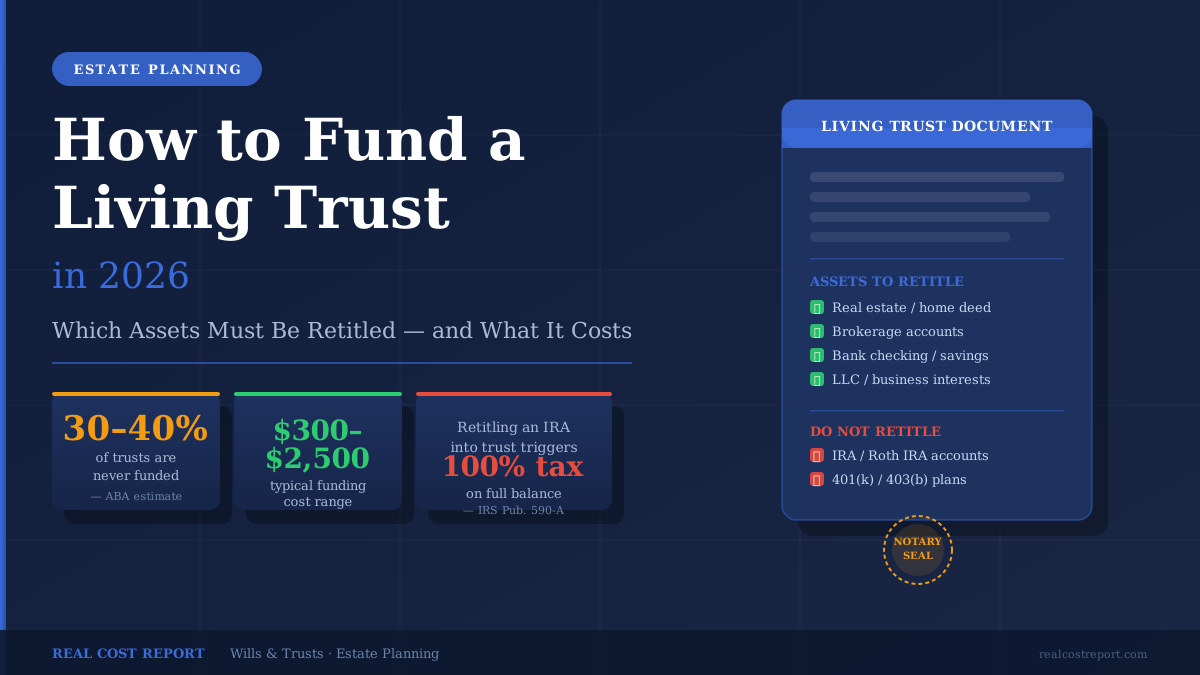
One cost many families overlook: funding the living trust. Retitling your home, brokerage accounts, and bank accounts into the trust name is not automatic. Attorneys often charge separately for deed preparation — typically $200–$500 per real property parcel — and some financial institutions require a Medallion Signature Guarantee or notarized certification before accepting title changes. Budget $500–$1,500 in total retitling costs for a typical three-to-five asset estate. Testamentary trusts require no retitling during your lifetime, which is why their upfront cost is genuinely lower.
Probate Costs: The Hidden Price of the Testamentary Trust
Every testamentary trust passes through probate before it activates. This is not optional — a testamentary trust has no legal standing until the will is admitted to probate and a judge formally appoints a trustee. In straightforward estates, that process takes six to nine months. In contested estates or those with real property in multiple states, probate can run two to four years.
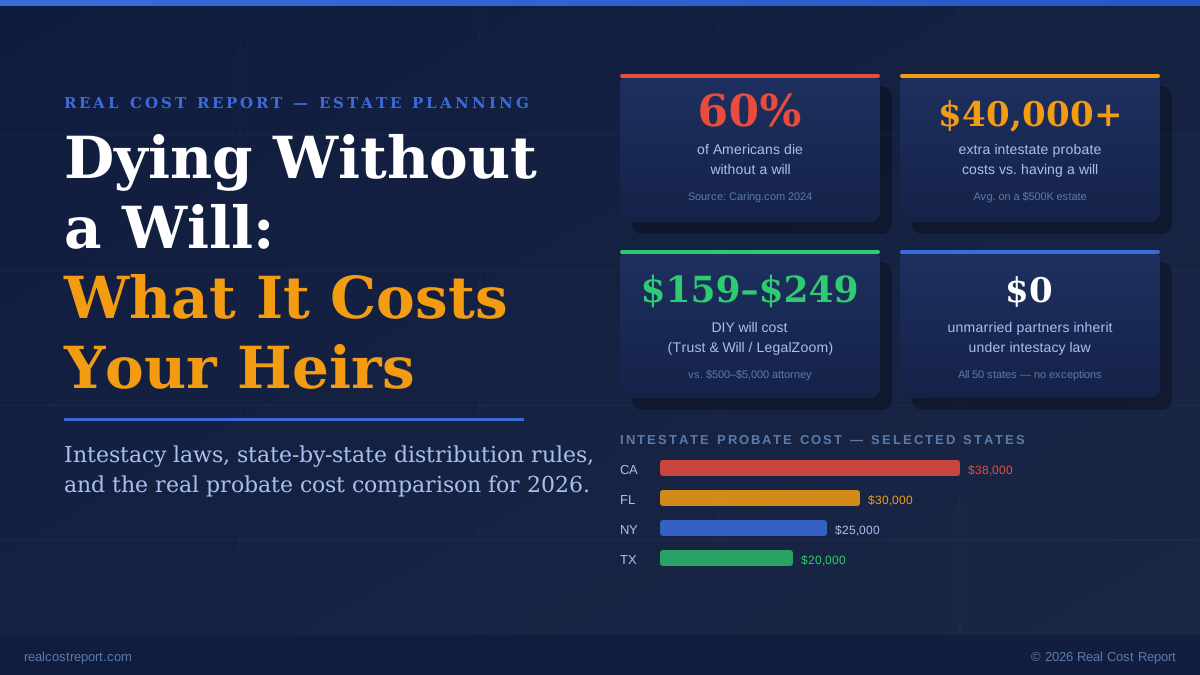
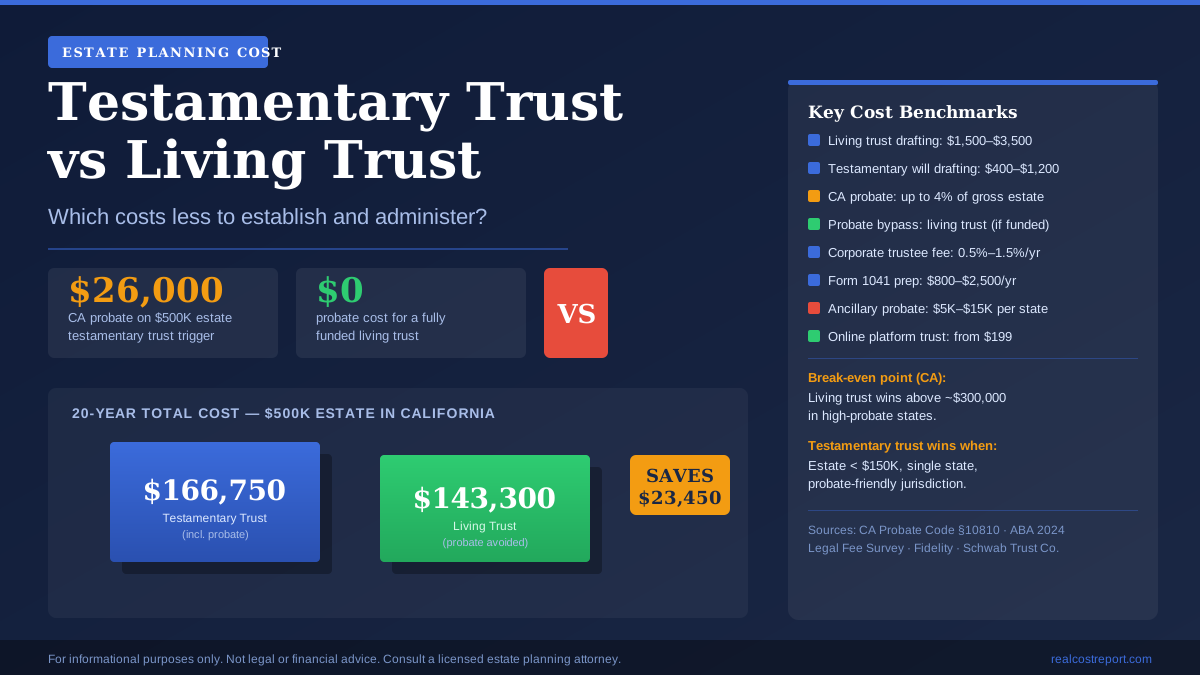
Probate costs are driven by three variables: state law, estate gross value, and attorney billing model. California uses a statutory fee schedule under Probate Code §10810, where both the attorney and the executor are each entitled to: 4% of the first $100,000, 3% of the next $100,000, 2% of the next $800,000, and 1% of the next $9 million. For a $500,000 gross estate, that means $13,000 each to the attorney and executor — $26,000 total before court filing fees, appraisal costs, or bond premiums.
California fee model per California Probate Code §10810 (verify at leginfo.legislature.ca.gov). TX/FL estimates based on average hourly attorney rates of $250–$400/hr and typical case hours reported by the Texas Bar Association (verify at texasbar.com). Living trust probate cost assumes complete funding before death.
Texas and Florida do not use statutory fee schedules, so probate costs there depend on attorney hourly rates and case complexity. Simple, uncontested estates in Texas are sometimes resolved for $3,000–$6,000 through an independent administration process. Florida’s formal administration, however, regularly runs $7,000–$15,000 for mid-size estates. Neither state’s costs approach California’s, but both still represent a significant cost that a properly funded living trust eliminates entirely.
One critical qualifier: a living trust must be fully funded to bypass probate. Assets still held in the grantor’s individual name at death will be swept into probate regardless of the trust’s existence. Partially funded trusts — which NAELA attorneys report seeing frequently among DIY and online-platform customers — lose much of this cost advantage.
Testamentary Trust vs Living Trust: Which Costs Less Over 20 Years?
The upfront/ongoing distinction is what most comparisons miss entirely. Setup cost is a one-time event. Trustee fees, accountant fees, and annual court reporting (required in some states for testamentary trusts administered under court supervision) are recurring. Modeling both structures over a 20-year administration period reveals where the real money goes.
Assumptions for the model below: $500,000 estate in California; 1% annual professional trustee fee (mid-range for a corporate trustee like Schwab Trust Company or Fidelity Personal Trust); $1,500/year in trust tax return preparation (Form 1041); $500/year in miscellaneous administrative costs. Testamentary trust incurs full California statutory probate fees at opening. Living trust setup cost includes $2,500 attorney fee plus $800 in asset retitling.
Model constructed by Real Cost Report editorial team. Trustee fee benchmarks sourced from Fidelity Personal Trust published fee schedules (verify at fidelity.com) and Charles Schwab Trust Company (verify at schwab.com). California probate fees per Probate Code §10810.
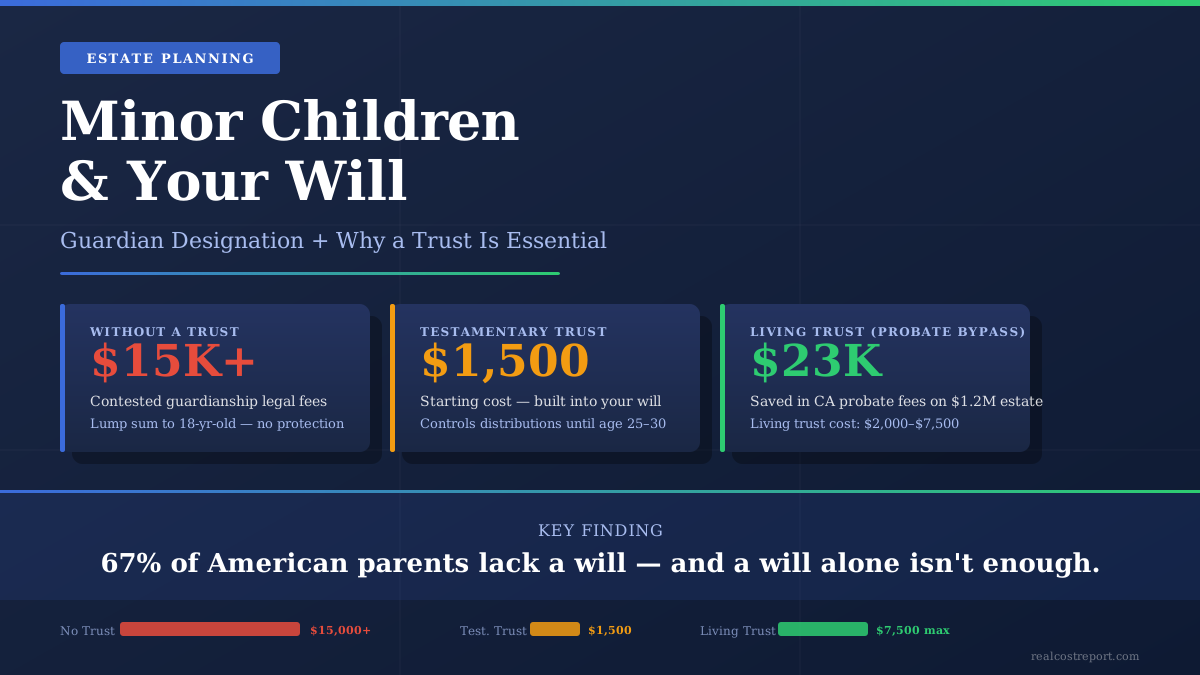
The living trust saves $23,450 over 20 years in this California scenario — entirely because of avoided probate. In Texas, where probate costs roughly $7,000 for the same estate, the living trust’s advantage shrinks to approximately $4,150 over 20 years, making setup costs a more meaningful factor. In states with simplified small-estate affidavit procedures (estates under $184,500 in California, or $75,000 in many others), a testamentary trust can be the better economic choice.
Verdict
For estates above $300,000 in California, New York, or Florida, the living trust wins on total lifetime cost — often by $20,000–$50,000 — despite costing more upfront. For estates below $150,000 in probate-friendly states like Texas or with a surviving spouse who inherits outright, the testamentary trust’s lower drafting cost may never be fully erased by probate savings.
Ongoing Administration Costs: What Both Trusts Share (and Where They Differ)
Once a trust is active and funded, the cost structures converge significantly. Both testamentary and living trusts require a trustee, both must file annual income tax returns (IRS Form 1041) if they generate more than $600 in gross income, and both must maintain accounting records for beneficiaries. The differences in ongoing cost are narrower than most people expect.
Professional corporate trustees charge between 0.50% and 1.50% of assets under management annually, with most settling around 0.85%–1.0% for trusts in the $250,000–$2,000,000 range. Fidelity Personal Trust services start at 0.50% for accounts over $1,000,000 and scale up to 1.25% for smaller trusts. Charles Schwab Trust Company published rates run 0.75%–1.00% for trusts in the $500,000–$2,000,000 range. Individual (family member) trustees pay no fee — but carry fiduciary liability and the time burden of annual accountings.
One genuine ongoing cost difference: some states require court-supervised accountings for testamentary trusts. California Probate Code §1060 requires a testamentary trustee to file periodic accountings with the court unless all beneficiaries waive this in writing. Each filing typically costs $500–$2,000 in attorney fees. Living trusts face no such requirement under California law. If beneficiaries decline to waive, a testamentary trust’s ongoing administrative cost increases by $500–$2,000 every one to three years — a cost living trusts don’t carry.
Trust income tax preparation (Form 1041) typically runs $800–$2,500 annually depending on the number of K-1s issued, investment complexity, and whether the trust holds real estate or business interests. This cost is identical for both trust types. Estate planning attorneys at firms like Stoel Rives or Holland & Knight routinely bill $1,500–$2,000 for first-year trust administration guidance regardless of trust type, a cost many families underestimate when modeling total expense.
What Most People Get Wrong About Trust Costs
Five specific misunderstandings drive bad trust decisions — and in most cases, the error costs the family money.
Mistake 1: Comparing only the drafting fee. The $750 will with a testamentary trust clause looks far cheaper than a $3,500 living trust package — until you add probate. Families who compare only drafting fees and choose the cheaper option in a high-probate state can end up paying $20,000–$30,000 more over the trust’s lifetime. Correct action: always model total lifecycle cost before deciding.
Mistake 2: Assuming a living trust automatically avoids probate. A living trust only bypasses probate for assets titled in the trust’s name. Beneficiary designation accounts (IRAs, 401(k)s, life insurance) bypass probate regardless of trust ownership. Assets still in the grantor’s personal name at death go through probate even if a trust exists. NAELA reports that incomplete trust funding is among the most common and expensive estate planning errors. Correct action: fund the trust completely at signing and review titling annually.
Mistake 3: Overlooking state-specific probate shortcuts. Many states have simplified procedures that make testamentary trust probate far less expensive. California’s small estate affidavit applies to estates under $184,500 (2024 threshold). Texas independent administration eliminates most court supervision. If your estate qualifies, the probate cost that justifies a living trust may not materialize. Correct action: confirm your state’s thresholds with a local attorney before assuming probate will be expensive.
Mistake 4: Ignoring ancillary probate for out-of-state real property. A testamentary trust (or unfunded living trust) that includes real property in a second state triggers ancillary probate — a separate probate proceeding in each state where real property is held. At $5,000–$15,000 per state, owning a Florida vacation home and a California primary residence could cost $30,000–$40,000 in combined probate. A properly funded living trust eliminates all ancillary probate. Correct action: if you own real property in more than one state, a living trust is almost always the correct economic choice.
Mistake 5: Treating online platform trusts as equivalent to attorney-drafted trusts. Trust & Will, Fabric, and similar platforms offer living trust documents starting at $199. These products are appropriate for simple, single-state estates with straightforward beneficiary arrangements. They do not include the attorney review, state-specific customization, or funding assistance that complex estates require. A poorly drafted or unfunded trust that fails to avoid probate provides no cost advantage over a testamentary trust — and costs more to create. Correct action: use online platforms only if your estate is under $250,000, located in one state, and contains no business interests, minor beneficiaries with special needs, or contested asset titling.
Who Should Choose a Testamentary Trust (and When a Living Trust Is Worth the Cost)
The right choice depends on three factors: estate size, state of residence, and the complexity of your family structure. No formula applies universally, but the following decision logic covers the majority of situations.
Choose a testamentary trust if: Your estate’s probatable assets fall below your state’s small estate threshold (making probate fast and inexpensive); you are in a probate-friendly state with independent administration like Texas; your primary concern is controlling distributions to a minor child over time and you want court oversight of the trustee; or you have a simple, single-state estate and cost-effective legal advice suggests probate will be uncomplicated.
Choose a living trust if: Your estate exceeds $300,000 in California, New York, Florida, or another high-probate-cost state; you own real estate in more than one state; you have a blended family, minor children from a previous relationship, or a beneficiary with special needs who requires an SNT; you value privacy (probated wills become public record; living trusts do not); or you want asset distribution to begin immediately after death without waiting for a court calendar.
For retirees and pre-retirees aged 60–75: The living trust’s front-loaded cost is amortized over a shorter administration window than for younger grantors, which makes the break-even calculation tighter. However, the privacy, speed-of-distribution, and ancillary probate benefits often remain decisive regardless of estate size. A $400,000 estate with a Florida condo and a California primary residence should almost always use a living trust — the alternative could cost $25,000–$40,000 in dual-state probate.
For young professionals aged 28–45: If your estate is currently below $150,000 and you have no out-of-state real property, a well-drafted will with a testamentary trust clause and updated beneficiary designations may adequately protect your family at a lower cost today. Revisit the decision when your estate crosses the $200,000–$300,000 threshold or when you acquire real property.
How We Researched This Article
This analysis was conducted by the Real Cost Report editorial team in May 2026. Our methodology combined published fee schedules, statutory law, and professional organization survey data to build cost models from primary sources — not secondary aggregators or anonymous forum posts.
Attorney drafting fee ranges were sourced from the American Bar Association’s 2024 Legal Fees Survey, accessible at americanbar.org. NAELA member practice benchmarks were used to validate fee ranges for complex trust documents; their resources are available at naela.org. California probate fee calculations were derived directly from the California Probate Code, accessible through leginfo.legislature.ca.gov. Corporate trustee fee schedules were drawn from Fidelity Personal Trust and Charles Schwab Trust Company published rate disclosures, available at fidelity.com and schwab.com.
The 20-year cost model was constructed by our team using the fee inputs above applied to a hypothetical $500,000 California estate with a professional corporate trustee, annual tax preparation, and standard miscellaneous costs. Asset growth was held flat for simplicity; real-world trustee fees will increase as assets grow, benefiting both structures equally in percentage terms. The model represents one scenario and should not be treated as predictive for any specific estate.
Limitations: probate cost estimates for Texas and Florida reflect published hourly rate ranges and reported average case hours from state bar surveys, not measured outcomes from individual cases. Actual probate costs vary substantially with attorney billing, case complexity, and executor compensation elections. Online platform pricing was verified against Trust & Will and Fabric published rates as of Q1 2026 and is subject to change. This analysis does not model irrevocable trust variants, Medicaid asset protection trusts, or special needs trust structures, which carry materially different cost profiles.
All figures were verified against named primary sources before publication.