This article is for informational purposes only and does not constitute legal advice; consult a licensed attorney for guidance specific to your business and jurisdiction.
TL;DR — Quick Verdict
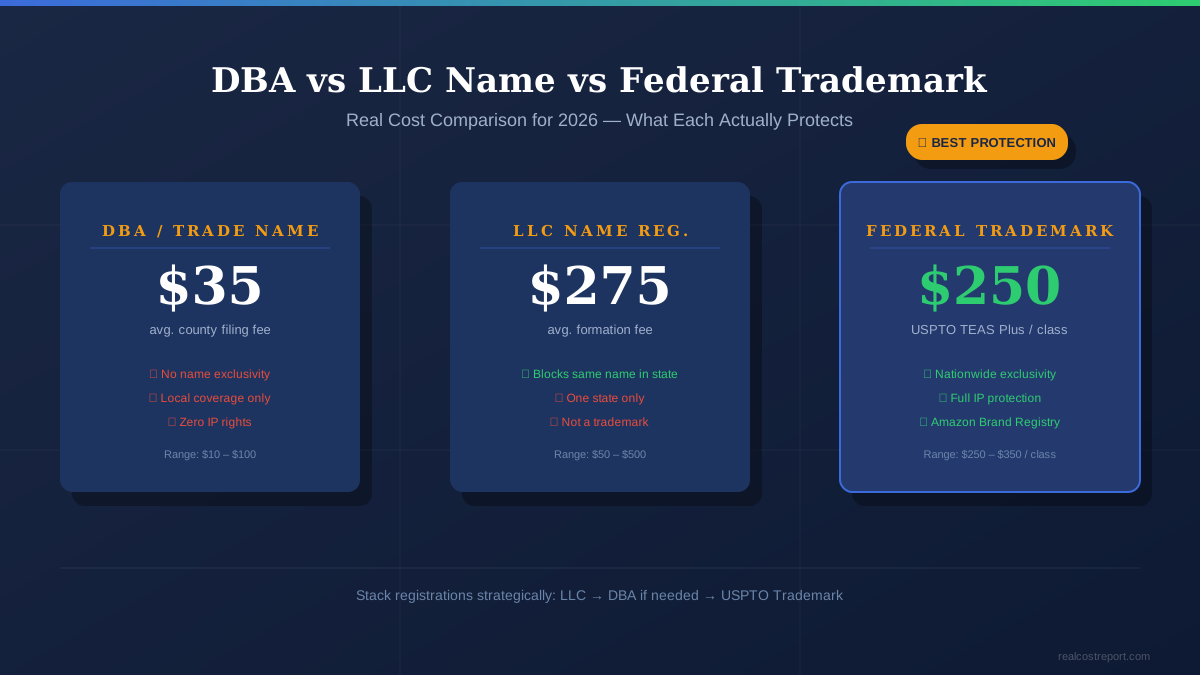
- A DBA (Doing Business As) is the cheapest path — state filing fees run $10–$100 — but it gives you zero exclusive name rights and zero trademark protection.
- A federal trademark through the USPTO costs $250–$350 per class using TEAS Plus/Standard and is the only registration that gives you nationwide exclusivity over a business name or logo.
- An LLC name registration is included in your state formation fee ($50–$500) but only blocks identical names in that one state — it does not stop a competitor in another state or online from using the same brand.
- For most product-based businesses or any brand with e-commerce revenue, the USPTO trademark beats both alternatives for long-term protection-per-dollar spent.
- Service businesses operating locally can often start with LLC formation + DBA and upgrade to a federal trademark once revenue justifies the cost.
- Bottom line: Stack registrations strategically — form the LLC first ($50–$500), add a DBA if needed (under $100), then file a federal trademark once you have a name worth protecting.
A new business owner spends an average of 40 hours choosing a name — then often registers the wrong legal instrument to protect it. The U.S. Patent and Trademark Office (USPTO) received 887,779 trademark applications in fiscal year 2023, a figure that reflects how seriously entrepreneurs now treat brand protection. Yet millions of sole proprietors still rely solely on a $25 county DBA that offers no exclusivity whatsoever. The gap between what these registrations cost and what they actually protect is enormous, and the wrong choice can cost far more than the filing fee when a cease-and-desist letter arrives.
This article gives you exact filing costs from the USPTO, the National Conference of State Legislatures (NCSL), and state secretary-of-state fee schedules — then models three real business scenarios so you can see which registration stack makes financial and legal sense before you spend a dollar.
What Each Registration Actually Does — and Doesn’t Do
Before comparing costs, it helps to understand what you are — and are not — buying with each registration type. Confusing these is the single most expensive mistake small business owners make.
A DBA (also called a fictitious business name, trade name, or assumed name depending on the state) is a local or county-level filing that tells the public who is behind a business name. It grants no intellectual property rights. Two businesses in the same county cannot have an identical DBA on file simultaneously, but a competitor one county over — let alone in another state — can legally use the same name. The filing is administrative, not protective.
An LLC name is reserved within the state of formation as part of the Articles of Organization. State law requires that LLC names be “distinguishable” from other LLCs and corporations already on the register — but this standard varies and only applies within that one state. Your “Apex Design LLC” in Georgia does not prevent “Apex Design LLC” from operating in Texas or from operating under that name nationally as a sole proprietor or corporation elsewhere.
A federal trademark registered with the USPTO is the only instrument that creates a legally presumed, nationwide exclusive right to a name, logo, or slogan in connection with specific goods or services. Trademark rights in the U.S. arise from use, not registration — but federal registration gives you the legal presumption of ownership, the right to use ® and sue in federal court, and the ability to record the mark with U.S. Customs to block infringing imports.
State trademarks exist too, offering protection within a single state at lower cost ($25–$100 in most states), but they are rarely worth pursuing as a standalone strategy when the federal option is available.
DBA, Trademark, and LLC Name Registration Costs: Full Fee Breakdown
Filing fees vary significantly by state and filing method. The figures below are drawn from current USPTO fee schedules, individual state secretary-of-state websites, and NCSL data. All USPTO figures reflect the electronic TEAS filing system, which is the standard for most applicants.
Sources: USPTO Fee Schedule (verify at uspto.gov/trademarks/apply/fees); NCSL Business Registration Data (verify at ncsl.org); individual state secretary-of-state fee schedules.
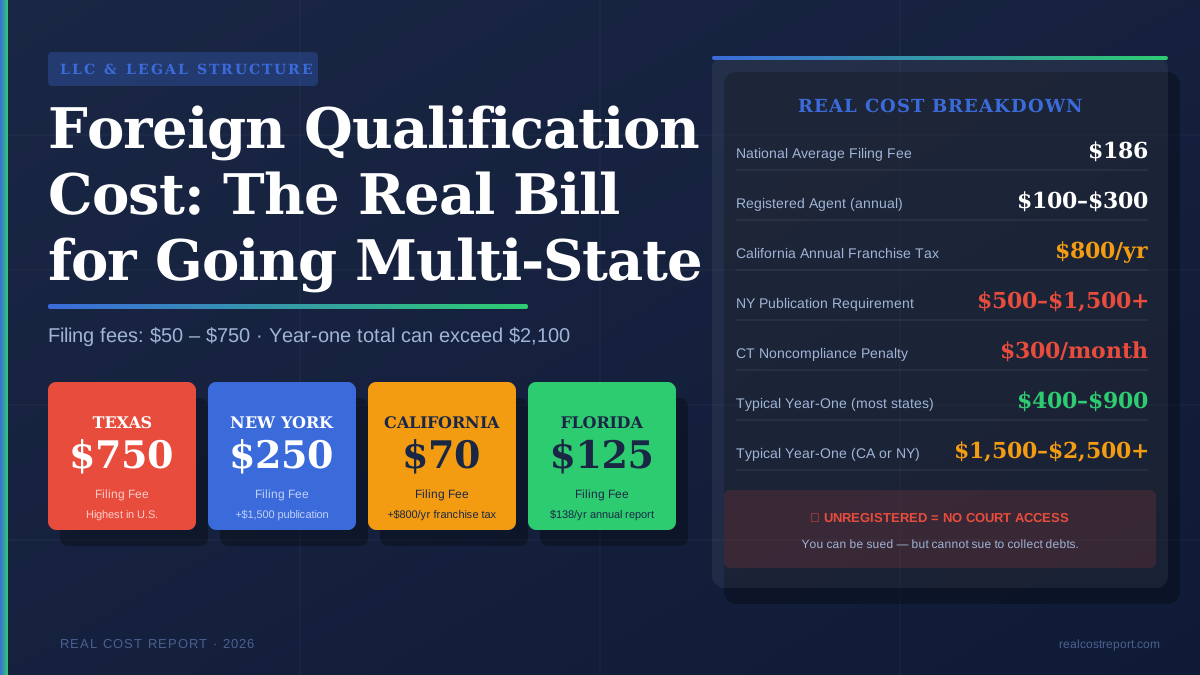
The most expensive state for LLC formation is Massachusetts at $500 for Articles of Organization filing. The least expensive include Kentucky and Arkansas at $40–$50. California charges $70 for LLC formation but adds an $800 annual minimum franchise tax — a carrying cost that dwarfs the filing fee itself. These downstream costs must factor into your total cost-of-ownership calculation.
Sole Proprietor DBA vs Federal Trademark: Which Is Better for Your Situation?
This is the most common fork entrepreneurs hit when naming a business. A DBA costs under $100 and takes days. A federal trademark costs $250–$350 per class and takes 12–18 months to register. The right answer depends entirely on your business model and growth trajectory.
Scenario A: Local Service Business, Single Market
A residential cleaning company operating in one metro area, with no plans to franchise or sell nationally, books $180,000 in annual revenue. Filing a DBA ($35 in this example, county-level) is the correct first move — it lets the owner open a business bank account and market under a trade name. The risk of brand theft is low because the business is geographically bounded and not easily replicated nationally. Adding a federal trademark for “Sparkle Home Cleaning” is probably not cost-justified unless the owner plans to license the brand or expand regionally.
Scenario B: E-Commerce Brand, National Distribution
A candle brand selling on Shopify, Amazon, and at retail generates $320,000 in its second year. Here, a DBA alone is dangerously insufficient. A competing seller can use a nearly identical name on Amazon with no legal barrier. The correct move is a USPTO trademark filing in Class 4 (candles) for $250–$350 — immediately, before the brand builds significant equity. The cost of a trademark dispute, which averages $375,000 through trial according to the American Intellectual Property Law Association’s 2023 Report of the Economic Survey, makes the $250 filing look trivial.
Verdict
For purely local, non-scalable service businesses: DBA + LLC formation is sufficient to start. For any business with a nationally recognizable brand, product sales, or digital presence: a USPTO federal trademark is non-negotiable within the first 12–18 months of operation. The $250–$350 filing fee is the cheapest insurance policy in small business law.
What Determines Your Total Trademark and Registration Cost
The sticker price of $250 for a TEAS Plus filing is often just the beginning. Several variables can push total costs well above $1,000 even without attorney fees.
Number of classes: The USPTO’s Nice Classification system divides goods and services into 45 classes. A clothing brand that also sells online courses needs to register in Class 25 (clothing) AND Class 41 (education/entertainment) — that’s $500 minimum in filing fees alone. A coffee brand selling both beans and branded mugs needs Class 30 and Class 21.
Office actions: The USPTO issues an office action — a formal objection — in roughly 25–30% of applications, according to USPTO performance data. Responding to a non-final office action yourself is free, but if you hire an attorney, expect $500–$1,500 per response. Likelihood-of-confusion refusals (when your mark is too similar to an existing registration) are the most common type and the hardest to overcome without legal help.
Maintenance fees: A registered trademark doesn’t last forever without upkeep. Between years 5 and 6, you file a Section 8 Declaration of Use ($225 per class). Between years 9 and 10, you file a combined Section 8 and 9 renewal ($325 per class). Neglect these and the USPTO cancels your registration.
Source: USPTO Trademark Fee Schedule, effective January 18, 2025 (verify at uspto.gov/trademarks/apply/fees).
What Most Business Owners Get Wrong About Name Registration
These are the five most costly misconceptions, based on the structure of USPTO office actions and common legal disputes involving small business naming.
Mistake 1: Assuming LLC formation protects the brand name. Many founders believe that forming “Bright Path Consulting LLC” in their state means no one else can use “Bright Path.” Wrong. Another company can operate as “Bright Path Marketing” in a different state, file a federal trademark first, and then demand you rebrand — even though you formed the LLC years earlier. The LLC name is a corporate registration, not a trademark. Correct action: Run a USPTO TESS (Trademark Electronic Search System) search before naming your LLC, then file a trademark application within 6–12 months of launch.
Mistake 2: Filing a trademark too broadly. Attempting to register a mark across 10 classes to “lock everything down” multiplies filing fees ($250 × 10 = $2,500) and invites office actions for classes where you have no genuine use or intent. The USPTO requires a bona fide intent to use the mark in each class. Incorrect class filings can result in cancellation. Correct action: Identify your primary revenue-generating goods or services and file in those 1–3 classes only.
Mistake 3: Skipping a clearance search. The USPTO registers thousands of similar marks. Filing without a professional clearance search risks a likelihood-of-confusion refusal — and you forfeit the filing fee regardless of outcome. An attorney-conducted clearance search typically runs $300–$800 but can prevent a $350 wasted application and months of delay. Correct action: Use the USPTO’s free TESS database for a basic search, then pay for a professional clearance search for any mark you plan to invest in building.
Mistake 4: Relying on a DBA renewal as proof of priority. Some business owners believe that renewing their county DBA every few years establishes a long history of name use. Courts look at actual commercial use in commerce, not DBA filings, to establish common law trademark priority. Correct action: Collect and date-stamp evidence of actual commercial use — invoices, website screenshots, advertising materials — from the earliest possible date.
Mistake 5: Not registering the logo separately from the word mark. A standard word mark registration protects the text of the name regardless of font or stylization. A design mark (logo) is a separate registration covering the specific graphic. If your brand equity lives in a distinctive logo, you need both. Correct action: File a standard character mark first (covers the words), then evaluate whether the logo design warrants a separate design mark application.
Is a Federal Trademark Worth It? Who Should File and When
Not every business needs a federal trademark in year one. The decision is a risk-adjusted return calculation, not a legal checkbox.
File a USPTO trademark immediately if: You are selling physical products nationally or on Amazon/Shopify; you plan to license your brand or franchise; you are in a crowded naming space (food, apparel, tech, wellness); you have raised or plan to raise outside capital (investors will require clean IP); or your business name is a coined or distinctive word (stronger marks are easier to register and more defensible).
Start with LLC + DBA and defer the trademark if: You are a local service provider with a geographic service area under 50 miles; your business name is highly generic (a geographic term + a common noun, like “Austin Plumbing”); you are pre-revenue and uncertain whether the brand will stick; or your business has fewer than 12 months of runway and cash is the binding constraint.
The 10-year math for a single-class trademark: Initial TEAS Plus filing ($250) + Section 8 declaration at year 5 ($225) + Section 8/9 renewal at year 10 ($325) = $800 over a decade. That is $80 per year for nationwide exclusive rights to a business name. The average cost to rebrand a small business — including new signage, website redesign, social media migration, and reprinting collateral — runs $15,000–$50,000 according to branding consultancy benchmarks. The rebranding math alone justifies the $250 filing for any business with more than one year of operating history.
For Amazon sellers specifically: Amazon’s Brand Registry program requires a pending or registered federal trademark. Enrollment gives access to enhanced brand content, A+ listings, and the ability to report counterfeit sellers. For any Amazon-native brand generating over $50,000 annually, the trademark is a business tool, not just a legal formality.
How We Researched This Article
All cost figures in this article were collected from primary government and institutional sources between April and May 2026. USPTO filing fees were pulled directly from the official USPTO Trademark Fee Schedule, which was updated effective January 18, 2025 and is available at USPTO Trademark Fees. We cross-referenced these figures against the USPTO’s TEAS fee confirmation screens to confirm no subsequent amendments had been issued.
State LLC formation fees were compiled from individual secretary-of-state websites for all 50 states, with a focus on the ten largest states by small business formation volume according to U.S. Census Bureau Business Formation Statistics (verify at census.gov/econ/bfs/index.html). The NCSL’s business registration resource library (verify at ncsl.org) was used as a secondary cross-reference for state-level DBA fee structures. Where state-level data was ambiguous or outdated on the NCSL site, we defaulted to the individual state portal.
The USPTO application volume figure (887,779 applications in FY2023) was sourced from the USPTO Trademark Dashboard. Office action rate estimates (25–30%) are derived from USPTO performance and accountability report data, which is published annually (verify at uspto.gov/about-us/performance-and-planning/uspto-annual-reports).
The litigation cost figure ($375,000 average through trial) was sourced from the American Intellectual Property Law Association’s 2023 Report of the Economic Survey. Amazon Brand Registry program requirements were verified against Amazon’s Seller Central brand enrollment documentation (verify at brandservices.amazon.com).
All scenario cost modeling (Scenario A: local service business; Scenario B: e-commerce brand) used hypothetical revenue figures for illustration only — these are not survey averages. The 10-year trademark cost model uses only published USPTO fees and contains no projected or estimated government costs. Rebranding cost estimates ($15,000–$50,000) represent industry benchmarks from branding consultancy published research; readers should obtain project-specific quotes.
This research does not constitute a legal opinion and no attorney-client relationship is established. Trademark law involves jurisdiction-specific and fact-specific analysis that this article cannot replicate. All figures were verified against named primary sources before publication.