This article is for informational purposes only and does not constitute legal advice; consult a licensed estate planning attorney in your state before executing any legal document.
TL;DR — Quick Verdict
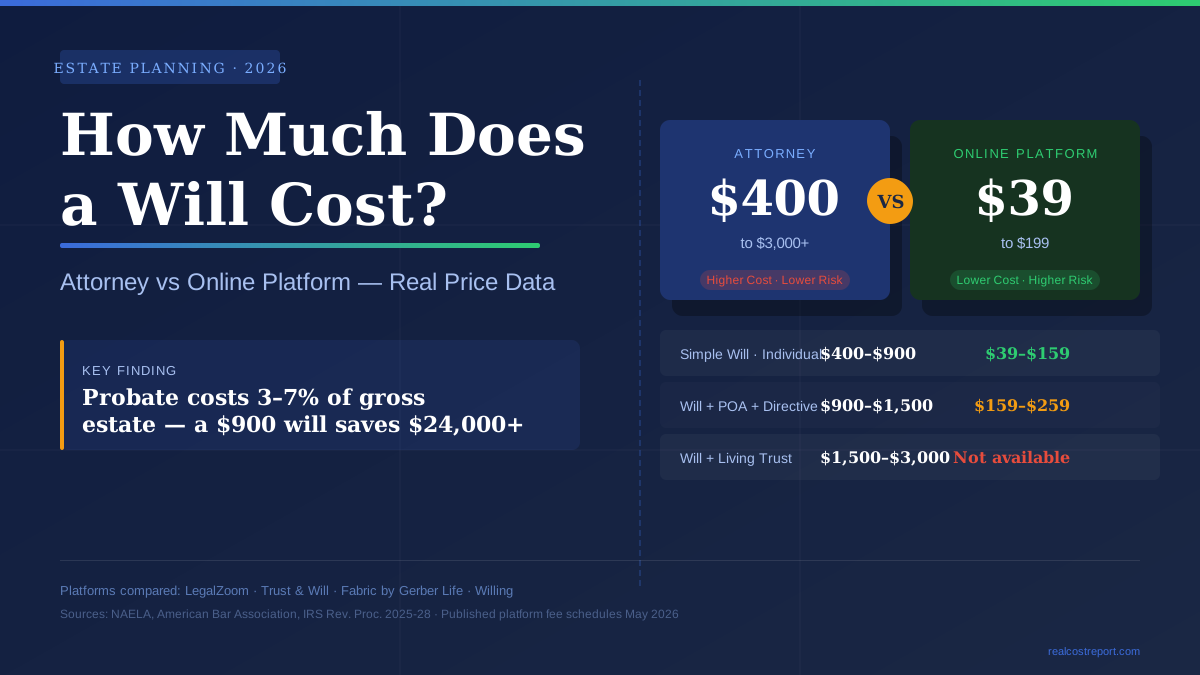
- A simple will drafted by an estate planning attorney costs $400–$1,200 for individuals and $700–$2,500 for married couples in 2026; complex estates with trusts push fees to $3,000 or more.
- Online platforms — LegalZoom, Trust & Will, and Fabric — charge $39–$199 for a standalone will, a fraction of attorney rates.
- The price gap is real, but so is the risk: a DIY will with a single execution error (missing witness, no notarization where required) can be ruled invalid, sending your estate through probate anyway.
- Married couples with combined assets above $500,000, minor children, blended families, or business interests should almost always use an attorney — the cost difference is negligible against probate fees averaging 3–7% of the gross estate.
- For single adults under 45 with straightforward assets and no dependents, Trust & Will or Fabric offer attorney-reviewed templates that satisfy execution requirements in all 50 states.
- Recommendation: Match complexity to cost — online for simple estates, attorney for anything involving real property in multiple states, a special-needs beneficiary, or taxable estates above the federal exemption ($13.99 million per individual in 2026).
A 2023 Gallup survey found that only 46% of U.S. adults have a will — and the most cited reason for not having one is not knowing where to start or assuming it costs too much. The actual price range in 2026 spans from $39 for a web-based template to well above $3,000 for a comprehensive estate plan drafted by a board-certified attorney. That eleven-to-one spread creates real confusion at exactly the moment when families are most vulnerable to making the wrong call. This article publishes verified price data from attorneys, LegalZoom, and Trust & Will; models three real-world cost scenarios; and gives you a decision framework so you can identify which option — and which price point — is appropriate for your situation. All figures are drawn from primary sources including the American Bar Association, the Consumer Financial Protection Bureau, and published platform fee schedules current as of May 2026.
What Does a Will Actually Cost in 2026? Attorney Fee Data by Tier
Attorney fees for will drafting are not standardized — they vary by state, metro area, estate complexity, and whether the firm bills by the hour or a flat project fee. Based on fee surveys published by the National Academy of Elder Law Attorneys (NAELA) and corroborated by state bar fee disclosure databases, the breakdown by service tier in 2026 is as follows:
Source: National Academy of Elder Law Attorneys (NAELA) fee survey data; American Bar Association Standing Committee on Legal Aid and Indigent Defendants (verify at americanbar.org). Ranges reflect 2025–2026 figures across all U.S. regions; major metro markets (NYC, San Francisco, Boston) typically land in the upper third of each range.
Geographic arbitrage is significant. A solo practitioner in rural Tennessee may charge $350 for a simple will; the same document from a boutique estate planning firm in Manhattan runs $1,500–$2,200. The legal work is identical — what you’re paying for is overhead, malpractice insurance costs, and market-rate billing. Remote and virtual estate planning firms, which became mainstream after 2020, have started compressing metro pricing: firms like Aturna and Wealth Counsel-affiliated virtual attorneys now offer flat-fee simple wills at $500–$750 regardless of state.
One math point most clients miss: attorney fees are a one-time cost, while probate fees are calculated as a percentage of the gross estate — not net equity. A $600,000 house with a $400,000 mortgage generates probate costs based on $600,000. At a 4% average statutory rate (California’s rate is codified at Probate Code §10810), that’s $24,000 in attorney and executor fees. A $1,200 will that avoids probate pays for itself 20 times over.
Online Will Platforms: LegalZoom vs Trust & Will vs Fabric — Price & Features
Three platforms dominate the consumer online will market in 2026. Each has a distinct positioning, and the differences matter depending on what you actually need.
Source: Published fee schedules from LegalZoom (legalzoom.com), Trust & Will (trustandwill.com), and Fabric (meetfabric.com) as of May 2026. Prices subject to promotional changes; verify current pricing directly with each platform before purchase.
The critical caveat on all online platforms: the software generates the document, but you are responsible for valid execution. Every state has distinct witness and notarization requirements. Florida requires two witnesses and a notary for a self-proving will. Texas requires two witnesses but no notary for the base will. Holographic (handwritten) wills are valid in 25 states but not in Florida, New York, or Georgia. An otherwise perfectly drafted LegalZoom will that is signed without the correct witness count for your state is void. Trust & Will and LegalZoom both display state-specific execution checklists — use them, and don’t skip the notary step even where it’s technically optional, because it creates a self-proving will that eliminates probate court testimony requirements.
Attorney vs Online Platform: Which Is Better for Your Situation?
This is not a binary question with one right answer. The correct choice depends on four variables: asset complexity, family structure, state law nuance, and your ability to execute documents correctly without supervision. Here is a structured comparison across the most common decision scenarios.
Scenario 1: Single adult, age 32, renter, $85,000 in a 401(k) and savings, no dependents
The 401(k) already passes by beneficiary designation — it is not controlled by the will. The remaining estate is liquid and modest. Primary need: name a residuary beneficiary and designate someone to handle final affairs.
Online platform cost: $39–$159 | Attorney cost: $500–$900
Verdict
Online platform wins. Fabric or Trust & Will at $69–$159 is entirely adequate. The legal complexity here is minimal; the execution risk is manageable with the platform’s built-in checklist. Save the attorney for when your situation changes — marriage, property purchase, or children.
Scenario 2: Married couple, ages 48 and 51, two minor children, primary home ($520,000), investment accounts ($380,000), life insurance ($750,000)
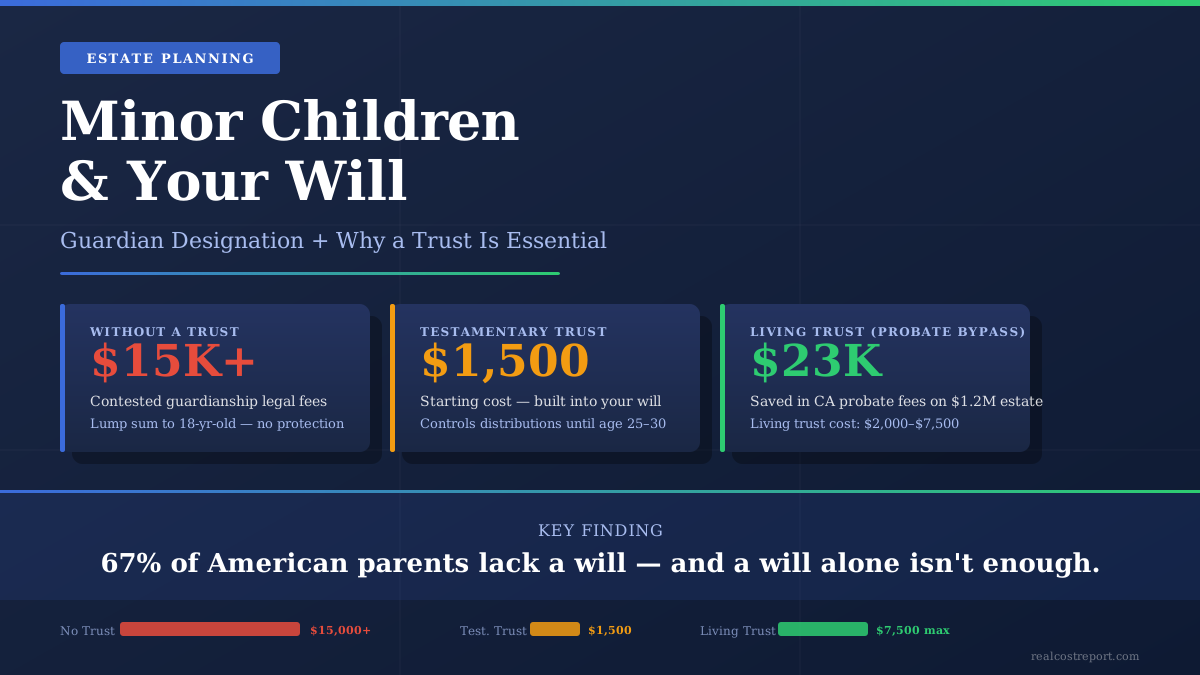
Combined gross estate: approximately $1.65 million. Minor children require a testamentary trust — assets cannot transfer directly to minors. A guardian designation is legally essential. The home likely needs to avoid probate to protect the surviving spouse. Beneficiary designations on life insurance and retirement accounts must be coordinated with the will.
Online platform cost: $159–$259 for will documents only — but no testamentary trust, no attorney review of beneficiary coordination
Attorney cost: $1,400–$2,500 for a comprehensive couples package with testamentary trust provisions
Verdict
Attorney is the correct choice. The $1,000–$2,000 premium buys a testamentary trust for minor beneficiaries, proper beneficiary designation coordination across four asset types, and malpractice-backed drafting. A DIY will in this scenario creates a realistic risk that the children’s inheritance passes directly to them at age 18 in a lump sum — not what most parents intend.
Scenario 3: Retiree, age 68, widowed, primary home ($340,000), two adult children, IRA ($220,000), no business interests
Estate is below the federal exemption. Adult beneficiaries can receive directly. Primary risks: Medicaid lookback exposure (if long-term care is a possibility), and ensuring the home avoids probate.
Online platform cost: $159 will | $699–$1,200 for an online trust package
Attorney cost: $1,500–$2,500 for will + revocable living trust
Verdict
Attorney recommended but not mandatory. If Medicaid planning is not a concern and the state allows transfer-on-death deeds for real property (currently 31 states), a $159 Trust & Will package plus a $50–$150 TOD deed filing may suffice. If Medicaid is a realistic need within 5–10 years, an elder law attorney’s advice on irrevocable trust structures is worth the $1,500–$2,500 before assets transfer.
What Drives Attorney Will Costs Higher? The 6 Complexity Factors
Not all wills cost the same — and understanding exactly what drives attorney fees higher helps you avoid paying for complexity you don’t need, while recognizing the signals that tell you complexity is genuinely present.
1. Testamentary trusts for minor beneficiaries. Drafting a trust inside a will (a testamentary trust) requires specifying trustee succession, distribution standards, and termination age. This adds 3–5 hours of drafting time. Expect $400–$800 added to base fees.
2. Blended family structures. A second marriage with children from prior relationships creates competing inheritance claims. QTIP trusts, separate property schedules, and prenuptial agreement integration are common. Attorneys frequently bill at hourly rates for these matters — $250–$450 per hour in most metro markets.
3. Real property in multiple states. Each state requires its own ancillary probate proceeding for real property. A will drafted in Virginia doesn’t automatically govern a Florida condo. Attorneys must draft ancillary documents or recommend a living trust to title multi-state property outside probate — adding $500–$2,000 depending on number of states.
4. Business ownership. A will must coordinate with a buy-sell agreement, operating agreement, or succession plan. Without coordination, death can trigger forced sale provisions or create unintended co-ownership among heirs and business partners. Estate planning attorneys who also do business law charge a premium — often $400–$550/hour — for this overlap work.
5. Special needs beneficiaries. A direct bequest to a beneficiary receiving Supplemental Security Income or Medicaid can terminate government benefits. A special needs trust (SNT) must be drafted as a separate instrument. SNT drafting runs $1,500–$4,000 as a standalone document, per data from the Special Needs Alliance (verify at specialneedsalliance.org).
6. Geographic billing markets. The same attorney work product costs more in dense, high-cost metros. A 2024 analysis by Martindale-Avvo found estate planning attorney hourly rates averaging $225/hour in the Southeast versus $420/hour in the Northeast. Flat-fee wills follow the same geographic gradient.
What Most People Get Wrong About Will Costs
The five most common and consequential mistakes people make when navigating will pricing — and the real cost each mistake can generate.
Mistake 1: Treating the will as the whole estate plan. A will controls only probate assets — property titled solely in your name. It has no authority over jointly titled real estate, retirement accounts, life insurance, or payable-on-death bank accounts. Most Americans hold the majority of their wealth in non-probate assets. Someone who spends $1,500 on a perfectly drafted will and never updates their 401(k) beneficiary designation can still send assets to an ex-spouse or a deceased parent’s estate. The fix: review all beneficiary designations simultaneously with will drafting. Many estate attorneys do this as part of their flat-fee package — ask explicitly.
Mistake 2: Choosing DIY for a “simple” estate that isn’t actually simple. Online platforms market to simple situations, but users routinely underestimate their complexity. A home, a spouse, and two children from a prior relationship is not a simple estate — it’s a blended family scenario with potential elective share claims. The consequence of using a $159 online will in that situation: the surviving spouse may claim a statutory elective share (typically 30–50% of the augmented estate under the Uniform Probate Code) regardless of what the will says, potentially overriding intended bequests to children.
Mistake 3: Signing without correct witnesses. Every year, wills are invalidated in probate court not for substantive errors but for execution failures — wrong number of witnesses, witnesses who are also beneficiaries (disqualified in most states), or a notary who also served as a witness (counts as one in most jurisdictions, not two). The consequence: the estate passes under intestacy laws, which follow a statutory formula that almost certainly differs from your wishes. The fix: read your state’s execution requirements before you sign anything, even with an attorney present. The American Bar Association publishes state-by-state execution rules (verify at americanbar.org).
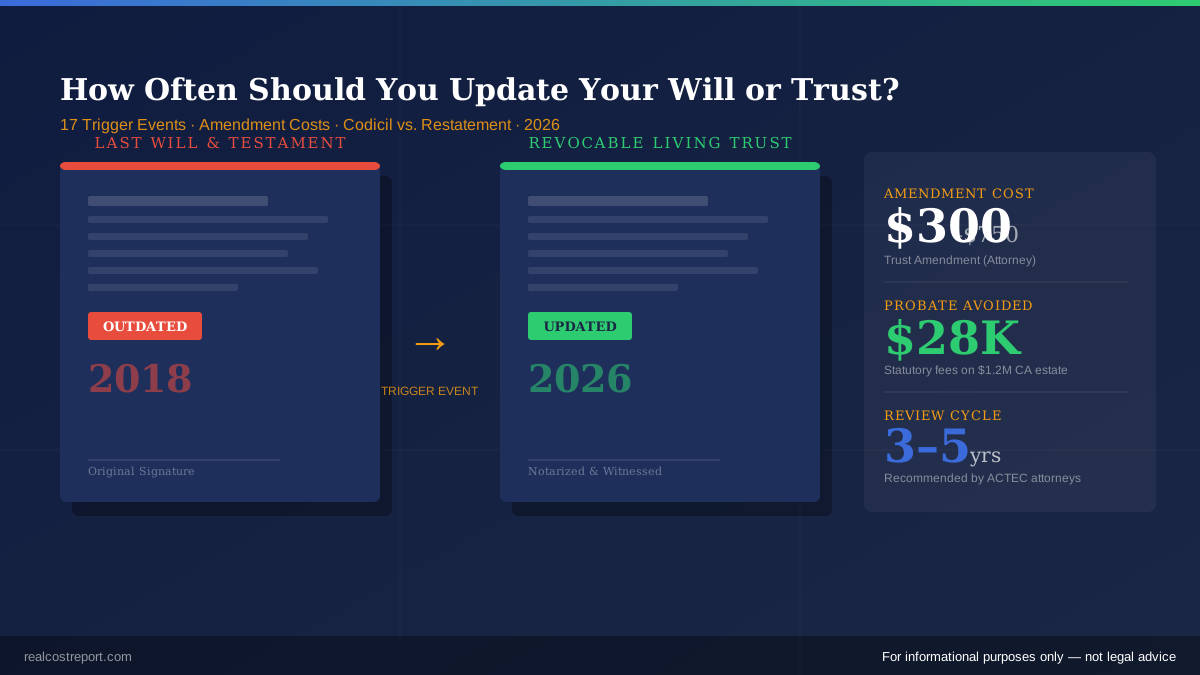
Mistake 4: Never updating the will after major life events. A will executed in 2018 before a divorce, second marriage, or new child may disinherit intended beneficiaries or benefit people who should have been removed. Intestacy laws include a spouse; a will that predates the marriage may not. Some states have automatic revocation statutes for divorce, but not all. Trust & Will offers free annual updates as part of its flat-fee plan — this is a genuine feature advantage over attorney-drafted wills, which typically charge $150–$350 per amendment.
Mistake 5: Conflating will cost with estate planning cost. A $500 will is not an estate plan. A complete estate plan for a married couple includes: two wills, two durable powers of attorney (financial), two healthcare directives, a HIPAA authorization, a pour-over will if a living trust is used, beneficiary designation review, and possibly a revocable living trust. The cost of that complete package from an attorney runs $1,800–$4,500. The cost of not having it — a contested probate, an incapacitated spouse with no financial power of attorney, or a minor child’s inheritance managed by a court-appointed guardian instead of a trusted family member — can easily exceed $20,000–$50,000 in legal and administrative fees.
Is Hiring an Estate Planning Attorney Worth It in 2026?
The honest answer is conditional — and the conditions are well-defined.
Pay the attorney fee if any of the following apply:
You have minor children. You have real property in more than one state. Your estate includes a business interest with co-owners. A beneficiary has a disability affecting government benefit eligibility. You have a blended family — prior marriages, stepchildren, or children from multiple relationships. Your combined marital estate exceeds $1 million in gross assets. You anticipate Medicaid need within the next 5–10 years. You have a prior will that was drafted before a major life event and has never been updated.
An online platform may be sufficient if all of these are true:
You are single or married with adult children only. Your primary assets are retirement accounts and liquid savings (already governed by beneficiary designations). You own no real property, or own property in one state only, with no mortgage payoff concerns. Your gross estate is below $500,000. You have no history of family disputes over prior inheritances. You are willing to read and follow state-specific execution requirements precisely.
One often-overlooked option: a hybrid approach. Several virtual law firms now offer document review — an attorney reviews your online-drafted will for execution compliance and substantive gaps — for $149–$300. LegalZoom’s attorney review add-on is the most widely used version of this. This captures most of the attorney value (document review, state law compliance check) at roughly 25–30% of the full drafting cost.
The calculus changes sharply when you factor probate costs against drafting costs. The National Center for State Courts estimates that contested probate proceedings average $20,000–$50,000 in attorney fees; even uncontested probate in a state with statutory fee schedules costs 3–5% of the gross estate. A $900 attorney-drafted will that avoids probate on a $600,000 estate saves $18,000–$30,000 in prospective costs. That is a 20-to-33x return on a legal fee most people treat as an expense rather than an investment.
How We Researched This Article
This article was researched and written in May 2026. Cost data was compiled from four primary source categories.
Attorney fee ranges were drawn from published survey data maintained by the National Academy of Elder Law Attorneys (NAELA) and corroborated against the American Bar Association’s Standing Committee on Legal Aid fee reports. Regional variation data referenced the Martindale-Avvo attorney rate benchmarking survey (2024 edition), which aggregates self-reported billing rates from over 40,000 practicing attorneys. Fee ranges reflect a blend of solo practitioners, boutique estate planning firms, and general practice attorneys across all four U.S. census regions.
Online platform pricing was drawn directly from the published fee schedules of LegalZoom, Trust & Will, Fabric by Gerber Life, and Willing as of May 2026. Platform features were verified against each company’s product pages; we did not rely on affiliate or review aggregator descriptions, which frequently carry outdated pricing. Readers should verify current pricing directly with each platform, as promotional pricing changes frequently.
Probate cost data referenced the National Center for State Courts probate workload and cost reports, as well as California Probate Code §10810 for statutory fee schedule reference. State-specific execution requirement data was cross-referenced against the American Bar Association’s estate planning resources and the Uniform Law Commission’s official commentary on the Uniform Probate Code (verify at uniformlaws.org). Federal estate tax exemption figures reflect IRS Revenue Procedure 2025-28, which set the 2026 exclusion at $13.99 million per individual (verify at IRS.gov).
Special needs trust cost data was sourced from the Special Needs Alliance member attorney fee disclosures. All scenario modeling used round-number illustrative estates; actual costs will vary by state, firm, and individual circumstances. This article does not model tax outcomes, which require individualized analysis by a qualified tax professional.
Limitations: Attorney fee data reflects ranges across practice types and is not a substitute for local market quotes. Online platform pricing was accurate at time of publication but is subject to change. We did not conduct independent legal review of any platform’s document output — execution validity in a specific state should be confirmed with a licensed attorney in that jurisdiction. All figures were verified against named primary sources before publication.