This is not medical advice. Consult a licensed healthcare provider for medical decisions and a licensed insurance agent for coverage decisions.
TL;DR — Quick Verdict
- Missing your Medicare Initial Enrollment Period triggers permanent premium surcharges — Part B late penalties average $105.90/month extra for a two-year delay as of 2025 CMS rates.
- Part B penalty compounds at 10% per 12-month gap in coverage — with no cap — meaning a five-year delay costs 50% more every month for life.
- Part D drug coverage penalties are smaller but equally permanent: 1% of the national base premium ($36.78 in 2025) per month uncovered.
- Employer coverage from a company with 20+ employees qualifies you for a Special Enrollment Period, eliminating penalties entirely — coverage from smaller employers does not.
- IRMAA surcharges hit higher earners separately from late penalties — a married couple with $206,000+ in income pays an additional $838.80/month combined on top of standard premiums.
- Recommendation: Enroll during your Initial Enrollment Period unless you have confirmed qualifying employer coverage; verify your employer’s size in writing before delaying.
One administrative mistake — missing a Medicare enrollment window by even a single day — can cost tens of thousands of dollars over a typical retirement. The Centers for Medicare & Medicaid Services (CMS) reported that as of 2023, more than 55 million Americans were enrolled in Medicare, yet enforcement of late enrollment penalties remains one of the most financially damaging and least-understood rules in the program. The standard Part B monthly premium for 2025 is $185.00 per month; a beneficiary who enrolled two years late pays $222.00 instead — every month for the rest of their life. This article identifies every enrollment deadline that triggers a penalty, quantifies each penalty using current CMS rate data, compares qualifying versus disqualifying delay situations, and explains the specific exceptions UnitedHealthcare, Aetna, and every other Medicare plan cannot override. You will leave knowing exactly when to act and what each day of delay costs in real dollars.
Every Medicare Enrollment Window — Deadlines and What Happens If You Miss Each One
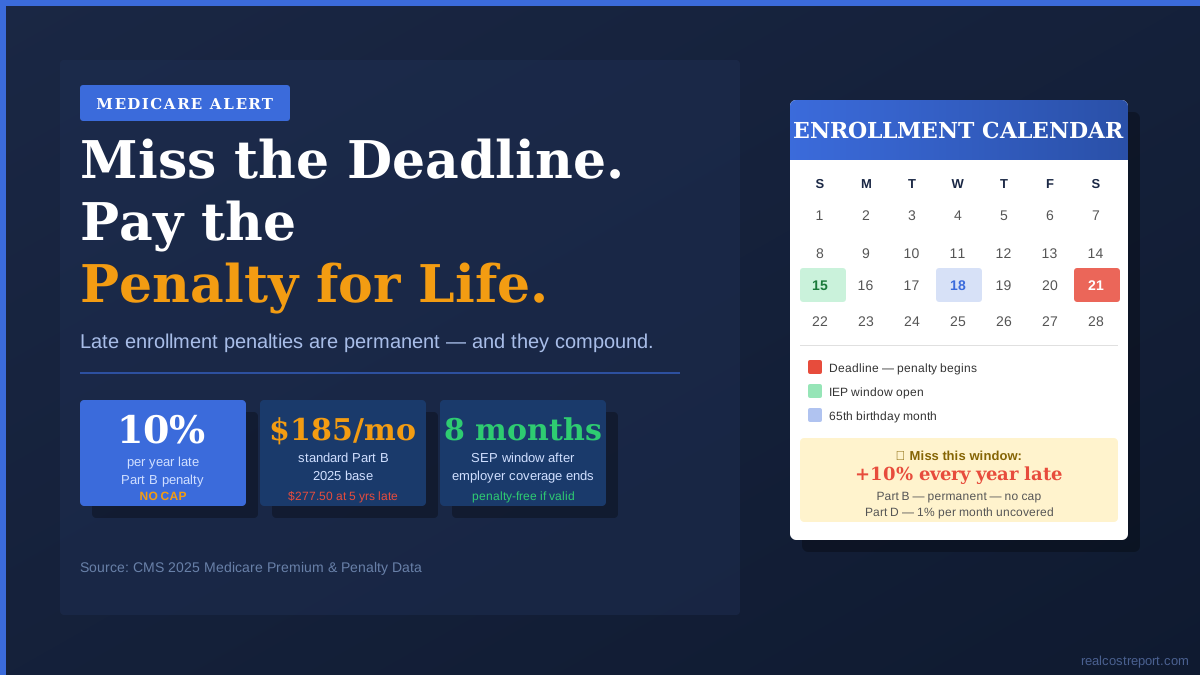
Medicare operates on four distinct enrollment windows. Each has its own trigger date, duration, and consequence for missing it. The Initial Enrollment Period (IEP) is the most consequential: it opens three months before your 65th birthday month, includes your birthday month, and closes three months after — seven months total. Coverage start date shifts based on when within that window you enroll. Enrolling in months one through three starts coverage on the first day of your birthday month. Enrolling during or after your birthday month delays coverage by one to three months.
The General Enrollment Period (GEP) runs January 1 through March 31 each year and is the fallback for anyone who missed their IEP without a qualifying exception. Coverage under GEP begins July 1 of the same year — a gap that can leave you uninsured for up to six months. The Special Enrollment Period (SEP) is the safety valve for people with qualifying employer coverage and requires documented proof; without it, CMS defaults to GEP rules and applies penalties. The Annual Enrollment Period (AEP), October 15 through December 7, governs changes to Medicare Advantage and Part D plans, not initial Part A or Part B enrollment.
Source: Centers for Medicare & Medicaid Services (CMS) — (verify at medicare.gov)
What Each Late Penalty Actually Costs: Part A, Part B, and Part D in Real Dollars
CMS calculates each penalty differently. Understanding the math matters because the penalties are not one-time fees — they are permanent monthly additions to your premium for the rest of your life.
Part A: Most beneficiaries receive Part A premium-free because they or a spouse paid Medicare taxes for at least 40 quarters (10 years). Those with 30–39 quarters paid $285/month in 2025; those with fewer than 30 quarters paid $518/month. A late enrollee in the sub-30-quarter category pays a 10% surcharge for twice the number of years they were without coverage — so a two-year delay means a 10% penalty for four years.
Part B: The penalty is 10% of the standard premium for every full 12-month period you were eligible but not enrolled. At the 2025 standard premium of $185.00/month: one year late = $203.50/month ($18.50 extra); two years late = $222.00/month ($37.00 extra); five years late = $277.50/month ($92.50 extra). There is no cap. A beneficiary who delayed enrollment for 10 years — not uncommon for people who worked past 65 with small-employer coverage — pays $370.00/month for the standard plan, double the base rate, for the remainder of their life.
Part D: CMS calculates this penalty as 1% of the national base beneficiary premium multiplied by the number of uncovered months. The 2025 national base premium is $36.78. One year uncovered = $4.41/month extra ($36.78 × 12%). Three years uncovered = $13.24/month extra. These amounts recalculate each year as the base premium changes, so your penalty can drift slightly year to year.
Source: CMS 2025 Medicare Parts A & B premiums and Part D national base premium — Centers for Medicare & Medicaid Services (verify at cms.gov). 10-year cost projection assumes constant 2025 premium rates for illustration only.
Qualifying Employer Coverage vs. Non-Qualifying Coverage: Which Delays Are Penalty-Free?
The most expensive mistake working seniors make is assuming any employer health insurance protects them from Medicare late penalties. CMS rules are rigid: protection applies only when coverage comes from a current employer whose group health plan covers 20 or more employees. Retiree health coverage, COBRA, individual marketplace plans, VA benefits, and coverage from an employer with fewer than 20 employees do not qualify. Each of these non-qualifying situations triggers penalties the moment your IEP closes.
The SEP clock matters as much as the eligibility question. Once qualifying employer coverage ends — whether because you retire, lose the job, or the employer drops coverage — you have exactly eight months to enroll in Part B without penalty. Waiting until the end of COBRA to enroll is the most common trap: COBRA is not qualifying coverage and does not pause the SEP clock. A beneficiary who retired at 66, spent 18 months on COBRA, then tried to enroll through an SEP will be denied the SEP and directed to the GEP, where a permanent penalty accrues.
Verdict
Delaying Medicare via a qualifying large-employer plan (20+ employees) is penalty-free and financially sound if employer premiums are lower than Medicare Part B + Medigap costs. Delaying via COBRA, retiree coverage, or a small employer’s plan is a permanent financial mistake — penalties compound monthly with no ceiling and no forgiveness mechanism.
Source: CMS Medicare Special Enrollment Period rules — Social Security Administration (verify at ssa.gov) and medicare.gov
What Most People Get Wrong About Medicare Enrollment Penalties
Five specific misconceptions generate the majority of preventable penalty costs among people transitioning into Medicare. Each follows the same pattern: a plausible assumption that turns out to be factually incorrect under CMS rules.
Mistake 1: Assuming Social Security enrollment triggers automatic Medicare enrollment. If you claim Social Security before 65, you are automatically enrolled in Parts A and B at 65 — true. But if you delay Social Security past 65 to increase your benefit, Medicare enrollment does not happen automatically. You must actively enroll through Social Security Administration (SSA) during your IEP. Missing this distinction is responsible for a significant share of Part B late penalties. Correct action: Set a calendar reminder for the first month of your IEP window, three months before your 65th birthday, regardless of your Social Security claiming strategy.
Mistake 2: Believing Part A enrollment automatically satisfies Part D creditable coverage requirements. Part A alone does not count as creditable drug coverage. Beneficiaries who enroll in Part A — which is premium-free for most — but skip Part D because they take few medications face a permanent Part D penalty for every uncovered month. Correct action: Enroll in a Part D plan, even a low-cost $0-premium plan, during your IEP unless you have documented creditable drug coverage from another source.
Mistake 3: Thinking penalties can be waived by appealing to Medicare Advantage insurers like Humana or UnitedHealthcare. Private Medicare Advantage carriers have zero authority over CMS penalty determinations. The penalty is assessed by SSA and CMS — it appears as a higher premium regardless of which plan you select. No insurer can waive, negotiate, or absorb it. Correct action: Resolve any penalty dispute directly through SSA by submitting a request for reconsideration with documented proof of qualifying coverage.
Mistake 4: Counting spousal employer coverage incorrectly. Coverage through a spouse’s employer plan qualifies for an SEP only if the spouse is still actively employed. Once the spouse retires, the SEP clock starts — even if you remain on the spouse’s plan through a COBRA extension. Correct action: The moment a spouse announces retirement, verify your Medicare IEP or SEP window immediately.
Mistake 5: Assuming the IRMAA surcharge is a penalty for late enrollment. Income-Related Monthly Adjustment Amount (IRMAA) is a separate income-based surcharge, not a penalty. In 2025, individuals with modified adjusted gross income above $106,000 (or $212,000 for married couples filing jointly) pay surcharges ranging from an additional $74.00 to $443.90 per month on Part B alone, per CMS IRMAA brackets. These stack on top of any late enrollment penalty. Correct action: Project retirement income carefully — Roth conversions or asset sales in the two years before Medicare enrollment can permanently push you into a higher IRMAA bracket.
Is Delaying Medicare Enrollment Ever Worth It? A Scenario-by-Scenario Analysis
For a narrow set of beneficiaries, delaying enrollment is not just permissible — it is mathematically correct. The decision hinges on a break-even calculation comparing the cost of Medicare premiums plus Medigap against the cost of existing coverage, factored against the risk of losing SEP eligibility.
Scenario A — Large-employer employee, 65, paying $150/month for employer coverage: Standard Part B at $185/month plus a Medigap Plan G at roughly $120–$180/month equals $305–$365/month combined. Staying on the employer plan saves $155–$215/month with no penalty exposure, provided the employer is confirmed at 20+ employees. Delay is clearly worth it.
Scenario B — Small-employer employee, 65, paying $250/month for employer coverage: The employer has 18 employees. Medicare becomes primary. Failing to enroll in Part B means Medicare will not pay claims, and the small group insurer can legally deny claims that Medicare should have covered. Staying on this plan creates both a penalty and potential claim denials. Enrolling in Medicare immediately and using the employer plan as secondary — or dropping the employer plan — is the only financially sound option.
Scenario C — Self-employed individual on ACA marketplace plan, 65: Marketplace subsidies end at Medicare eligibility. Continuing a marketplace plan without Medicare is legal but generates Part B and Part D penalties from the IEP close date. ACA plans do not qualify as SEP-triggering coverage. Enroll in Medicare during IEP, period.
Scenario D — High earner, household income $240,000, age 64: IRMAA brackets use income from two years prior. At $240,000, 2025 Part B IRMAA adds $295.90/month per person on top of the $185.00 base — a combined household Part B cost of $1,921.80/month for the couple before any Medigap or Part D. A late penalty on top of this is catastrophic. Coordinate enrollment timing with a fee-only financial advisor and review Roth conversion timing in years 62–64 to potentially lower IRMAA exposure.
Kaiser Family Foundation (KFF) analysis indicates that Medicare Advantage premiums have remained relatively low — averaging $17/month for employer-sponsored Medicare Advantage plans — but this does not eliminate the underlying Part B premium or late penalties. Plan selection affects add-on costs, not the base penalty structure.
How We Researched This Article
This article was produced using primary data from government and academic sources only. No proprietary data vendors, insurance carrier marketing materials, or secondary aggregator sites were used as authoritative sources.
Premium figures for Medicare Parts A, B, and D were sourced directly from the CMS 2025 Medicare Parts A and B Premiums and Deductibles Fact Sheet published by the Centers for Medicare & Medicaid Services. The 2025 Part D national base beneficiary premium of $36.78 was taken from the CMS 2025 Part D application memorandum. IRMAA brackets were cross-referenced against the CMS IRMAA table published for the 2025 benefit year.
Enrollment period rules — including IEP window structure, SEP qualifying conditions, and GEP coverage start dates — were verified against the Social Security Administration’s official enrollment guidance at ssa.gov/medicare/ and against medicare.gov’s enrollment basics pages. Medicare Advantage premium averages were drawn from Kaiser Family Foundation Medicare policy research (verify at kff.org). Qualifying employer size thresholds were verified against CMS’s Medicare Secondary Payer rules.
Penalty cost projections in the data tables use constant 2025 CMS premium rates and are explicitly modeled estimates, not measured historical costs. Real-world lifetime penalty costs will vary as CMS adjusts base premiums annually; the 10-year projections illustrate the compounding structure of penalties and are not forward-looking guarantees. Scenarios in the “Is Delaying Worth It” section are constructed illustrations using confirmed 2025 rate data; individual circumstances will differ.
This research was last conducted in May 2026. All figures were verified against named primary sources before publication.