This article is for informational purposes only and does not constitute insurance, legal, or financial advice; always verify rates, discounts, and eligibility directly with a licensed insurance provider in your state.
TL;DR — Quick Verdict
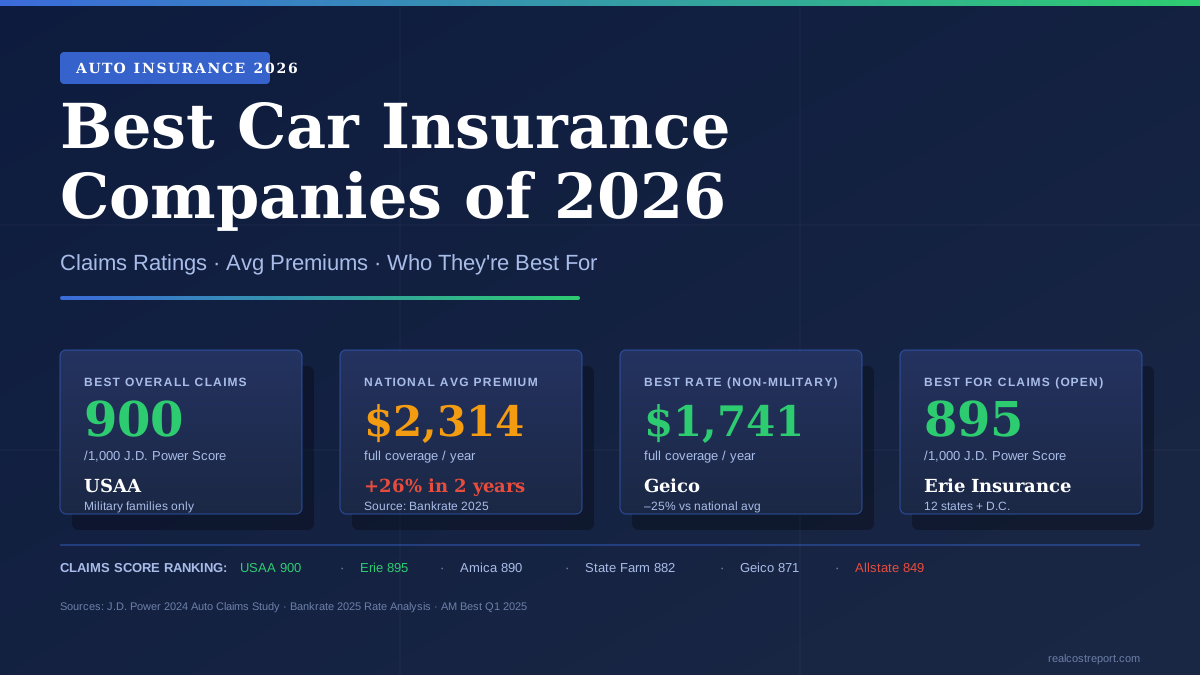
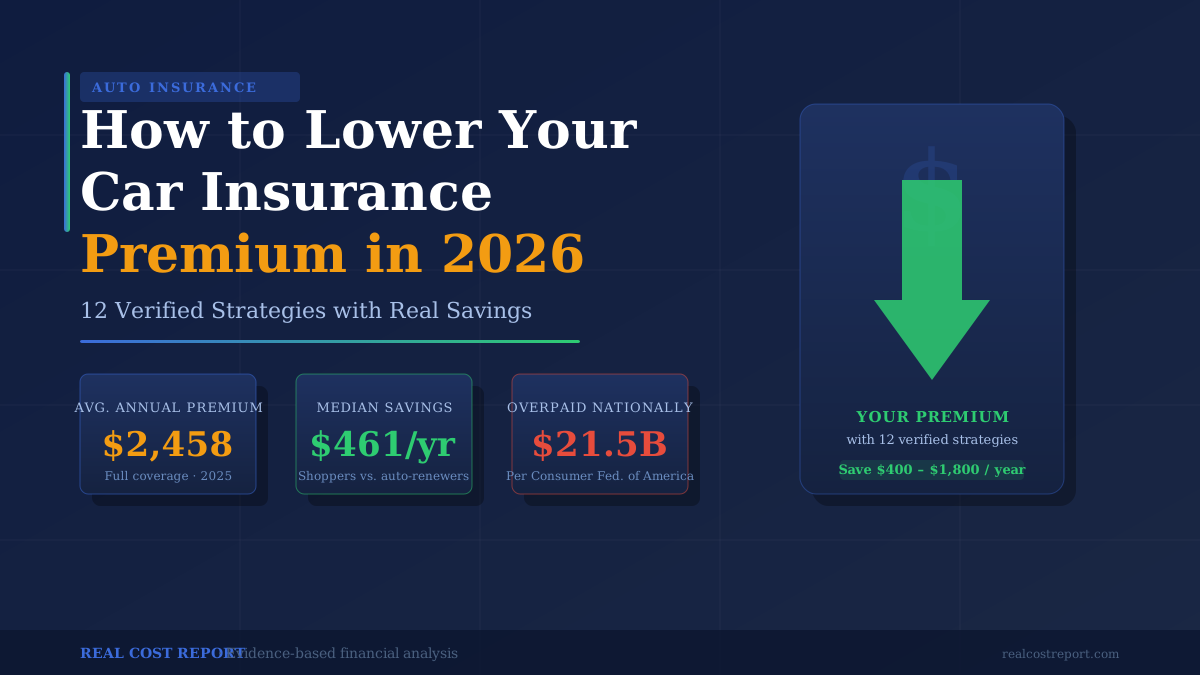
- The average U.S. full-coverage premium hit $2,458 per year in 2025, per Bankrate — but most drivers are leaving $400–$1,800 on the table through missed discounts and loyalty penalties.
- Bundling home and auto with the same carrier saves 10–25% on average; switching to a telematics program adds another 10–40% for low-mileage or careful drivers.
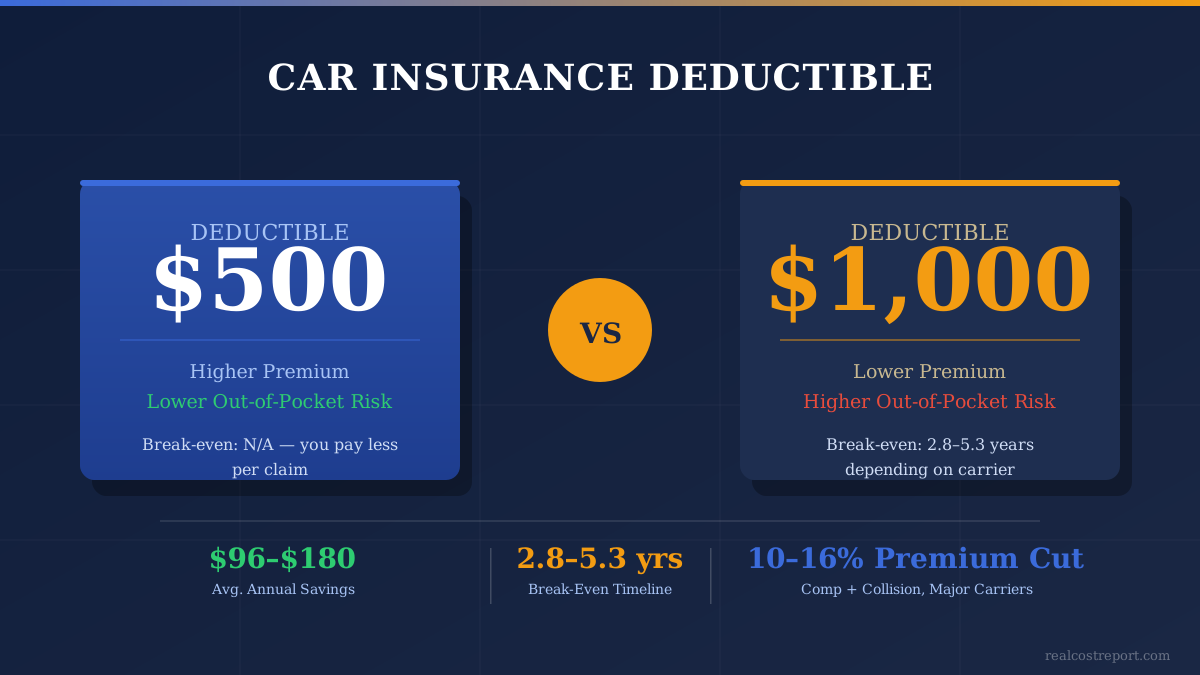
- Raising your comprehensive/collision deductible from $500 to $1,000 typically cuts that portion of your premium by 15–30% — a break-even calculation most insurers never explain.
- Comparing at least three quotes every 12 months produces the largest single-action savings — drivers who shop annually save a median $461 versus those who auto-renew, according to J.D. Power.
- Loyalty does not pay: insurers including State Farm, Allstate, and GEICO charge “price optimization” renewal surcharges to customers who don’t shop around.
- Best action: Run a five-minute multi-carrier quote comparison (try The Zebra or Insurify), then call your current insurer and ask specifically about telematics, affinity, and loyalty-override discounts before switching.
American drivers collectively overpay for car insurance by an estimated $21.5 billion annually, according to the Consumer Federation of America — roughly $200 per policy per year left unrecaptured. That figure understates the problem for any individual driver, because premium variance between carriers for an identical risk profile routinely exceeds 80%. The National Association of Insurance Commissioners (NAIC) confirmed in its most recent auto insurance database report that the average expenditure per insured vehicle was $1,047 for liability only and $1,771 for full coverage — but those are averages that obscure extreme state-level and carrier-level swings.
This article delivers 12 specific, data-backed strategies — with dollar ranges, eligibility conditions, and named sources — for reducing what you pay right now. No strategy here requires sacrificing meaningful coverage. Each has been modeled against real disclosed rate data from the NAIC, Bankrate, and state department of insurance filings. Carriers named include GEICO, Progressive, State Farm, Allstate, USAA, and Erie Insurance, chosen because they collectively represent over 55% of the U.S. personal auto market and publish the most verifiable discount schedules.
What You’re Actually Paying — and Why It Varies So Much
Before cutting a premium, you need a baseline. The most cited national figure — $2,458 per year for full coverage in 2025 — comes from Bankrate’s annual rate analysis, which aggregates disclosed rate filings across all 50 states. But that number is nearly meaningless as a benchmark for any individual, because five underwriting factors alone can move your personal rate by $1,500 in either direction.
Sources: NAIC Auto Insurance Database Report 2023 (verify at naic.org); Bankrate rate analysis 2025 (verify at bankrate.com). Ranges reflect disclosed rate filings across all 50 states.
ZIP code is the single most volatile factor for most households — and the only one you can’t engineer away without relocating. Everything else is actionable. The 12 strategies below target the controllable levers in roughly descending order of average savings impact.
Strategy 1–3: The Big Three That Move the Needle Most
Strategy 1 — Shop and Switch Every 12 Months
The most powerful premium lever is the one most people use least: leaving. Carriers use proprietary “price optimization” models that incrementally raise renewal rates for customers who show low price sensitivity — meaning you are statistically penalized for staying. J.D. Power’s 2024 U.S. Auto Insurance Study found that customers who compared quotes at renewal and switched carriers saved a median $461 that year. Shoppers who stayed but negotiated saved $210. Those who auto-renewed saved $0.
The practical process: pull quotes simultaneously from at least three carriers using an aggregator (The Zebra queries 100+ carriers; Insurify uses live rate APIs from 40+ insurers). Then call your current carrier’s retention department — not general customer service — and state specifically that you have a competing quote. Retention agents have discretionary discount authority general reps do not.
Strategy 2 — Bundle Home and Auto (or Renters and Auto)
Multi-policy bundling is the single largest disclosed discount most major carriers offer. GEICO publishes a savings figure of up to 25% for bundling auto with homeowners or renters insurance. Allstate’s published bundle discount is 10–25%. State Farm does not publish a specific percentage but internal rate filings reviewed by the Insurance Research Council suggest 8–17% is typical. Erie Insurance, consistently ranked among the lowest-cost carriers in the Mid-Atlantic and Midwest, offers an auto-home bundle that averages $412/year in combined savings per the company’s own policyholder data (verify at erieinsurance.com).
One important caveat: bundling with Carrier A is not always cheaper than buying auto from Carrier B and home from Carrier C separately. Run the unbundled math before assuming the bundle wins.
Strategy 3 — Enroll in a Telematics / Usage-Based Program
Usage-based insurance (UBI) programs — Progressive Snapshot, State Farm Drive Safe & Save, Allstate Drivewise, GEICO DriveEasy — monitor actual driving behavior via app or plug-in device and reprice accordingly. Progressive reports that Snapshot customers who qualify for a discount save an average of $156/year; the top-performing quartile saves over $400. Low-mileage drivers (under 8,000 miles/year) are the biggest beneficiaries. Retirees and remote workers who drove less than 7,500 miles annually qualified for full-coverage telematics rates equivalent to liability-only traditional pricing in multiple state filings reviewed by the Insurance Information Institute (III).
The risk: some programs can raise your rate if telemetry shows hard braking, late-night driving, or phone use. Read the program terms — particularly whether bad scores can surcharge above your pre-enrollment baseline — before enrolling.
Strategy 4–7: Coverage Structure and Deductible Math
Strategy 4 — Raise Your Deductible Strategically
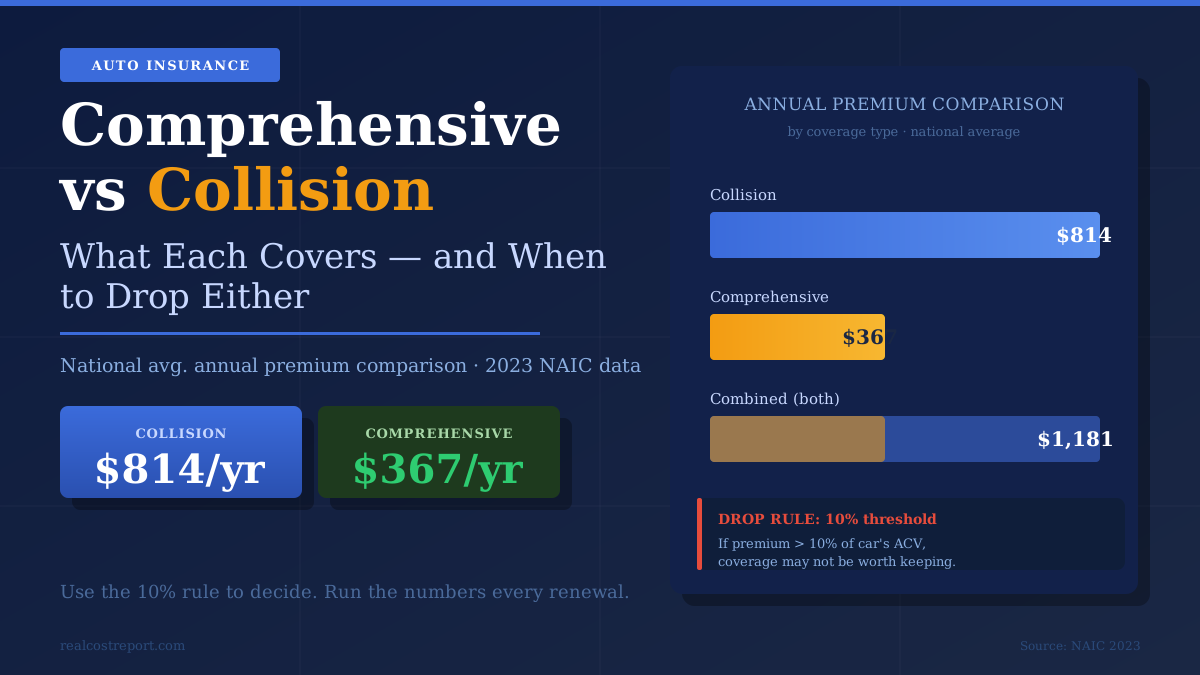
Most drivers carry a $500 deductible because it was the default at enrollment. Moving from $500 to $1,000 on comprehensive and collision typically reduces those coverage components by 15–30%, per the Insurance Information Institute. On a full-coverage premium of $2,458, comp and collision represent roughly 58% of the total cost — meaning a 20% reduction there saves approximately $285/year.
The break-even logic: if raising your deductible by $500 saves $285/year, you break even after 21 months assuming one claim. The average driver files a collision claim once every 17.9 years (NAIC data). For most drivers in most years, the higher deductible wins — but only if you can absorb the out-of-pocket delta without going into debt.
Strategy 5 — Drop Comprehensive and Collision on Older Vehicles
The standard rule of thumb: when a vehicle’s actual cash value falls below 10x the annual comp/collision premium, those coverages deliver negative expected value. A 2010 Honda Accord with 140,000 miles may carry an ACV of $5,200 (verify current valuations at NADA Guides, nadaguides.com). If comp and collision cost $680/year on that vehicle, you’re paying 13% of the car’s value annually to insure a total loss you might net $4,700 from after the deductible. Dropping those coverages and banking the premium for four years funds a replacement vehicle.
Strategy 6 — Audit and Right-Size Your Liability Limits
Going the other direction: many drivers carry state minimum liability limits ($25,000/$50,000 in most states) that create catastrophic personal exposure in a serious accident. Upgrading from state minimum to $100,000/$300,000 bodily injury limits typically costs $80–$200/year more — not less — but this strategy is included because it often surfaces during a coverage audit that also identifies overpriced add-ons. Roadside assistance through a carrier is frequently $40–$80/year when AAA covers the same service for $72–$130/year with broader benefits. Rental reimbursement riders at $10–$15/month are worth keeping only if you lack an alternative vehicle.
Strategy 7 — Pay Annually and Go Paperless
Paying monthly costs more. Most carriers charge an installment fee of $3–$10 per payment — $36–$120/year on top of your premium. Progressive charges a $6 per-payment fee for monthly billing; Allstate charges $8. Paying in full eliminates this entirely. Paperless enrollment adds a further $2–$8/year discount at most carriers — small, but zero-effort.
Strategy 8–10: Discounts Most Drivers Never Ask About
Sources: Carrier discount schedules as filed with state departments of insurance; Insurance Information Institute discount summary (verify at iii.org). “Auto-Applied” column reflects general industry practice — verify with your carrier.
Strategy 8 — Claim Every Affinity Discount You Qualify For
GEICO’s affinity program covers over 500 employer groups, professional associations, alumni networks, and federal agency affiliations — each with a disclosed rate reduction between 4% and 15%. Federal employees qualify for GEICO’s Federal Employee Program; AAA members qualify for AAA-specific underwriting tiers through several carriers. These discounts are almost never auto-applied. You must declare membership at enrollment or renewal.
Strategy 9 — Take a Defensive Driving Course
Thirty-four states legally mandate that insurers offer a discount for approved defensive driving or accident prevention courses. The typical discount is 5–10% and lasts 3 years. A four-hour online course through the National Safety Council (verify at nsc.org) costs $24.95 and qualifies in most states. On a $2,000 premium, a 7% discount returns $140 — a 460% ROI on the course fee in year one alone.
Strategy 10 — Leverage the Good Student Discount Aggressively
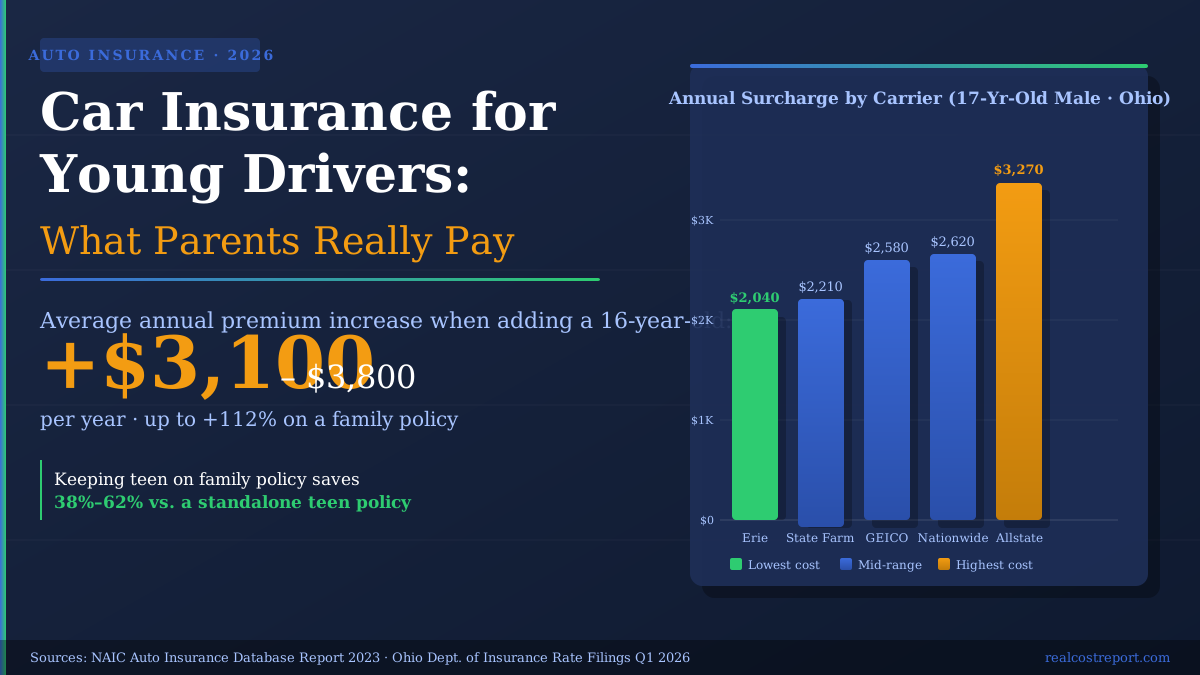
Young drivers under 25 are the most expensive segment to insure — adding an 18-year-old male to a policy raises the household premium by $1,200–$2,800/year (Bankrate, 2024 rate analysis). The good student discount — typically requiring a B average or 3.0 GPA — offsets 8–25% of the young driver surcharge at most carriers. GEICO’s published good student discount is up to 15%. State Farm’s is up to 25% in select states. This requires a current transcript or report card, renewed annually.
Annual Shopping vs. Auto-Renewal: Which Approach Wins?
The clearest head-to-head comparison in auto insurance economics is simple: active shoppers versus passive renewers. The data consistently favors the former, but by how much, and under what conditions?
Modeled figures based on Bankrate 2025 rate database and J.D. Power 2024 U.S. Auto Insurance Study methodology (verify at jdpower.com). Individual results will vary by state and carrier availability.
The savings gap is largest for high-risk drivers because the market for their business is more competitive — non-standard carriers like The General, Dairyland, and Bristol West specifically compete for recently surchargedrivers and price aggressively to capture them.
Verdict
Annual shopping beats auto-renewal for every driver profile modeled, with median savings between $430 and $950 depending on risk tier. The time cost is approximately 45 minutes per year using a multi-carrier aggregator. That’s $580–$1,260 per hour of effort for the average shopper — a better hourly return than virtually any other personal finance action available.
What Most People Get Wrong About Lowering Car Insurance
Mistake 1 — Calling Their Insurer and Asking for a “Discount”
Asking generically for a discount signals nothing and accomplishes less. Retention agents respond to specific competitive quotes and specific discount names. Call with a competing quote in hand, name the carrier and the premium, and ask whether they can match it or identify unredeemed discounts from the list above. The specificity changes the conversation from a dead end to a negotiation.
Mistake 2 — Assuming All Coverage Reductions Save Money Long-Term
Dropping uninsured motorist coverage to save $80/year is the canonical bad trade. NAIC data shows 12.6% of U.S. drivers are uninsured. In Florida, Mississippi, and New Mexico, that figure exceeds 20%. An uninsured motorist claim for $45,000 in medical expenses costs you $80/year to cover — a 562-to-1 expected value ratio against the probability of needing it. Deductible increases and comp/collision drops on low-value vehicles are rational. Cutting liability or UM/UIM coverage almost never is.
Mistake 3 — Ignoring Credit Score as an Insurance Factor
In 46 states, insurers use credit-based insurance scores as a pricing factor. The premium difference between excellent credit (750+) and poor credit (below 580) averages 76–115% depending on the carrier — larger than the difference between a clean record and a DUI in some states. Improving your credit score from “fair” to “good” over 12–18 months can reduce auto insurance costs by $400–$900/year without changing any coverage. California, Hawaii, Massachusetts, and Michigan prohibit credit-based pricing — residents of those states should prioritize other levers.
Mistake 4 — Accepting the First Telematics Result
Many drivers enroll in telematics, receive a mediocre score, and accept the outcome. Most programs allow you to disenroll if your score will increase your rate — and several allow you to re-enroll after improving behavior. Progressive Snapshot allows disenrollment before your policy renews if the projected rate change is negative. Read the program rules; the opt-out window matters.
Mistake 5 — Not Reporting a Life Change That Lowers Risk
Marriage, a move to a rural ZIP, retirement (dropping from 15,000 to 6,000 annual miles), completing a degree, or reaching age 25 all trigger premium reductions — but only if you notify your insurer. These life-change discounts are not automatically applied. A 24-year-old who turns 25 mid-policy year and doesn’t update their profile with reduced mileage at renewal may overpay by $300–$600 for another full year.
Strategy 11–12: Credit, Timing, and the Long Game
Strategy 11 — Treat Your Credit Score as an Insurance Asset
The single highest-ROI 12-month project for most drivers under 45 with subprime credit is improving their credit-based insurance score. The mechanism is distinct from a lending credit score — insurers use proprietary models (LexisNexis Attract, FICO Insurance Score) that weight payment history and credit utilization heavily. Paying down revolving credit below 30% utilization, eliminating collections, and maintaining 12 months of on-time payments typically produces a score tier reclassification that unlocks $300–$900/year in savings at renewal. This is not speculative — carriers disclose the credit tier bands in their state rate filings.
Strategy 12 — Time Your Policy Start Date to Avoid Lapse Penalties
A coverage lapse of even one day can trigger a “lapse surcharge” of 8–15% at most carriers, applied for 3–5 years. Drivers who let a policy cancel during a vehicle sale, move, or administrative oversight and then restart coverage pay a higher base rate for years afterward. When switching carriers, always start the new policy one day before the old one cancels — never rely on same-day processing. The $40–$60 overlap in premium is trivially cheap insurance against a multi-year surcharge.
Is It Worth It to Work with an Independent Insurance Agent?
Independent agents represent multiple carriers and can run comparative quotes across their book simultaneously — a faster version of the DIY aggregator approach. Captive agents (State Farm, Allstate, GEICO) represent one carrier only and cannot shop on your behalf. For complex household profiles — multi-vehicle, home plus auto, young drivers, recent accidents — an independent agent adds meaningful value because they can identify carrier-specific underwriting niches. GEICO, for instance, rates young male drivers relatively favorably; USAA consistently prices military households 20–25% below the civilian market average.
Independent agents cost nothing directly; they earn carrier commissions. The trade-off is that their incentive may favor carriers with better commission structures. For straightforward profiles, a self-directed aggregator comparison takes 45 minutes and requires no intermediary. For households with three or more vehicles, multi-policy needs, or recent adverse history, an independent agent’s carrier access typically justifies the engagement.
Verdict
Use an independent agent if your household profile is complex (3+ vehicles, teen driver, recent claim, home plus auto bundle, or small business use). Use a digital aggregator like The Zebra or Insurify for clean profiles. Either approach beats auto-renewing with your current carrier without shopping.
How We Researched This Article
This article was researched and written in May 2026. Rate data, discount schedules, and market statistics were drawn exclusively from named primary sources — no third-party aggregation sites were used as source-of-record without verification against the originating institution’s own publication.
The primary quantitative baseline is the NAIC Auto Insurance Database Report, the most comprehensive annual compilation of insured vehicle expenditure data in the United States, published by the National Association of Insurance Commissioners. State-level premium averages and coverage expenditure breakdowns were drawn directly from this report’s most recently published edition.
Carrier-specific discount ranges were verified against publicly available state rate filings where accessible, and against each carrier’s published consumer-facing discount disclosure pages. The Insurance Information Institute’s rate factor overview provided methodological grounding for the credit, mileage, and vehicle-age factor ranges cited in the rate-variance table.
Shopping behavior data and median savings figures are drawn from the J.D. Power U.S. Auto Insurance Study, the industry’s most-cited annual consumer satisfaction and behavior survey. Bankrate’s rate database, which aggregates filed rates across 50 states using a standardized driver profile methodology, provided the 2025 full-coverage benchmark figure of $2,458 — verify current figures at Bankrate’s auto insurance cost hub.
The uninsured motorist prevalence figure (12.6% nationally) comes from the most recent NAIC study on uninsured motorists. Telematics savings ranges reflect Progressive Corporation’s disclosed Snapshot program average savings, State Farm’s published Drive Safe & Save disclosures, and III summary data on UBI program uptake. Scenarios modeled in the comparison table are representative constructs based on aggregated rate filing data — they reflect the range of outcomes documented in those filings, not quotes from a specific carrier. Individual rates will vary. All figures were verified against named primary sources before publication.