Past performance does not indicate future results. This is not investment advice.
TL;DR — Quick Verdict
- The most widely cited rule (25x annual expenses) puts a $70,000/year spender’s target at $1,750,000 — but that number shifts dramatically with retirement age and Social Security timing.
- Fidelity benchmarks recommend 10x your final salary saved by age 67; Vanguard’s modeling suggests a personalized spending-rate approach yields more accurate targets for most households.
- A 62-year-old retiree needs roughly 20–30% more saved than a 67-year-old retiree with identical expenses, due to the longer draw-down horizon and Social Security delay penalty.
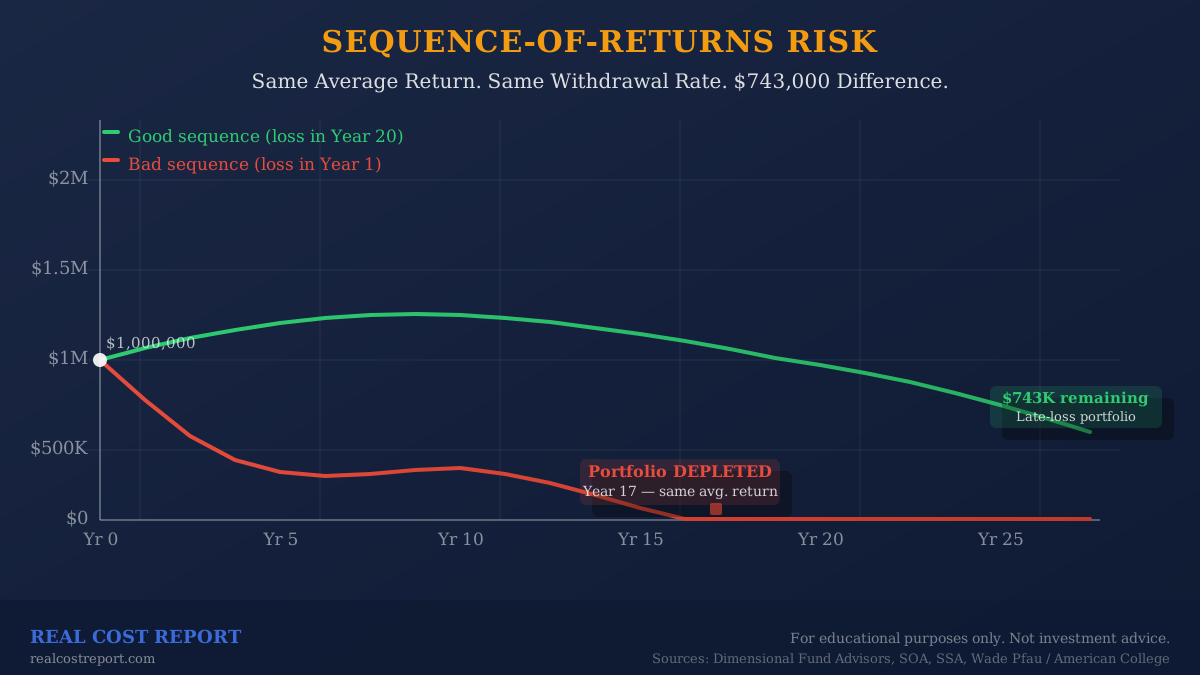
- Sequence-of-returns risk — not average market performance — is the primary reason early retirees run out of money; a 10% drop in year one is nearly twice as damaging as the same drop in year ten.
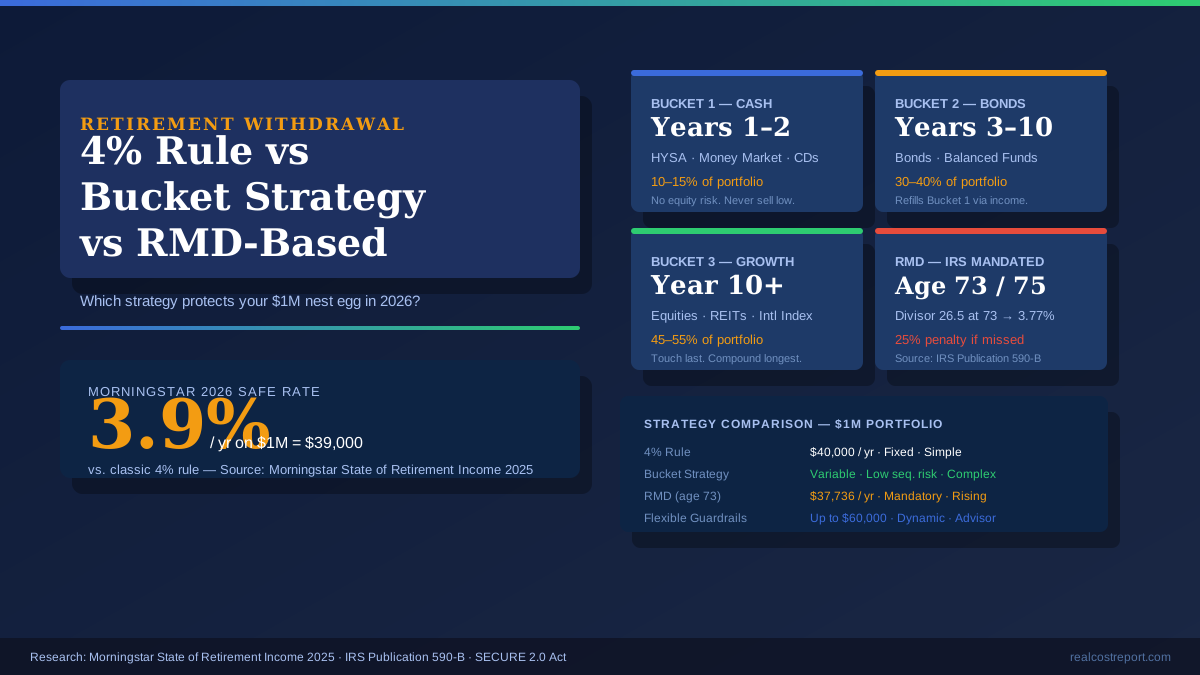
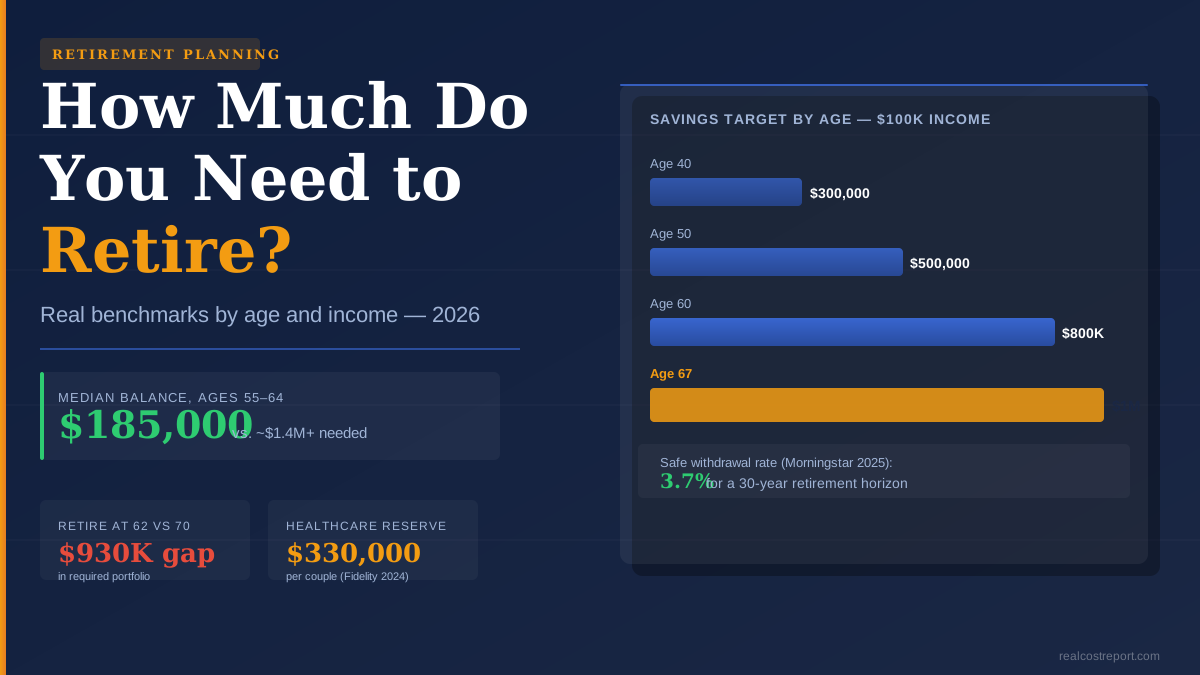
- The 4% withdrawal rule remains defensible for 30-year retirements but Morningstar’s 2025 research sets a safer starting rate at 3.7% for portfolios with a 30+ year horizon.
- Recommendation: Run your number against the income-replacement table below, then stress-test it with a 3.5% withdrawal rate and a 2-year Social Security delay before treating any benchmark as final.
A 2024 Federal Reserve Survey of Consumer Finances found the median retirement account balance for Americans aged 55–64 is $185,000 — less than one-eighth of what a typical household in that age bracket will actually need. That gap is not a savings motivation problem. It is a calculation problem: most people are working toward a number they arrived at without modeling their own income, expenses, retirement age, or Social Security strategy. Fidelity’s 10x rule and the classic 4% withdrawal formula are legitimate starting points, but applying them without adjustment produces targets that are off by hundreds of thousands of dollars. This article delivers verified savings benchmarks by age and income, a direct comparison of the Fidelity and Vanguard methodologies, scenario modeling for early versus traditional retirement, and a plain-language breakdown of the variables that move your number the most.
The Real Retirement Number: Benchmarks by Age and Income
No single retirement savings figure applies universally. Your number is a function of your expected annual spending, your planned retirement age, your anticipated Social Security benefit, and how long your money must last. The standard framework — multiply annual expenses by 25 to derive the portfolio needed to sustain a 4% annual withdrawal indefinitely — is mathematically sound for a 30-year retirement beginning at 65. Deviations from those conditions, earlier retirement, higher spending, or lower expected returns, require proportional adjustments to the multiplier.
The table below applies Fidelity’s salary-multiple benchmarks alongside a spending-based model for three income tiers. Spending is estimated at 80% of pre-retirement gross income, the standard income-replacement ratio used by Fidelity Investments and the Employee Benefit Research Institute (EBRI).
Benchmarks derived from Fidelity Investments salary-multiple guidelines (3x at 40, 5x at 50, 8x at 60, 10x at 67). Final target column also reflects a 25x annual spending model at 80% income replacement. Verify at fidelity.com.
Note the implicit assumption in Fidelity’s multiples: they are calibrated for a retirement starting at 67 with Social Security providing a meaningful income floor. If you plan to retire before Social Security eligibility — or if your Social Security benefit is below average — these multiples understate your actual target by 15–25%.
Fidelity vs Vanguard Retirement Methodology: Which Number Should You Trust?
Fidelity and Vanguard are the two largest providers of 401(k) plans in the United States and both publish retirement savings frameworks widely used by financial planners. Their methodologies differ in a meaningful way that affects how you should interpret each firm’s guidance.
Fidelity anchors its benchmarks to salary multiples — simple, memorable, and easy to track on any account statement. The appeal is accessibility. The limitation is that salary multiples assume a stable income-replacement ratio, a relatively standard retirement age, and moderate Social Security benefits. They also assume you will claim Social Security at full retirement age, which the Social Security Administration (SSA) defines as 67 for anyone born after 1960.
Vanguard’s approach, detailed in its annual “How America Saves” report and its retirement income modeling tools, centers on spending-rate analysis rather than income multiples. Vanguard argues — persuasively — that what you spend in retirement matters more than what you earned before it. A $150,000-a-year earner who lives on $65,000 per year has a meaningfully different savings target than one who lives on $110,000 per year, even though Fidelity’s 10x rule produces the same $1,500,000 target for both.
Methodology comparison based on published guidance from Fidelity Investments (verify at fidelity.com) and Vanguard Group (verify at vanguard.com). Withdrawal rate ranges reflect Vanguard’s retirement income framework documentation.
Verdict
Use Fidelity’s salary multiples as a monthly progress check — they are easy to calculate and benchmark against peers. Use Vanguard’s spending-based model to set your actual retirement target. If those two numbers diverge by more than 20%, the spending model wins. Salary multiples cannot account for frugal high-earners or high-spending average earners.
How Retirement Age Changes Your Number: Early vs Traditional Retirement
Retirement age is the single most powerful variable in your savings calculation. It works against you on two fronts simultaneously: retiring earlier means your portfolio must last longer, and it typically means a reduced or delayed Social Security benefit. The compounding effect of those two factors is larger than most pre-retirees expect.
Consider a household with $80,000 in annual retirement spending needs. Here is how the required portfolio changes by retirement age, assuming Social Security is claimed optimally in each scenario and the portfolio earns a 6% nominal annual return.
Age 62 retirement: Social Security benefit claimed at 62 is reduced by up to 30% versus the full retirement age benefit, per the SSA. With a lower benefit floor, the portfolio must cover a larger annual gap for potentially 28–33 years. Required portfolio: approximately $2,000,000–$2,200,000.
Age 67 retirement: Full Social Security benefit kicks in. Assuming an average benefit of $1,907/month (SSA’s 2024 average for retired workers), that is $22,884 annually. The portfolio covers $57,116 per year for a 25-year horizon. At a 4% withdrawal rate: $1,428,000 required.
Age 70 retirement: Delayed Social Security claiming increases benefits by 8% per year past full retirement age, per SSA rules. A benefit that would be $1,907 at 67 becomes approximately $2,430/month at 70 — $29,160 annually. Portfolio covers $50,840 per year. Required portfolio drops to approximately $1,270,000 at 4% withdrawal.
The math reveals a counterintuitive reality: retiring at 70 instead of 62 can reduce your required portfolio by $730,000–$930,000 for the same annual spending level. For households where portfolio shortfall is a genuine risk, working three additional years may be more effective than a decade of aggressive saving.
What Most People Get Wrong About Retirement Savings
The gaps between what people believe about retirement savings and how the numbers actually work are wide and consequential. These are the five most expensive misunderstandings this research identified.
Mistake 1: Treating the 4% rule as a guarantee. The 4% rule originated in William Bengen’s 1994 research and was validated by the Trinity Study using historical U.S. market data. Morningstar’s 2025 retirement research updated the safe starting withdrawal rate to 3.7% for a 30-year horizon with a balanced portfolio. Using 4% on a $1,500,000 portfolio produces $60,000 per year; using 3.7% produces $55,500. Over 30 years, that $4,500 annual difference compounds into a meaningfully different longevity outcome. The consequence of ignoring this: a 7–12% higher probability of portfolio depletion, per Morningstar’s modeling. Correct action: use 3.7%–3.8% as your planning rate, and model 4% only as an optimistic ceiling.
Mistake 2: Ignoring sequence-of-returns risk. Two retirees with identical portfolios and identical average returns over 30 years can have dramatically different outcomes depending on when bad years occur. A 20% market decline in retirement year one forces the retiree to sell more shares at depressed prices to fund living expenses — shares that are then unavailable for the subsequent recovery. Research from the Journal of Financial Planning demonstrates that negative returns in the first five years of retirement have roughly twice the impact on terminal portfolio value compared to the same returns in years 25–30. Correct action: hold 1–2 years of living expenses in cash or short-term bonds at retirement to avoid forced selling in down markets.
Mistake 3: Underestimating healthcare costs. Fidelity’s 2024 Retiree Health Care Cost Estimate found that a 65-year-old couple retiring today needs an average of $330,000 in after-tax savings dedicated specifically to healthcare costs. This figure is separate from long-term care. Most retirement calculators embed a generic 3% healthcare inflation assumption; the actual historical rate for retiree healthcare has run closer to 5%–6% annually, per the Center for Medicare and Medicaid Services (CMS). Correct action: add a dedicated healthcare reserve to your retirement portfolio calculation rather than absorbing it into general spending estimates.
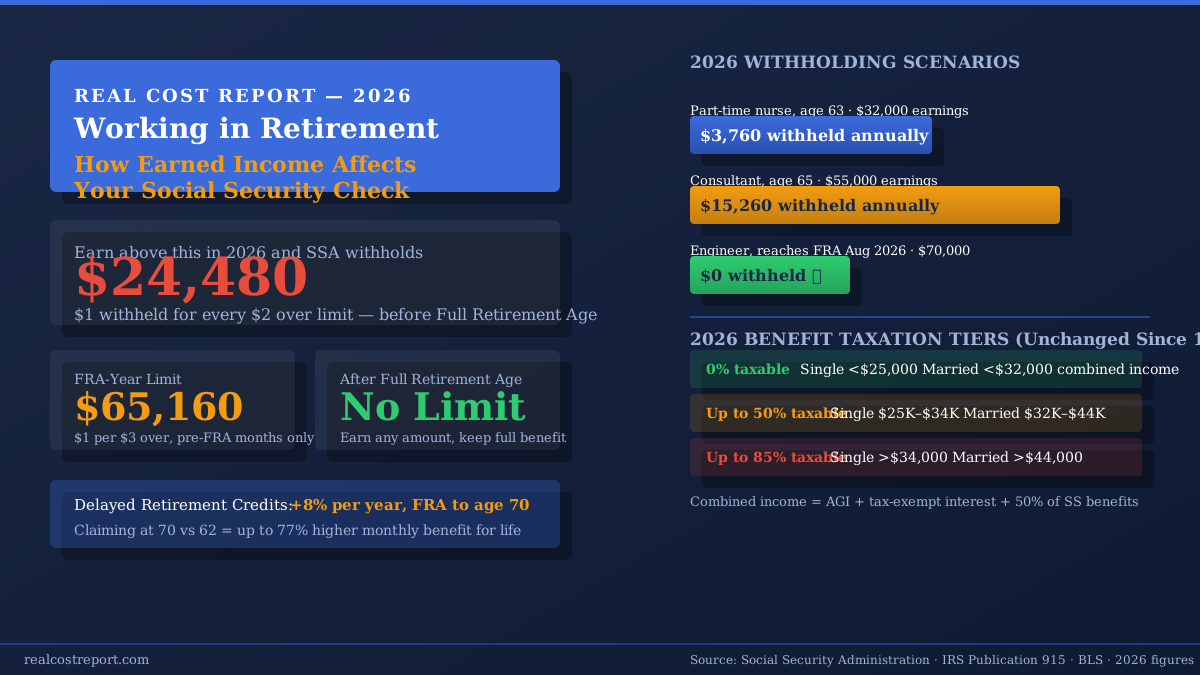
Mistake 4: Claiming Social Security too early. The SSA’s own data shows that the majority of Americans claim Social Security before their full retirement age. Claiming at 62 versus 70 represents a permanent benefit difference of approximately 76% — a gap that widens every year the retiree lives past break-even age (typically 80–82). For a couple where one spouse had a high lifetime income, delaying the higher earner’s claim to 70 can add $100,000–$200,000 in lifetime benefits. Correct action: model Social Security timing as a portfolio asset, not an afterthought.
Mistake 5: Using pre-tax balances as face value. A $1,000,000 traditional 401(k) is not a $1,000,000 retirement asset. Every dollar withdrawn is taxed as ordinary income. Depending on your marginal rate in retirement — and required minimum distributions (RMDs) begin at age 73 under the SECURE 2.0 Act — your effective after-tax value could be $700,000–$800,000. Correct action: build a tax-diversified portfolio with a mix of traditional pre-tax accounts, Roth accounts, and taxable brokerage holdings. Roth conversions between retirement and age 73 can reduce RMD exposure meaningfully.
Is $1 Million Enough to Retire? Scenario Modeling by Household Type
The $1,000,000 retirement milestone carries enormous psychological weight and is marketed heavily by fund companies including T. Rowe Price and Charles Schwab. Whether it is actually sufficient depends entirely on variables most marketing materials leave out. Here are four scenarios modeled against real inputs.
Scenario A — Single, age 67, $45,000 annual spending: Social Security benefit of $18,000/year (below average, reflecting part-time work history). Portfolio must cover $27,000/year. At a 3.7% withdrawal rate, the required portfolio is $729,730. A $1,000,000 portfolio is more than sufficient — in fact, 37% above the minimum threshold. Verdict: $1M works comfortably.
Scenario B — Married couple, age 65, $85,000 annual spending: Combined Social Security of $38,000/year (one spouse at average, one at 60% of average). Portfolio covers $47,000/year. Required portfolio at 3.7%: $1,270,270. A $1,000,000 portfolio falls $270,000 short. Verdict: $1M is not enough without supplemental income or spending reduction.
Scenario C — Single, age 60, $65,000 annual spending, no Social Security for 7 years: The 7-year bridge before Social Security begins means the portfolio bears the full $65,000 load initially. Required portfolio rises to approximately $1,600,000–$1,750,000 depending on bridge funding strategy. Verdict: $1M is significantly insufficient for early retirement at this spending level.
Scenario D — Married couple, age 70, $70,000 annual spending: Both delayed Social Security to 70. Combined benefit: $52,000/year. Portfolio covers $18,000/year. Required portfolio: $486,486 at 3.7%. A $1,000,000 portfolio provides over twice the needed coverage. Verdict: $1M is excellent — surplus capital available for legacy or long-term care reserve.
The pattern across these four scenarios is clear: Social Security timing and retirement age matter more to retirement security than portfolio size alone. A couple in Scenario D with $1,000,000 is in a stronger position than a couple in Scenario B with $1,200,000.
How We Researched This Article
This article was researched and modeled in May 2026. All primary data sources are named below. No statistics were estimated or extrapolated without attribution to a named institution.
Retirement savings benchmarks were sourced from published guidance by Fidelity Investments retirement planning resources and Vanguard Group’s “How America Saves” annual report (verify at vanguard.com). Social Security benefit amounts, claiming reduction percentages, and delayed claiming credits were drawn directly from the Social Security Administration’s official retirement planner.
The updated safe withdrawal rate of 3.7% for 30-year retirement horizons reflects Morningstar’s State of Retirement Income research, published annually and last reviewed for this article in its 2025 edition. Healthcare cost estimates of $330,000 per couple were drawn from Fidelity’s 2024 Retiree Health Care Cost Estimate press release. Median retirement account balances for the 55–64 age cohort were sourced from the Federal Reserve’s 2023 Survey of Consumer Finances.
The income-replacement ratio of 80% used throughout the benchmark tables reflects published guidance from EBRI (Employee Benefit Research Institute) and Fidelity Investments — both primary sources rather than secondary summaries. RMD age of 73 reflects the SECURE 2.0 Act provisions as enacted. Scenario modeling in the “Is $1 Million Enough” section used a 3.7% withdrawal rate throughout for consistency with Morningstar’s current conservative guidance. Sequence-of-returns risk framing reflects peer-reviewed research in the Journal of Financial Planning.
Limitations: Withdrawal rate research is modeled on historical U.S. market data and does not guarantee future portfolio performance. Social Security benefit figures used in scenario modeling reflect 2024 SSA averages and will differ for individuals based on actual earnings history. Tax treatment of retirement accounts reflects 2025–2026 federal tax law; state tax treatment varies significantly and was not modeled.
All figures were verified against named primary sources before publication.