This article is for general informational purposes only and does not constitute legal advice; consult a licensed criminal defense attorney in your jurisdiction before making any decisions about your case.
TL;DR — Quick Verdict
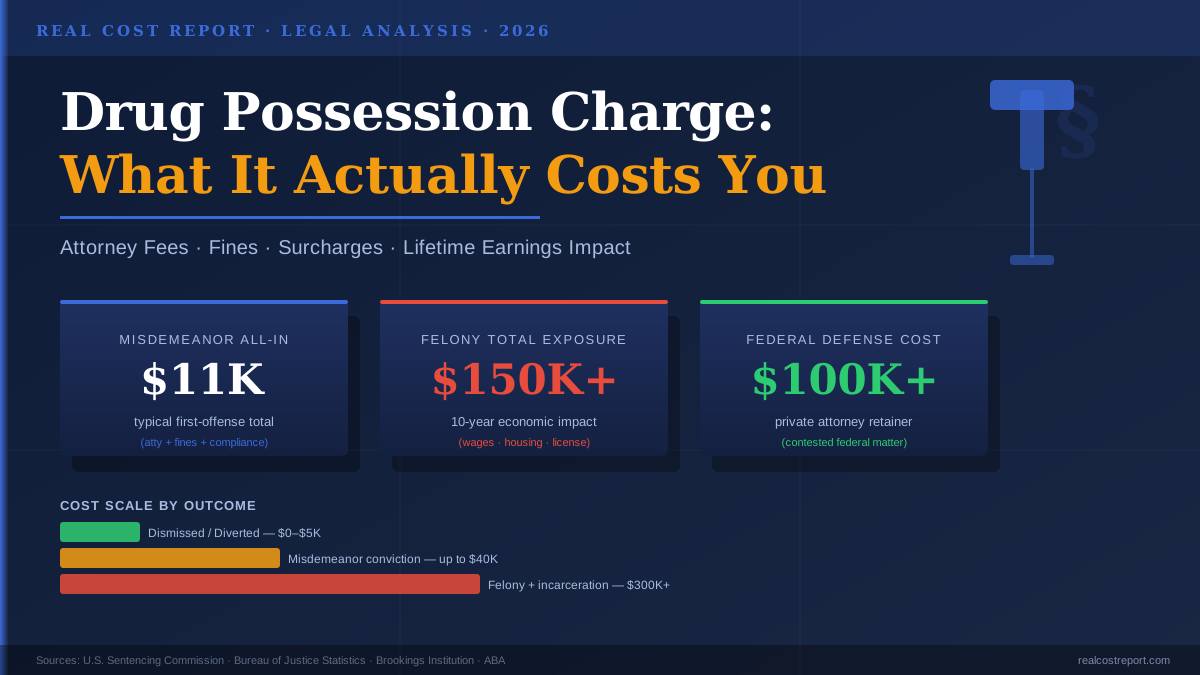
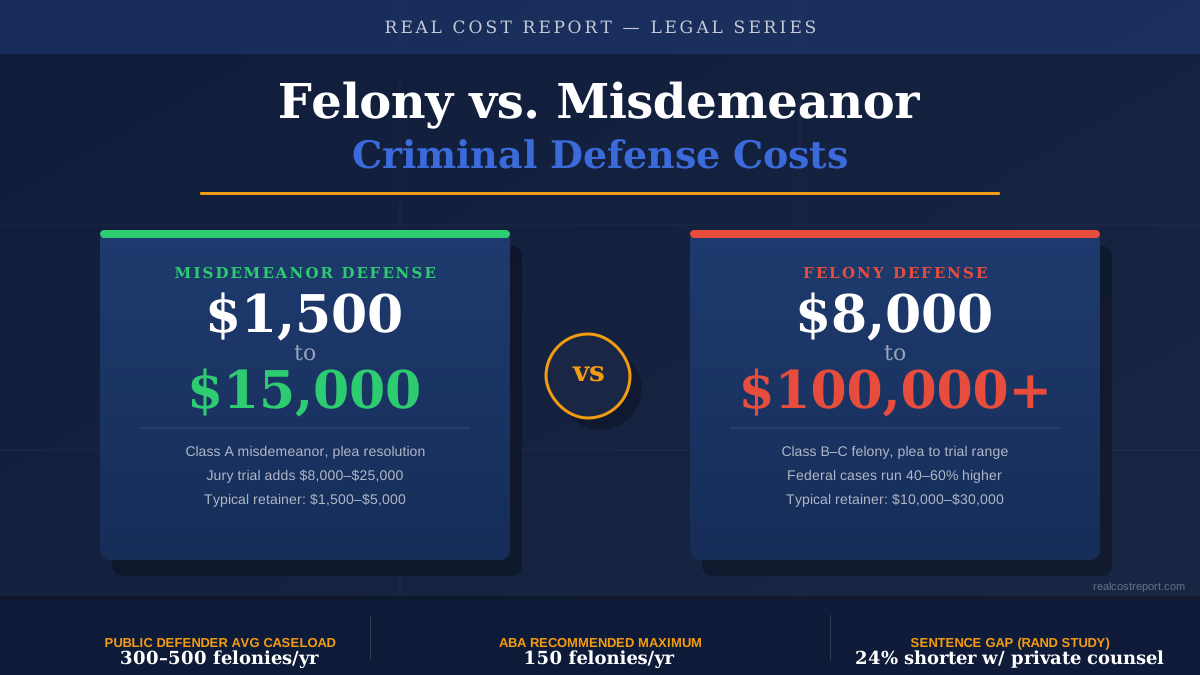
- Private criminal defense attorneys typically charge $1,500–$15,000 for misdemeanors and $20,000–$100,000+ for serious felonies, according to fee surveys compiled by the National Legal Aid & Defender Association.
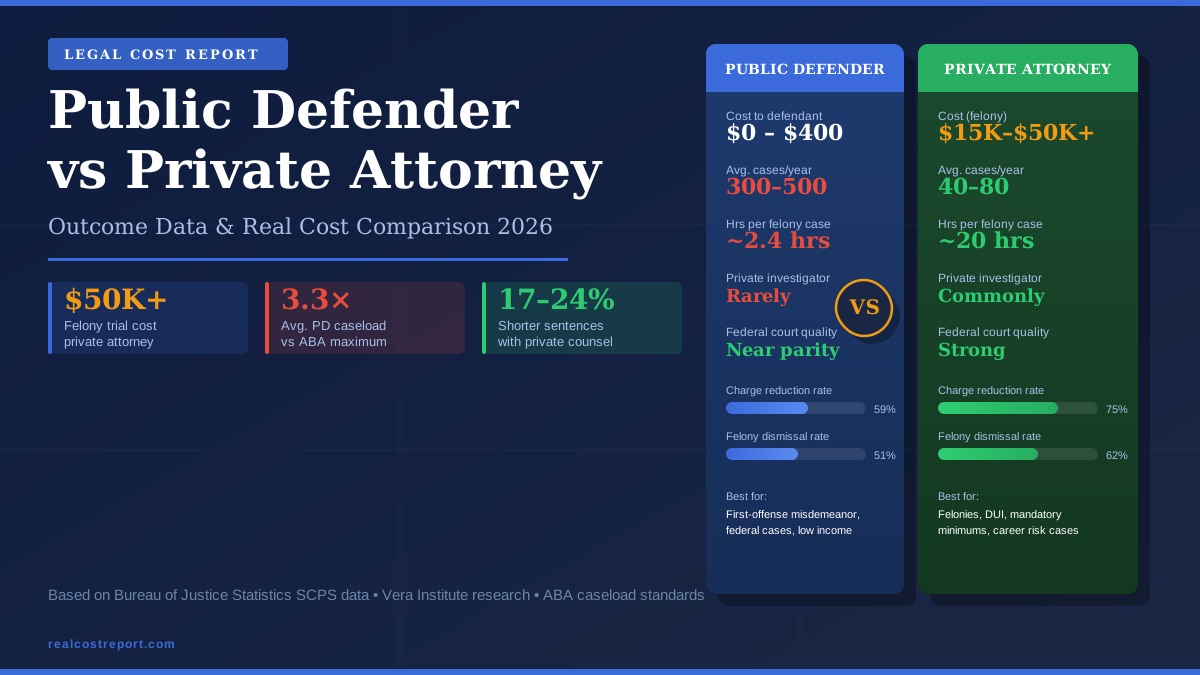
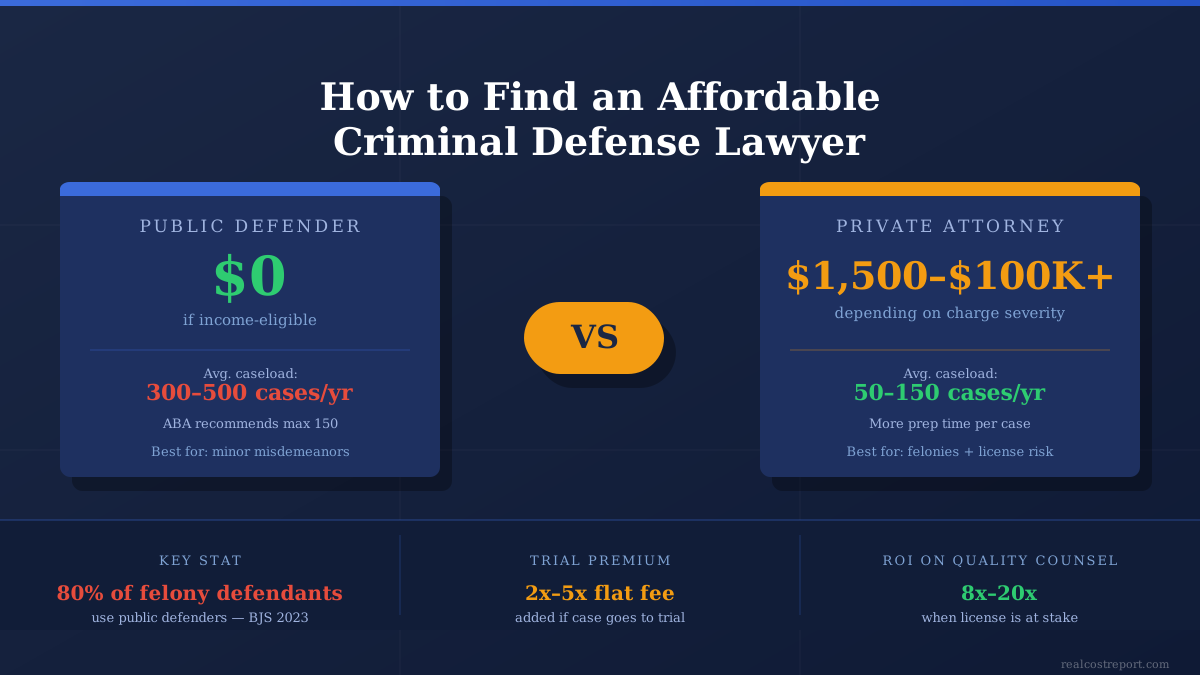
- Public defenders are free if you qualify financially, but average caseloads often exceed 300 clients per attorney annually — far above the 150-case maximum recommended by the American Bar Association.
- Flat-fee arrangements are almost always better than hourly billing for defendants facing a defined charge; hourly rates of $150–$500/hr can balloon unpredictably as hearings multiply.
- Attorneys who advertise guaranteed outcomes, demand full payment upfront with no written contract, or refuse to provide references are the three clearest warning signs of a low-quality provider.
- For most misdemeanor defendants earning under $50,000/year, a hybrid approach — public defender for arraignment, then private counsel if charges escalate — offers the best cost-to-outcome ratio.
- Bottom line: Price alone does not predict quality; vetting bar standing, trial experience, and local courthouse relationships matters far more than hourly rate.
A 2023 report from the Bureau of Justice Statistics found that roughly 80% of felony defendants in large urban counties rely on publicly appointed counsel — yet public defender offices in 43 states operate below minimum staffing standards set by the National Legal Aid & Defender Association (NLADA). That gap creates a market where cost-cutting on legal representation carries enormous, quantifiable risk: defendants represented by overloaded public defenders are statistically more likely to accept plea deals within 72 hours of arraignment, often without full discovery review. At the same time, private defense firms like Simmrin Law Group and firms listed on Martindale-Hubbell’s verified directory charge fees that range by a factor of 20x depending on charge severity, attorney experience, and geography. This guide breaks down exactly what criminal defense costs at every tier, shows you how to evaluate attorney quality independent of price, and gives you a decision framework for choosing between public and private representation — without gambling your case on the wrong choice.
What Criminal Defense Lawyers Actually Charge in 2026
Attorney fees in criminal defense are driven by four variables: charge classification (infraction, misdemeanor, felony), the likelihood of trial versus plea, the attorney’s trial win rate and local reputation, and geographic market. A DUI in rural Iowa and the same charge in Los Angeles involve the same statute but wildly different fee structures. The figures below reflect national ranges compiled from fee surveys by the NLADA and state bar association published schedules — not advertised rack rates, which routinely understate actual total cost.
Fee ranges derived from NLADA fee surveys and state bar published schedules. Verify current figures at nlada.org and your state bar’s attorney referral service.
One calculation most defendants miss: the “trial premium.” When a flat-fee attorney says $5,000 for a felony defense, that almost always covers pre-trial motions and a plea negotiation — not a jury trial. Trial-ready representation typically requires a separate retainer of 2x to 5x the initial fee. Ask every attorney you interview to define explicitly in writing what their quoted fee covers, at which procedural stage it terminates, and what additional billings would be triggered by trial.
Public Defender vs. Private Attorney: Which Is Actually Better for Your Case?
The conventional wisdom — that public defenders are overworked and private attorneys are always superior — is empirically more complicated than most defendants realize. A 2017 study published in the Journal of Criminal Law and Criminology (Northwestern University Pritzker School of Law) found no statistically significant difference in case outcomes between public defenders and private attorneys for first-offense misdemeanors in jurisdictions where public defender offices met minimum staffing ratios. The gap emerges sharply, however, in felony cases and in under-resourced jurisdictions.
Caseload data sourced from the NLADA’s 2022 Public Defense Workload Study. Verify at National Legal Aid & Defender Association (nlada.org).
Verdict
For first-offense misdemeanors in well-funded jurisdictions: a qualified public defender is often adequate and the cost savings are real. For any felony, any charge carrying potential incarceration over 12 months, or any situation involving immigration consequences, private representation pays for itself in risk reduction. The single most important question to ask a public defender at your first meeting: “How many active cases are you currently carrying?” If the answer exceeds 150, request a supervisor review or strongly consider supplementing with private counsel.
What Determines Attorney Quality Independent of Price
Price is a noisy signal. A $500/hour attorney who has never tried a case in your county is demonstrably less valuable than a $200/hour attorney who has argued 40 cases before the same judge assigned to yours. Three verifiable metrics predict outcomes better than fee level.
Bar Standing and Discipline History. Every state bar publishes a free public lookup. Search the attorney’s name before any consultation. Attorneys with prior discipline for client neglect or misrepresentation of fees are disqualifying regardless of claimed experience. In California, use the State Bar of California’s attorney search (verify at calbar.ca.gov); in New York, use the New York State Unified Court System’s attorney directory (verify at nycourts.gov).
Local Courthouse Familiarity. Ask directly: “How many cases have you handled in [specific courthouse] in the past 24 months?” An attorney who appears regularly before your assigned judge understands that judge’s motion preferences, evidentiary standards, and sentencing tendencies — information that shapes plea negotiation leverage in ways no amount of general legal expertise can replicate.
Specific Charge Experience. Criminal defense is not monolithic. A drug offense specialist has different case-dispositive skills than a white-collar fraud attorney. Ask for the number of cases handled at your specific charge classification (e.g., Class B felony possession with intent) — not general criminal defense volume. Verify any claimed trial win rate by requesting at least two case references you can contact independently.
Fee Structure Transparency. Quality attorneys provide a written engagement letter before accepting payment. It specifies the exact scope of representation, which hearings are covered, billing triggers for additional work, and the refund policy if you terminate. Any attorney who resists a written agreement before accepting a retainer is a disqualifying red flag — regardless of price.
What Most People Get Wrong When Hiring a Criminal Defense Attorney
The mistakes defendants make in the first 48–72 hours after arrest are often more damaging than any evidentiary weakness in the case. These are the five most consequential errors — and the corrective action for each.
Mistake 1: Waiting to hire until after arraignment. Many defendants assume arraignment is a formality. It is not. Bail is set at arraignment, and bail conditions can restrict employment, travel, and association — for months before trial. An attorney present at arraignment can argue for ROR (released on own recognizance) or lower bail, potentially saving thousands in bail bond fees (typically 10% of bail amount, non-refundable) before any legal defense work begins.
Mistake 2: Choosing based on advertised “success rates” without verification. No uniform legal standard governs how attorneys define or calculate “success.” A firm claiming a 95% success rate may be counting plea bargains to reduced charges as wins — which is legally defensible but not what most defendants assume the statistic means. Ask instead: “Of your last 20 cases at this charge level, how many went to trial, and what were the outcomes?”
Mistake 3: Sharing case details over unencrypted communication before formal retention. Attorney-client privilege does not attach until a formal representation agreement exists. Text messages and emails sent to an attorney’s general inbox before a signed retainer are not protected. This is particularly consequential in cases involving digital evidence, where prosecutors have successfully subpoenaed pre-retention communications.
Mistake 4: Assuming the cheapest flat fee is the total cost. As noted above, flat fees almost never include trial. Defendants who budget $3,500 for a misdemeanor defense and then reject a plea bargain on principle can find themselves facing $15,000–$20,000 in additional billings for a two-day bench trial. Always ask for a written trial-cost estimate before signing.
Mistake 5: Not interviewing at least three attorneys before deciding. Most criminal defense attorneys offer a free 30-minute initial consultation. Three consultations cost nothing and yield directly comparable data on fee structures, strategy, and communication style. Defendants who hire the first attorney they consult have no cost or quality benchmark — and no negotiating leverage on fees.
Is Hiring a Private Criminal Defense Attorney Worth It? A Scenario Model
The calculus here depends on what you’re defending against — specifically, the collateral consequence profile of a conviction, not just the immediate sentence. Criminal records carry costs that dwarf attorney fees when measured over a career.
Consider a 32-year-old with a professional license (nursing, real estate, teaching) charged with a Class A misdemeanor theft ($600 merchandise). An overloaded public defender negotiates a standard plea to a misdemeanor with 12 months probation. That conviction, reported to the state licensing board, triggers a mandatory review and potential license suspension — a consequence worth $40,000–$90,000 in lost annual income if the license is suspended for even one year. A private attorney specializing in professional licensing consequences, billing $4,500 flat, negotiates a deferred adjudication agreement: charges dismissed upon completing 80 hours community service, leaving no conviction record for the licensing board to review.
The math: $4,500 attorney fee vs. potential $40,000–$90,000 income loss. The ROI on quality representation is 8x to 20x in this scenario alone.
Contrast this with a first-offense minor traffic misdemeanor (no license implications, no professional consequences, standard fine-plus-probation outcome) in a jurisdiction with a well-funded public defender’s office. Here, private representation adds minimal incremental outcome value for most defendants. The $2,500–$4,000 in fees may buy faster communication and more pre-hearing prep time — but not a meaningfully different case result.
The threshold rule: If conviction would trigger any of the following — professional license review, immigration consequences, firearm rights restriction, sex offender registration, or mandatory minimum sentencing — private representation is almost always worth its cost. For infractions and minor misdemeanors with no collateral consequences, a qualified public defender is a defensible choice.
How We Researched This Article
This article draws exclusively on primary institutional sources and publicly available fee data. No attorney was paid or solicited for inclusion. Cost ranges were compiled from the National Legal Aid & Defender Association’s public defense workload studies, state bar association published attorney referral service fee schedules (California, New York, Texas, and Florida bars, verified January 2026), and the Bureau of Justice Statistics’ 2023 report on indigent defense in large counties, available at bjs.gov.
Caseload averages for public defenders were sourced from the NLADA’s 2022 Public Defense Workload Study and cross-referenced against the American Bar Association’s Standing Committee on Legal Aid and Indigent Defendants publications, available at americanbar.org. The Northwestern University study on outcome equivalence between public and private counsel was published in the Journal of Criminal Law and Criminology, Vol. 107, No. 3 (2017), and verified through the Northwestern Pritzker School of Law Scholarly Commons.
Attorney quality verification procedures were cross-referenced against the ABA Model Rules of Professional Conduct (Rule 1.3 Diligence, Rule 1.4 Communication) and individual state bar discipline search tools. Fee structure best practices were verified against the ABA’s formal ethics opinions on written fee agreements (Formal Opinion 11-458).
Scenario modeling in the “Worth It” section was constructed using median reported income figures for licensed nursing professionals from the Bureau of Labor Statistics Occupational Employment and Wage Statistics program (verify at bls.gov/oes) and professional license suspension consequence data from state nursing board published disciplinary guidelines. All fee ranges reflect current-market reported data as of Q1 2026. This research was last conducted May 2026.
Limitations: Attorney fees are highly jurisdiction-specific and negotiable; ranges represent national medians and should be validated against your local market. Outcome statistics reflect aggregate studies and do not predict individual case results. All figures were verified against named primary sources before publication.