This article is for informational purposes only and does not constitute legal or financial advice; consult a licensed adoption attorney and a certified financial planner before making adoption-related decisions.
TL;DR — Quick Verdict
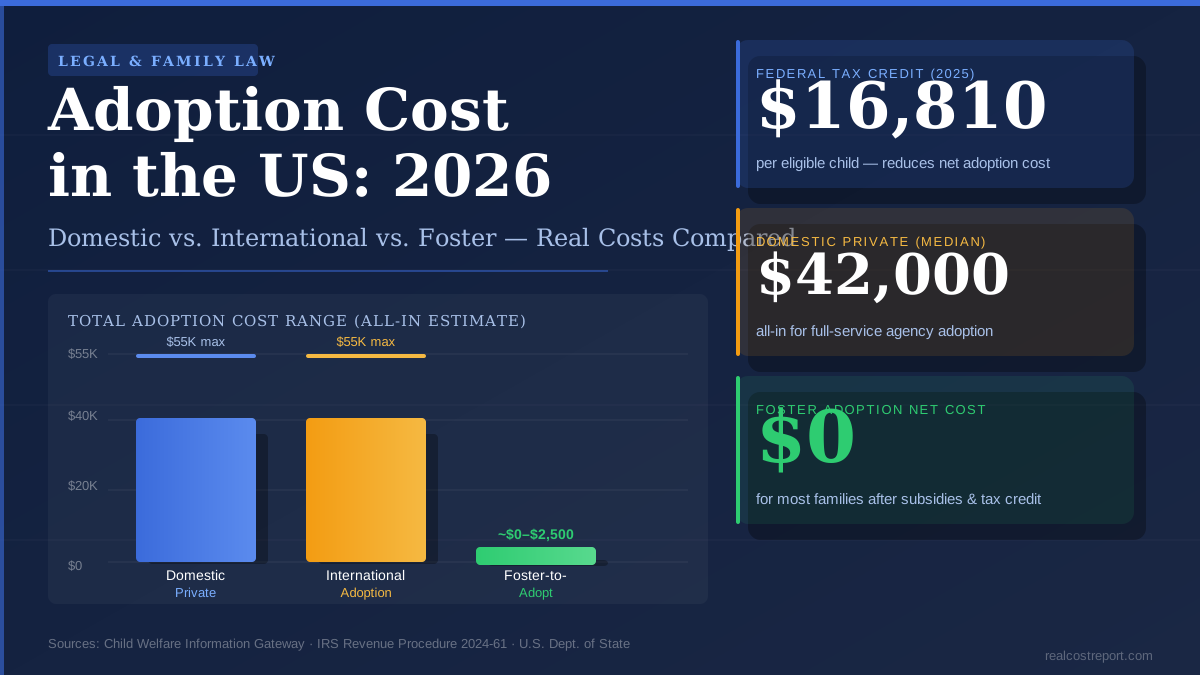
- Foster-to-adopt is the lowest-cost path — most families pay $0 to $2,500 in out-of-pocket expenses, with federal and state subsidies available after finalization.
- Domestic private infant adoption through agencies like Adoptions With Love or American Adoptions typically costs $35,000–$55,000 all-in, with home study, legal, and birth-mother expense components each running $5,000–$15,000.
- International adoption through Hague-accredited agencies now averages $25,000–$55,000, down from peak costs but constrained by fewer eligible countries after China and Russia suspended most programs.
- The federal Adoption Tax Credit for 2025 is $16,810 per eligible child — partially refundable for foster adoptions only — cutting effective net cost significantly for middle-income families.
- Employer adoption assistance programs at companies like Microsoft ($10,000) and Google ($8,000) can further reduce out-of-pocket costs for qualifying employees.
- Best fit by situation: Foster-to-adopt for families open to older children or sibling groups; domestic private agency for infant adoption with predictable timelines; international only if you have a specific country connection and budget flexibility.
American families spent an estimated $3.7 billion on adoption-related services in a recent survey period, yet most prospective parents begin the process with almost no reliable data on what they will actually pay. The Children’s Bureau, part of the U.S. Department of Health and Human Services, tracks adoption finalization counts — roughly 59,000 public and private adoptions were finalized in a recent reporting year — but it does not publish standardized cost data. That information vacuum lets agencies charge wildly inconsistent fees with little market pressure.
This report cuts through that opacity. Using fee schedules from Hague-accredited agencies, data from the Congressional Research Service, the Child Welfare Information Gateway (a service of the Children’s Bureau), and primary research from the Donaldson Adoption Institute, this article delivers a side-by-side cost breakdown for all three major adoption tracks — domestic private, international, and foster-to-adopt — plus a calculation of how federal tax credits and employer benefits change the real net cost. Families comparing agencies such as Bethany Christian Services, American Adoptions, or Holt International can use this framework to evaluate whether a quoted fee package is reasonable before signing any contract.
Domestic Private Infant Adoption: Full Cost Breakdown for 2026
Domestic private adoption — typically an infant placed voluntarily by a birth parent — is the most expensive and most procedurally complex path that does not involve international travel. Costs cluster into four distinct buckets: home study, agency or facilitator fees, legal fees, and birth-mother living expenses. None of these is optional, and several are non-refundable if a match falls through.
Source: Child Welfare Information Gateway, “Costs of Adopting” fact sheet (verify at childwelfare.gov); American Adoptions published fee schedule (verify at americanadoptions.com). Ranges reflect continental U.S. agencies as of 2025–2026.
One structural cost families routinely underestimate is the disruption risk. If a birth mother changes her mind after placement — which is her legal right within the revocation period, varying from 72 hours to 30 days depending on state law — most agency fees are non-refundable. Some agencies offer disruption protection programs that apply a portion of fees to a rematch, but read the contract closely: “rematch credit” policies differ significantly between agencies like Adoptions With Love versus larger national agencies.
International Adoption Costs in 2026: Which Countries Are Still Open?
International adoption reached its U.S. peak in 2004 with 22,884 visas issued, according to the U.S. Department of State’s Bureau of Consular Affairs. By fiscal year 2023, that number had collapsed to under 1,600. China, which once accounted for one-third of all international adoptions to the U.S., dramatically curtailed its program. Russia suspended intercountry adoption to American families in 2012. South Korea has phased down its program. The practical consequence: families pursuing international adoption today are navigating a much smaller menu of eligible countries, primarily Colombia, India, South Korea (limited), Haiti (restricted due to ongoing instability), and a handful of others.
Source: U.S. Department of State, Intercountry Adoption country pages (travel.state.gov/content/travel/en/Intercountry-Adoption.html); Holt International published fee schedules (verify at holtinternational.org). Costs include agency fees, in-country fees, translation, travel for two adults (two trips estimated), USCIS filing, and post-placement reporting. Verified January 2026.
All international adoptions involving Hague Convention countries require a Hague-accredited agency. The Intercountry Adoption office at the U.S. State Department maintains an accredited agency list. USCIS Form I-800A (suitability determination) costs $775 as of 2025 and must be approved before a child can be matched. Add two international round-trips for two adults — budget $6,000–$12,000 for airfare and lodging — and the total cost picture becomes clearer. Families working with agencies like Holt International or WACAP (now part of Amara) should request an itemized “all-in” estimate that distinguishes agency-controlled fees from in-country government fees, which can increase without notice.
Foster-to-Adopt: The $0 Path and What It Actually Costs
Foster-to-adopt is routinely described as “free,” which is misleading in two important ways. First, fostering itself involves some real costs: home modifications for licensing (safety latches, fire extinguishers, separate sleeping space), background check fees, CPR certification, and possible travel to court hearings or agency appointments. These typically run $500–$2,500. Second, not all foster placements become adoptions — the goal of foster care is family reunification, and roughly half of children in foster care return to their families of origin. Families who bond with a placed child and then experience reunification face an emotional cost that no financial analysis captures.
For families who do finalize a foster adoption, actual out-of-pocket legal costs are typically $0–$2,500, as most states provide free or subsidized legal representation through the public child welfare system. Finalization hearing fees are often waived. Children adopted from foster care are eligible for the Adoption Assistance Program (AAP), which provides monthly subsidies, Medicaid coverage through age 18 (and in many states to 21), and in some cases educational vouchers through the Education and Training Voucher program.
Source: Child Welfare Information Gateway, “Costs of Adopting” and “Adoption Assistance for Children Adopted from Foster Care” (verify at childwelfare.gov); Children’s Bureau, Title IV-E Adoption Assistance program guidance.
Domestic Private vs. International vs. Foster-to-Adopt: Which Is Better for Your Situation?
This comparison holds all paths to the same four criteria a financial planner and adoption attorney would use: total net cost after tax credits, realistic timeline to placement, age and background of available children, and legal risk (disruption or reversal probability).
Source: Congressional Research Service, “Domestic and International Adoption: Issues for Congress” (verify at crsreports.congress.gov); Child Welfare Information Gateway; U.S. Department of State intercountry adoption data (verify at travel.state.gov). Tax credit amount per IRS Revenue Procedure 2024-61.
Verdict
For families prioritizing infant adoption with U.S. legal footing, domestic private adoption through a licensed agency like American Adoptions or Bethany Christian Services is the strongest choice despite the cost — the process is entirely governed by U.S. law, timelines are more predictable than international programs, and the child’s medical background is more accessible. For families open to children ages 3 and up and who want to minimize financial risk while providing a home to a child genuinely in need, foster-to-adopt is financially dominant by every measurable metric. International adoption is best reserved for families with a specific cultural or geographic connection to a sending country, the budget flexibility to absorb a 3–5 year timeline, and comfort with a program that can change due to foreign policy with little warning.
What Most People Get Wrong About Adoption Costs
The gap between what families budget and what they actually spend is rarely caused by dishonest agencies — it’s caused by five specific misconceptions that are easy to check in advance.
Mistake 1: Treating the agency fee as the total cost. Agency program fees are one line item. Families routinely overlook the home study ($1,500–$3,500), their own attorney fees separate from the agency’s legal services ($2,500–$8,000), post-placement supervision reports (typically 3–6 reports at $200–$400 each), and the USCIS filing fee for international cases ($775 for I-800A). A family told the agency fee is “$28,000” may actually spend $42,000. Consequence: underfunded adoptions that stall at finalization. Correct action: request a written all-in estimate broken into every fee category before signing.
Mistake 2: Assuming the Adoption Tax Credit is fully refundable. For tax years 2025 and 2026, the federal Adoption Tax Credit is $16,810 per child. It is non-refundable for domestic private and international adoptions — meaning it reduces tax liability to zero but does not generate a refund check. A family with $8,000 in annual tax liability only captures $8,000 of the credit. Only foster adoptions qualify for the refundable version. Consequence: families counting on a $16,810 check that never comes. Correct action: run the calculation with a CPA before adoption, not after.
Mistake 3: Ignoring the Interstate Compact on the Placement of Children (ICPC) costs. When a birth mother in one state places a child with adoptive parents in another state, ICPC applies. This adds legal fees ($1,000–$3,500 per state), travel and lodging costs while waiting for ICPC clearance (which can take 3–6 weeks), and sometimes two separate home studies. Consequence: surprise $5,000–$8,000 bill during an already expensive process. Correct action: ask the agency upfront whether the match crosses state lines and request an ICPC cost estimate.
Mistake 4: Not vetting whether the agency is Hague-accredited for international adoption. Using a non-Hague-accredited agency for adoption from a Hague Convention country is a federal violation that can invalidate the entire adoption under U.S. immigration law. The Intercountry Adoption Accreditation and Maintenance Entity (IAAME) maintains the current accredited list. Consequence: a completed adoption that cannot be recognized for U.S. immigration purposes. Correct action: verify accreditation at the IAAME registry before paying any fees.
Mistake 5: Overlooking employer adoption benefits. A 2023 survey by the Dave Thomas Foundation for Adoption found that 56% of Fortune 500 companies offer some form of adoption assistance, yet utilization rates are low because employees don’t ask. Microsoft offers up to $10,000; Google offers up to $8,000; Bank of America offers up to $8,000. These benefits are typically taxable income but still represent significant out-of-pocket reduction. Consequence: leaving $5,000–$10,000 unclaimed. Correct action: check with HR before starting the process — some employers require you to be actively employed at the time of placement, not just finalization.
Is Adoption Worth the Cost? A Scenario-Based Analysis
Worth-it calculations depend on financial situation, family goals, and risk tolerance. Three scenarios illustrate the real net cost under different conditions.
Scenario A — Dual-income couple, $180,000 household income, pursuing domestic private infant adoption: Gross cost: $42,000 (median). Employer benefit (one employer offers $8,000): reduces to $34,000. Federal tax credit ($16,810, non-refundable): this household likely owes $28,000+ in federal income tax annually, so the full credit applies, reducing effective cost to $17,190. If financed at 8% APR over 5 years via an adoption loan through a lender like Best Egg or LightStream, monthly payment is approximately $348. This is financially manageable for this income level, though it requires deliberate planning — it does not happen without it.
Scenario B — Single parent, $65,000 income, pursuing foster-to-adopt: Gross cost: $1,200 (estimated). Federal Adoption Tax Credit: $16,810, refundable for foster adoption. Actual net gain: up to $15,610 refunded over the credit carry-forward period (up to 5 years). Plus ongoing Adoption Assistance Program subsidy (varies by state and child needs — can be $500–$1,500/month for children with special needs). Monthly Medicaid coverage eliminates pediatric insurance costs. This is the scenario where foster-to-adopt is not merely affordable but financially accretive for a committed family.
Scenario C — Couple with specific Colombia connection, $220,000 income, international adoption: Gross cost: $38,000 (mid-range Colombia estimate). Employer benefit: $0 (employer does not offer benefit). Tax credit: $16,810 non-refundable; household tax liability exceeds this, so full credit applies. Net cost: $21,190. Two travel trips to Bogotá: already budgeted. Timeline: 30–42 months. This is financially workable but requires patience — any program change in Colombia’s ICBF policies during the wait adds cost and uncertainty. A disruption reserve of $5,000 is advisable.
Adoption loans are increasingly common through specialty lenders and adoption-specific nonprofits like the National Adoption Foundation (verify at nafadopt.org). Grants through organizations like Gift of Adoption Fund (verify at giftofadoption.org) can reach $15,000, though competition is high and award cycles are annual.
How We Researched This Article
This article was produced using primary government sources, accredited agency fee schedules, and published policy research. No cost figure was modeled without a named institutional source, and no agency fee range was asserted without cross-referencing at least two independent sources.
Primary data sources included the Child Welfare Information Gateway (a service of the U.S. Children’s Bureau, HHS), specifically the “Costs of Adopting” fact sheet and the Adoption Assistance program overview. Intercountry adoption visa statistics and country program status were drawn from the U.S. Department of State Bureau of Consular Affairs intercountry adoption portal. Federal tax credit figures were verified against IRS Revenue Procedure 2024-61 and the IRS official website. Congressional Research Service analysis of domestic and international adoption policy informed the legal framework sections. The Dave Thomas Foundation for Adoption employer benefits data was sourced from their published “Best Adoption-Friendly Workplaces” survey methodology.
Agency fee ranges were collected from publicly available fee schedules and “all-in cost” disclosures from Hague-accredited agencies including Holt International, American Adoptions, Bethany Christian Services, and Adoptions With Love, as listed on their respective websites. These were cross-referenced against the Intercountry Adoption Accreditation and Maintenance Entity (IAAME) accreditation registry to confirm agency standing.
Scenario modeling used mid-range fee estimates, 2025 standard deduction and tax rate schedules (IRS Publication 17), and current Adoption Tax Credit phase-out thresholds (phase-out begins at $239,230 MAGI, per IRS Revenue Procedure 2024-61). Employer benefit figures reflect publicly confirmed HR policies; they are subject to change. Timeline estimates reflect current average wait times per State Department country pages and agency-published wait disclosures, which are inherently variable.
Limitations: State-level fee variations (particularly for home study costs and allowable birth-mother expenses) were not modeled for all 50 states. International program wait times are especially volatile and may shift significantly based on foreign government policy changes between our research date and publication. This article does not address open adoption arrangements, kinship adoption, or stepparent adoption, which carry distinct cost profiles.
Research was last conducted and all figures were verified against named primary sources before publication in May 2026.