This article is for informational purposes only and does not constitute legal advice; consult a licensed family law attorney in your state before making financial or legal decisions related to child support.
TL;DR — Quick Verdict
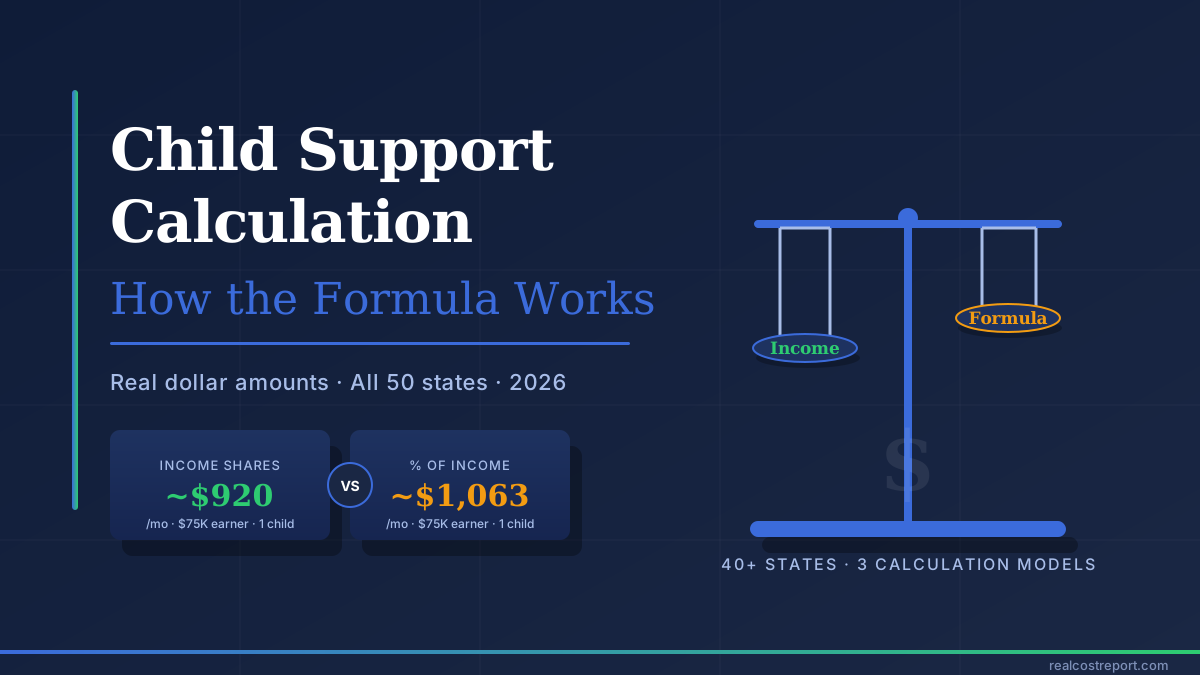
- Most states use either the Income Shares model or the Percentage of Income model — and the difference can swing your monthly obligation by $200–$600 on the same salary.
- A non-custodial parent earning $75,000 per year with one child can expect to pay roughly $750–$1,100/month depending on state, custody split, and allowable deductions.
- Income Shares states (used by 40+ states including California, Texas, and Florida) factor in both parents’ earnings; Percentage of Income states (including Wisconsin and Alaska) base the number on the paying parent’s income alone.
- Judges can deviate from guidelines by up to 20% based on documented special needs, extraordinary expenses, or shared custody arrangements — making legal representation at hearings financially consequential.
- Federal income tax does not offset child support payments — they are neither deductible for the payer nor taxable income for the recipient under current IRS rules as of 2026.
- If your income or custody arrangement changes by 15% or more, you typically qualify to petition for modification — failing to do so can cost thousands in arrears.
A single formula can mean the difference between a $650 and a $1,350 monthly payment — and most parents don’t know which model their state uses until they’re already in court. The Urban Institute estimated in a widely cited 2019 analysis that unpaid child support arrears exceeded $113 billion nationally, a figure driven in part by initial orders set at amounts families cannot sustain. Whether you are negotiating a parenting plan, reviewing an existing order, or preparing for a modification hearing, understanding the mechanics behind the number is not optional — it is financially critical.
This article breaks down the two dominant calculation models used across all 50 states, runs real-dollar scenarios for earners between $40,000 and $120,000, identifies the five variables that courts weight most heavily, and explains where LegalZoom’s self-help tools end and where a certified family law specialist — such as those credentialed by the American Academy of Matrimonial Lawyers — becomes necessary.
The Two Core Models: Income Shares vs. Percentage of Income
Every state uses one of two foundational frameworks, and the model your state applies determines not just your payment amount but what documentation you need to bring to court.
Income Shares is the dominant approach, adopted by more than 40 states. It starts from the premise that a child should receive the same total financial support they would have received if the household had remained intact. Both parents’ gross incomes are combined, then applied to a state-specific schedule that produces a “basic support obligation.” That total is then split proportionally. A parent earning $60,000 in a household with a combined income of $100,000 is responsible for 60% of the base obligation.
Percentage of Income ignores the custodial parent’s earnings entirely. The paying parent’s income is multiplied by a fixed statutory rate — typically 17% for one child in Wisconsin (verify at dhs.wisconsin.gov), rising incrementally for additional children. This model is simpler to calculate but produces structurally different outcomes at high and low income levels.
The Melson Formula, a hybrid used in Delaware, Hawaii, and Montana, layers a self-support reserve on top of both parents’ needs before calculating the child’s share — producing lower orders for very low-income parents but higher orders for middle earners compared to a straight Income Shares result.
Source: Office of Child Support Services, Administration for Children and Families, U.S. Department of Health and Human Services (verify at acf.hhs.gov); state model classifications verified against each state’s legislative code as of Q1 2026.
Real-Dollar Calculations: What You Actually Pay at $40K, $75K, and $120K
Abstract model descriptions are only useful when translated into payments. The scenarios below use California (Income Shares, DissoMaster-equivalent formula) and Wisconsin (flat Percentage of Income) to illustrate what the same earner owes under each system. California figures are modeled using the algebraic formula codified in California Family Code §4055; Wisconsin figures apply the statutory percentage table from Wisconsin Statute §767.511.
Assumptions: one child, no prior support orders, standard 20% parenting time for non-custodial parent, no daycare or extraordinary medical expenses, both parents employed.
Modeled figures. California estimates calculated using the algebraic formula in California Family Code §4055 (verify at leginfo.legislature.ca.gov); Wisconsin estimates apply Wisconsin Statute §767.511 percentage schedule (verify at docs.legis.wisconsin.gov). Custodial parent assumed to earn $42,000/year in CA scenarios. These are estimates only — certified software (DissoMaster, ChildCalc) and legal counsel produce binding figures.
The gap widens at higher incomes because California’s Income Shares formula credits both parents’ contributions and imposes a high-income cap on the basic schedule, while Wisconsin’s flat percentage has no such ceiling. A $120,000 earner in Wisconsin could owe $320 more per month — $3,840 per year — than an identical earner in California, purely because of model selection.
Two children changes the math again. California’s formula applies a multiplier of approximately 1.6x for the second child (not a simple doubling); Wisconsin’s statutory rate rises to 25% of gross income. At $75,000, a two-child obligation in Wisconsin reaches roughly $1,563/month gross — before any deductions for shared placement time.
The Five Variables Courts Weight Most — and How to Document Each
The formula gives you a baseline. These five variables determine whether the court adjusts that number up or down — sometimes dramatically.
1. Gross Income vs. Imputed Income
Courts use gross income, not take-home pay, as the starting point. If a parent is voluntarily unemployed or underemployed, judges in most states can impute income — assigning earning capacity based on prior employment history, education, or Bureau of Labor Statistics wage data for comparable occupations. A parent who left a $90,000 job and now earns $28,000 doing freelance work may find the court calculating support based on $90,000. Documenting a genuine career change requires employer letters, industry salary surveys, or vocational expert testimony.
2. Custodial Time / Parenting Time Percentage
This is the single largest adjustment lever in Income Shares states. Most states apply a parenting time credit that reduces the paying parent’s obligation proportionally once the threshold exceeds a minimum — often 20–25% overnight stays. In California, each additional percentage point of parenting time above 20% reduces the support obligation in a nonlinear curve. At 40% parenting time (nearly equal custody), California’s formula can reduce the base obligation by 35–45%, according to modeling published by the California Courts self-help center (verify at selfhelp.courts.ca.gov).
3. Child Care and Work-Related Expenses
Verifiable daycare, after-school care, and employment-related child care costs are added to the base obligation and split proportionally. A $1,200/month daycare bill shared 60/40 between parents adds $720 to the higher earner’s total obligation. These expenses must be documented with receipts or provider invoices.
4. Health Insurance Premiums
The parent carrying the child on their employer plan receives a credit equal to the child’s share of the premium. If the family plan costs $480/month and individual coverage would cost $310, the marginal cost attributable to the child is approximately $170. This credit reduces the net support obligation dollar-for-dollar in most jurisdictions.
5. Extraordinary Medical and Educational Expenses
Uninsured medical costs above a threshold (commonly $250 per incident), private school tuition if the child was already enrolled, and documented therapy or special education costs can be added to the base obligation by court order. These require a separate hearing and itemized documentation — verbal agreement between parties is not binding.
Income Shares vs. Percentage of Income: Which Model Costs You More?
The fairness of each model depends on which seat you occupy at the table.
For the paying parent with a higher income than the custodial parent: Income Shares typically produces a lower number because the custodial parent’s income offsets the combined obligation. At $90,000 non-custodial income and $35,000 custodial income, the combined obligation in an Income Shares state is calculated on $125,000 total, then the non-custodial share is 72% of that base — not 100% of the paying parent’s proportional income.
For the receiving parent with a lower income: Percentage of Income can produce a more predictable and sometimes higher number, since the custodial parent’s income is irrelevant and the formula is transparent. A $90,000 earner owes 17% regardless of what the custodial parent makes.
For equal earners in shared custody arrangements: Income Shares states often reduce or eliminate the obligation entirely when both parents earn similar amounts and time is roughly equal, since the formula offsets in both directions. Wisconsin’s flat rate would still produce a payment unless the parties negotiate otherwise.
Verdict
If you earn more than the custodial parent and have at least 25% parenting time, Income Shares states will almost always produce a lower monthly obligation. If you earn less than the custodial parent, the delta narrows and Percentage of Income may result in a more stable and predictable order. State of residence, however, is not a variable you control post-divorce unless relocation is on the table — making model selection a moot point for most families.
What Most People Get Wrong About Child Support Calculations
Mistake 1: Treating the Online Calculator as a Final Number
State-provided online calculators — including those on official court websites — are estimation tools. They do not account for judicial discretion, prior orders, or undisclosed income streams. Parents who walk into mediation with an online estimate as their anchor frequently accept or propose orders that deviate significantly from what certified legal software would produce. The consequence: a binding order that may be $150–$400/month off from the formula result, in either direction. The correct action is to run numbers through DissoMaster (California), SCDU (New York), or the equivalent certified platform before any negotiation.
Mistake 2: Assuming Net Income Is the Starting Point
Child support is calculated on gross income in the vast majority of states — not take-home pay after taxes, retirement contributions, or health insurance deductions. A parent earning $85,000 gross who takes home $58,000 after 401(k) contributions and benefits cannot argue that $58,000 is their income for support purposes. Voluntary retirement deferrals are typically excluded from income adjustments. Only mandatory deductions (union dues, required pension contributions) are deductible in most jurisdictions.
Mistake 3: Failing to Document Cash or Side Income
Courts can and do subpoena bank records, tax returns (Schedule C, K-1), and payment platform histories (Venmo, PayPal, Zelle). A self-employed parent who reports $45,000 in W-2 equivalent income but whose bank deposits reflect $78,000 in inflows faces imputed income — and potentially a contempt finding. The correct action is proactive disclosure with a CPA-prepared income analysis that separates business expenses from personal draws.
Mistake 4: Letting an Informal Agreement Stand
Paying more than the court order as a goodwill gesture, then reducing to the ordered amount, can result in an arrears claim. In most states, only payments made under a court order are credited against the obligation; voluntary overpayments do not create a credit for future underpayments. Any agreed modification must be submitted to and approved by the court to be enforceable.
Mistake 5: Ignoring Cost-of-Living and COLA Provisions
Some states — including Colorado and Massachusetts — automatically include cost-of-living adjustment (COLA) provisions tied to the Consumer Price Index in their standard orders. A parent who signed an order in 2019 without a COLA clause may have a lower real-dollar obligation today than a parent who signed in 2022 with one. Reviewing your order’s language before a modification hearing is essential; a COLA clause can add $40–$120 per year to an existing order without any court action.
Is Hiring a Family Law Attorney Worth the Cost?
LegalZoom’s child support services start at approximately $299 for document preparation (verify at legalzoom.com). A certified family law specialist — credentialed by the American Academy of Matrimonial Lawyers (verify at aaml.org) or a state bar family law section — typically charges $250–$500/hour, with contested hearings running $3,000–$15,000 in total fees depending on jurisdiction and complexity.
The break-even calculation is straightforward: if an attorney can reduce a monthly obligation by $200 through proper documentation of parenting time, income deductions, or extraordinary expenses, and their fee is $4,000, you break even in 20 months — with continued savings afterward for the duration of the order, which routinely runs 10–18 years until the child reaches majority.
Self-help is sufficient when: Both parties agree on custody, neither party has complex income (rental, business, investment), the state’s online worksheet produces a number both parties accept, and no extraordinary expenses are in dispute. States like Texas and Illinois offer well-documented self-help centers through their court systems.
An attorney is financially necessary when: Either party is self-employed or earns variable income; parenting time is contested; one party suspects the other of hiding income; the order involves interstate jurisdiction under the Uniform Interstate Family Support Act (UIFSA); or the order is being modified after a material change in income of 15% or more.
The American Bar Association’s Standing Committee on Legal Aid (verify at americanbar.org) maintains a directory of reduced-fee family law services for parents whose income falls below 200% of the federal poverty line — a resource that can cut legal costs by 60–80% for qualifying families.
How We Researched This Article
This article was researched and modeled in May 2026. All statutory formulas and percentage rates were verified directly against current state legislative codes and administrative guidance. No third-party summaries or legal information aggregator sites were used as primary sources.
The dollar figures in the scenario table were calculated using the algebraic child support formula codified in California Family Code §4055 (leginfo.legislature.ca.gov) and the percentage schedule in Wisconsin Statute §767.511 (docs.legis.wisconsin.gov). These are modeled outputs, not outputs from certified support-calculation software such as DissoMaster or ChildCalc; actual court-ordered amounts will differ based on inputs not captured in simplified scenarios.
State model classifications (Income Shares, Percentage of Income, Melson Formula) were verified against the Administration for Children and Families, Office of Child Support Services (acf.hhs.gov). The $113 billion arrears figure was sourced from the Urban Institute’s 2019 report “Reforming Child Support to Improve Outcomes for Children and Families” — readers should verify whether a more current estimate has been published at urban.org.
IRS treatment of child support payments (non-deductible / non-taxable) was confirmed against IRS Tax Topic 452 (irs.gov). UIFSA jurisdictional rules were reviewed against the Uniform Law Commission’s official text (verify at uniformlaws.org). The American Academy of Matrimonial Lawyers credentialing information was verified at aaml.org.
Limitations: Parenting time credit curves are state-specific and highly nonlinear; the California estimate assumes standard guideline conditions and a single custodial income figure. Judicial deviation practices were not quantified, as no reliable national dataset of deviation frequency by state exists in the public record as of this writing. Readers in states not modeled here should consult their state’s official child support guidelines worksheet.
All figures were verified against named primary sources before publication.