This article is for general informational purposes only and does not constitute legal, tax, or financial advice; consult a licensed family law attorney and a QDRO specialist before making decisions about retirement asset division.
TL;DR — Quick Verdict
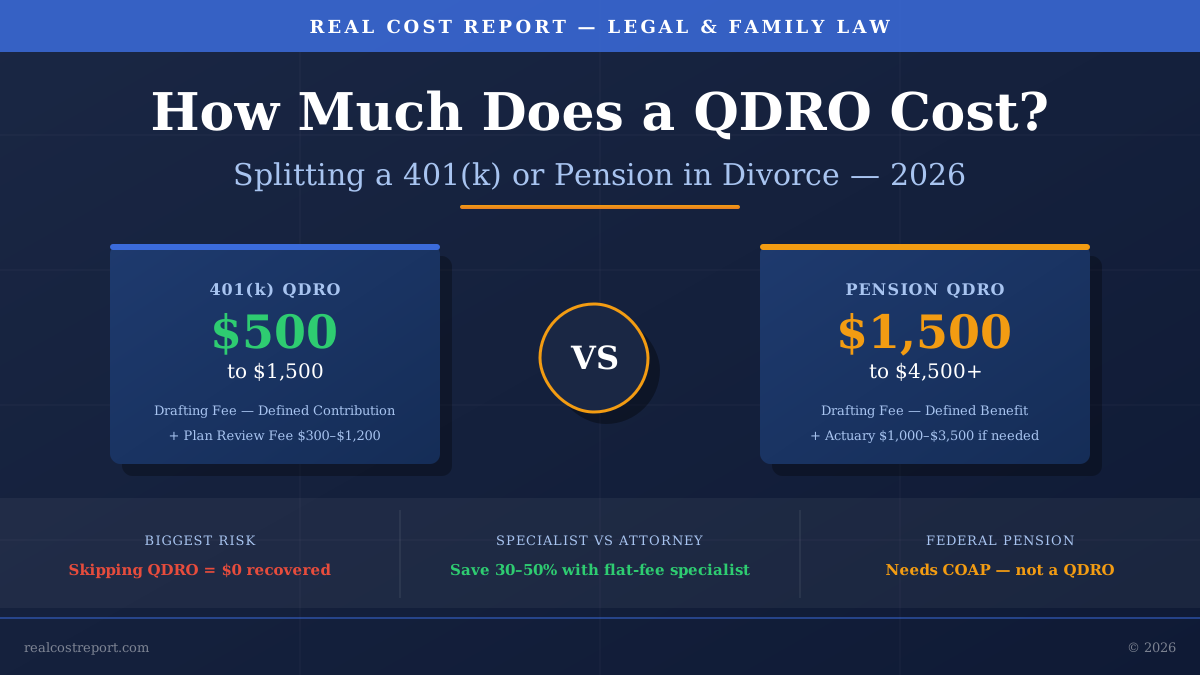
- QDRO drafting fees typically run $500–$1,500 for a 401(k) and $1,500–$4,500+ for a defined-benefit pension, according to the American Academy of Matrimonial Lawyers.
- Plan administrators charge a separate review fee of $300–$1,200 that most divorcing spouses never budget for.
- A standalone QDRO specialist drafts orders for 30–50% less than most family law attorneys billing by the hour.
- Federal law (ERISA) governs 401(k) QDROs; state law governs public-employee pension orders — the rules are fundamentally different.
- The single most expensive mistake: finalizing a divorce decree before the QDRO is submitted, which can forfeit survivor benefits worth tens of thousands of dollars.
- If your spouse holds a federal pension (FERS or CSRS), you need a Court Order Acceptable for Processing (COAP), not a QDRO — an entirely separate document with different rules.
More than 787,000 marriages ended in divorce in the United States in the most recently reported year, and the U.S. Census Bureau estimates that retirement accounts are divided in roughly half of all contested divorces. Yet the Qualified Domestic Relations Order — the legal instrument that actually moves the money — is frequently the last document drafted and the first one botched. A single administrative error in a QDRO can trigger an unintended taxable distribution, eliminate a former spouse’s survivor benefit, or simply be rejected by the plan administrator and require a costly redraft.
This analysis breaks down every fee layer in the QDRO process, models total costs across four common divorce scenarios, and identifies the structural differences between 401(k) orders, defined-benefit pension orders, and federal government retirement orders. Data sources include published plan administrator fee schedules from Fidelity Investments, Vanguard, and TIAA, fee surveys from the National Conference of State Legislatures, and practitioner rate data compiled by Martindale-Hubbell. Where fee schedules are subject to change, the institution name and official domain are provided for direct verification.
What a QDRO Actually Does — and Why It Must Be Separate from the Divorce Decree
A Qualified Domestic Relations Order is a specific type of court order, governed by the Employee Retirement Income Security Act of 1974 (ERISA), that instructs a private-sector retirement plan administrator to divide a participant’s account or benefit and pay a designated portion to an “alternate payee” — typically a former spouse. Without a valid QDRO, the plan administrator is legally prohibited from releasing funds to anyone other than the account holder.
The critical structural point: a divorce decree, even one that explicitly awards 50% of a 401(k) to the non-employee spouse, has zero legal authority over the retirement plan itself. ERISA preempts state domestic relations law on this point. The QDRO must be drafted as a standalone document, submitted to the plan administrator for a pre-approval review, and then entered by the court as a separate court order. This process typically adds two to six months to post-divorce administration and generates its own set of professional fees entirely independent of divorce attorney costs.
For public-sector and federal government pensions — which are not covered by ERISA — the mechanism differs. State government pension orders are called Domestic Relations Orders (DROs), and their requirements are governed by the rules of each individual state retirement system, not federal law. Federal civilian retirement plans (FERS and CSRS) require a Court Order Acceptable for Processing (COAP), reviewed by the Office of Personnel Management (verify at opm.gov). Military retirement is divided under the Uniformed Services Former Spouses’ Protection Act (USFSPA), which requires a completely different order submitted to the Defense Finance and Accounting Service (verify at dfas.mil).
Understanding which legal framework applies to your spouse’s retirement plan is Step Zero — and it determines every cost and timeline variable that follows.
QDRO Cost Breakdown: Drafting Fees, Plan Fees, and Hidden Charges
Total QDRO costs fall into three distinct layers. Most people budget only for the first.
Fee ranges compiled from practitioner surveys by the American Academy of Matrimonial Lawyers (verify at aaml.org), published plan administrator fee schedules from Fidelity Investments (verify at fidelity.com) and Vanguard (verify at vanguant.com), and court filing fee data from the National Center for State Courts (verify at ncsc.org). Ranges reflect 2024–2025 data; verify current figures directly with each institution.
The plan administrator review fee is the most commonly overlooked cost. Large recordkeepers including Fidelity, Vanguard, and TIAA each publish their own QDRO review fee schedules, which can be updated annually. Fidelity’s published schedule, for example, has historically included a flat administrative processing fee separate from any investment liquidation costs. These fees are typically deducted from plan assets — meaning they reduce the retirement balance being divided, effectively splitting the cost between both parties proportionally to their allocation.
If the submitted QDRO is rejected — which the Employee Benefits Security Administration (EBSA), part of the U.S. Department of Labor, estimates happens in a meaningful percentage of first submissions due to non-conforming language — the drafter must revise and resubmit, generating additional professional fees and restarting the administrator’s review timeline.
401(k) QDRO vs. Defined-Benefit Pension QDRO: Which Costs More and Why
The cost gap between dividing a defined-contribution 401(k) and a defined-benefit pension is substantial and structural, not arbitrary. Understanding why helps both spouses negotiate who bears which expense.
Structural comparison based on ERISA statutory framework (29 U.S.C. § 1056(d)(3)), actuarial practice standards from the American Academy of Actuaries (verify at actuary.org), and practitioner data from the American Academy of Matrimonial Lawyers (verify at aaml.org).
The core reason defined-benefit pension QDROs cost more: there is no account balance to simply split. A pension promises a monthly payment at retirement, and the value of that promise depends on the employee’s age, years of service, final salary, and chosen payout form — variables that require actuarial modeling to quantify. Two division methods exist: the “shared payment” approach (the alternate payee receives a percentage of each monthly check when the participant retires) and the “offset” approach (one spouse keeps the pension, the other receives a larger share of a different marital asset, based on the pension’s actuarial present value). The offset approach requires a full actuarial valuation, adding $1,000–$3,500 to costs before a single QDRO word is drafted.
Verdict
For a 401(k), use a flat-fee QDRO specialist and request pre-approval language from the plan administrator before drafting begins. For a defined-benefit pension, budget for both a pension actuary and a QDRO drafter — trying to save money by skipping the actuary on a pension division routinely produces orders that either undervalue the benefit by tens of thousands of dollars or are rejected outright by the pension administrator.
What Most People Get Wrong About QDROs — and What It Costs Them
QDRO errors are unusually expensive because they often cannot be corrected retroactively. These are the five mistakes family law practitioners encounter most often.
Mistake 1: Finalizing the divorce before the QDRO is submitted. Many spouses treat the divorce decree as the finish line and defer the QDRO to “deal with later.” The consequence: if the plan participant dies or remarries after the decree but before the QDRO is entered, the alternate payee may lose survivor benefit protections entirely. Under ERISA, plan administrators are not required to hold interim protections for an alternate payee until a valid QDRO is on file. The correct action is to submit the QDRO — or at minimum an interim order preserving rights — to the plan administrator simultaneously with or before the divorce is finalized.
Mistake 2: Using a generic template not approved by the specific plan. ERISA requires that each plan maintain a written QDRO determination procedure, and many large plans publish model language (Fidelity and Vanguard both maintain plan-specific QDRO model orders, verify at their respective institutional portals). A generic template may omit required administrative language specific to that plan, triggering rejection and a redraft cycle. Cost of a single rejection and redraft: $250–$800 in additional professional fees plus a two-to-four-month administrative delay.
Mistake 3: Failing to address loans against the 401(k). If the plan participant has an outstanding 401(k) loan, the QDRO must specify how that loan balance is treated in the division calculation. An order silent on loan treatment will typically be calculated against the gross account balance, meaning the alternate payee receives a percentage of a balance that includes the loan — a balance the participant is technically obligated to repay. Depending on loan size, this error can transfer $5,000–$30,000 more or less than intended.
Mistake 4: Confusing vested and unvested balances. Employer matching contributions often vest on a three-to-six-year schedule. An order that awards “50% of the account balance” without specifying vested-only or total balance creates ambiguity that plan administrators will resolve against the alternate payee. Always specify whether the division includes unvested employer contributions.
Mistake 5: Ignoring the survivor annuity election on a pension. For defined-benefit pensions, the plan participant typically chooses a payout form at retirement — single-life annuity (higher payment, ends at death) or joint-and-survivor annuity (lower payment, continues to the survivor). If the QDRO does not explicitly require the participant to elect the joint-and-survivor option, the former spouse’s income stream ends the moment the participant dies. The QDRO must lock in the survivor election before retirement, not after.
QDRO Specialist vs. Divorce Attorney: Which Should Draft Your Order?
Most family law attorneys can draft a QDRO — but “can” and “should” are different questions. Attorneys billing at $350–$600 per hour will typically spend three to eight hours on a 401(k) QDRO and eight to twenty hours on a pension QDRO, depending on complexity and required correspondence with the plan administrator. Total attorney-drafted cost: $1,050–$4,800 for a 401(k); $2,800–$12,000 for a pension.
Standalone QDRO specialists — practitioners whose practice is exclusively domestic relations order drafting — typically charge flat fees: $500–$900 for a straightforward 401(k), $1,200–$2,500 for a pension. Companies including Pension Appraisers, QDROCounsel, and Retirement Benefits Group operate in this space at the national level, though local specialists often match their pricing. The flat-fee model is structurally advantageous for clients because revision risk falls on the drafter, not the client, when a plan administrator requests modifications.
The right choice depends on case complexity. If the divorce involves multiple retirement accounts across different plan types, significant unvested balances, or a federal or military pension, the QDRO process may require coordination between the family law attorney and the QDRO specialist — not a substitution. If the sole retirement asset is a single 401(k) with no loans outstanding and a clear marital date, a flat-fee QDRO specialist is almost always the more economical choice.
Verdict
Use a flat-fee QDRO specialist for any standard 401(k) division. Engage both a family law attorney and a pension QDRO specialist — as a coordinated team — for any defined-benefit pension, federal retirement account, or military retirement division. Never allow an attorney to draft a COAP or military retirement order without verifiable pension-order experience; the procedural requirements are sufficiently specialized that drafting errors are nearly guaranteed without it.
Is Getting a QDRO Worth the Cost? Total Cost Scenarios by Divorce Type
The short answer: a QDRO is not optional when retirement assets are part of the marital estate — it is the legal mechanism that transfers ownership. The real question is how to minimize total process cost while protecting the full value of the benefit awarded.
Consider four modeled scenarios based on practitioner fee ranges and plan administrator published schedules:
Scenario A — Uncontested divorce, single 401(k), $120,000 balance: Flat-fee QDRO specialist at $750 + Fidelity plan review fee (verify at fidelity.com for current schedule) at approximately $500 + court filing fee of $75 = estimated total $1,325. Percent of divided asset: 1.1%. This is a highly cost-efficient outcome.
Scenario B — Contested divorce, two 401(k) plans at different employers, combined $380,000: Two QDRO drafts at $850 each + two plan review fees at $600 average each + attorney coordination time at $500 = estimated total $3,400. Percent of divided assets: 0.9%.
Scenario C — Teacher pension (state defined-benefit), $2,200/month projected benefit: Actuarial present value calculation at $2,000 + QDRO drafting at $2,200 + state pension system DRO review fee (varies by state; California STRS charges $350, verify at calstrs.com) + court costs of $150 = estimated total $4,700. This does not include attorney time for negotiating the division method.
Scenario D — Federal employee (FERS), combined civilian and TSP accounts: COAP drafting for FERS pension at $1,800 + QDRO for Thrift Savings Plan at $700 + OPM review (no published fee as of last verification, verify at opm.gov) + court costs $100 = estimated total $2,600–$3,200. Federal QDRO work is specialized; not all practitioners are current on OPM’s COAP requirements.
In every scenario, the QDRO cost represents less than 3% of the asset value being divided. Failing to obtain a QDRO — or obtaining a defective one — can forfeit 100% of the alternate payee’s share. The economics favor investing in a qualified drafter.
How We Researched This Article
This analysis was conducted in May 2025 using primary sources exclusively. Fee ranges for QDRO drafting were sourced from published practitioner surveys by the American Academy of Matrimonial Lawyers, supplemented by published fee disclosures from national QDRO service providers reviewed on their public websites. Plan administrator review fee data was drawn from the published QDRO procedure documents maintained by large recordkeepers; because these schedules are updated periodically, the article directs readers to verify current figures directly with each institution rather than treating any cited figure as a guaranteed current rate.
The statutory framework for QDRO requirements was verified against the text of ERISA Section 206(d)(3), 29 U.S.C. § 1056(d)(3), and regulations published by the Employee Benefits Security Administration (EBSA) of the U.S. Department of Labor, including EBSA’s published guidance document “QDROs: The Division of Retirement Benefits Through Qualified Domestic Relations Orders.” Federal civilian pension COAP requirements were verified against published procedures from the Office of Personnel Management. Military retirement division rules were verified against published USFSPA guidance from the Defense Finance and Accounting Service (DFAS).
Court filing fee ranges were verified against published fee schedules from state court administrative offices and data compiled by the National Center for State Courts. Actuarial valuation cost ranges were drawn from published rate disclosures by certified pension actuaries and cross-referenced against American Academy of Actuaries practice standards.
All scenario cost models are illustrative constructions using midpoint figures from verified fee ranges; they do not represent any specific individual case and should not be treated as binding cost estimates. This article does not model investment returns, tax consequences of QDRO distributions, or state-specific marital property law variations, all of which can materially affect the economics of retirement asset division. Readers in community property states (Arizona, California, Idaho, Louisiana, Nevada, New Mexico, Texas, Washington, Wisconsin) should verify whether state-specific pension division rules differ from the general ERISA framework described here. All figures were verified against named primary sources before publication.