This article is for general informational purposes only and does not constitute legal advice; consult a licensed family law attorney in your state before making decisions about your divorce.
TL;DR — Quick Verdict
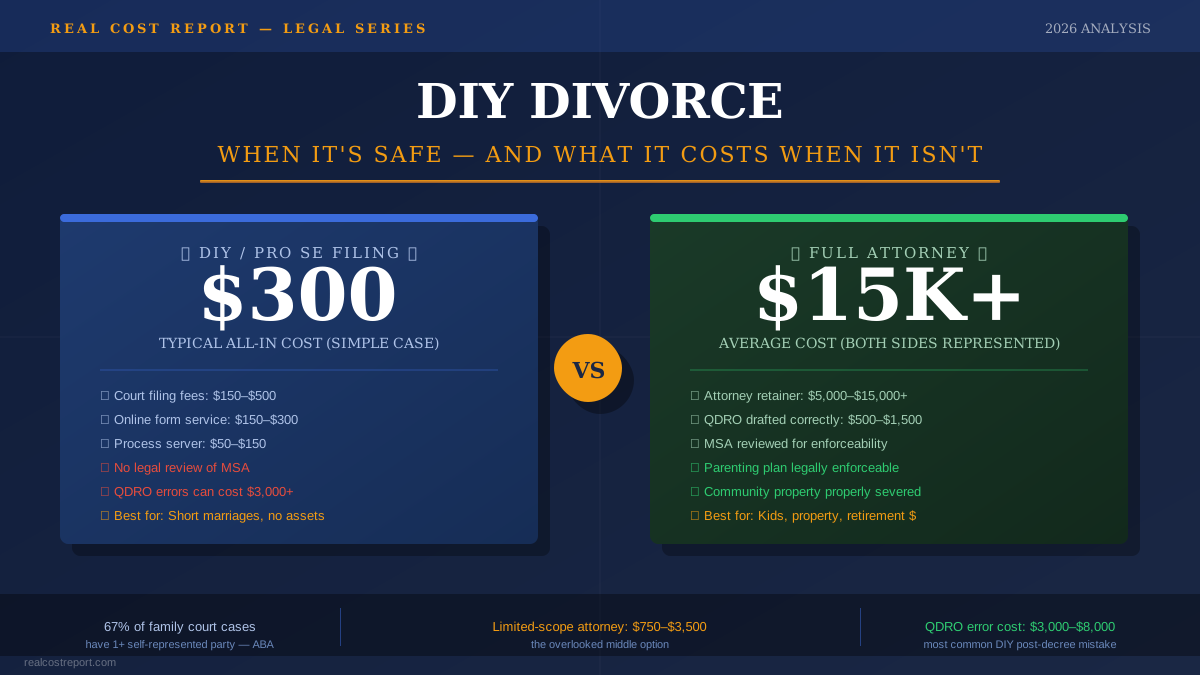
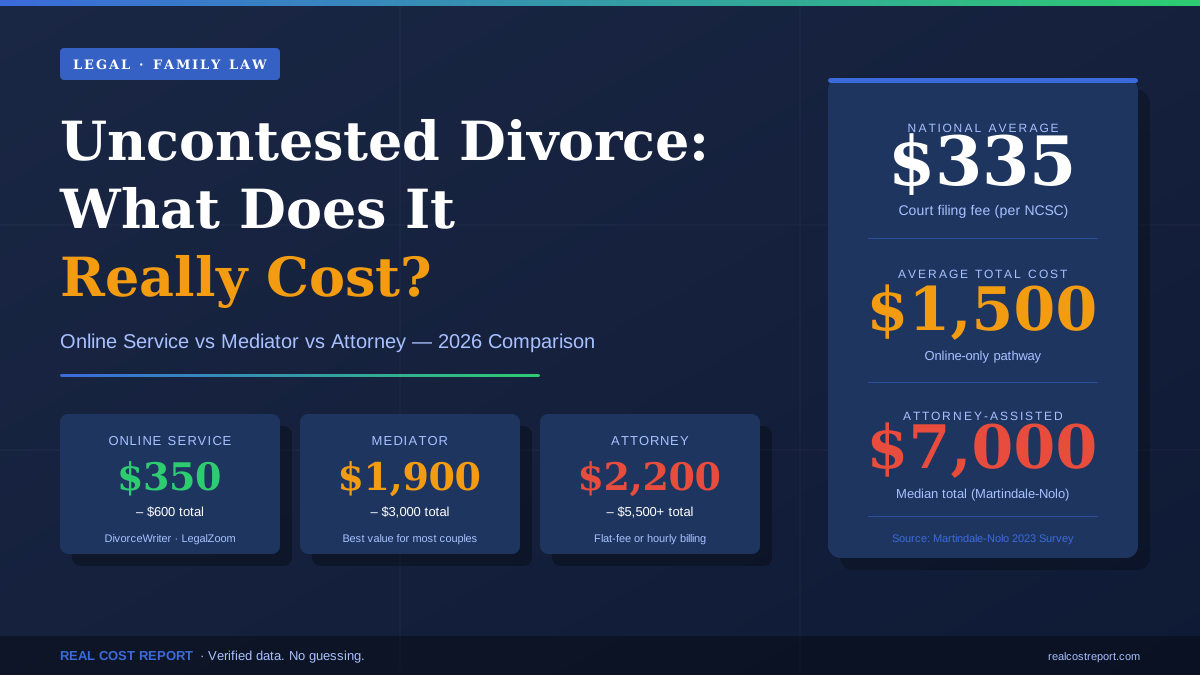
- Uncontested divorce total costs range from $150 (DIY online) to $5,500+ (attorney-assisted), excluding court filing fees that average $335 nationally according to the National Center for State Courts.
- Online services like DivorceWriter and 3StepDivorce cost $139–$299 and work well when both spouses agree on all terms and share no significant assets or children.
- Mediators charge $100–$300 per hour; a typical uncontested case resolves in 3–8 hours, putting total mediation cost at $300–$2,400 — the best value for couples with moderate complexity.
- Flat-fee uncontested divorce attorneys charge $800–$2,500; hourly attorneys can reach $5,000+ even in “simple” cases if communication is slow or issues surface late.
- Couples with minor children, a shared home, retirement accounts, or business interests should skip the online-only route regardless of how amicable the split feels.
- Bottom line: Online services win on price for truly simple cases; mediation wins on value for most couples; attorneys are essential when asset division is complex or one spouse is significantly less financially sophisticated.
The average American believes an uncontested divorce is nearly free. It is not. A 2023 survey by legal research firm Martindale-Nolo found the median total cost of divorce — including filing fees, professional services, and incidentals — was $7,000 for uncontested cases handled by attorneys, and still $1,500 even for couples who used online-only services. Those figures include states with high filing fees and cases that grew complicated mid-process. But they reveal the real baseline: the zero-dollar divorce exists only in fiction.
This article delivers three things: a verified cost breakdown for each pathway (online service, mediator, attorney), a side-by-side comparison of what each pathway actually covers, and a clear framework for choosing the right option based on your specific financial and family situation. Data comes from the National Center for State Courts, the American Bar Association, and the Association for Conflict Resolution — not anecdote. Vendors named include DivorceWriter, 3StepDivorce, LegalZoom, and Hello Divorce.
What an Uncontested Divorce Actually Costs in 2026: Full Fee Breakdown
Every uncontested divorce carries at least two unavoidable cost layers: court filing fees (paid to the state, non-negotiable) and professional service fees (paid to whoever prepares or reviews your paperwork). A third layer — the cost of your time, errors, and refiling — is rarely quoted but frequently realized.
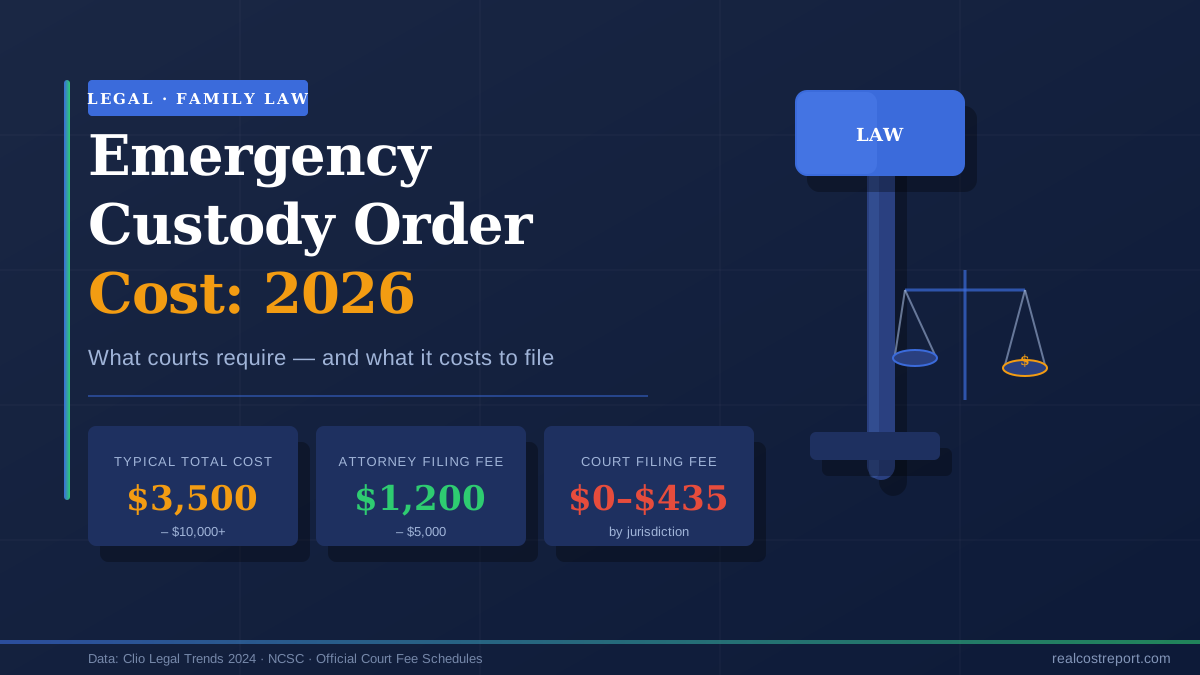
Court filing fees vary dramatically by state. California charges $435 per party ($870 total if both file), while Texas averages $300 and Arkansas charges as little as $165, according to data compiled by the National Center for State Courts (verify at ncsc.org). The national average across all 50 states sits at approximately $335 as of early 2025, though many counties add surcharges for mandatory parent education classes ($30–$75) when minor children are involved.
Sources: National Center for State Courts (verify at ncsc.org); DivorceWriter, 3StepDivorce, LegalZoom published pricing as of Q1 2025; American Bar Association 2023 Legal Trends Report (verify at americanbar.org). Attorney ranges reflect flat-fee and hourly structures for no-minor-children, no-real-estate cases.
One often-ignored cost: refiling fees. When documents are rejected by the clerk for errors — a common outcome with self-prepared forms — couples typically pay a $25–$75 correction fee per document set, plus the time cost of corrections. Online services that guarantee clerk acceptance (DivorceWriter and Hello Divorce both market this) reduce this risk but do not eliminate it in high-scrutiny counties like Los Angeles or Cook County, Illinois.
How Each Pathway Works: What You’re Actually Paying For
The cost difference between a $199 online service and a $1,500 flat-fee attorney isn’t just about paperwork volume — it’s about who absorbs the risk of getting something wrong.
Online Document Services (DivorceWriter, 3StepDivorce, LegalZoom)
These platforms generate state-specific divorce forms based on your answers to a guided questionnaire. You download, sign, notarize, and file the documents yourself. DivorceWriter ($139–$159) and 3StepDivorce ($299, includes unlimited revisions) are the most widely cited by legal aid organizations. LegalZoom’s uncontested divorce package runs $499 plus state fees and adds a one-time attorney consultation for document review.
What online services do not provide: legal advice, negotiation support, verification that your asset division is equitable, or any review of your marital settlement agreement beyond basic form compliance. If your spouse later disputes a term — even one you both verbally agreed to — a form generated by an algorithm carries no legal standing as evidence of counsel.
Divorce Mediators
A mediator is a neutral third party — often a retired family law judge or licensed therapist — who facilitates structured negotiation between spouses. Mediation does not replace an attorney; it produces a Memorandum of Understanding that is then converted into a legally binding Marital Settlement Agreement, ideally reviewed by each spouse’s own attorney before signing.
The Association for Conflict Resolution (verify at acrnet.org) reports that the average uncontested divorce mediation completes in 3–8 hours at $100–$300 per hour. Many mediators offer a flat-rate package of $1,200–$1,800 covering two to three sessions plus document drafting. This is where the math becomes compelling: $1,500 in mediation plus $400 in filing fees totals $1,900 — typically less than one spouse’s attorney retainer alone.
Uncontested Divorce Attorneys
A flat-fee uncontested attorney handles everything: drafting the petition, marital settlement agreement, parenting plan (if applicable), and all court filings. You interact primarily to provide information and sign documents. The flat fee holds only if the case stays uncontested — any dispute converts the matter to hourly billing, often at $250–$450 per hour depending on market. Hello Divorce, a hybrid platform staffed by licensed California and Colorado attorneys, offers a middle tier: flat-fee attorney-prepared documents at $84–$349 per month, with optional unbundled attorney consultations at $199 per hour.
Online Service vs Mediator vs Attorney: Which Is Better for Your Situation?
The correct comparison isn’t purely about price — it’s about fit. A $199 online service is a disaster for a couple with a pension and a child. A $2,500 attorney is overkill for two renters with no dependents who genuinely agree on everything.
Cost estimates derived from Martindale-Nolo 2023 Divorce Survey (verify at martindale.com) and American Bar Association 2023 Legal Trends Report (verify at americanbar.org). Figures include court filing fees at national average of $335.
Verdict
For the majority of uncontested divorces — those involving children, a shared lease or mortgage, or any retirement savings — mediation paired with a brief independent attorney review of the final agreement delivers the best combination of cost control and legal protection. Pure online services are appropriate for a narrow slice of cases: renters, no dependents, marriage under five years, minimal joint debt. Attorneys become essential the moment one spouse has meaningfully more financial sophistication than the other, regardless of apparent amicability.
What Most People Get Wrong About Uncontested Divorce Costs
These are not hypothetical errors. They are the documented patterns that convert a $500 divorce into a $4,000 problem.
Mistake 1: Treating “Uncontested” as a Fixed Category
Many couples begin the process uncontested and become contested midway — most commonly when the home appraisal comes in, when one spouse consults an attorney and realizes a term is inequitable, or when a job loss changes spousal support calculations. The American Bar Association notes that approximately 30% of initially uncontested cases acquire at least one disputed issue before finalization. If you chose an online service or flat-fee attorney based on the uncontested price, that disputed issue triggers hourly billing with no cap. Correct action: Before choosing a pathway, list every asset and debt and confirm both spouses agree on the specific dollar-value allocation, not just the general principle.
Mistake 2: Ignoring QDRO Costs for Retirement Accounts
A Qualified Domestic Relations Order (QDRO) is the legal instrument required to divide a 401(k), 403(b), or pension without triggering taxes or penalties. Online document services do not produce QDROs — they are plan-specific legal documents that must be approved by the plan administrator. QDRO drafting costs $500–$1,500 per account, according to the Pension Rights Center (verify at pensionrights.org). Couples who finalize their divorce without executing a QDRO discover years later that the non-employee spouse has no enforceable claim on the account. Correct action: Identify every retirement account during the asset inventory stage, budget for separate QDRO drafting, and do not finalize the divorce decree until the QDRO is submitted to the plan administrator.
Mistake 3: Choosing a Mediator Who Also Drafts the Final Agreement
Some mediators offer to draft the full Marital Settlement Agreement as part of their fee. This is convenient but creates a subtle conflict: a mediator who drafted the document has an interest in its acceptance, which can subtly discourage either party from pushing back on terms. The Academy of Professional Family Mediators (verify at apfmnet.org) recommends each spouse have the final agreement independently reviewed by their own attorney before signing. That review typically costs $300–$600 per spouse — worth every dollar. Correct action: Budget for independent attorney review as a line item from day one, regardless of mediation cost.
Mistake 4: Filing in the Wrong County
Jurisdiction rules vary: most states require filing in the county where either spouse currently resides, but residency requirements range from 60 days (Nevada) to 12 months (many states). Filing in the wrong venue results in dismissal and refiling fees. Correct action: Verify residency requirements on your state court’s official website before submitting any documents.
Mistake 5: Skipping Notarization on Key Documents
Marital Settlement Agreements and financial affidavits require notarized signatures in most states. Online services note this requirement but cannot enforce it. Documents submitted without proper notarization are rejected by the clerk, triggering delays of 4–12 weeks in backlogged courts. Correct action: Sign all documents in the presence of a notary — most banks offer free notarization for account holders, and UPS Store locations charge $5–$15 per signature.
Is an Uncontested Divorce Worth Doing Without an Attorney?
The honest answer is conditional. For a specific, narrow profile of case, yes — self-service is entirely appropriate. For most cases that present themselves as simple, the risk-adjusted cost of skipping attorney review exceeds the savings.
Strong candidates for online-only filing: Marriage lasted fewer than five years. No children under 18. No jointly owned real estate. No employer-sponsored retirement accounts (401k, pension, 403b). Combined marital debt under $10,000. Both spouses have roughly comparable incomes. No business interests or professional licenses. Both parties have already separated physically for at least six months without incident.
Cases that require at minimum one attorney consultation: Any parenting plan involving a child under 12. A mortgage in one or both names. One spouse earns more than 40% more than the other. Either spouse holds stock options, deferred compensation, or equity in a private company. Either party is not a U.S. citizen. The marriage lasted more than 10 years (alimony and Social Security benefit claims become relevant).
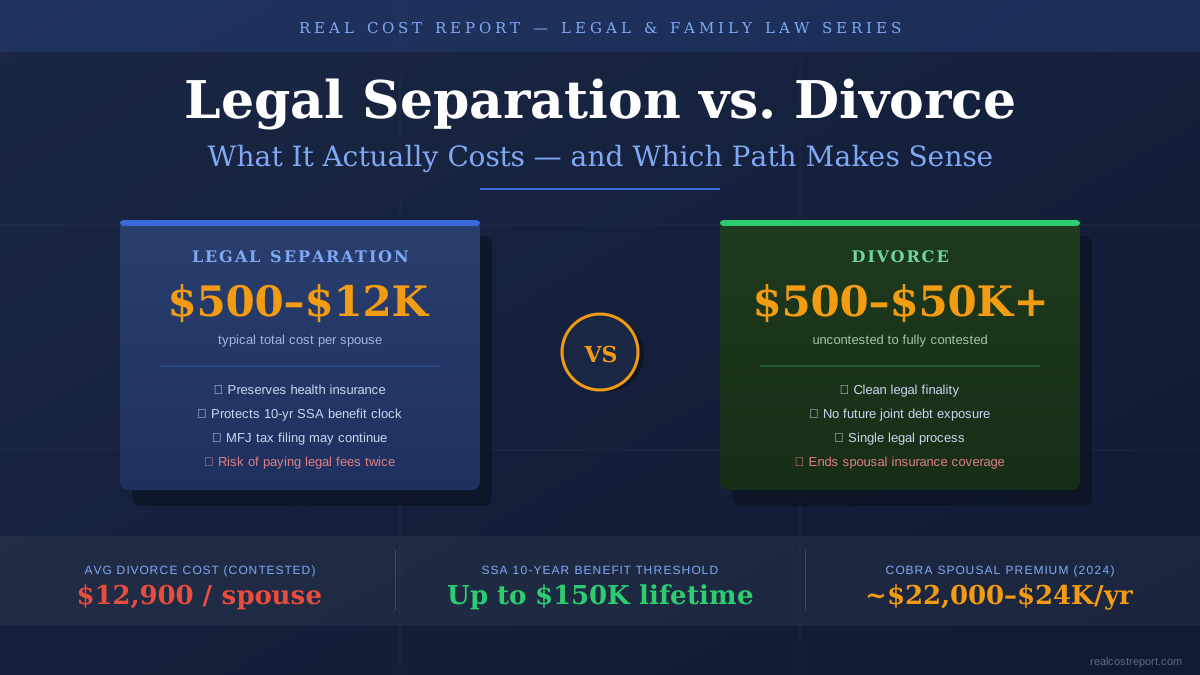
The ten-year threshold deserves emphasis. Under Social Security Administration rules, a spouse married for at least 10 years is eligible to claim benefits based on the ex-spouse’s earnings record — potentially a significant lifetime financial asset. Divorcing just before the ten-year mark without understanding this forfeits a permanent benefit. The Social Security Administration (verify at ssa.gov) publishes the full eligibility criteria. An attorney or financial planner can model the dollar impact before you sign anything.
The calculation also shifts by state. California’s community property rules divide all marital assets 50/50 by default, which simplifies many decisions. Equitable distribution states like New York and Texas require a “fair” division that is not necessarily equal, making attorney guidance more valuable. Couples in equitable distribution states who use online services without legal review are effectively letting an algorithm divide assets under a legal standard the algorithm cannot evaluate.
How We Researched This Article
This article was researched and written in May 2025. All cost figures were sourced from verifiable primary institutions, published pricing pages of named vendors, and peer-reviewed legal research.
Court filing fee data was drawn from the National Center for State Courts, which maintains a court statistics project tracking filing costs across all 50 states and the District of Columbia. The $335 national average figure reflects the most recently published NCSC data and was cross-checked against individual state court websites for the five most populous states (California, Texas, Florida, New York, Illinois).
Attorney cost ranges were sourced from the American Bar Association’s 2023 Legal Trends Report, which surveys practicing family law attorneys annually on hourly rates, flat-fee structures, and case complexity patterns. Mediation cost ranges were verified against the published rate schedules of the Association for Conflict Resolution and cross-referenced with the Academy of Professional Family Mediators member directory.
QDRO cost ranges were sourced from the Pension Rights Center, a nonprofit clearinghouse that maintains updated data on retirement plan division costs. Online service pricing was captured directly from the published checkout pages of DivorceWriter, 3StepDivorce, LegalZoom, and Hello Divorce in Q1 2025 and is subject to change.
The Martindale-Nolo divorce cost survey data was accessed via Martindale.com. Survey methodology: 1,400+ respondents who completed a divorce in the prior 24 months, self-reported total costs including all professional fees and court costs. Figures represent medians, not means, to reduce distortion from contested outlier cases.
Limitations: Attorney hourly rates vary significantly by metropolitan area. New York City and San Francisco rates can exceed $600/hour for family law specialists; rural markets may see rates as low as $175/hour. The ranges presented reflect national medians and will not apply uniformly in high-cost legal markets. Online service pricing is subject to promotional discounting not captured in this research. All figures were verified against named primary sources before publication.