This is not legal advice. Consult a licensed attorney in your state.
TL;DR — Quick Verdict
- Losing a personal injury trial means zero compensation — but your out-of-pocket litigation costs can still reach $5,000 to $30,000 or more, even under a contingency fee arrangement.
- Most personal injury attorneys charge no attorney fee if you lose, but hard costs — court filing fees, expert witness fees, and deposition transcripts — are often still your responsibility.
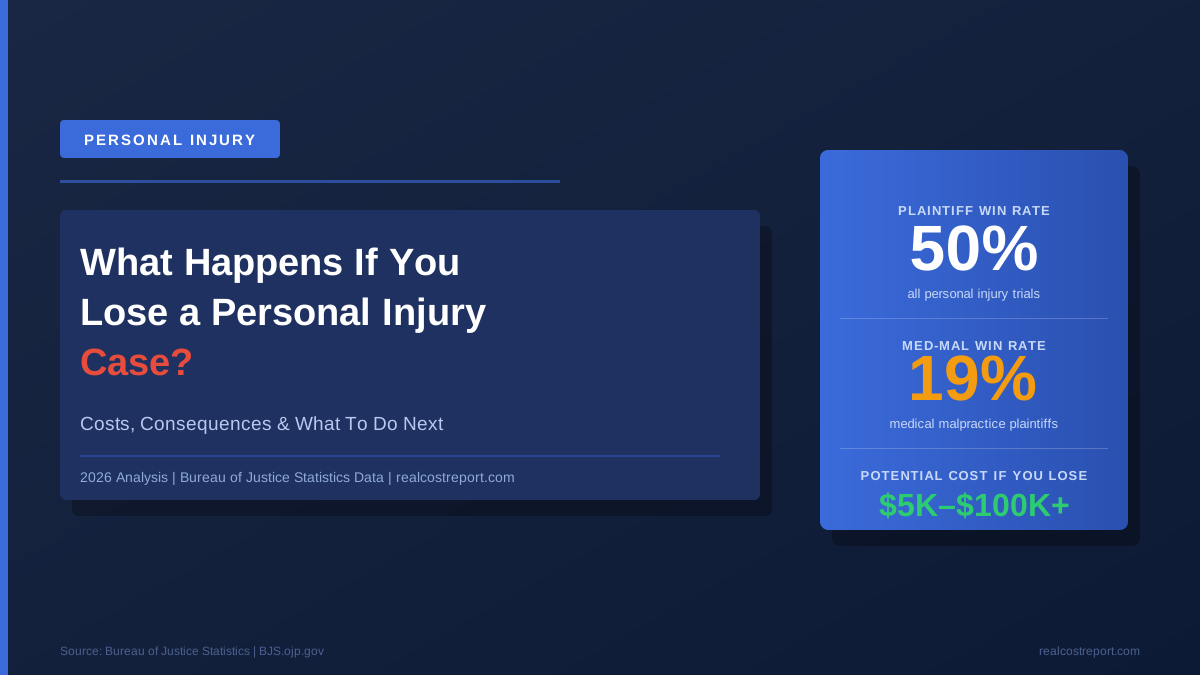
- According to the Bureau of Justice Statistics, plaintiffs win only about 50–56% of personal injury cases that reach trial; medical malpractice plaintiffs win just 19% of the time.
- The “American Rule” means losing plaintiffs rarely pay the defendant’s attorney fees — but exceptions exist, especially if a court finds your claim was frivolous or a Rule 68 offer was rejected.
- Appealing a lost verdict requires a new fee arrangement and can add $10,000–$50,000+ in costs with no guaranteed recovery.
- If your case was lost on procedural grounds or new evidence exists, re-filing before the statute of limitations expires may be an option — consult a second attorney immediately.
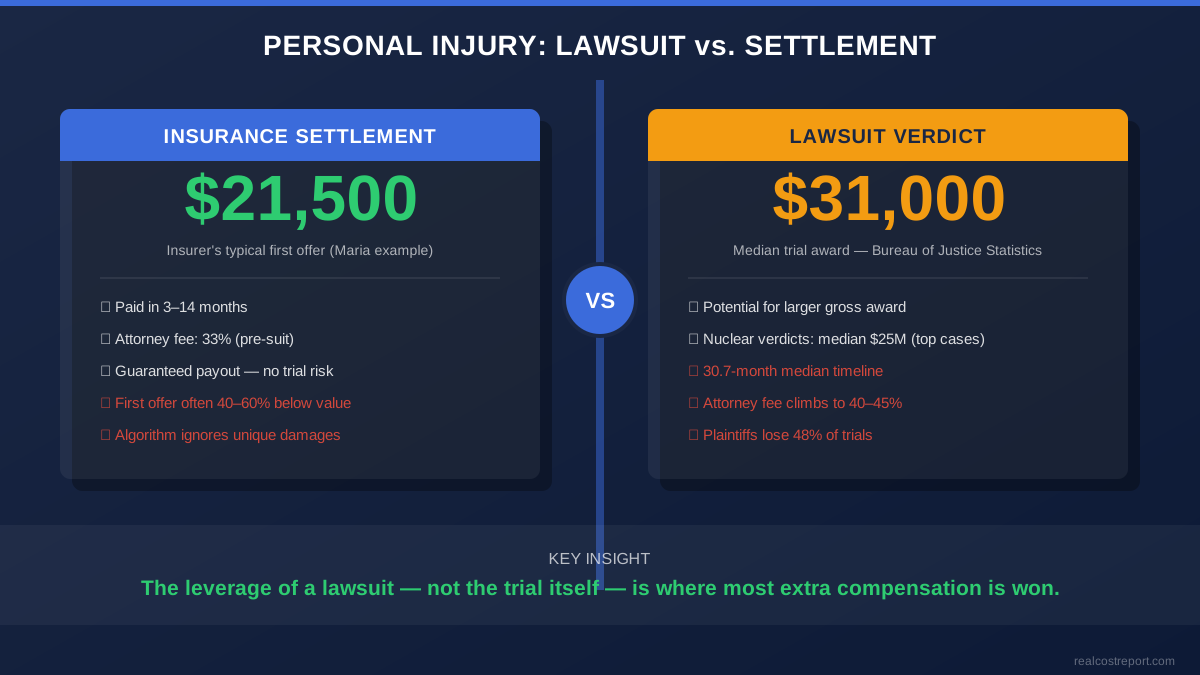
A personal injury case that goes to verdict is a financial gamble with asymmetric stakes. Win, and you might recover the median award of $31,000 — or, in severe cases, far more. Lose, and you walk away with nothing in compensation but potentially thousands of dollars in litigation expenses that do not disappear with the jury’s verdict. According to the Bureau of Justice Statistics, roughly 3–4% of all personal injury claims actually reach a courtroom — but for those that do, nearly half of plaintiffs lose. Understanding what that loss actually costs, and what options remain afterward, is information your attorney should explain before trial, not after. This article breaks down every financial consequence of a lost personal injury verdict: which costs survive a loss, when defendants can shift their legal fees to you, what appeal really costs, and how plaintiffs successfully navigate their next move after an adverse verdict. Firms like Morgan & Morgan and national insurers each know this math cold — you should too.
The Real Cost Breakdown: What You Still Owe After a Loss
The most misunderstood aspect of a contingency fee agreement is what it does not cover. Under a standard arrangement, your personal injury attorney collects no fee if you lose — that much is accurate. What most plaintiffs do not realize is that attorney fees and case costs are two separate categories, and the latter often survive a loss regardless of outcome.
Case costs — sometimes called litigation expenses — are the hard dollars spent to move a case through the legal system. Filing fees, deposition transcripts, expert witness preparation, and medical record retrieval are all costs, not fees. Whether your firm absorbs these costs on a loss or passes them to the client depends entirely on the specific language in your contingency fee agreement. Some agreements are explicit: “Client is responsible for all costs regardless of outcome.” Others state the firm absorbs costs if there is no recovery. Read that agreement before you proceed to trial.
Source: Nolo Legal Encyclopedia — “What Are Costs in a Personal Injury Case?” (verify at nolo.com); expert witness hourly rates per expresslegalfunding.com 2026 litigation cost guide
Rates shown are sample averages. Your actual litigation costs vary by jurisdiction, case complexity, number of expert witnesses, and fee agreement terms.
Expert witnesses drive the largest share of pre-trial expenses. A medical expert in a serious injury case may bill $250 to $1,500 per hour for case review, deposition preparation, and trial testimony. A complex product liability case with three expert witnesses can accumulate $40,000 or more in expert fees alone — costs that existed before a single juror was seated. If your agreement requires reimbursement on a loss, that bill lands on you the moment the verdict is read.
How the “American Rule” Protects You — and When It Doesn’t
Most losing plaintiffs in personal injury cases are protected by a legal doctrine known as the American Rule: each party pays its own attorney fees regardless of outcome. This is the opposite of the “English Rule” used in the United Kingdom, where the losing side typically pays the winner’s legal costs. In the United States, the American Rule means a defendant who defeats your personal injury claim generally cannot force you to pay their attorney’s bill — which, for a fully litigated trial, can easily reach six figures.
However, the American Rule carries important exceptions that plaintiffs frequently overlook until it is too late.
Federal Rule of Civil Procedure Rule 68 — Offer of Judgment. If a defendant makes a formal settlement offer under Rule 68 and you reject it, then proceed to trial and win a judgment smaller than that offer, you may be ordered to pay the defendant’s post-offer court costs. This is not attorney fees — but court costs can still be substantial. The strategic implication: never reject a Rule 68 offer without calculating the risk of a lower verdict.
Frivolous claim sanctions. Under Fed. R. Civ. P. Rule 11, a federal court can sanction a plaintiff whose case lacked a reasonable legal or factual basis. Several states have parallel statutes — Florida’s Fla. Stat. § 57.105, for example, explicitly allows courts to award attorney fees against a party who raised claims with no objectively reasonable basis. If a court determines your claim was frivolous, the defendant’s legal fees become your obligation.
Contractual fee-shifting. Some defendants — landlords, retailers, event venues — include fee-shifting clauses in contracts that may govern an injury on their property. If you signed a waiver, release, or service agreement before the incident, that document could obligate you to pay defense costs if you lose. Review any such agreements with your attorney before filing.
For the vast majority of standard personal injury cases — car accidents, slip and falls, workplace injuries — these exceptions will not apply. But ignoring them entirely is the financial mistake that turns a courtroom loss into a compounding debt problem.
Plaintiff vs. Defense Verdicts: Who Actually Wins at Trial?
Before assessing what happens after a loss, it helps to understand how likely that loss is. The data from the Bureau of Justice Statistics paints a nuanced picture that differs significantly by case type.
Source: Bureau of Justice Statistics, Civil Justice Survey of State Courts — win rates and median awards compiled from BJS tort trial data (verify at bjs.ojp.gov). Intentional tort and premises liability median awards reflect BJS survey data cited in independent aggregation at onthemap.com.
The data reveals a counterintuitive truth: the case types with the lowest plaintiff win rates — medical malpractice (19%) and product liability (38%) — tend to produce the highest awards when plaintiffs do win. This means defendants in those categories are fighting hard because the stakes justify it. A medical malpractice plaintiff who loses at trial has typically spent two or more years and tens of thousands of dollars in expert fees chasing a verdict that 81% of similarly situated plaintiffs never collect. That risk calculation must inform every trial vs. settlement decision.
Verdict
For motor vehicle plaintiffs, the odds at trial are reasonable at 61% — trial is a defensible choice when liability is clear and a settlement offer is inadequate. For medical malpractice and product liability plaintiffs, the 19–38% win rate demands extraordinary evidence and expert preparation before rejecting any settlement offer. The expected value calculation almost always favors settlement in those case types.
Appealing a Lost Personal Injury Verdict: What It Actually Costs
Losing at trial does not necessarily mean the case is over. Plaintiffs have the right to appeal, but appealing a personal injury verdict is a separate legal proceeding with its own costs, timelines, and probability of success — and it is rarely the easy path that disappointed clients hope for.
An appeal is not a retrial. Appellate courts do not re-examine evidence or re-hear witnesses. They review whether the trial court made legal errors — improper jury instructions, wrongfully admitted evidence, or incorrect rulings on motions. If the jury simply did not believe your witnesses, that fact pattern is generally not appealable.
The costs of appeal add up quickly. Appellate attorneys typically charge hourly rates of $300 to $600 or more, and a standard personal injury appeal requires briefing, record preparation, and potentially oral argument. Total appeal costs commonly range from $10,000 to $50,000 before any new resolution. Under some contingency fee agreements, an appeal triggers a renegotiated or higher fee percentage — often an additional 5% of any recovery — because the attorney is taking on new risk and workload.
Timing matters critically. Notice of appeal in most state courts must be filed within 30 days of judgment. Miss that window and the right to appeal is forfeited. If you are considering an appeal after a personal injury loss, that conversation with an appellate attorney needs to happen within days, not weeks, of the verdict.
For context: consider a plaintiff in a premises liability case whose attorney fronted $22,000 in expert and litigation costs under a cost-sharing agreement. After losing at trial, the client now faces a bill for those costs, an appeal that requires a new upfront retainer of $15,000, and a 39% base win rate for premises liability cases even when they do reach trial. The total financial exposure before seeing a dollar of recovery could exceed $37,000. That is the calculation that makes post-verdict settlement negotiations — which defendants sometimes offer to avoid appeal costs — worth exploring immediately.
What Most Losing Plaintiffs Get Wrong — and the Consequences
The period immediately after a personal injury verdict is where financially damaging mistakes cluster. Each of the following errors has a specific, preventable cost.
Mistake 1: Assuming you owe nothing because you had a contingency fee agreement. The consequence: receiving an invoice weeks later for $8,000 in expert witness fees and deposition costs that your agreement explicitly required you to repay regardless of outcome. The correct action: read the cost reimbursement section of your fee agreement before trial begins, not after. Ask your attorney directly: “If we lose, what do I owe and when?”
Mistake 2: Missing the appeal deadline while “thinking it over.” The consequence: permanently losing the right to challenge the verdict on any grounds, including clear legal errors by the trial judge. The correct action: schedule a consultation with an appellate attorney within five business days of a verdict. In most jurisdictions, 30 days is the hard deadline — and some states are shorter.
Mistake 3: Assuming a lost case cannot be re-filed. The consequence: walking away from a viable claim that was dismissed on procedural grounds (failure to serve properly, wrong venue, expired discovery deadlines) rather than on the merits. The correct action: ask whether the dismissal was “with prejudice” or “without prejudice.” A dismissal without prejudice preserves the right to re-file, subject to the statute of limitations clock — which may still have time remaining.
Mistake 4: Rejecting a pre-trial settlement offer without documenting the reasoning. The consequence: discovering after a defense verdict that the rejected offer — say, $85,000 — would have netted more after contingency fees than the $0 the jury awarded. The correct action: require your attorney to provide a written analysis of any settlement offer versus trial prospects before you reject it. That document protects you from hindsight regret and ensures the decision was truly informed.
Mistake 5: Ignoring comparative fault findings that reduced the award to zero. The consequence: not understanding that states using contributory negligence (Alabama, Maryland, North Carolina, Virginia, and Washington D.C.) can bar recovery entirely if you were even 1% at fault, while pure comparative negligence states like California only reduce your award proportionally. The correct action: before filing, ask your attorney which fault standard applies in your state and how your own conduct during the incident will be characterized by the defense.
Is Filing a Personal Injury Case Worth It If You Might Lose?
The financial risk of losing a personal injury case is real, but it must be weighed against the structure that contingency fee arrangements provide. For most plaintiffs, the actual out-of-pocket exposure on a loss is confined to litigation costs — not attorney fees. That makes the calculus very different from, say, business litigation where hourly fees accumulate regardless of outcome.
Here is the conditional logic that should govern your decision:
If liability is clear and documented — dashcam footage, witness statements, an at-fault police report, a clear slip-and-fall incident report — the risk profile of proceeding is lower. Defense verdicts in clear-liability cases are rare. Settlement is likely, and trial is a credible backstop.
If liability is disputed and expert testimony is required — as in most medical malpractice, product liability, and complex premises cases — the cost-benefit analysis shifts. You may be authorizing $15,000 to $40,000 in expert fees before trial even begins. If your case falls into a category with a 19–38% plaintiff win rate, a settlement at 50 cents on the dollar may deliver more net value than a trial gamble.
If your injuries are documented and ongoing — MRI results, surgical records, physical therapy notes, lost wage documentation — you have the evidentiary foundation that drives both settlement pressure and jury sympathy. Unverified pain and suffering claims without medical corroboration are the single greatest predictor of defense verdicts in otherwise viable cases.
If you are a retiree or person with limited income — the post-loss cost exposure may be manageable (since many firms do absorb costs on a loss), but the emotional and time costs of a two-year litigation process deserve the same weight as the financial ones. Personal injury trials average nearly two years from filing to verdict, per the U.S. Department of Justice data.
If you have already received one settlement offer — never reject any formal offer without understanding the Rule 68 implications and getting a written evaluation of trial probability from your attorney. A rejected offer of $60,000 that produces a defense verdict costs more than the dollar figure: it costs years of time and potentially thousands in unrecovered litigation expenses.
What’s Changed in 2026: Tort Reform and Its Impact on Personal Injury Trial Risk
The legal landscape for personal injury plaintiffs shifted materially in several states heading into 2026. Florida’s HB 837 tort reform legislation, passed in 2023, shortened the statute of limitations for negligence claims from four years to two years and modified comparative negligence standards — changes that continue to reshape litigation strategy and settlement calculations in 2025 and 2026. California is simultaneously navigating a high-stakes ballot initiative battle over contingency fee caps and medical damage recovery limits in auto accident cases, with competing proposals backed by Uber and plaintiffs’ attorneys. If enacted, such a cap could directly affect net recovery for plaintiffs and the economic viability of certain case types. Plaintiffs and their attorneys in these states face a materially different risk environment than existed just three years ago. Any plaintiff evaluating whether to accept a settlement or proceed to trial in 2026 should ask their attorney specifically how recent state-level tort reforms affect their case’s net recovery potential.
How We Researched This Article
This article draws on primary data from the Bureau of Justice Statistics (BJS), an arm of the U.S. Department of Justice, specifically its Civil Justice Survey of State Courts and published tort trial verdict data covering plaintiff win rates, median awards by case type, and trial frequency. BJS data is available for independent verification at bjs.ojp.gov. Win rate figures cited for specific case types — motor vehicle (61%), premises liability (39%), product liability (38%), and medical malpractice (19%) — are drawn directly from BJS survey publications and cross-referenced against the U.S. Department of Justice’s tort trial data published at ojp.gov.
Litigation cost ranges for expert witness fees, court filing fees, deposition transcripts, and total case expense were sourced from Nolo’s legal encyclopedia (nolo.com), the Florida Bar’s published consumer pamphlet on attorney fees (floridabar.org), and state-level Oregon Revised Statute §20.340 governing contingency fee agreements. Federal Rule of Civil Procedure Rule 68 cost-shifting provisions were verified against the Legal Information Institute at Cornell Law School at law.cornell.edu. State tort reform developments — specifically Florida HB 837 and California ballot initiative activity — were verified against published state legislative sources and legal trade reporting as of May 2026.
Median award figures are drawn from BJS civil trial data. These figures reflect trial verdicts specifically and do not represent the broader universe of settlements, which are generally confidential and not systematically reported. Regional variation in litigation costs, fee agreements, and appeal deadlines is significant: California, Florida, New York, and Texas each carry distinct procedural rules that affect cost exposure on a lost verdict. Readers in those states should verify state-specific rules with a licensed attorney. Research for this article was conducted and verified in May 2026. All figures were verified against named primary sources before publication.