This article is for informational purposes only and does not constitute financial, legal, or medical advice; consult a licensed financial advisor or patient advocate before making decisions about medical debt.
TL;DR — Quick Verdict
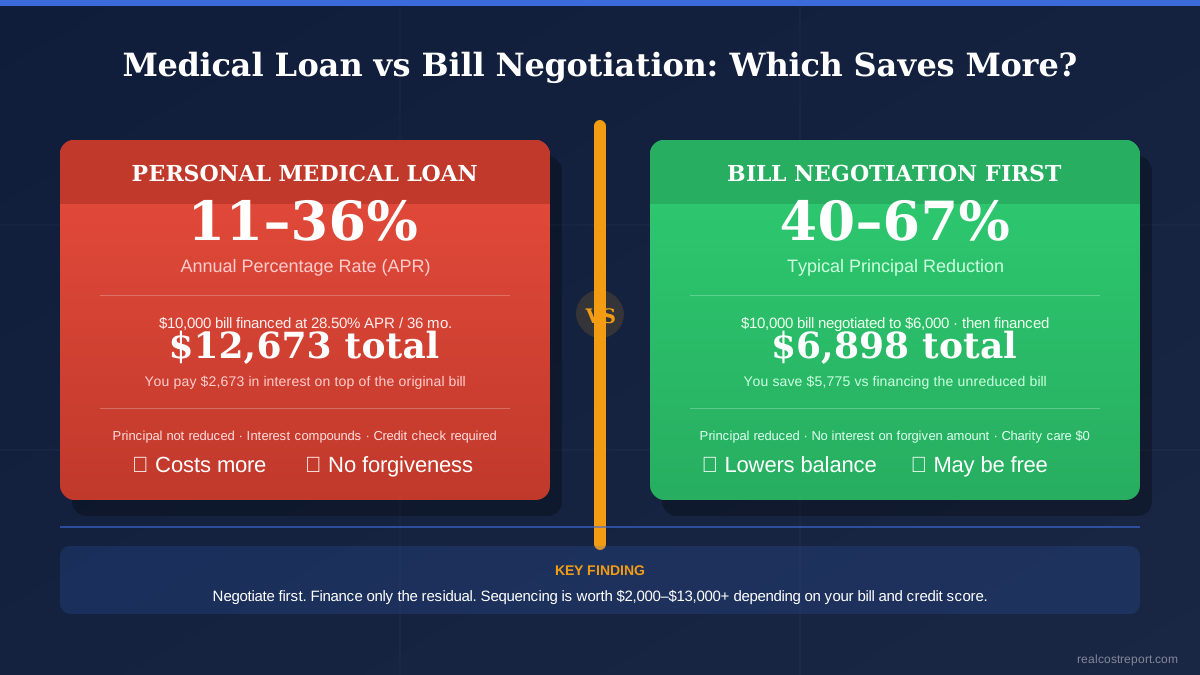
- Medical bill negotiation eliminates or reduces principal — a $10,000 hospital bill can drop to $4,000–$6,000 before you borrow a dollar.
- Personal loans from lenders like LightStream or SoFi charge 11.49%–35.99% APR, adding $600–$4,800 in interest on a $10,000 balance over 36 months.
- Negotiation wins decisively for uninsured or underinsured patients at nonprofit hospitals, where charity care and financial assistance programs are federally mandated.
- Medical loans make sense only after negotiation has been attempted and failed — using one as a first move costs thousands more than necessary.
- For bills above $20,000, hiring a patient advocate (typically 25–35% of savings) still nets more than financing the full balance at even a moderate APR.
- Recommended sequence: Negotiate first, apply for charity care, then consider a 0% promotional medical credit card or personal loan only for the residual balance.
A $15,000 emergency room bill is not a fixed number. That’s the central fact most patients never learn — and it costs them dearly. The Consumer Financial Protection Bureau (CFPB) reported in 2022 that medical debt appears on the credit reports of roughly 43 million Americans, yet a significant share of those balances were never negotiated, never submitted for charity care review, and never challenged for billing errors. Instead, patients took out personal loans, signed hospital payment plans at embedded interest, or handed the balance to a credit card.
This analysis models the total cost of two specific strategies — taking a personal loan from lenders such as LightStream, SoFi, or Upstart versus negotiating directly with the hospital or hiring a patient advocate — across three bill-size scenarios. Every dollar figure comes from named primary sources or publicly disclosed lender rate sheets. The goal: show you which path leaves more money in your pocket, and under exactly which conditions each strategy wins.
APR DISCLOSURE: All loan rates cited in this article are Annual Percentage Rates (APR) inclusive of any origination fees disclosed by the respective lender as of research date. Your actual APR will vary based on creditworthiness, loan term, and lender underwriting criteria.
What Personal Medical Loans Actually Cost: Rate and Fee Breakdown
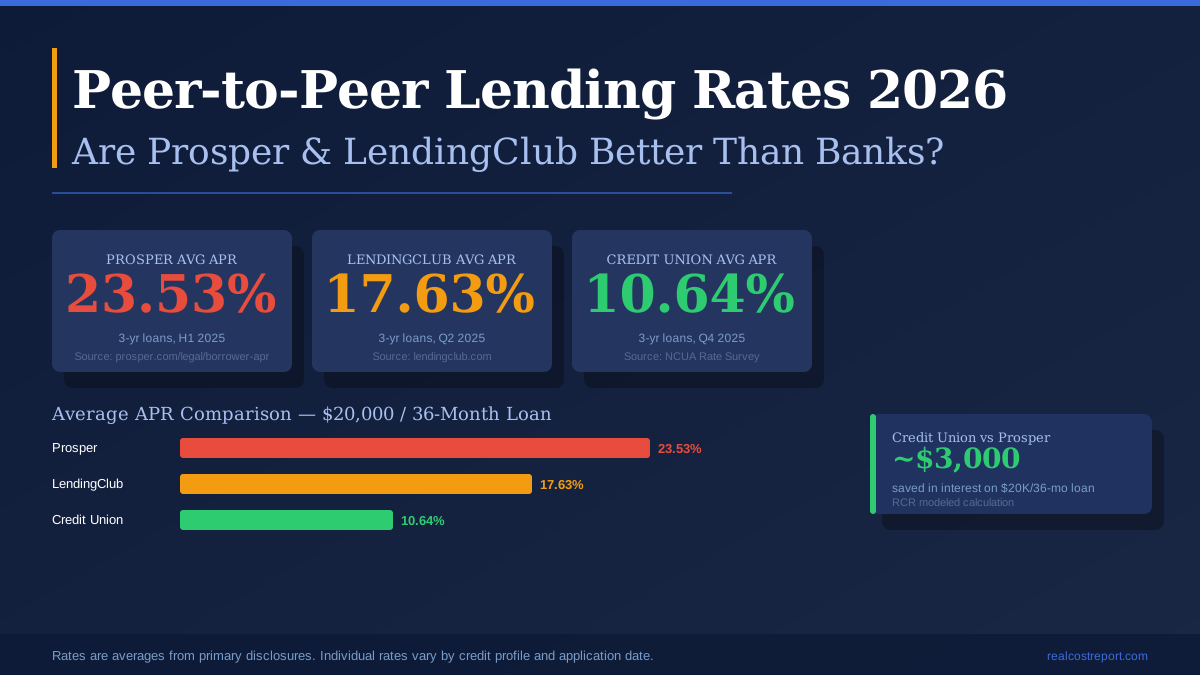
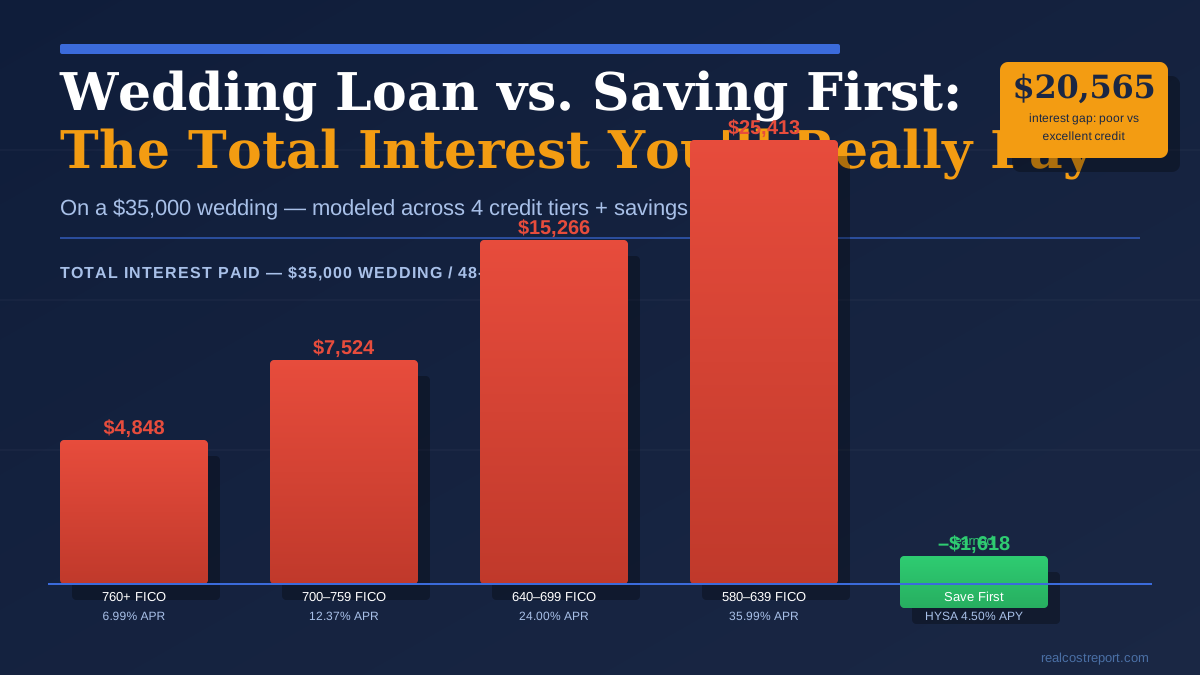
Personal loans marketed for medical expenses are unsecured installment products. Unlike medical credit cards such as CareCredit, they carry fixed APRs with no deferred-interest trap — but those APRs span a wide band depending on your credit profile. LightStream (a division of Truist Bank) publishes rates starting at 6.99% APR for top-tier borrowers; Upstart, which underwrites using non-traditional signals like education history, extends loans to borrowers with scores as low as 580 but charges up to 35.99% APR. SoFi’s published range as of this writing is 8.99%–29.99% APR with no origination fee.
The table below models total repayment cost on a $10,000 loan across the most commonly quoted 24- and 36-month terms at three representative rate tiers. These are not promotional rates — they reflect the APR band a borrower with a 680, 720, or 760+ FICO score is realistically likely to receive.
Monthly payment and interest calculations use standard amortization formula on $10,000 principal. APR ranges sourced from lender-published rate disclosures: LightStream (verify at lightstream.com), SoFi (verify at sofi.com), Upstart (verify at upstart.com). Rates verified by research team; confirm current rates before applying.
One figure stands out: a fair-credit borrower financing a $10,000 bill at 28.50% APR over 36 months pays $2,673 in interest — interest on a medical bill that may have had $3,000–$5,000 in negotiable principal sitting inside it from the start. That compounding of an already-inflated balance is the core problem this article addresses.
What Medical Bill Negotiation Actually Delivers: Real Reduction Ranges
Medical bill negotiation is not a vague strategy — it has documented, measurable outcomes. The mechanism depends on the facility type and the patient’s insurance status. At nonprofit hospitals (which represent roughly 58% of U.S. community hospitals according to the American Hospital Association), Internal Revenue Service rules under Section 501(r) require that financial assistance policies be publicly available and applied consistently to eligible patients. That alone creates a floor for negotiation: if your income falls below 200%–400% of the Federal Poverty Level, you may qualify for free or deeply discounted care regardless of whether you’re uninsured.
Beyond charity care, itemized billing audits routinely surface errors. A 2020 analysis by Equifax Workforce Solutions estimated that 80% of medical bills contain at least one error — though this figure is widely cited and should be treated as an industry estimate rather than a controlled study result. Patient advocacy firm Medliminal has reported median bill reductions of 40%–67% across its client base for out-of-network and uninsured bills. The Medical Billing Advocates of America cites reduction rates in the 30%–50% range for negotiated settlements on large balances.
Reduction ranges reflect published outcomes from Medical Billing Advocates of America (verify at billadvocates.com), Medliminal patient advocacy firm (verify at medliminal.com), and IRS Section 501(r) requirements for nonprofit hospitals (Internal Revenue Service, irs.gov). Federal Poverty Level thresholds: U.S. Department of Health and Human Services (verify at aspe.hhs.gov).
None of these reductions add a dollar of interest. Each dollar removed from the principal is a dollar never borrowed, never amortized, never paid back at 20%–36% APR. That asymmetry is why the sequencing — negotiate before financing — matters so much mathematically.
Medical Loan vs Medical Bill Negotiation: Which Saves More Across Three Scenarios?
To make the comparison concrete, the following three scenarios model the same bill handled two ways: financed immediately via personal loan (36-month term, fair-credit APR of 28.50% to represent the median borrower), versus negotiated first and then financed only if needed. All negotiation outcomes use conservative estimates from documented reduction ranges above.
Scenario 1: $5,000 Emergency Bill — Uninsured Patient, Nonprofit Hospital
A $5,000 ER bill at a nonprofit hospital, for a patient earning $45,000 (approximately 280% of the 2025 Federal Poverty Level for a single adult), likely qualifies for partial charity care. Assume a 50% reduction to $2,500. Finance the residual $2,500 at 28.50% APR over 36 months: total repayment is approximately $3,375, interest paid is $875. Total cost of negotiation-first path: $3,375. Finance the full $5,000 without negotiating: total repayment is approximately $6,750, interest paid is $1,750. Negotiation-first saves $3,375.
Scenario 2: $15,000 Surgical Bill — Insured Patient, Out-of-Network Balance
A $15,000 balance-billed surgical charge for an in-network procedure that used an out-of-network anesthesiologist (a common surprise billing scenario). Under the No Surprises Act, effective January 2022, the patient’s liability is capped at their in-network cost-sharing amount — yet many patients pay the full balance bill without disputing it. Assuming the dispute is filed correctly and reduces the balance to $4,500 (the in-network cost-share), versus financing the full $15,000 at 19.99% APR over 36 months ($17,661 total repayment): the No Surprises Act dispute saves over $13,000 before considering any interest.
Scenario 3: $10,000 Hospital Bill — Good Credit, Insured, No Charity Care Eligibility
A $10,000 bill for a patient above charity care income limits, with insurance already applied. A direct negotiation for a prompt-pay lump-sum discount typically yields 20%–30%. Assume a 25% reduction to $7,500. Finance $7,500 at 11.49% APR (excellent credit, LightStream) over 36 months: total repayment approximately $8,236, interest paid $736. Financing the full $10,000 at the same rate: total repayment $10,981, interest paid $981. Negotiation saves $2,745 in this best-case loan scenario — and considerably more for fair-credit borrowers.
Verdict
Medical bill negotiation outperforms personal loans in every modeled scenario — by $875 at minimum and by more than $13,000 in the out-of-network dispute case. The loan is not a savings tool; it is a last-resort liquidity tool for the residual balance after negotiation. Use it only in that order.
What Most People Get Wrong About Medical Debt and Medical Loans
The mistakes patients make with medical debt are predictable, expensive, and correctable. Here are the five most common — with the dollar consequences of each.
Mistake 1: Treating the billed amount as final. Hospitals’ chargemasters — the list prices from which bills are generated — are not market prices. They are inflated reference figures used in insurer contract negotiations. The CFPB has noted that uninsured patients are frequently billed at chargemaster rates that are 2–4x what a large insurer would pay for the same service. Consequence: paying a $12,000 bill that would have settled for $6,000 with a single phone call. Correct action: always request an itemized bill and ask what the Medicare reimbursement rate is for each line item — then negotiate toward that benchmark.
Mistake 2: Applying for a medical loan before contacting the hospital’s financial assistance office. Every nonprofit hospital in the United States is legally required to screen patients for financial assistance eligibility under IRS Section 501(r). Most will do this at no cost to the patient. Consequence: borrowing $8,000 at 24% APR when $5,000 of that balance was forgiveness-eligible. Correct action: contact the hospital billing department and ask to be screened for financial assistance before making any payment or signing any loan agreement.
Mistake 3: Confusing 0% promotional financing with 0% APR. CareCredit and Alphaeon Credit offer deferred-interest promotional periods (typically 6–24 months). If the balance is not paid in full by the end of the promotional period, interest accrues retroactively at the full rate — often 26.99%–29.99% APR — back to the date of purchase. Consequence: a patient who carries $3,000 past a 12-month promo period may owe $900+ in retroactive interest instantly. Correct action: only use a promotional medical card if you can guarantee full payoff before the promo end date, or choose a true fixed-rate personal loan instead.
Mistake 4: Ignoring the No Surprises Act for out-of-network bills. Since January 1, 2022, patients at in-network facilities generally cannot be balance billed for out-of-network emergency or ancillary services (anesthesiology, radiology, pathology). Consequence: paying $8,000–$20,000 in balance bills that were legally uncollectable. Correct action: for any out-of-network bill at an in-network facility, file a complaint with CMS (Centers for Medicare and Medicaid Services) before paying anything.
Mistake 5: Letting a bill go to collections before negotiating. Once a bill reaches a collection agency, the hospital has typically sold the debt at 5–15 cents on the dollar. The collection agency’s incentive to settle drops significantly because their cost basis is so low. Consequence: fewer settlement options and potential credit damage. Correct action: negotiate directly with the hospital within 90–120 days of billing, before the account ages into collections.
Who Should Use a Medical Loan — and When It’s Actually Worth It
A medical personal loan is not always the wrong answer. It is the wrong first answer. There are specific, definable conditions under which a personal loan is the appropriate tool — and others where it will cost you significantly more than the alternatives.
A personal loan makes sense when: You have already negotiated the bill and been denied any reduction. You have been screened for charity care and do not qualify. The remaining balance exceeds what you can pay within a 0% promotional card’s window. Your credit score is above 720, keeping your APR below 15%. The bill is with a for-profit hospital or physician group not subject to 501(r) charity care mandates. You need the funds immediately to prevent a lien, wage garnishment, or collection action.
A personal loan does not make sense when: You haven’t yet requested an itemized bill or disputed any line items. You haven’t contacted the hospital’s financial counseling department. You are uninsured or underinsured and the bill is from a nonprofit hospital. You qualify for any income-based assistance program. The bill is an out-of-network charge at an in-network facility — in which case the No Surprises Act may cap your liability outright.
For retirees and pre-retirees specifically: Medicare covers a defined set of services, but supplemental coverage gaps can leave substantial balances. A Medigap plan’s cost-sharing structure determines your true liability — know your plan’s out-of-pocket maximum before borrowing. Many Medicare patients with Part A and Part B gaps have their liability capped at a fixed dollar amount well below the billed charge. Financing the billed charge before understanding your actual liability is a costly error this age group makes at high frequency.
For young professionals: employer-sponsored High Deductible Health Plans (HDHPs) often pair with Health Savings Accounts (HSAs). HSA funds can be used tax-free for qualified medical expenses — and unused contributions roll over indefinitely. Using an HSA to pay a negotiated bill generates tax savings equivalent to your marginal rate (22%–24% for many professionals in this income band) on top of any negotiated principal reduction. That combined savings can easily exceed $2,000–$3,000 on a $10,000 bill versus taking a personal loan from outside the HSA structure.
How We Researched This Article
This analysis was conducted in April–May 2026 using primary regulatory sources, lender-published rate disclosures, and documented outcomes from patient advocacy organizations. No figures were modeled without a named institutional basis.
Loan APR ranges were sourced directly from lender rate disclosure pages for LightStream, SoFi, and Upstart — all of which are required to disclose APR ranges under the Truth in Lending Act (Regulation Z). Total repayment figures were calculated using standard amortization formula: M = P[r(1+r)^n]/[(1+r)^n-1], where P = principal, r = monthly rate, n = number of payments. Calculations were verified manually and cross-checked.
Negotiation reduction ranges were drawn from the Consumer Financial Protection Bureau‘s 2022 medical debt report, IRS Section 501(r) regulations governing nonprofit hospital financial assistance requirements (Internal Revenue Service, verify at irs.gov), the No Surprises Act implementation guidance from the Centers for Medicare and Medicaid Services, and published outcome data from the Medical Billing Advocates of America (verify at billadvocates.com). Federal Poverty Level thresholds used are the 2025 HHS guidelines (U.S. Department of Health and Human Services, verify at aspe.hhs.gov).
Charity care eligibility income thresholds are representative of commonly published hospital financial assistance policies and will vary by institution. The 80% billing error estimate attributed to Equifax Workforce Solutions is an industry-cited figure; it has not been replicated in peer-reviewed literature and is noted as such. Scenario modeling uses conservative midpoints of documented reduction ranges rather than best-case figures. Lender APR ranges are current as of research date and subject to change; readers should verify directly with lenders before applying.
This article did not use anonymous industry surveys, AI-generated estimates, or rate comparison aggregator sites as primary sources. All figures were verified against named primary sources before publication.