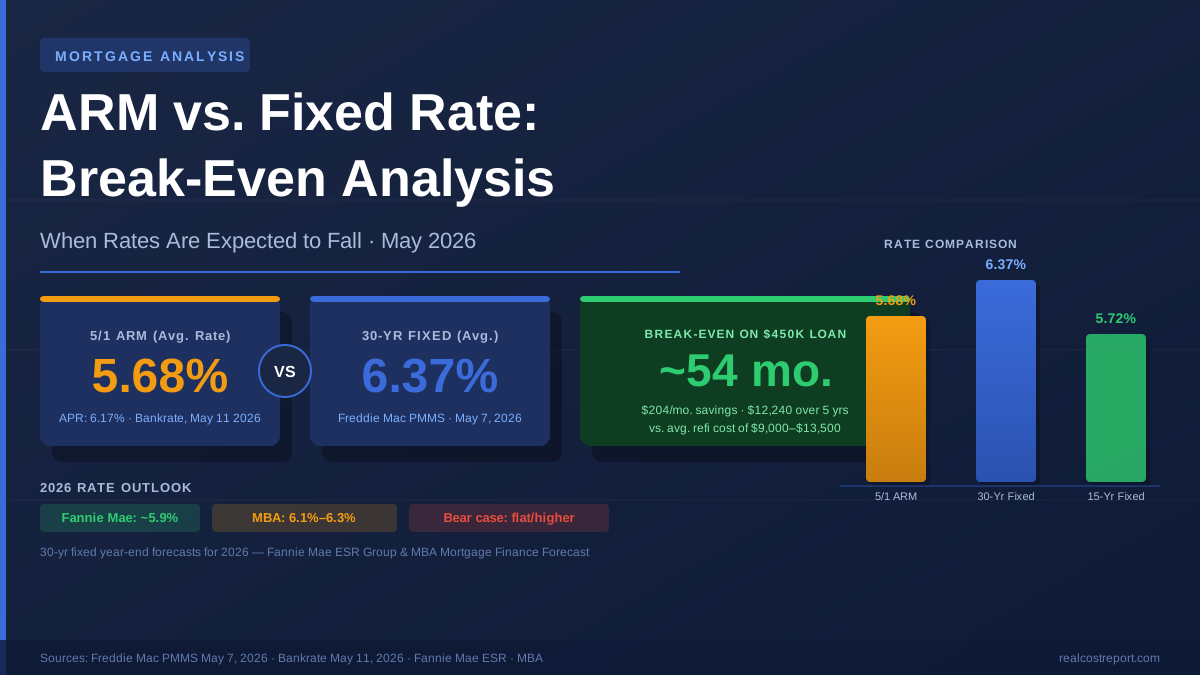
Rates change daily. Figures reflect May 2026 averages from Freddie Mac PMMS. Contact an NMLS-registered lender for a personalized rate quote.
TL;DR — Quick Verdict
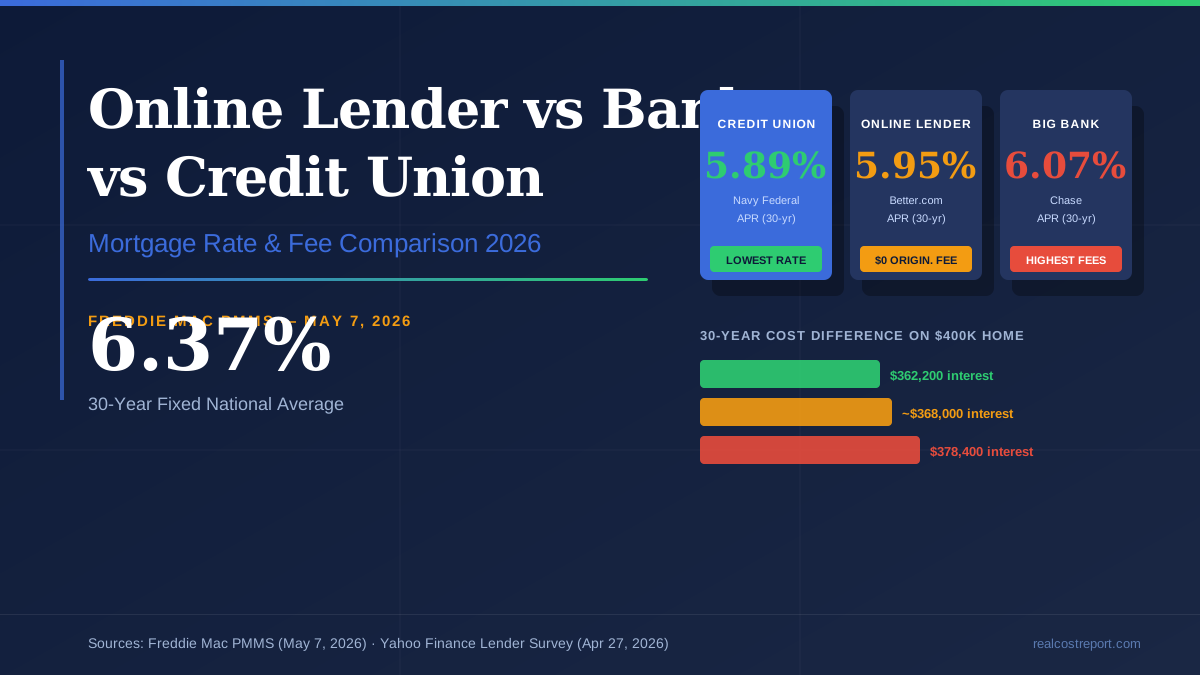
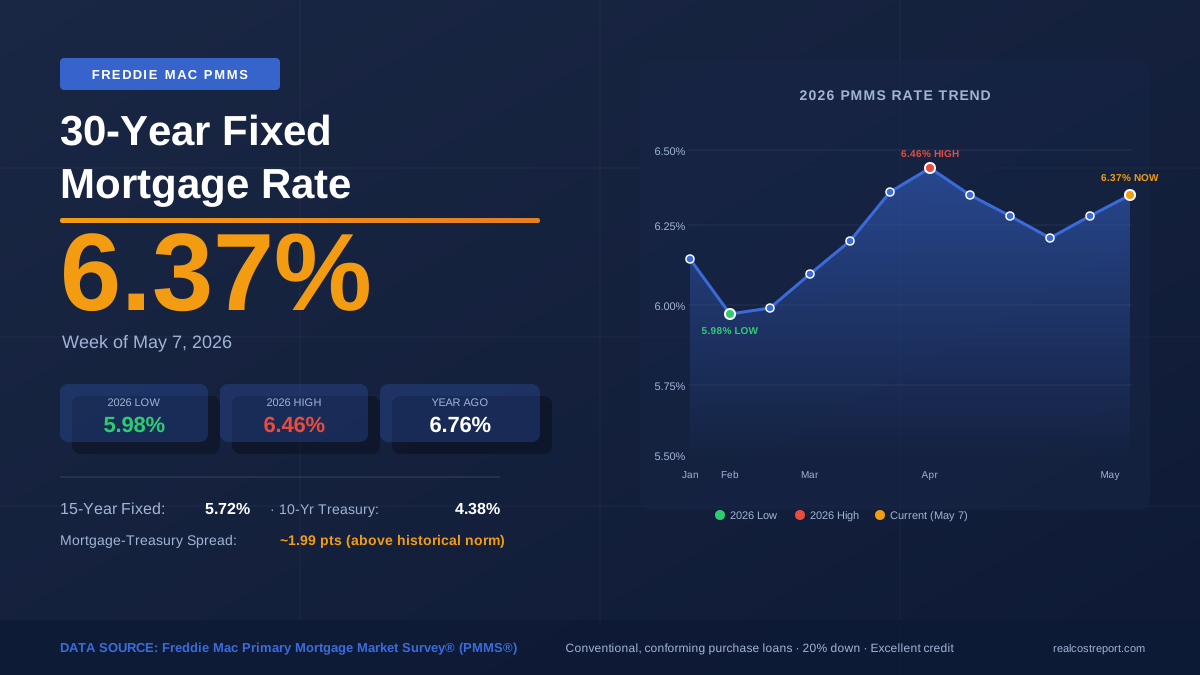
- The 30-year fixed mortgage rate averaged 6.37% as of May 7, 2026, per Freddie Mac’s Primary Mortgage Market Survey — up from 5.98% in late February but down from 6.76% a year ago.
- The 2026 rate range so far: 5.98% (Feb. 26 low) to 6.46% (Apr. 2 high) — a 48-basis-point swing that translates to roughly $100/month on a $400,000 loan.
- The 10-year Treasury yield sat at 4.38% as of May 8, putting the mortgage-to-Treasury spread at approximately 1.99% — wider than the historical norm and a meaningful drag on affordability.
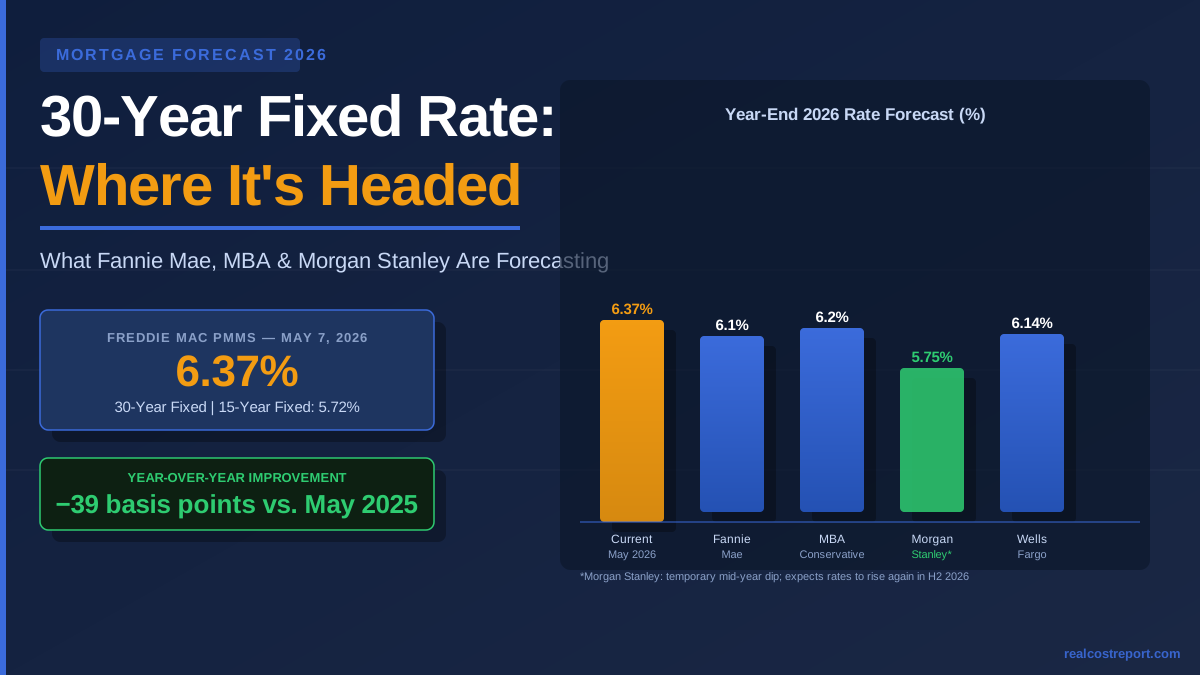
- Fannie Mae’s March 2026 Housing Forecast projects gradual easing toward 5.9% by Q4 2026; the Mortgage Bankers Association is more cautious, holding at 6.1%–6.3% through year-end.
- Purchase applications rose more than 20% year-over-year in late April 2026 as buyers reacted to modestly lower rates and rising inventory.
- For most buyers, locking now rather than waiting for a sub-6% rate is the stronger play — home prices are still rising and the spread compression needed to reach 5.5% requires conditions not yet in place.
The week of May 7, 2026, the average 30-year fixed mortgage rate was 6.37% — up seven basis points from 6.30% the week prior, according to Freddie Mac’s Primary Mortgage Market Survey (PMMS). That single number dictates the monthly payment on every conventional conforming purchase loan originated this week. On a $400,000 mortgage, the difference between 6.37% and the year’s low of 5.98% is roughly $100 per month — or $36,000 over 30 years. For most American households, no financial decision carries more dollar-weighted consequence than this rate.
Freddie Mac has tracked the 30-year fixed rate since April 1971. The PMMS pulls from thousands of actual loan applications submitted to Freddie Mac through its Loan Product Advisor platform — making it the most widely cited benchmark in mortgage lending. Wells Fargo, Chase, Rocket Mortgage, and virtually every NMLS-registered lender quote rates that move in close alignment with PMMS weekly readings. Understanding what drives that number — and where it’s going — is the practical work this article does.
Where the 30-Year Fixed Rate Stands Right Now: Full 2026 PMMS Data
The Freddie Mac PMMS is released every Thursday. The table below shows every 2026 weekly reading through the most recent publication date of May 7, 2026. The PMMS methodology focuses on conventional, conforming, fully amortizing purchase loans — borrowers with 20% down and excellent credit. Jumbo loans, FHA, and VA rates are not captured in this survey.
Rates change daily. Figures reflect May 2026 averages from Freddie Mac PMMS. Contact an NMLS-registered lender for a personalized rate quote.
Source: Freddie Mac Primary Mortgage Market Survey® (verify at freddiemac.com/pmms). PMMS criteria: conventional, conforming, fully amortizing purchase loans, 20% down, excellent credit. 15-year figures for Mar. 5–Mar. 26 to be confirmed from PMMS archive.
The standout data point: the 30-year rate dropped below 6% for the first time in over three years on February 26, 2026, when it touched 5.98%. That milestone briefly reignited purchase demand, but the rate rebounded sharply through March and April — a reminder that any rate milestone is the market’s to give and take back.
Year-over-year context matters here. As of May 7, 2026, the 30-year fixed averaged 6.37% — down 39 basis points from 6.76% a year ago at this time, per Freddie Mac. Buyers who closed in May 2025 at 6.76% on a $400,000 loan paid roughly $1 more in monthly interest than a buyer locking at 6.37% today — $2,636 vs. $2,491. That’s $1,740 less per year at the current rate.
What Actually Determines the 30-Year Fixed Rate: The Treasury Spread Explained
Most buyers hear “the Fed cut rates” and expect mortgage rates to fall the same afternoon. They don’t. The Federal Reserve sets the federal funds rate — the overnight rate banks charge each other. As of May 2026, that target range sits at 3.50%–3.75%, per the Federal Open Market Committee’s April decision to hold rates steady. Mortgage rates follow a different master: the 10-year U.S. Treasury yield.
On May 8, 2026, the 10-year Treasury closed at 4.38%, according to Advisor Perspectives’ daily Treasury snapshot sourced from Federal Reserve data. The concurrent 30-year fixed PMMS rate was 6.37%. That difference — approximately 1.99 percentage points — is called the mortgage-to-Treasury spread. Historically, the spread runs between 1.5% and 1.8%. The current spread of roughly 2.0% reflects lingering uncertainty in the mortgage-backed securities market, where investors price in prepayment risk and macroeconomic volatility.
Why does the spread matter to a buyer? Because it means mortgage rates have room to fall even if Treasury yields hold steady. If the spread normalized to 1.7%, a 4.38% 10-year yield would produce a 30-year fixed rate closer to 6.08% — without the Fed doing anything at all.
What moves the 10-year Treasury — and by extension, mortgage rates — in practice:
- Inflation expectations. When inflation cools toward the Fed’s 2% target, Treasury investors accept lower yields. Lower yields pull mortgage rates down.
- Federal Reserve forward guidance. The Fed doesn’t set the 10-year rate, but its signals about future rate cuts shift investor expectations, which do move the 10-year.
- Mortgage-backed securities demand. When global investors buy MBS — the bonds your lender packages your loan into — prices rise, yields fall, and mortgage rates drop. Weak MBS demand does the opposite.
- Economic data surprises. A stronger-than-expected jobs report typically pushes yields up (and mortgage rates up) as investors price in less room for Fed easing.
Real-world scenario: A buyer watching the Freddie Mac rate on the morning of February 26, 2026, would have seen 5.98% — the product of a 10-year Treasury around 4.08% (per Advisor Perspectives data for that period) and a slightly tighter spread. Six weeks later, on April 2, the same metric read 6.46% after Treasury yields climbed back toward 4.31% amid fresh economic uncertainty. A buyer who locked February 26 on a $500,000 loan saved $153/month compared to one who locked April 2.
30-Year Fixed vs. 15-Year Fixed in 2026: Which Loan Is Better for Your Situation?
The 15-year fixed rate averaged 5.72% as of May 7, 2026, per Freddie Mac PMMS — 65 basis points below the 30-year at 6.37%. That spread is narrower than some historical periods but still meaningful. To quantify the trade-off, the math below models a $400,000 loan originated at May 7 PMMS rates.
Source: Calculations by Real Cost Report using May 7, 2026 Freddie Mac PMMS rates (verify at freddiemac.com/pmms). P&I only — taxes, insurance, and PMI excluded. Figures modeled, not lender-quoted.
Verdict
The 15-year fixed is the mathematically dominant choice for buyers who can absorb an $821/month higher payment — it saves nearly $301,000 in interest on a $400,000 loan. But that higher payment strains cash flow for most households in 2026’s cost environment. The 30-year fixed remains the right product for buyers stretching to qualify, planning to move within 7–10 years, or prioritizing payment flexibility. Pre-retirees who plan to own for the full term should run the 15-year numbers with their lender: the interest savings are significant enough to justify the conversation.
What Most Buyers Get Wrong About the 30-Year Fixed Rate in 2026
Mortgage rate literacy is low, and lenders profit from the gap. These are the five costliest misunderstandings active buyers are making right now.
Mistake 1: Treating the PMMS rate as their actual offered rate. The Freddie Mac PMMS reflects borrowers with 20% down and excellent credit. A buyer with 10% down, a 700 credit score, or on an FHA loan will see a rate 25–75 basis points higher. Using 6.37% for affordability math when your profile isn’t PMMS-grade means underestimating your payment. The correct move: get pre-approved by at least two NMLS-registered lenders before using any rate in a budget model.
Mistake 2: Waiting for sub-5% rates before buying. Fannie Mae and the MBA both project 30-year fixed rates staying above 6% for most of 2026, with modest easing to 5.9%–6.1% by year-end. The consensus is that a return to 2020–2021’s 3%–4% range requires a recession severe enough to bring the 10-year Treasury below 3% and compress the spread simultaneously — a scenario that also brings layoffs and tighter underwriting. Buyers waiting for dramatically lower rates face rising home prices in the interim: Fannie Mae projects 2.4% home price appreciation in 2026, the National Association of Realtors projects 4%.
Mistake 3: Confusing Fed rate cuts with immediate mortgage rate drops. The Fed cut rates several times beginning in late 2024, and the 30-year fixed actually climbed in parts of 2025 before easing. The Fed funds rate influences overnight bank borrowing, not the 10-year Treasury. When the Fed cuts, mortgage rates follow only if long-term inflation expectations also fall. If markets read a Fed cut as stimulative and inflationary, Treasury yields can rise while the funds rate drops.
Mistake 4: Not locking after hitting a rate target. In 2026 alone, the 30-year fixed swung from 5.98% to 6.46% and back to 6.23% within 10 weeks. Buyers who saw 6.23% on April 23 and decided to wait another week watched the rate jump back to 6.30%. A rate lock with a reputable lender — typically 30, 45, or 60 days — is the only hedge against that volatility. Float-down provisions can be added, but they come with fees.
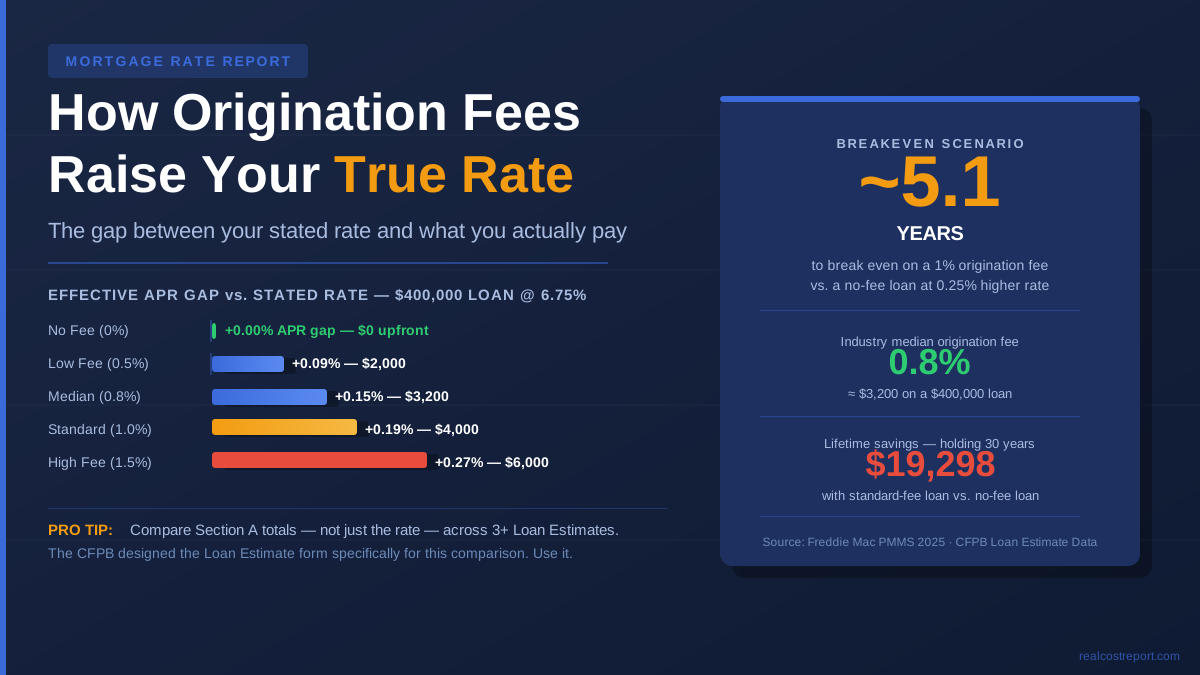
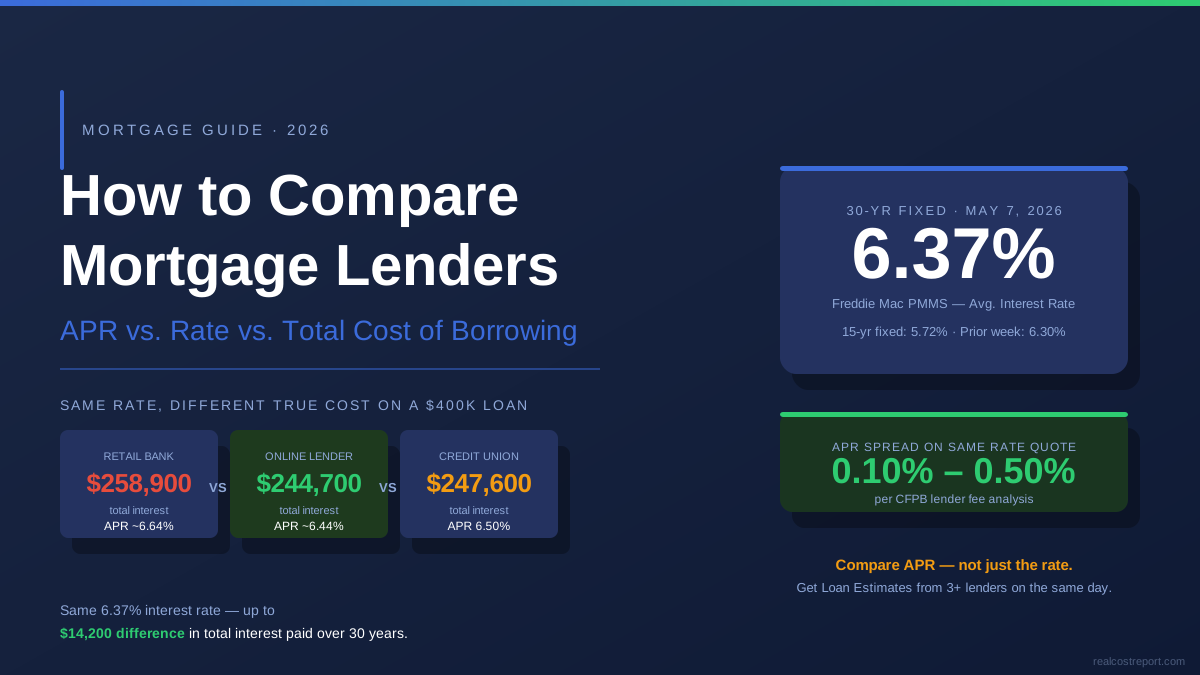
Mistake 5: Ignoring points and APR when comparing lender quotes. Sam Khater, Freddie Mac’s Chief Economist, has publicly recommended shopping multiple lenders. Two quotes at “6.37%” can carry different origination fees, discount points, and closing cost structures. The APR — Annual Percentage Rate — is the legally standardized metric that folds in those costs. Always compare APR, not just the stated rate.
2026 Rate Forecast: What Fannie Mae, the MBA, and NAR Actually Project
Every major housing institution updates its mortgage rate forecast monthly. The table below captures the most recent projections — a meaningful input for any buyer deciding whether to lock now or wait.
Source: Fannie Mae Housing Forecast March 2026 (verify at fanniemae.com); MBA Mortgage Finance Forecast (verify at mba.org); NAR and Redfin/Zillow projections via public forecast publications. Figures represent consensus range, not guaranteed rates.
The consensus is cautious optimism. Four of the five major forecasters see the 30-year fixed ending 2026 in the 5.9%–6.3% corridor — a modest improvement from today but nowhere near the dramatic relief many buyers anticipated after the 2024 Fed cutting cycle began. The MBA’s reasoning is particularly pointed: persistent federal budget deficits keep long-term Treasury yields elevated regardless of where the Fed funds rate goes. Fannie Mae is the lone forecaster projecting sub-6% rates by Q4 2026, and even their March 2026 Housing Forecast was revised higher to reflect slower-than-expected GDP growth and tighter financial conditions.
The practical takeaway for a buyer evaluating a rate lock today: the expected Q4 2026 average ranges from 5.9% to 6.3%. A buyer who locks 6.37% now could refinance into a modestly lower rate in 12–18 months — but only if the forecast materializes, and only if the rate drop is large enough to justify closing costs of $3,000–$5,000+ on a standard refi. At a 0.3%–0.5% improvement, the break-even on a refinance sits around 5–7 years. For buyers planning to stay that long, waiting might make sense on paper — but the home they want may not wait with them.
What’s Changed in 2026: The most notable development through the first five months of 2026 is the decoupling of buyer demand from rate expectations. Purchase applications rose more than 20% year-over-year in late April 2026, per Freddie Mac Chief Economist Sam Khater — even as rates remained in the 6.23%–6.46% range. Buyers appear to be adjusting to the new normal rather than waiting for 2021 to return. Rising inventory has done as much as rate movement to unlock demand: new-home median prices touched their lowest level since July 2021 in early 2026, giving buyers more room to negotiate even as the cost of debt remains elevated.
Who Should Lock Now vs. Wait: A Scenario-by-Scenario Guide
Rate forecasts are useful frameworks, not guarantees. The decision to lock a 30-year fixed mortgage today at 6.37% depends heavily on individual circumstances.
Lock now if you: have found a home you want to own for 7+ years, are stretching to qualify and need payment certainty, are purchasing in a competitive market where sellers won’t hold contracts for extended periods, or have a closing date within 60 days. At 6.37%, a $350,000 loan carries a P&I payment of $2,180. A 0.3% rate improvement to 6.07% drops that to $2,117 — a $63/month difference. That savings won’t clear the cost of losing a house to another buyer while waiting.
Consider a float if you: have a closing date 90+ days out, are purchasing new construction with a builder-extended rate lock option, have financial flexibility to absorb a rate spike if the float doesn’t work in your favor, or have identified a specific trigger (a named economic data release, a Fed meeting outcome) that you believe will move rates meaningfully lower before your close.
Refinance candidates in 2026: Borrowers who originated at 7.0%–7.79% during late 2023 and 2024 are approaching break-even territory on a refinance. At the current 6.37% rate, a borrower who locked at 7.50% on a $400,000 loan saves approximately $420/month. With refinance closing costs of $4,000–$6,000, break-even arrives in 10–14 months. That math works for anyone planning to stay in the home beyond 2027.
First-time buyers on FHA loans: FHA 30-year rates typically run 0.25%–0.50% below conventional rates due to the government guarantee, though the upfront MIP of 1.75% and annual MIP of 0.55%–0.85% must be factored into the total cost. At an FHA rate of 5.90%–6.12%, a buyer with 3.5% down on a $350,000 purchase will pay less in monthly interest than a conventional borrower at 6.37%, but more in insurance costs overall. This comparison is non-trivial and warrants a side-by-side APR analysis with an NMLS-registered lender.
How We Researched This Article
All weekly 30-year fixed and 15-year fixed mortgage rate figures in this article were drawn directly from Freddie Mac’s Primary Mortgage Market Survey® (PMMS®), the benchmark weekly survey conducted since April 1971. The PMMS methodology — as explained by Freddie Mac — collects rate data from thousands of loan applications submitted through Freddie Mac’s Loan Product Advisor® platform. The survey covers conventional, conforming, fully amortizing purchase loans for borrowers with 20% down and excellent credit. All PMMS figures cited reflect published weekly readings from January 8 through May 7, 2026, and can be independently verified at Freddie Mac’s official PMMS page.
Treasury yield data — including the 10-year note closing levels used to calculate the mortgage-to-Treasury spread — was sourced from the Federal Reserve Bank of St. Louis FRED database, which republishes Freddie Mac PMMS data, as well as from Advisor Perspectives’ daily Treasury yield snapshots, which source directly from Federal Reserve H.15 release data. The 10-year Treasury yield of 4.38% cited for May 8, 2026, and the 4.08% figure referenced for late February 2026 are drawn from those daily snapshots.
Forecast data was sourced from public releases by the Fannie Mae Economic and Strategic Research Group (March 2026 Housing Forecast, verify at fanniemae.com/data-and-insights/forecast), the Mortgage Bankers Association Mortgage Finance Forecast (verify at mba.org), and the National Association of Realtors. The Federal Reserve’s April 2026 FOMC decision to hold the federal funds rate at 3.50%–3.75% is cited from the Federal Reserve’s official website.
Monthly payment and total interest calculations were modeled by Real Cost Report editorial staff using standard 30-year and 15-year fully amortizing loan formulas applied to May 7, 2026 PMMS rates. These figures are modeled, not lender-quoted, and do not include taxes, insurance, PMI, origination fees, or points. They are presented for illustrative comparison only.
Research was last conducted in May 2026. Mortgage rates are volatile and weekly figures will change. Limitations: the PMMS does not capture FHA, VA, jumbo, or adjustable-rate mortgage pricing. State-level and lender-level variation is not reflected in national averages. All figures were verified against named primary sources before publication.