Rates change daily. Figures reflect May 2026 averages. Contact an NMLS-registered lender for a personalized rate quote.
TL;DR — Quick Verdict
- A borrower with a 760+ FICO score pays roughly 0.75%–1.10% less in APR than one with a 620–639 score on the same 30-year conventional loan — translating to $150–$200 more per month on a $400,000 mortgage.
- Over 30 years, that rate gap costs the lower-tier borrower $54,000–$72,000 in additional interest on a $400,000 loan balance.
- The FHFA’s LLPA matrix, set by Fannie Mae and Freddie Mac, is the primary pricing mechanism — and since May 2023 it requires a 780+ FICO to unlock the absolute best conventional rate tier.
- FHA loans close the gap for scores below 680, but PMI costs partially offset the rate advantage for scores between 620–659.
- Paying credit card balances below 30% utilization can raise a FICO score enough to shift tiers in as little as 30–45 days — a move worth thousands at closing.
- Bottom line: If your score sits between 700–759, a short delay to cross the 760 threshold is almost always worth it. Below 620, FHA financing is likely your most practical path to a competitive payment.
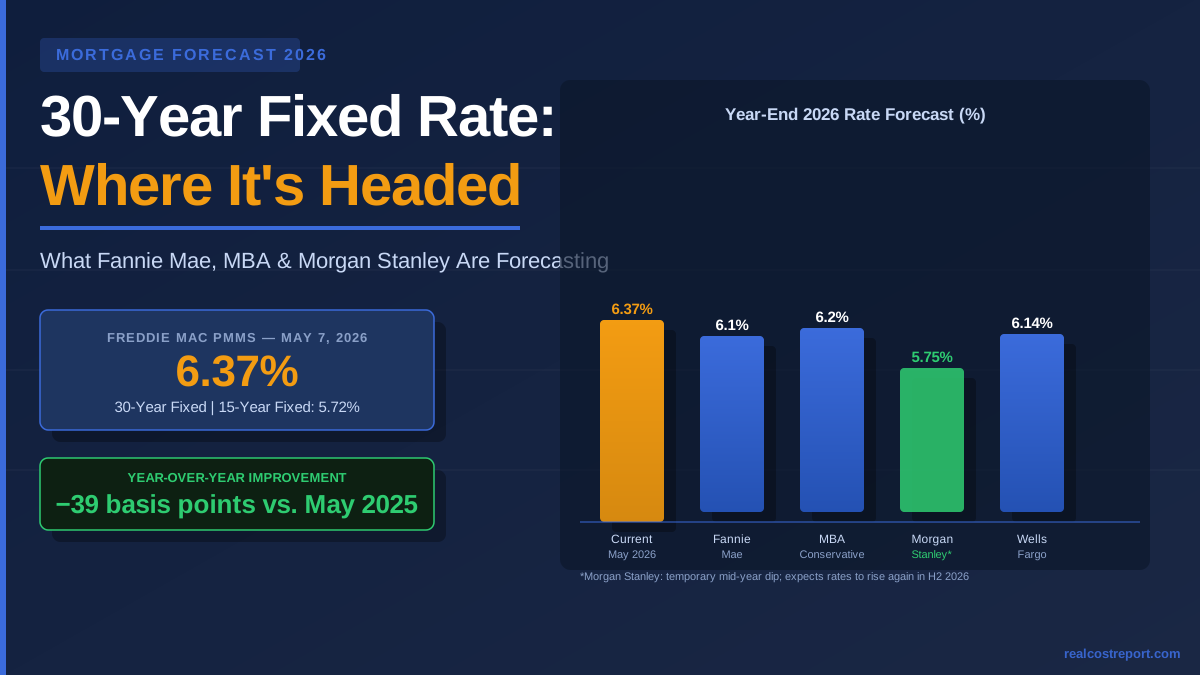
The mortgage you qualify for today is partly determined by a number you may not have checked in months. According to the Freddie Mac Primary Mortgage Market Survey, the benchmark 30-year fixed-rate mortgage averaged 6.37% as of May 7, 2026 — but that figure assumes excellent credit. Borrowers with FICO scores below 660 routinely pay 50–110 basis points more, enough to add well over $100 to their monthly payment on a median loan. myFICO’s rate comparison data shows that on a $400,000 30-year fixed loan, the spread between a 760+ score and a 620–639 score reached approximately 0.9 percentage points in early 2026 — a gap that compounds quietly but devastatingly over three decades. Lenders like Rocket Mortgage and loanDepot price risk using tiered FICO score bands set largely by the Federal Housing Finance Agency’s Loan Level Price Adjustment (LLPA) matrix. Understanding exactly where your score falls — and what it costs you — is the single most actionable step before any mortgage application.
Mortgage Rates by FICO Score Tier: What the Numbers Show in May 2026
The FHFA’s LLPA framework divides conventional borrowers into credit score bands that directly influence the rate a lender can offer when selling the loan to Fannie Mae or Freddie Mac. Since the May 2023 LLPA overhaul, the benchmark for the best pricing tier shifted upward from 740 to 780. That change still governs pricing today, with no new FHFA matrix updates formally adopted as of May 2026.
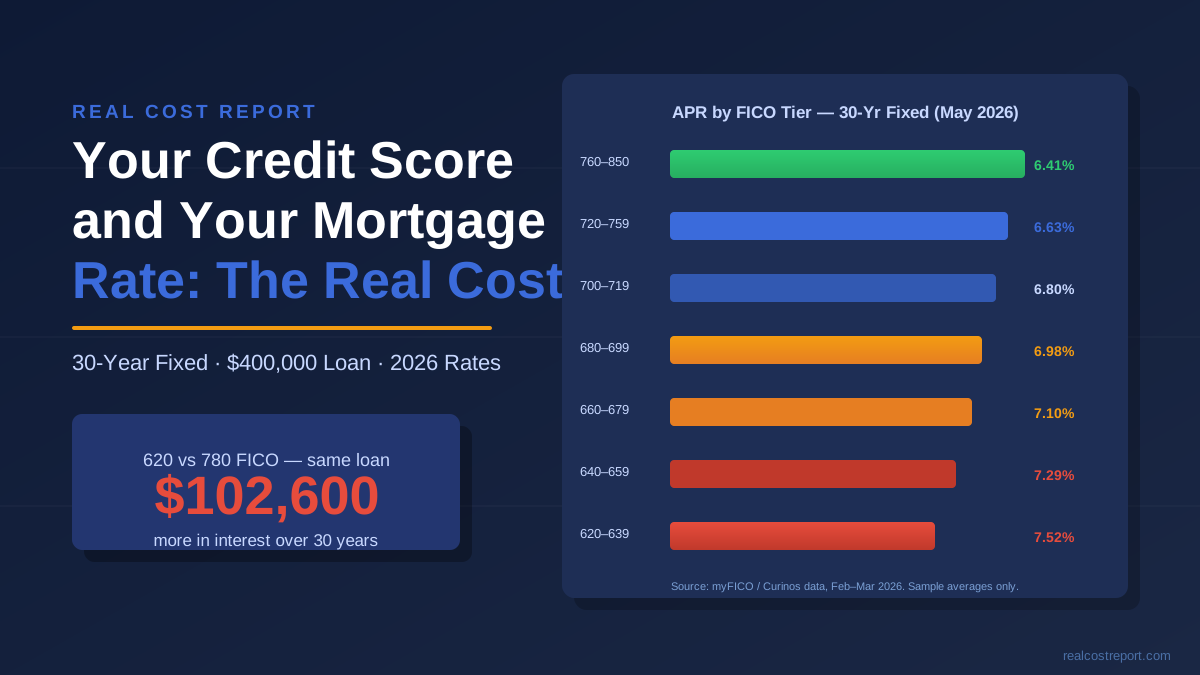
The table below uses APR estimates drawn from myFICO’s loan savings data (verified February 2026) and Curinos rate data published by Experian (March 2026), applied to a $400,000 conventional 30-year fixed-rate mortgage with 20% down. Monthly payments reflect principal and interest only.
Sources: myFICO Loan Savings Calculator data (February 2026); Curinos rate data via Experian (March 2026). Payments calculated on a $400,000 loan balance, 30-year fixed, 20% down, owner-occupied primary residence. APRs are sample averages — individual quotes vary by lender, state, and full risk profile. Verify current rates at myfico.com and freddiemac.com/pmms.
Rates shown are sample averages. Your premium varies by risk profile, state, and insurer.
Three findings stand out in this data. First, the 700–759 band — where most Americans with “good” credit actually sit — is not the best pricing tier. It costs $56–$99 more per month than a 760+ borrower on this loan size. Second, the steepest single jump in rate occurs between 679 and 660, where LLPAs accelerate. Third, the 620–639 tier carries a cumulative 30-year penalty of over $102,000 compared to the top tier — more than a year of mortgage payments given back to the lender in interest alone.
How the LLPA Matrix Actually Sets Your Rate
Most borrowers hear “your rate depends on your credit score” and treat it as a smooth curve. It isn’t. Fannie Mae and Freddie Mac apply Loan Level Price Adjustments — discrete fee add-ons expressed as percentages of the loan amount — that stack on top of baseline market rates. These fees are not visible as separate line items; they are embedded into the interest rate a lender quotes you, which is why two borrowers with adjacent FICO scores can see notably different rate offers.
The FHFA sets the LLPA matrix and updates it periodically. The May 2023 overhaul was the most consequential in years: it moved the best pricing threshold from 740 to 780, while also reducing penalties for some lower-score borrowers. As of May 2026, no new formal LLPA updates have been adopted, though FHFA Director Bill Pulte announced a review of the matrix in late 2025 with the stated goal of reducing costs for buyers and homeowners.
Here is a concrete scenario. Two buyers — call them Dana and Marcus — both apply for a $400,000 conventional loan with 20% down on the same property on the same day. Dana’s middle FICO score is 783. Marcus’s is 704. Dana’s LLPA for credit score is effectively 0.375% (assuming standard LTV). Marcus’s is approximately 1.25%. That 0.875% difference in LLPA translates — at the standard 4-to-1 conversion rate between LLPA percentage points and interest rate basis points — to roughly 22 additional basis points in rate. Multiply that over 30 years on $400,000 and the gap in total interest paid approaches $35,000. Nothing changed between their applications except three digits.
Down payment interacts with the score tier in ways that amplify or compress these differences. A borrower at 780+ who puts down 25% faces no LLPA at all for credit score or LTV. The same borrower at 700 with 20% down still carries a meaningful add-on. This is why pre-approval shopping matters: a lender running your numbers should be showing you the full LLPA load, not just quoting you a headline rate.
FHA vs. Conventional at 620–700: Which Loan Costs Less?
For borrowers in the 620–700 FICO range, the conventional vs. FHA decision is not purely about qualifying — it is about which structure produces a lower lifetime cost. FHA loans do not use the LLPA matrix at all, which gives lower-score borrowers access to near-market rates. The tradeoff is mandatory mortgage insurance: an upfront premium of 1.75% of the loan amount plus an ongoing annual MIP of 0.55% for most 30-year loans with less than 10% down — and crucially, FHA MIP does not cancel automatically the way conventional PMI does once you reach 20% equity.
Sources: FHA MIP rates from HUD/CMS.gov (verify at hud.gov); conventional PMI estimate based on industry averages for 680 FICO, 95% LTV. APRs from myFICO rate data (February 2026). All figures are illustrative for comparison; your actual costs will differ.
Verdict
For FICO scores of 680 and above: conventional wins if you can put down 20%, because you avoid MIP entirely and can potentially cancel PMI early. FHA wins if your down payment is under 10% — the lower interest rate offsets the MIP cost in the short run, though the long-run MIP burden favors conventional borrowers who build equity quickly. For scores between 620–659: FHA is almost always the better starting point, and the gap is wide enough that even the non-cancelling MIP does not close it.
What Most Borrowers Get Wrong About Credit Score and Mortgage Rates
Mistake 1: Assuming 700 qualifies you for the best rate. A 700 score gets you approved — it does not get you the best pricing. The threshold for the most favorable LLPA tier on conventional loans is 780, a fact that changed in May 2023 and still catches buyers off guard. Borrowers with 700–759 scores leave meaningful money on the table by applying before reaching the 760 floor. The consequence: tens of thousands in additional interest. The correct action: check your middle FICO score (not VantageScore or FICO 8, which lenders do not use for mortgages) and compare it against current tier thresholds before locking a rate.
Mistake 2: Applying with all three bureau scores when one is a drag. Mortgage lenders pull a tri-merge report and use your middle score — or, for co-borrowers, the lower of the two borrowers’ middle scores. A co-borrower with a 620 score can pull a primary borrower’s 790 down to the bottom tier for pricing purposes. The consequence: a rate penalty on the full loan amount. The correct action: run the math on whether applying solo (if income qualifies) produces a better rate-adjusted payment than applying jointly.
Mistake 3: Believing rate-shopping hurts your score materially. Multiple hard inquiries for mortgage loans within a 45-day window are treated as a single inquiry by FICO scoring models. The consequence of not shopping: paying a higher rate at your existing lender when a competing lender — using the same LLPA matrix but with a tighter margin — would quote less. The correct action: get at least three competing loan estimates within the same 2-week window and compare APRs, not just interest rates.
Mistake 4: Ignoring utilization as a near-term lever. Credit utilization — the share of revolving credit in use — drives roughly 30% of a FICO score. Paying a credit card balance from 60% utilization to under 29% can add 20–40 points in a single billing cycle. The consequence of waiting: a borrower sitting at 738 who could reach 762 in 30 days is choosing to pay the higher tier rate for the entire life of the loan. The correct action: pull your current credit report through annualcreditreport.com, calculate utilization per card and in aggregate, and pay down high-balance cards before applying.
Mistake 5: Confusing VantageScore with FICO for mortgage purposes. Free credit monitoring apps — from Credit Karma, Chase, and many banks — show VantageScore 3.0 or 4.0 estimates. Mortgage lenders still primarily use classic FICO versions 2, 4, and 5 across the three bureaus. These can diverge by 20–50 points in either direction. Borrowers who walk into a pre-approval assuming their app-displayed score are frequently surprised by the lender’s pull. The correct action: obtain your mortgage-specific FICO scores through myFICO before applying.
Is It Worth Waiting to Improve Your Score Before Applying?
The math here is surprisingly straightforward once you know which tier you are in and how close you are to the next threshold. The question is never abstract — it is: how many months of delay does it take for the monthly savings from a better rate to break even against the payments you make during that waiting period?
Consider three borrowers, each targeting a $400,000 purchase, all renting at $2,100/month while they wait:
Scenario A — The 738-to-762 jump. A borrower at 738 who can reach 762 in 45 days by paying down credit card balances saves approximately $56/month in payment. They lose 1.5 months of rent at $2,100 while waiting ($3,150). The break-even on that cost is 56 months — just over 4.5 years. Against a 30-year mortgage, the net savings over the loan life is roughly $20,160 minus $3,150 in rent paid during the delay, for a net gain of about $17,000. Waiting is clearly worth it.
Scenario B — The 700-to-720 move. This borrower is already in a middle tier and the improvement stays within the same LLPA band. The rate difference is negligible. In this case, waiting costs real rent dollars with essentially no rate benefit. Apply now.
Scenario C — The 655-to-680 push. The rate gap between these two tiers is approximately 28 basis points, worth roughly $67/month on a $400,000 loan. If the borrower can realistically reach 680 in 90 days, the rent cost of waiting is $6,300. Break-even is 94 months — nearly 8 years into a 30-year mortgage — still net positive over the loan life by about $18,000. Worth it for a long-term buyer. If the borrower plans to sell in 5–7 years, the calculus flips — wait-and-improve may not break even before the expected sale date.
If your score is already 760 or higher: apply. There is no meaningful additional rate improvement above 780 for most conventional borrowers — the data from multiple 2026 sources confirms that chasing a higher score beyond that threshold produces negligible pricing benefit.
If you are below 620: conventional financing is not currently available through standard channels, though Fannie Mae’s removal of its mandatory 620 minimum in November 2025 means some lenders may evaluate your full financial picture. FHA at 580+ with 3.5% down remains the most accessible path. VA loans — available to eligible veterans — skip the LLPA matrix entirely and carry no mortgage insurance, making them the single best rate value regardless of score tier.
What’s Changed in 2026: New Credit Score Models and the Rate Picture
Three developments in the past 12 months have meaningfully shifted the landscape for mortgage borrowers and their credit scores.
First, Fannie Mae removed its mandatory 620 minimum FICO requirement for automated underwriting as of November 16, 2025. The system now uses a holistic internal credit risk assessment that evaluates a borrower’s full financial picture. In practice, many lenders still maintain internal overlays requiring a 620 minimum, and most private mortgage insurers do as well — so the practical floor has not disappeared, but options are expanding for creditworthy borrowers with thin or unconventional credit files.
Second, the FHFA announced in July 2025 that it will permit VantageScore 4.0 as part of credit qualification for mortgages sold to Fannie and Freddie, and HUD followed with plans to accept both FICO Score 10T and VantageScore 4.0. As of May 2026, a pilot program with up to 21 major lenders is operationally testing VantageScore 4.0 acquisition. Separate LLPA grids for VantageScore and FICO are required before broad rollout. Borrowers should not assume these changes affect their current pre-approval — classic FICO remains the standard for the vast majority of originations.
Third, FHFA Director Bill Pulte announced in October 2025 that the LLPA matrix itself is under active review, with the goal of reducing costs for buyers and homeowners. No formal matrix changes have been adopted as of the publication of this article. Borrowers currently in a rate-lock or actively house-hunting should plan against the existing matrix and treat any future LLPA relief as a potential upside, not a guaranteed outcome.
How We Researched This Article
Rate data in this article draws from three primary sources. The benchmark 30-year fixed-rate figure of 6.37% is sourced directly from the Freddie Mac Primary Mortgage Market Survey (PMMS) for the week of May 7, 2026. Credit-score-tiered APR figures are derived from myFICO’s Loan Savings Calculator data (verified February 2026) and Curinos rate data as published by Experian’s mortgage rate comparison resource (March 2026). These figures represent sample national averages for a 30-year fixed-rate, owner-occupied, conforming purchase loan with 20% down payment and the stated FICO score range.
LLPA mechanics and the May 2023 matrix overhaul are sourced from the FHFA’s published LLPA Matrix (verify at fhfa.gov) and contemporaneous guidance from the Consumer Financial Protection Bureau (consumerfinance.gov). The 4-to-1 LLPA-to-rate conversion rule referenced in the body of this article represents an industry standard approximation; actual conversion depends on secondary market pricing at origination and may differ by lender.
Monthly payment calculations are performed using standard amortization math applied to the stated APRs and a $400,000 loan balance. Total interest figures are derived by multiplying monthly payment by 360 and subtracting principal. These are modeled estimates, not directly measured lender quotes. FHA MIP rates are sourced from HUD’s current MIP schedule (verify at hud.gov). The scenario modeling in the “Is It Worth Waiting” section uses the rate tiers established above and assumes the borrower rents at $2,100/month during any improvement period — an approximation; readers should substitute their actual carrying costs.
Regional rate variation is significant: borrowers in high-cost states including California, New York, and Massachusetts may see different LLPA structures for high-balance loans. All figures reflect primary residence, owner-occupied, single-unit properties. Investment and second-home LLPA schedules differ materially and are outside the scope of this article. Research was conducted in May 2026. All figures were verified against named primary sources before publication.