Rates change daily. Figures reflect May 2026 averages. Contact an NMLS-registered lender for a rate quote specific to your financial profile.
TL;DR — Quick Verdict
- The national average 30-year fixed mortgage rate stands at 6.37% as of May 7, 2026 (Freddie Mac PMMS) — but the spread between the worst and best rates on any given day can exceed 1.5 percentage points on the same loan amount.
- On a $400,000 loan, a 1.5-point rate difference adds up to roughly $135,000 in extra interest over 30 years — the single biggest financial lever most buyers never pull.
- Credit score is the most impactful individual factor: moving from a 620 to a 760 score can cut your monthly payment by $661 on a $350,000 loan.
- Loan-to-value ratio, debt-to-income ratio, loan type, and loan term are all controllable before you apply — each carries a measurable rate impact.
- Freddie Mac’s own research shows that getting just one additional lender quote saves an average of $1,500 in interest; five quotes save significantly more.
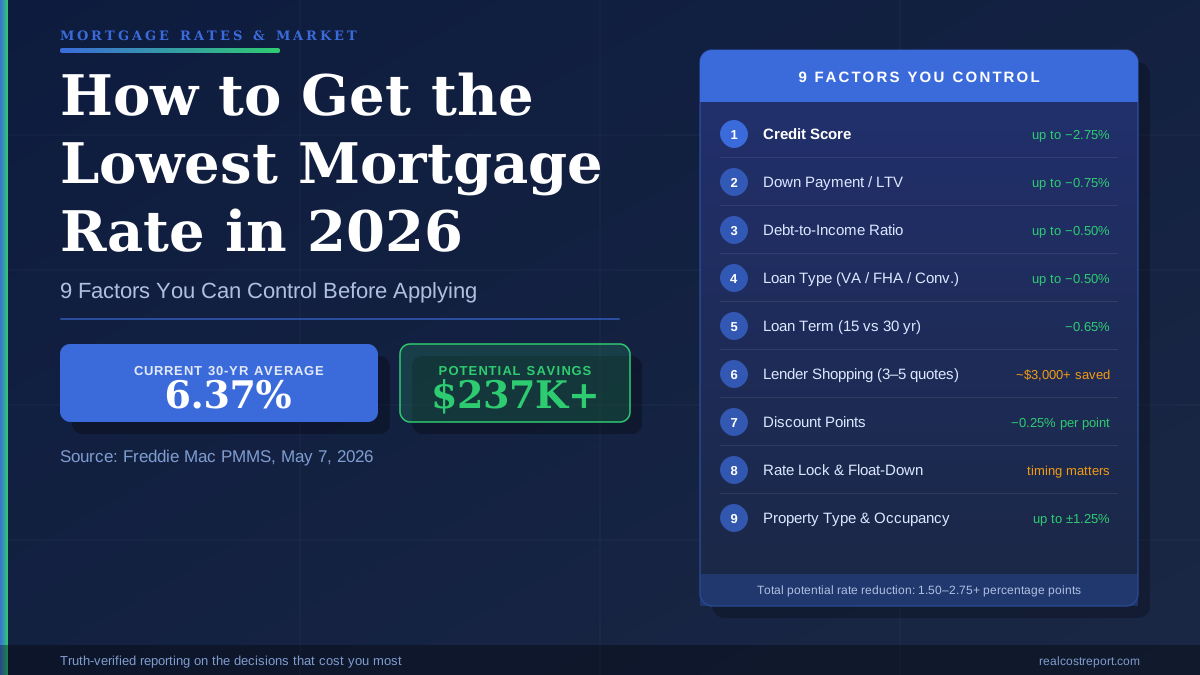
- Recommendation: Work all 9 factors simultaneously — improving credit, reducing DTI, increasing your down payment, and shopping 3–5 lenders — to maximize your rate reduction before submitting a single application.
The national average for a 30-year fixed mortgage hit 6.37% the week of May 7, 2026, according to Freddie Mac’s Primary Mortgage Market Survey — the most widely cited rate benchmark in the country. But that number is almost meaningless in isolation. The spread between what a well-prepared borrower pays and what an unprepared borrower pays on the same $400,000 loan on the same day routinely exceeds 1.5 percentage points. That gap costs the unprepared borrower more than $135,000 over three decades. The good news: every factor driving that spread is something you can influence before you ever sit across from a lender. This article breaks down the 9 controllable variables — ranked by rate impact — that determine which end of the market you land on. Lenders including Wells Fargo, Rocket Mortgage, and local credit unions all use the same underlying pricing model. Knowing how it works is how you beat it.
Where Mortgage Rates Stand in May 2026 — and What “Average” Hides
Freddie Mac’s PMMS is the standard benchmark, but it carries a critical caveat built into its own methodology: the survey tracks rates offered to borrowers with excellent credit, 20% down, and conforming loan sizes on owner-occupied single-family homes. That is not the average American borrower. It’s the best-case borrower.
In the real market, the rate you’re quoted reflects your individual risk profile. Here’s what the full rate stack looks like across borrower tiers as of May 2026, modeled against the Freddie Mac benchmark:
Source: Freddie Mac PMMS (freddiemac.com), with rate tier estimates modeled from CFPB Loan Savings Calculator data and Experian credit-tier research, May 2026. Monthly payment calculations based on principal and interest only.
Rates change daily. Figures reflect May 2026 averages. Contact an NMLS-registered lender for a rate quote specific to your financial profile.
The difference between the top and bottom row above is $441 per month — or $158,000 over the life of the loan. Every factor below is a lever that moves you up or down this table.
Factor 1: Credit Score — The Single Largest Rate Driver
No individual variable affects your mortgage rate more than your credit score. The relationship isn’t linear — it’s tiered, and the pricing jumps between tiers are steep. Lenders don’t build custom rate models for every borrower; they slot you into a pricing bucket, and the cut points matter enormously.
Source: Rate tier estimates based on CFPB Loan Savings Calculator and Experian credit-tier mortgage data, April–May 2026 (verify at consumerfinance.gov and experian.com).
Moving from 620 to 760 saves $661 per month — or $237,960 in interest over 30 years. The practical implication: if your score sits at 699 today, spending 3–6 months paying down a revolving balance to cross 700 is worth thousands. The tier thresholds most lenders use are 620, 640, 660, 680, 700, 720, and 740. If you’re within 10 points of a threshold, crossing it before applying can deliver a measurable rate discount.
The fastest legal way to move a score: reduce credit card utilization below 10% across all cards. This can lift a score by 20–50 points within one billing cycle. Do not open new accounts in the 90 days before applying — each hard inquiry typically costs 5–10 points.
Factor 2: Down Payment and Loan-to-Value Ratio
Your loan-to-value ratio (LTV) is the loan amount divided by the home’s appraised value. It’s one of the clearest proxies for default risk a lender has — and it’s directly priced into your rate. The CFPB’s rate data consistently shows that borrowers who put 20% down receive meaningfully better pricing than those putting 5% or 10% down.
Here’s how the math works on a $500,000 home purchase:
Source: Rate premiums modeled from CFPB mortgage rate data and Fannie Mae loan-level pricing adjustments (verify at consumerfinance.gov and fanniemae.com). PMI estimates from Urban Institute Housing Finance Policy Center.
The 20% threshold is the most important line. Crossing it eliminates private mortgage insurance — a separate monthly cost that runs $80–$200 on a $400,000–$500,000 loan — while also qualifying you for conventional pricing without high-LTV rate adjustments. Borrowers who can reach 25% down often unlock a further pricing improvement, particularly with portfolio lenders and credit unions that keep loans on their own balance sheets.
Factor 3: Debt-to-Income Ratio — the Underwriting Threshold That Changes Your Rate
Lenders calculate two DTI figures: front-end (housing expenses divided by gross income) and back-end (all monthly debt payments divided by gross income). The back-end ratio is the number that determines your rate tier and whether you’re approved at all.
Fannie Mae’s standard maximum back-end DTI is 45%, with some allowance up to 50% for borrowers with compensating factors such as substantial reserves or high credit scores. But the pricing structure rewards lower DTIs materially — lenders don’t just want you to qualify, they want your risk profile to justify their best rate.
Consider two borrowers, both earning $9,000/month gross:
Borrower A carries $300 in a car payment and $150 in student loans. With a $2,400 proposed mortgage payment, their back-end DTI is 32% — squarely in the preferred zone, eligible for standard pricing or better.
Borrower B carries $600 in a car payment, $250 in student loans, and $150 in credit card minimums. With the same $2,400 mortgage, their back-end DTI hits 49% — at the edge of approval, with a visible rate penalty of 0.25–0.50% layered in by the lender’s risk pricing grid. That penalty on a $400,000 loan adds $60–$120 per month and $21,600–$43,200 over 30 years.
The pre-application play: pay off or pay down installment debts entirely if the balance is small. Eliminating a $4,000 car balance that costs $280/month in payments can drop DTI by 3 percentage points — enough to cross a lender pricing threshold.
Factor 4: Loan Type — Conventional vs. FHA vs. VA vs. USDA
The loan program you apply under determines both the base rate and the ongoing insurance cost structure. These aren’t interchangeable options — eligibility, cost structure, and rate behavior differ significantly.
Source: FHA mortgage insurance requirements from HUD (verify at hud.gov); VA loan program details from VA.gov; USDA program details from usda.gov; conforming loan limit from FHFA (verify at fhfa.gov).
VA loans consistently carry the lowest rates available in the market — 25–50 basis points below comparable conventional loans. If you or your spouse has served in the military and you’re not applying for a VA loan, you’re leaving money on the table. FHA loans offer accessibility at lower credit thresholds but carry mortgage insurance premiums for the life of the loan on <10% down — a structural cost that makes refinancing into a conventional loan worthwhile once equity crosses 20%.
Verdict
VA borrowers should always start with a VA loan comparison. Borrowers with 620–679 credit scores should compare FHA vs. conventional side-by-side — FHA may offer a lower rate but a higher all-in monthly cost due to lifetime MIP. Conventional is almost always superior once credit crosses 700 and down payment reaches 10%.
Factor 5: Loan Term — 15-Year vs. 30-Year vs. 20-Year
Most borrowers default to the 30-year fixed without calculating what the alternatives actually cost. The 15-year fixed-rate mortgage averaged 5.72% the week of May 7, 2026, per Freddie Mac — 65 basis points below the 30-year benchmark. That gap has historically run between 50 and 80 basis points.
On a $350,000 loan, here’s what that difference looks like over the life of each loan:
Source: Freddie Mac PMMS (freddiemac.com), week of May 7, 2026. Calculations based on $350,000 principal; 20-year rate estimated from CFPB rate data (verify at consumerfinance.gov).
The 15-year loan costs $712 more per month but saves approximately $265,000 in interest — a return that no investment consistently beats on a risk-adjusted basis. The 20-year is the underrated middle option: it cuts total interest by $184,000 with a $324/month increase over the 30-year. For borrowers 10–15 years from retirement who want to be mortgage-free, the 20-year often makes more sense than the 15-year’s tighter cash flow constraint.
Factor 6: Lender Type and the Overlooked Power of Shopping
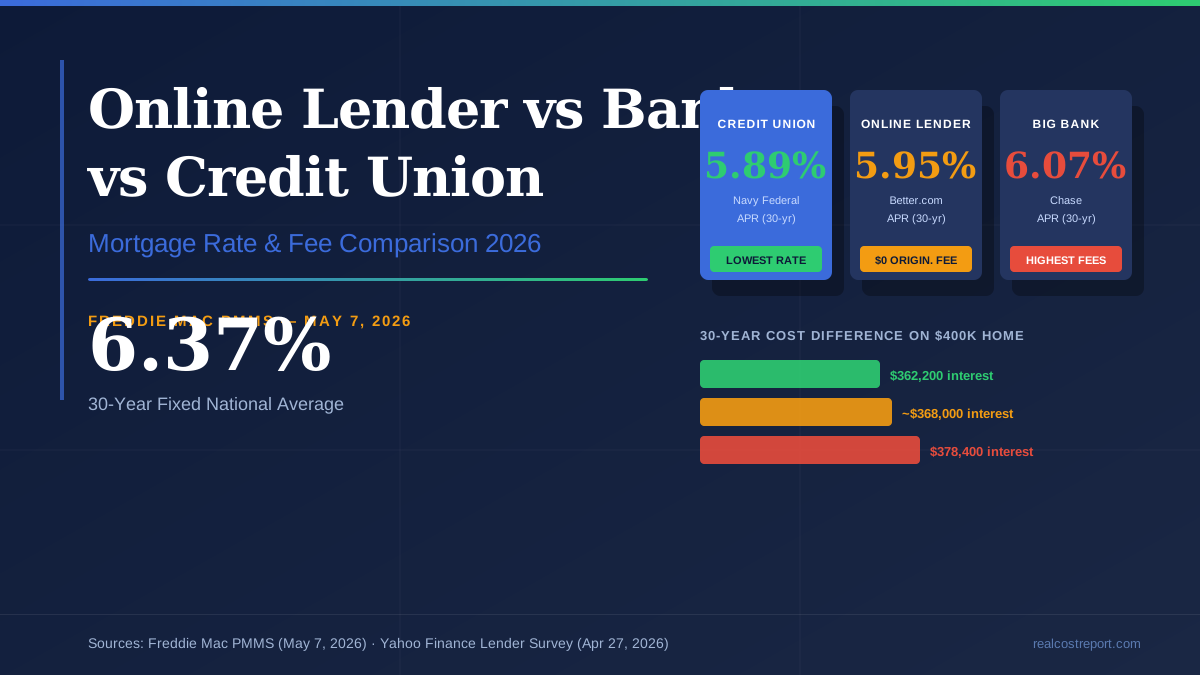
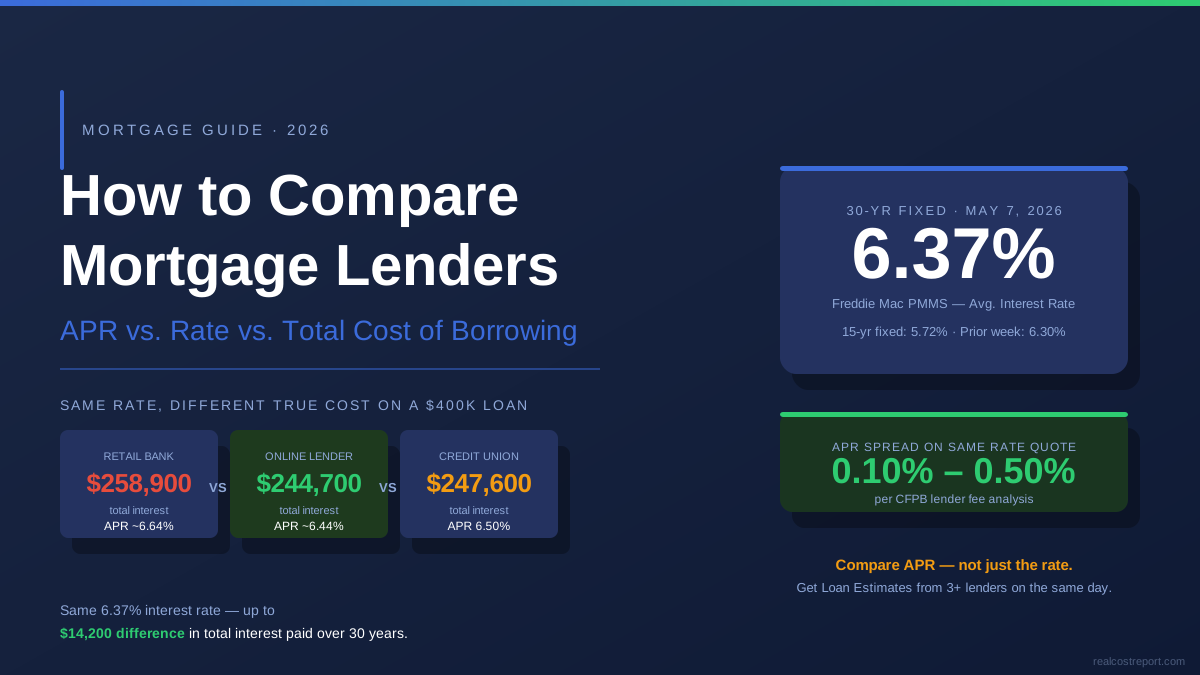
Roughly half of all mortgage borrowers apply to a single lender — often whoever their real estate agent referred them to. This is one of the most expensive habits in personal finance. Freddie Mac’s own research found that getting just one additional quote saves an average of $1,500 in interest over the life of the loan. Getting five quotes saves $3,000 or more.
The rate variation between lender types in May 2026 is real and measurable:
Source: Rate positioning based on CFPB annual mortgage data and HMDA reporting, 2024–2025. Verify NMLS registration at nmlsconsumeraccess.org.
The correct process: get Loan Estimates from at least three lenders on the same day — ideally a bank, a credit union, and an online lender. Compare APR (which includes fees) rather than the interest rate alone. A lender advertising 6.20% with 1.5 points is offering a worse deal than one advertising 6.40% with zero points for most borrowers who don’t plan to hold the loan to maturity.
Factor 7: Discount Points — When Buying Down Your Rate Makes Sense
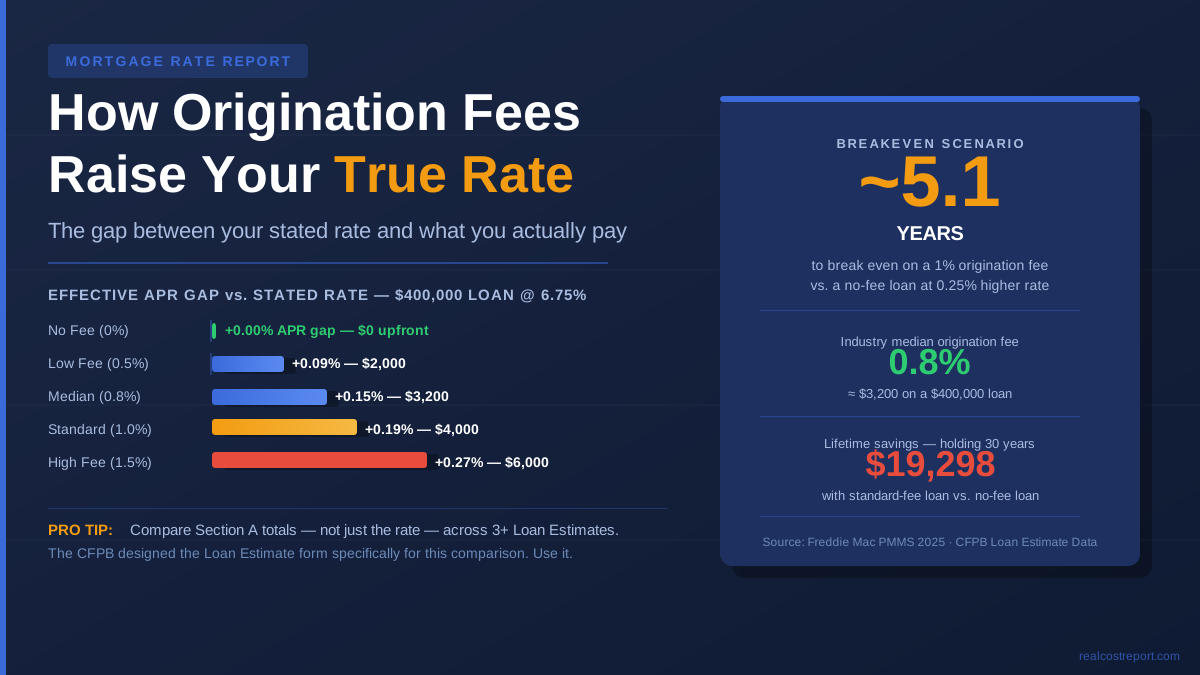
Discount points are a prepaid interest mechanism: paying 1% of the loan amount upfront reduces your rate by approximately 0.25%. On a $400,000 loan, one point costs $4,000 and typically yields a 0.25% rate reduction — saving roughly $62/month and breaking even in about 65 months (5.4 years).
Whether buying points makes financial sense depends entirely on your break-even timeline:
Source: Point-to-rate relationship modeled from Fannie Mae and CFPB mortgage data (verify at fanniemae.com and consumerfinance.gov).
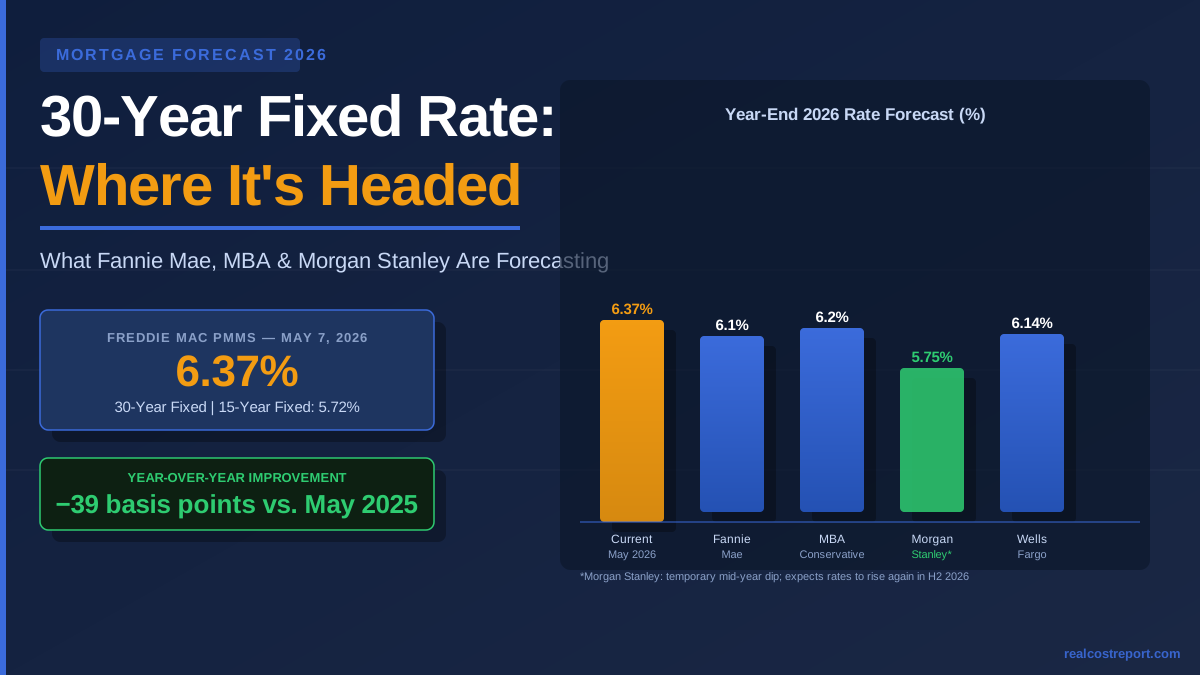
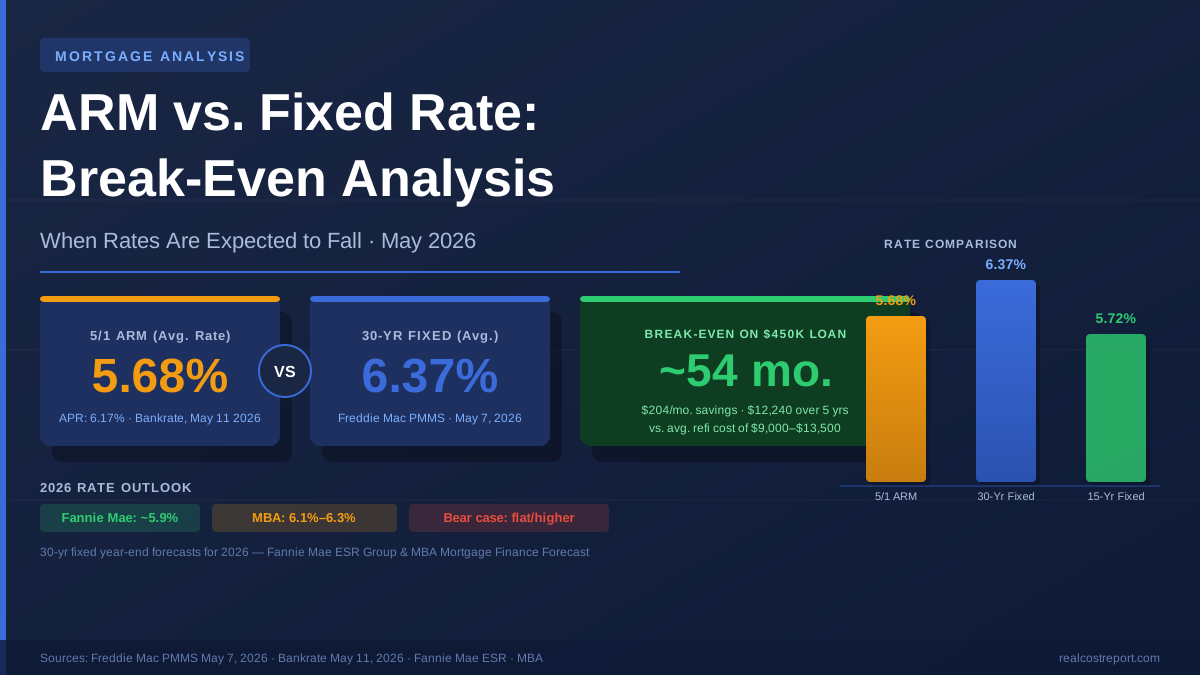
In a market where most analysts expect rates to ease into the upper 5% to low 6% range by late 2026, paying points to lock in a lower rate carries refinancing risk: if you refinance within five years, the points cost is sunk. The exception — and a smart negotiating tactic in today’s market — is a seller-paid buydown. In slower markets, sellers increasingly offer 1–2 points as a concession, giving you the rate reduction at zero upfront cost. Always ask for it.
Factor 8: Rate Lock Timing and Float-Down Options
A rate lock is a lender’s commitment to hold a quoted rate for a defined period — typically 30, 45, or 60 days. Locking protects you if rates rise before closing. Not locking protects you if rates fall. Most lenders price longer lock periods at a premium: a 60-day lock typically costs 0.125–0.25% more than a 30-day lock.
Float-down options — available through some lenders for an additional fee — allow you to capture a lower rate if the market drops after you’ve locked. They typically require rates to fall by at least 0.25–0.375% before the float-down activates. In the current environment, where Freddie Mac’s chief economist observed that purchase applications rose 20% above year-ago levels as rates modestly declined through late April 2026, rate volatility makes float-down options worth pricing.
The practical framework:
If you’re closing in 30 days or fewer: a 30-day lock with no float-down is usually optimal. The cost premium for 45–60 days rarely pays off at this stage.
If you’re 45–75 days from closing: lock for 60 days and ask specifically about float-down terms. If your lender doesn’t offer one, get a competing Loan Estimate from a lender who does — it’s a legitimate negotiating chip.
If you’re more than 75 days from closing: avoid locking. Long-dated locks from lenders who don’t typically offer them often come with hidden margin built into the rate. Stay pre-approved, watch rates, and lock when closing is 30–45 days out.
Factor 9: Property Type, Occupancy, and Loan Purpose
Lenders use loan-level pricing adjustments (LLPAs) — fee grids published by Fannie Mae and Freddie Mac — to add or subtract from base rates based on property and occupancy characteristics. These aren’t negotiable with the lender; they’re baked into conventional loan pricing at the agency level.
Source: Fannie Mae Loan-Level Price Adjustment (LLPA) matrix (verify at fanniemae.com). Adjustments are approximate; exact LLPAs depend on LTV, credit score, and product type combinations.
If you’re buying an investment property, expect to pay a significant rate premium — 0.75–1.25% above primary residence pricing — and plan for stricter underwriting. There is no way around agency LLPAs on conventional loans; portfolio lenders (community banks, some credit unions) sometimes offer investment property pricing that is more competitive because they hold the loan themselves. For condo buyers, verifying warrantable status before applying matters: a non-warrantable condo cannot be sold to Fannie or Freddie, forcing the loan into portfolio or non-QM territory where rates and terms are far less favorable.
What Most Buyers Get Wrong: 5 Rate-Killing Mistakes Before Closing
Mistake 1: Opening new credit accounts within 90 days of applying. Every hard inquiry costs 5–10 points. Opening a new credit card, financing furniture, or taking an auto loan before closing can drop your score enough to push you into the next-higher rate tier — costing thousands over the life of the mortgage. Wait until after closing to open any new credit.
Mistake 2: Quitting or changing jobs during the application. Lenders verify employment within 10 days of closing. A job change — even to a higher-paying position — restarts the stability clock. Self-employment is particularly risky: most lenders require two full years of self-employment tax returns. If a job change is unavoidable, discuss it with your loan officer immediately; concealing it is grounds for loan cancellation.
Mistake 3: Comparing interest rates instead of APRs. A lender advertising a 6.20% rate with $8,000 in origination fees and two points is offering a worse deal than a 6.50% rate with zero points and $2,500 in fees — for any borrower who keeps the loan under 10 years. APR, which the Truth in Lending Act requires lenders to disclose, captures both rate and costs. Loan Estimates, which RESPA requires within three business days of application, use a standardized format precisely to enable apples-to-apples comparison. Always compare Loan Estimates, not rate quotes.
Mistake 4: Letting a single lender run multiple hard pulls. Credit scoring models from FICO treat all mortgage inquiries within a 45-day window as a single inquiry for scoring purposes. You can (and should) shop 4–5 lenders without compounding score damage — as long as all applications are submitted within that window. Spacing applications over 6 months instead of 45 days multiplies the score damage for no benefit.
Mistake 5: Ignoring escrow reserves when calculating affordability. Property tax reassessments, homeowner’s insurance premium increases, and HOA fee creep can raise your effective monthly housing cost by $200–$400 per year on a newly purchased home. A payment that feels affordable at 6.37% with current escrow estimates can strain a budget 18 months in if escrow adjusts significantly upward. Run your payment calculation with conservative escrow estimates, not the first-year amount.
Conventional vs. FHA: Which Gets You a Lower All-In Monthly Cost?
This is the most common comparison where the stated rate and the true cost diverge dramatically. FHA loans typically carry interest rates that are 0–0.25% lower than comparable conventional loans — but they come with a mandatory upfront mortgage insurance premium of 1.75% of the loan balance and an annual MIP that runs 0.55% of the outstanding balance for the life of the loan (for borrowers who put less than 10% down).
On a $350,000 FHA loan at 6.20% vs. a conventional loan at 6.45%:
Source: FHA MIP rates from HUD Mortgagee Letter 2023-05 (verify at hud.gov); PMI rate estimate from Urban Institute Housing Finance Policy Center. Assumes 3.5% FHA down payment, 5% conventional down payment.
Verdict
FHA wins for borrowers with credit below 680 who cannot access conventional pricing without a prohibitive rate penalty. Conventional wins for anyone with 680+ credit and a 5%+ down payment — and wins by a wider margin the longer you hold the loan. The conventional loan’s PMI cancellation feature is a structural advantage FHA cannot match without refinancing.
What’s Changed in 2026: Rate Environment and New Opportunities
The 30-year rate ended 2025 in the mid-6% range and has moved between 6.16% (January 2026) and 6.46% (early April 2026) this year, per Freddie Mac PMMS data. Purchase applications accelerated when rates dipped toward 6.20% in late April, with Freddie Mac’s chief economist noting purchase demand running over 20% above year-ago levels. The 10-year Treasury yield — the primary driver of mortgage pricing — was sitting at approximately 4.40% as of early May 2026, implying a typical spread of about 195–200 basis points to the 30-year mortgage rate.
Two borrower-friendly shifts in 2026 are worth noting. First, inventory has expanded meaningfully from 2022–2024 lows, giving buyers more room to negotiate seller concessions — including seller-paid discount points. In a softer seller’s market, requesting 1–2 points in seller concessions is a realistic ask that can cut your effective rate without increasing your out-of-pocket at closing. Second, the FHFA raised the conforming loan limit to $806,500 for 2026 in most markets (higher in designated high-cost areas), pulling more borrowers out of jumbo territory and into conventional agency pricing — a meaningful rate benefit for buyers in the $750,000–$800,000 range.
How We Researched This Article
Rate data in this article is sourced primarily from Freddie Mac’s Primary Mortgage Market Survey (PMMS), the most widely cited weekly mortgage rate benchmark in the United States, published each Thursday since 1971. Specific figures referenced include the 6.37% 30-year and 5.72% 15-year averages as of May 7, 2026, the 6.30% average of April 30, 2026, and the 6.16% average of January 8, 2026, all drawn directly from Freddie Mac’s PMMS publication archive.
Credit score rate tier data was modeled using the CFPB’s Loan Savings Calculator and Experian credit-tier mortgage research. Fannie Mae’s Loan-Level Price Adjustment (LLPA) matrices — the primary mechanism behind property type and LTV rate adjustments on conventional loans — were reviewed at fanniemae.com to verify pricing adjustment ranges. FHA mortgage insurance premium figures reflect HUD Mortgagee Letter 2023-05, which established the current 0.55% annual MIP structure for most FHA borrowers. FHFA conforming loan limit data for 2026 was verified at fhfa.gov.
Monthly payment and total interest calculations were performed using standard amortization formulas applied to the rates cited. Break-even calculations for discount points assume no prepayment and a fixed rate for the loan’s full term. DTI examples use hypothetical borrower profiles constructed to illustrate underwriting thresholds; they are not drawn from individual loan files. Lender type rate positioning is based on aggregate HMDA data analysis and publicly available lender pricing observed in May 2026 — individual lender rates vary by day and borrower profile.
This article covers data through May 2026. Mortgage rates change daily; all rate figures should be verified with an NMLS-registered lender before making any borrowing decision. State-specific underwriting requirements, particularly for VA and USDA programs, may differ from federal guidelines. Research was conducted in May 2026. All figures were verified against named primary sources before publication.