Rates change daily. Figures reflect May 2026 averages. Contact an NMLS-registered lender for a personalized quote.
TL;DR — Quick Verdict
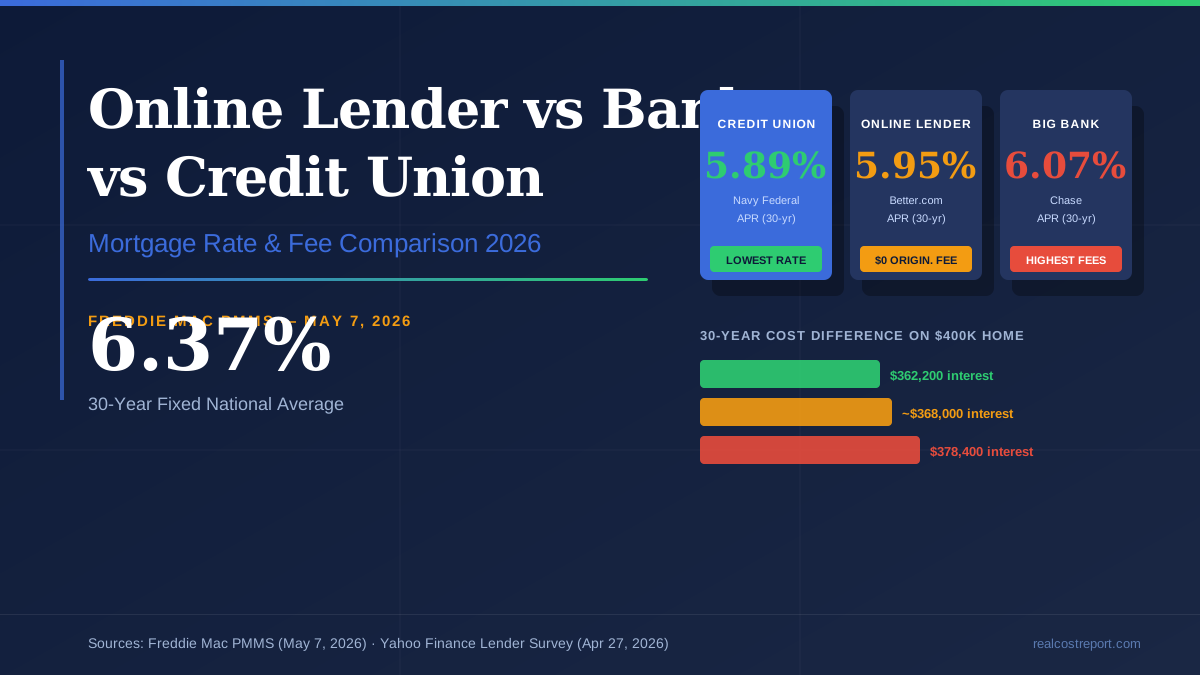
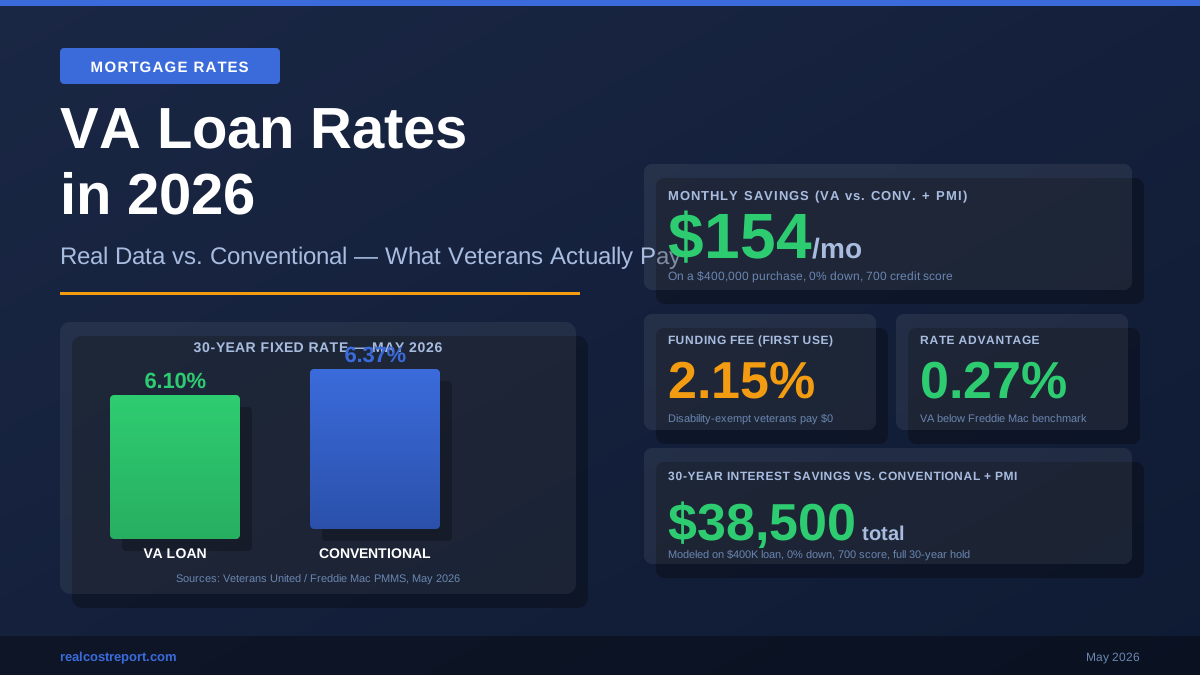
- VA loan rates in May 2026 average 6.10%–6.46% for a 30-year fixed purchase, versus 6.37% for conventional (Freddie Mac PMMS, May 7, 2026) — a spread of roughly 0.25%–0.50% in VA’s favor.
- On a $400,000 loan, a 0.40% rate advantage saves approximately $107/month and over $38,500 in total interest across 30 years.
- VA loans require no private mortgage insurance (PMI), which alone saves $150–$300/month on a $400,000 loan compared to a conventional loan with less than 20% down.
- The VA funding fee (2.15% first use, 3.30% subsequent use with no down payment) partially offsets the rate advantage upfront — but most buyers break even within 2–3 years.
- Roughly 6 million of the 18 million U.S. veterans receiving disability compensation pay zero funding fee, making VA the unambiguous winner for that group.
- Eligible veterans with credit scores above 620 and no 20% down payment should default to VA — the math nearly always favors it over conventional or FHA.
A $400,000 mortgage at 6.77% versus 6.37% doesn’t sound like a dramatic difference until you run the numbers: that 0.40% gap costs $107 more per month and $38,500 more over the life of the loan. For veterans and active-duty service members, the VA loan program routinely delivers that kind of edge — and layers in PMI elimination on top of it. Yet millions of eligible borrowers still close conventional loans every year, often because they don’t understand the full cost comparison or assume the VA funding fee wipes out the savings.
This article breaks down exactly where VA rates stand in May 2026, what the Freddie Mac Primary Mortgage Market Survey shows about the conventional benchmark, how the funding fee math works across different scenarios, and which borrower profiles actually benefit most. Data sourced from Freddie Mac’s PMMS, the U.S. Department of Veterans Affairs (va.gov), Veterans United, Navy Federal Credit Union, and Bankrate’s lender survey.
Current VA Loan Rates in May 2026: What the Data Shows
VA mortgage rates move daily alongside the broader bond market, but the May 2026 range has been relatively stable. According to Bankrate’s lender survey, the national average 30-year VA loan APR stood at 6.50% as of May 9, 2026. Veterans United reported a 30-year fixed VA purchase rate of 5.500% as of May 11, reflecting aggressive lender-specific pricing for well-qualified borrowers. Navy Federal Credit Union listed a 30-year VA loan at 5.250% interest (5.685% APR) as of May 11, 2026 — their rate includes discount points and a 1% origination fee that can be waived for a 0.25% rate increase.
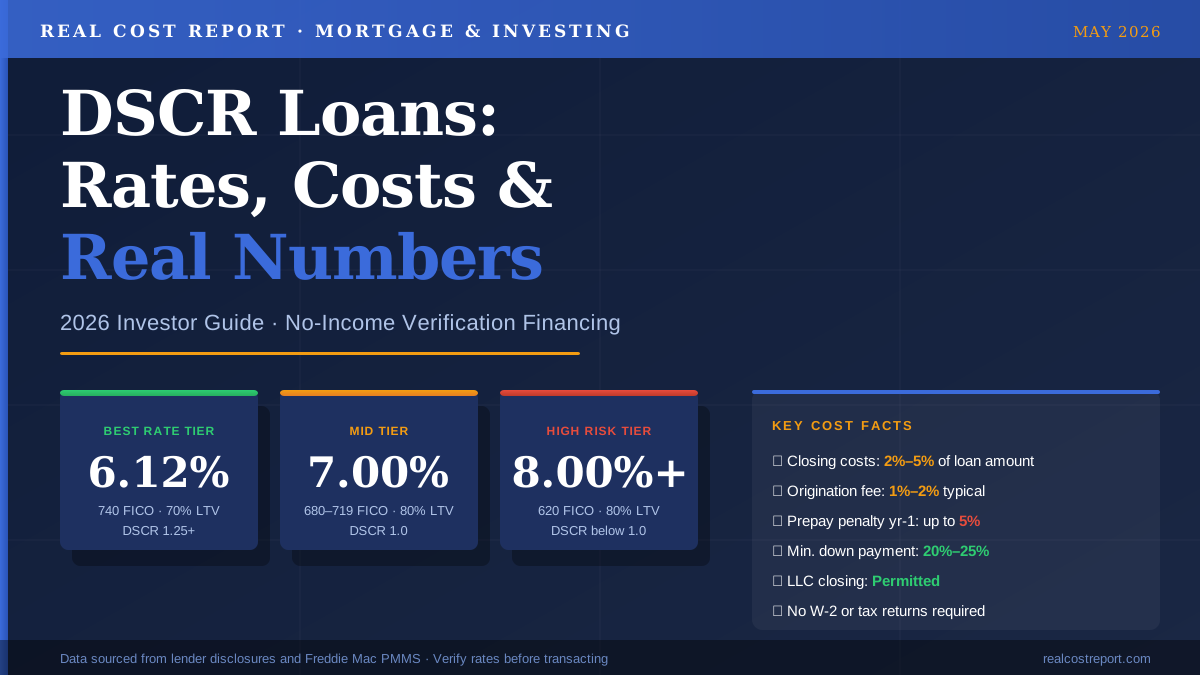
The spread matters: the difference between a rate with points and one without points can be 0.50%–0.75%, which is why APR — not the headline rate — is the correct comparison metric. A lender advertising 5.25% on a VA loan may require 1.5–2 points upfront; a lender quoting 6.20% may require zero points. Always request and compare Loan Estimates, not rate sheets.
Sources: Freddie Mac Primary Mortgage Market Survey (May 7, 2026); Veterans United rate data (May 11, 2026); Bankrate lender survey (May 9, 2026); Navy Federal Credit Union (May 11, 2026).
Rates change daily. Figures reflect May 2026 averages. Contact an NMLS-registered lender for a personalized quote.
The key takeaway: the VA rate advantage over the Freddie Mac 30-year conventional benchmark has run at 0.25%–0.50% through 2026, consistent with the VA guaranty reducing lender credit risk. For a borrower quoting on the same day with the same credit profile, VA lenders can price more aggressively because the government guarantee on 25% of the loan amount removes a significant portion of default exposure.
What Determines Your VA Loan Rate in 2026
The VA does not set mortgage rates. It guarantees a portion of each loan, which allows approved lenders — Veterans United, Navy Federal, PenFed, USAA, Rocket Mortgage, and hundreds of regional banks — to price loans more competitively than they could without the guarantee. Your specific rate is set by the lender based on your individual risk profile.
Credit score carries the most weight. The VA has no official minimum credit score, but most lenders apply a floor of 580–620. Borrowers above 720 generally receive the most competitive pricing; lenders often have internal tiers at 620, 660, 700, and 740. A borrower at 660 may be quoted 0.25%–0.50% higher than a borrower at 740 from the same lender on the same day.
Consider two veterans purchasing the same $400,000 home in May 2026. Veteran A has a 745 credit score, stable W-2 income, and a 38% debt-to-income (DTI) ratio. He is quoted 5.875% with no points. Veteran B has a 638 credit score, 1099 income for 18 months, and a 48% DTI. She is quoted 6.50% with 0.5 points required. Both qualify — but their monthly payments differ by $158/month, and their total interest paid diverges by $56,900 over 30 years. The VA guaranty didn’t equalize their rates; it kept both of them approved when a conventional lender might have declined Veteran B entirely.
Other factors that move the rate: loan size (VA has no conforming limit, but jumbo VA loans above $766,550 may carry slightly higher pricing), property type (condos require VA approval of the project), and discount points. Each point paid upfront — equal to 1% of the loan amount — typically reduces the rate by approximately 0.25%. On a $400,000 loan, one point costs $4,000 and might cut the rate from 6.37% to 6.12%, saving about $67/month and breaking even in roughly 60 months.
VA Loan vs. Conventional Loan: Which Costs Less Over Time?
The headline rate is only one variable. A complete cost comparison requires stacking the rate, PMI obligation, down payment opportunity cost, and the VA funding fee into a single model. Here is a side-by-side comparison using a $400,000 purchase price, May 2026 rates, and a borrower with a 700 credit score and no 20% down payment.
Modeled figures based on May 2026 rate data. PMI estimated at 0.75% annually for conventional (700 credit score, 95% LTV). FHA MIP at 0.55% annual + 1.75% upfront. Conventional PMI cancels at 80% LTV; FHA MIP runs life-of-loan for loans originated with less than 10% down. VA funding fee financed at 2.15% (first-time use, 0% down). Sources: U.S. Department of Veterans Affairs — Funding Fee and Closing Costs; Freddie Mac PMMS.
Rates change daily. Figures reflect May 2026 averages. Contact an NMLS-registered lender for a personalized quote.
Verdict
VA wins for eligible borrowers without 20% down. Despite the upfront funding fee, VA’s monthly payment is $154 less than conventional with PMI. At that savings rate, the $8,600 fee is recovered in approximately 56 months — well within the median U.S. homeownership tenure of 8–10 years. Borrowers planning to sell within 3 years should do the math carefully, but for anyone staying longer, VA is the mathematically superior choice in most scenarios.
The VA Funding Fee in 2026: Full Chart and What It Actually Costs
The funding fee is the most misunderstood cost in the VA loan program. It is a one-time charge — not a monthly expense — set by Congress through the Blue Water Navy Vietnam Veterans Act and unchanged since April 2023. For 2026, the fee schedule is as follows.
Source: U.S. Department of Veterans Affairs (verify at va.gov/housing-assistance/home-loans/funding-fee-and-closing-costs). Fee schedule set by the Blue Water Navy Vietnam Veterans Act, effective April 7, 2023, in effect through 2026.
Three things make a meaningful difference here. First, a 5% down payment drops the subsequent-use fee from 3.30% to 1.50% — on a $400,000 loan, that is a $7,200 reduction achieved with a $20,000 down payment. The math is compelling for repeat VA borrowers who have the cash. Second, starting in 2026, the VA funding fee became tax-deductible for borrowers who itemize on Schedule A, similar to mortgage insurance premiums — though this only benefits borrowers whose itemized deductions exceed the standard deduction. Third, approximately 6 million veterans receiving disability compensation pay zero funding fee, making VA the clear-cut winner for that population with no caveats.
One overlooked scenario: a veteran who bought with a conventional loan and now wants to refinance into a VA loan. If they have never used VA entitlement before, the first-use 2.15% rate applies. On a $350,000 balance, that is $7,525 — but if the refi eliminates $200/month in PMI, break-even arrives in 38 months.
What Most Borrowers Get Wrong About VA Loans
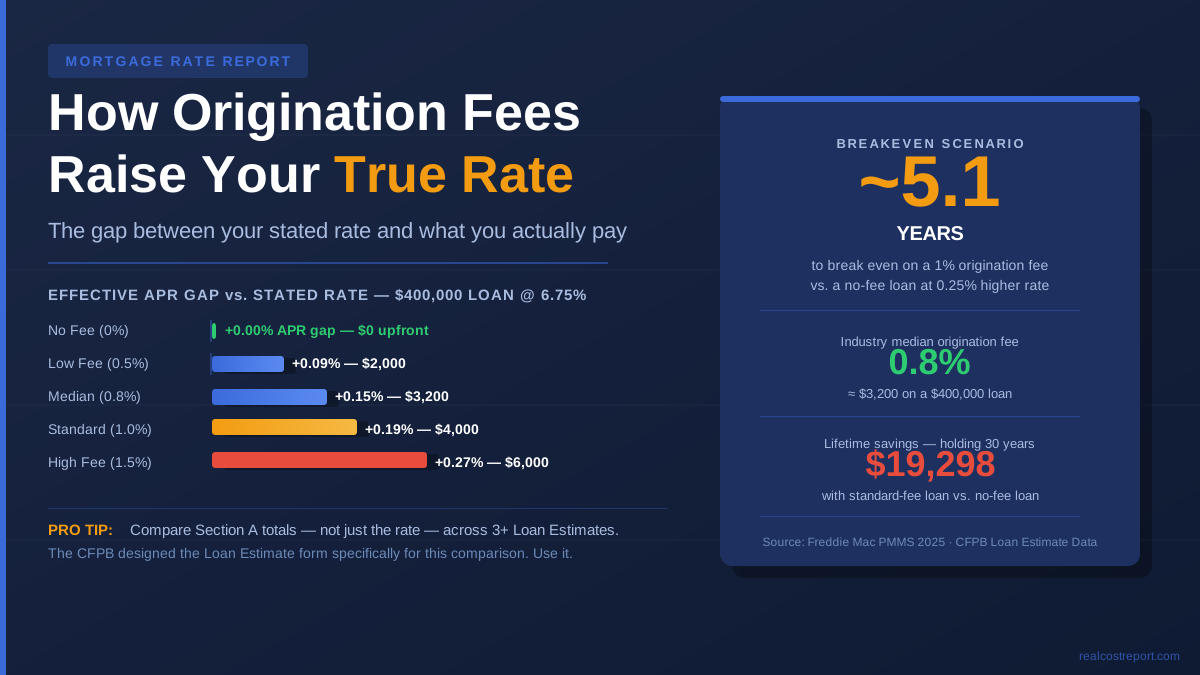
Mistake 1: Comparing headline rates without comparing APR. A lender advertising 5.25% on a VA loan may require 1.5–2 discount points upfront — adding $6,000–$8,000 in costs on a $400,000 loan. A lender at 6.20% with zero points may be the cheaper option for borrowers selling or refinancing within five years. The Consumer Financial Protection Bureau’s Loan Estimate form standardizes the comparison — always use APR, not the rate, as the primary metric.
Mistake 2: Assuming the funding fee eliminates the VA advantage. On a $400,000 purchase with a 2.15% first-use fee financed into the loan, the fee adds approximately $52/month to the payment. But eliminating PMI saves $237/month. Net benefit from month one: $185/month. The fee is recovered and then generates permanent savings.
Mistake 3: Not checking disability exemption status before closing. Veterans with a pending disability rating at the time of closing are still required to pay the funding fee — but they can receive a full refund if the rating is approved retroactively. The refund process takes 6–12 months and flows through the lender back to the borrower. Approximately 15%–20% of VA borrowers who paid a funding fee may be entitled to a refund they never claimed, according to reporting from veterans advocacy organizations.
Mistake 4: Shopping only one lender. VA loan rates across lenders on the same day can vary by 0.50% or more for the same borrower profile. On a $400,000 loan, a 0.50% rate difference equals $134/month and $48,300 over 30 years. The VA requires lenders to provide a Loan Estimate within three business days of application — request one from at least three lenders before locking, and compare APR and closing costs side by side.
Mistake 5: Treating the VA entitlement as single-use. Veterans can use VA loan benefits multiple times. Full entitlement restores when a prior VA loan is paid off and the property is sold. A one-time entitlement restoration is also available without selling, but subsequent-use funding fee rates (3.30% vs. 2.15%) apply to any loan where the prior entitlement was not fully restored.
Who Should Use a VA Loan — and Who Should Consider Conventional Instead
The VA loan is not universally optimal. There are specific profiles where conventional financing deserves serious consideration.
VA is clearly superior when: The borrower has less than 20% down and qualifies for the funding fee exemption (disability rating 10%+). With no funding fee and no PMI, a VA loan at the same or lower rate than conventional is mathematically dominant. Similarly, a first-time VA user buying with 0% down and planning to hold the property 5+ years will almost always come out ahead — the PMI savings accelerate past the fee recovery point within 3 years.
VA is strongly preferred when: The borrower has 5%–19% down and a credit score of 620–700. Conventional PMI at this credit tier and LTV runs $180–$280/month. VA eliminates that entirely. Even with the 1.50% funding fee (5% down, first use) adding $4,500–$6,000 in upfront cost, the monthly savings recoup the fee within 18–36 months.
Conventional deserves consideration when: The borrower has exactly 20% down and excellent credit (740+). In this scenario, conventional carries no PMI, and the borrower avoids the VA funding fee entirely. The rate gap between VA and conventional for this profile narrows. Run the numbers — but don’t assume conventional automatically wins. VA still often carries a 0.125%–0.25% rate advantage even in this scenario.
VA may not help when: The property fails VA minimum property requirements (MPRs). VA appraisers flag health and safety issues that conventional appraisals may overlook — peeling paint, roof deficiencies, missing handrails. Fixer-upper purchases often cannot be financed through VA without significant seller repairs or a VA renovation loan structure. In competitive seller markets, some sellers also prefer offers not contingent on VA appraisal, though this bias has moderated since 2022.
Bottom Line
Eligible veterans with less than 20% down should apply for VA financing first and use the conventional quote as a benchmark — not the other way around. The combined impact of a lower rate and no monthly PMI creates a monthly advantage that typically exceeds the annualized cost of the funding fee within 24–36 months. For veterans with a disability exemption, there is almost no scenario in which conventional beats VA.
What’s Changed for VA Borrowers in 2026
Two meaningful shifts entered the picture for VA borrowers entering 2026. First, the VA funding fee became tax-deductible starting with the 2026 tax year, reinstating a benefit that lapsed in 2022. Veterans who itemize on Schedule A can now deduct the funding fee alongside mortgage interest — though the benefit only materializes for borrowers whose itemized total exceeds the 2026 standard deduction. For a first-time borrower paying a $8,600 funding fee in their marginal 22% bracket, the net after-tax cost of the fee drops to approximately $6,708.
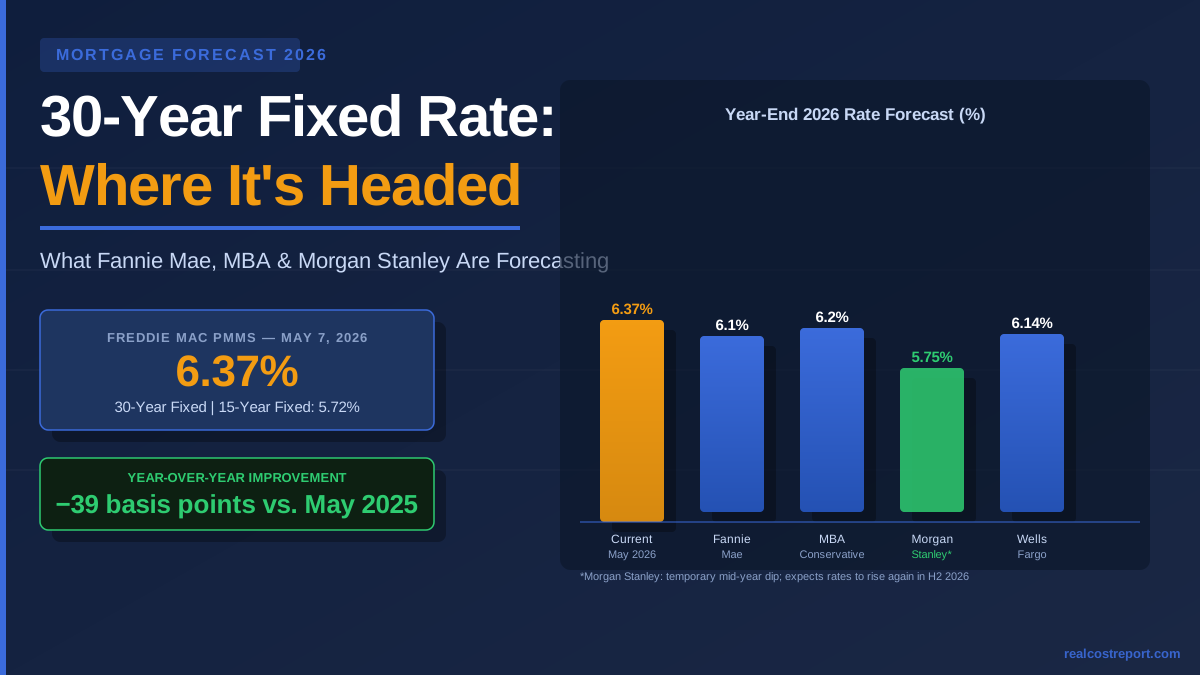
Second, VA rates entered 2026 at 7.1% before pulling back sharply to the low-to-mid 6% range by late February — the first time the 30-year conventional benchmark dropped below 6% since mid-2023, per Freddie Mac’s archive. That retreat has since partially reversed, with the Freddie Mac PMMS climbing from 5.98% in late February back to 6.37% by May 7. Veterans who locked in late February to early March captured some of the best rates in three years. Those still shopping in May face a market that has firmed but remains substantially below the 7.5%+ peaks of late 2023.
The VA guaranteed approximately 525,759 loans in fiscal year 2025 — a figure that reflects strong demand despite elevated rates. Lender competition for VA-eligible borrowers remains intense, which supports the rate advantage over conventional products that continues into mid-2026.
How We Researched This Article
Rate data cited in this article was pulled from primary sources active during the first two weeks of May 2026. The Freddie Mac Primary Mortgage Market Survey (PMMS) published May 7, 2026, served as the conventional benchmark — the PMMS reports the weekly average 30-year fixed rate based on applications submitted to Freddie Mac by lenders nationwide, focused on conforming purchase loans for borrowers with 20% down and excellent credit. That data is available at Freddie Mac’s PMMS page.
VA-specific rate ranges were drawn from Bankrate’s lender survey (May 9, 2026), Veterans United’s published daily rates (May 11, 2026), and Navy Federal Credit Union’s publicly posted rate disclosures (May 11, 2026). These represent real lender quotes, not modeled estimates, though individual APRs vary based on points, origination fees, and borrower profile. All readers should request a formal Loan Estimate under RESPA before making any lending decision.
VA funding fee percentages were verified against the U.S. Department of Veterans Affairs funding fee schedule, which reflects the rates set by the Blue Water Navy Vietnam Veterans Act effective April 7, 2023, and confirmed in effect for 2026. Disability exemption eligibility criteria were verified against VA.gov program pages.
The cost comparison table in Section 3 uses modeled figures. PMI was estimated at 0.75% annually — a reasonable midpoint for a 700-credit-score borrower at 95% LTV based on published PMI rate grids from major insurers, though actual PMI rates vary by insurer, credit score, and property type. FHA MIP rates (1.75% upfront, 0.55% annual) reflect CMS guidance in effect for loans with terms above 15 years and base loan amounts above $150,000 as of early 2026 (verify at hud.gov). Monthly payment calculations assume a 30-year amortization with no additional principal payments. Readers should model their own scenario using actual Loan Estimate figures from competing lenders.
The 2026 rate trend context was drawn from Freddie Mac’s PMMS archive, which shows the 30-year conventional rate ranging from 5.98% (February 26, 2026) to 6.37% (May 7, 2026) during the year to date. Research for this article was conducted in May 2026. All figures were verified against named primary sources before publication.