Rates change daily. Figures reflect May 2026 averages from Freddie Mac’s Primary Mortgage Market Survey. Contact an NMLS-registered lender for a personalized rate quote.
TL;DR — Quick Verdict
- The Federal Reserve does not set mortgage rates — the 10-year U.S. Treasury yield does, and the two regularly move in opposite directions.
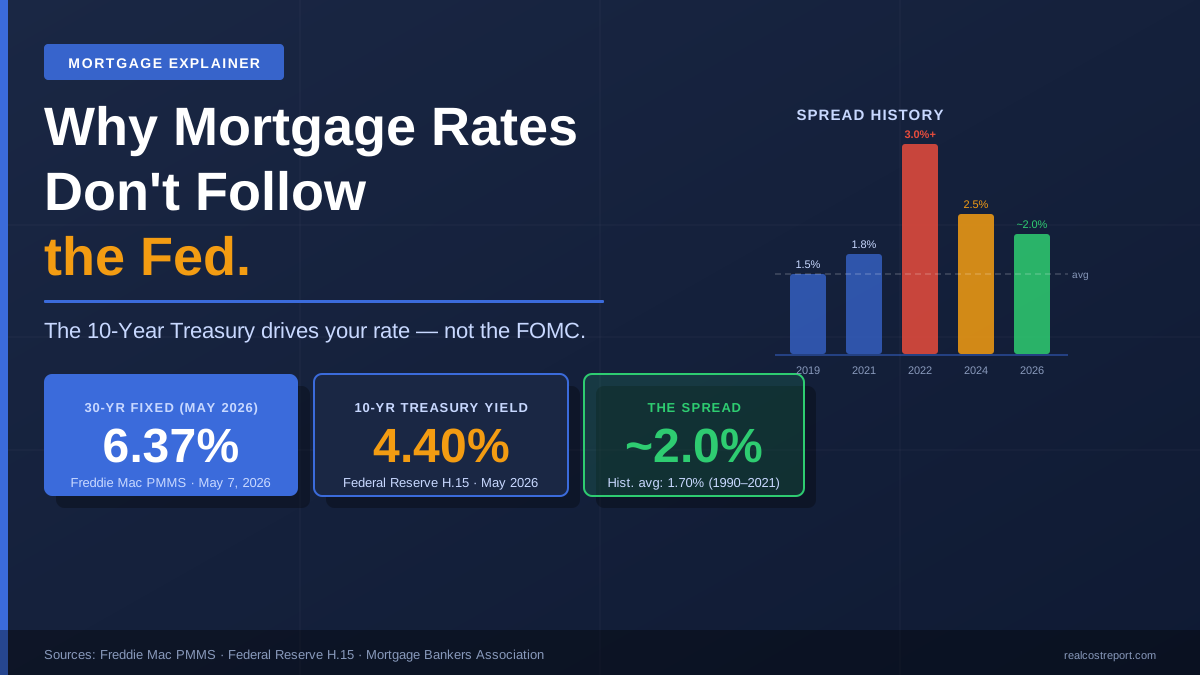
- As of May 7, 2026, Freddie Mac’s PMMS puts the 30-year fixed at 6.37%, while the 10-year Treasury yields approximately 4.4% — a spread of roughly 2.0 percentage points.
- The long-term historical spread between the 30-year fixed rate and the 10-year Treasury is about 1.7 percentage points; today’s elevated gap costs a typical borrower an extra $80–$130 per month on a $350,000 loan.
- When the Fed cut its benchmark rate by 100 basis points in late 2024, the 10-year Treasury yield rose by 114 basis points — mortgage rates followed Treasuries up, not the Fed down.
- Mortgage-backed securities (MBS) demand, Federal Reserve quantitative tightening, and inflation expectations are the three forces that drive the spread beyond the Treasury yield.
- Borrowers waiting for Fed cuts to reduce their rate are tracking the wrong indicator — watch the 10-year Treasury and MBS spread instead.
The Fed cut interest rates three times in 2024. Mortgage rates went up. To anyone who had been waiting for the Fed to move before locking a rate with a lender like Rocket Mortgage or United Wholesale Mortgage, that felt like a betrayal. It wasn’t. It was a mechanics problem: most borrowers are watching the wrong number. The Federal Reserve controls the overnight lending rate between banks — a short-term instrument that has almost no direct connection to the 30-year fixed mortgage rate sitting on your pre-approval letter. According to Fannie Mae’s Housing Insights research, mortgage rates are primarily benchmarked to the 10-year Treasury note, not the federal funds rate. Understanding that single distinction — and the spread that sits on top of it — is worth thousands of dollars to anyone who is buying, refinancing, or timing a rate lock in 2026. This article maps the full mechanism: how Treasuries price mortgages, what the MBS market adds on top, and exactly what has kept the 30-year rate above 6% even as the Fed has eased policy.
Current Rates vs. the 10-Year Treasury: What the Numbers Actually Show
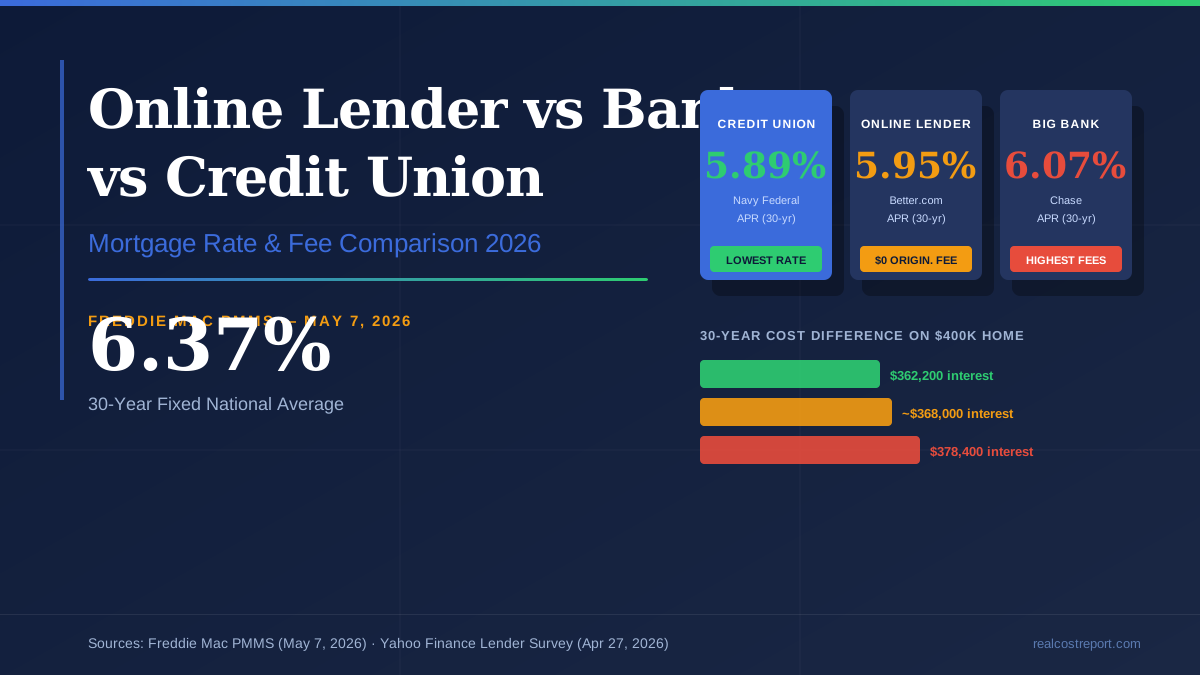
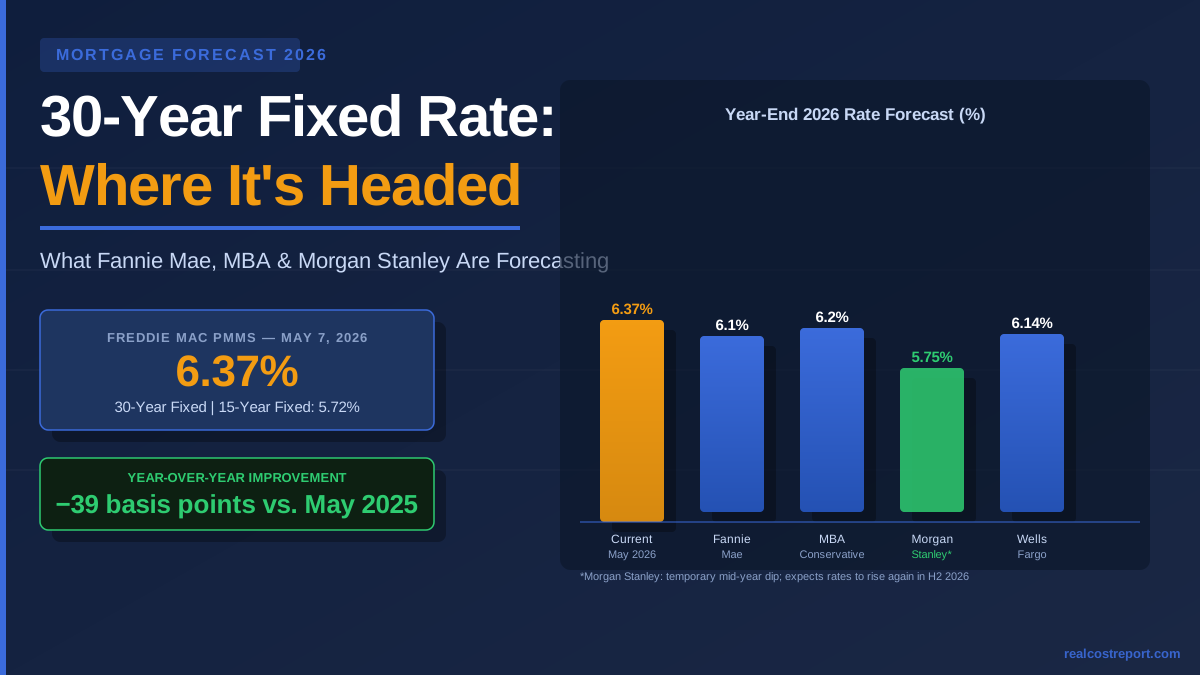
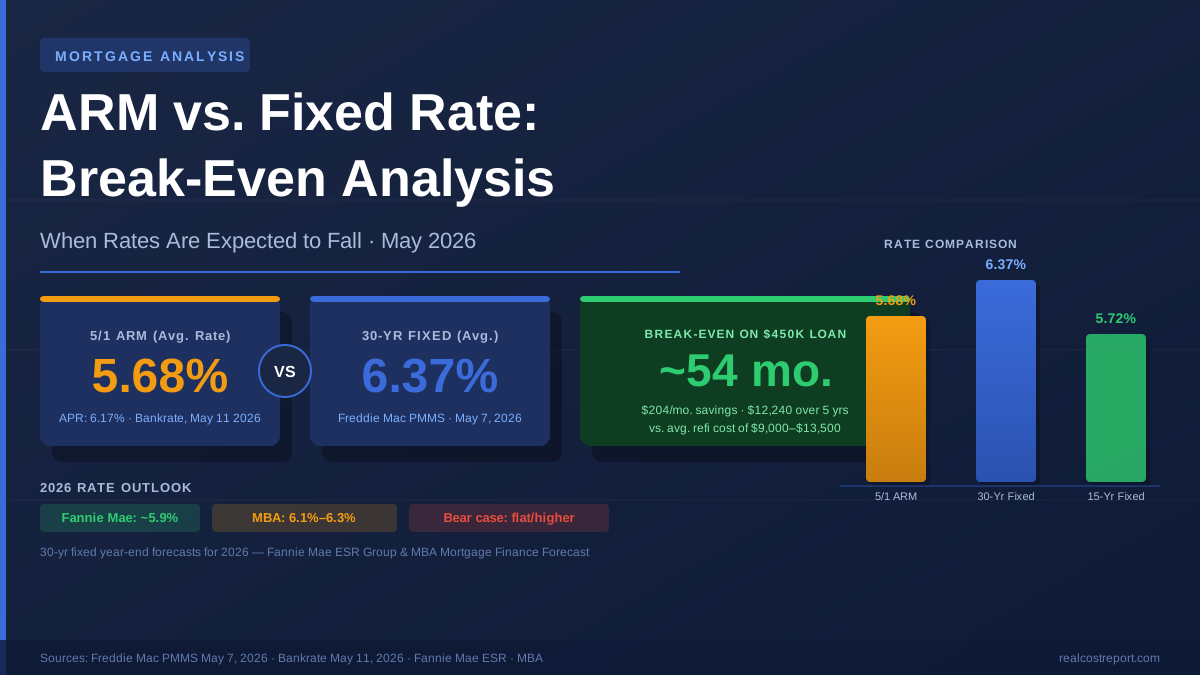
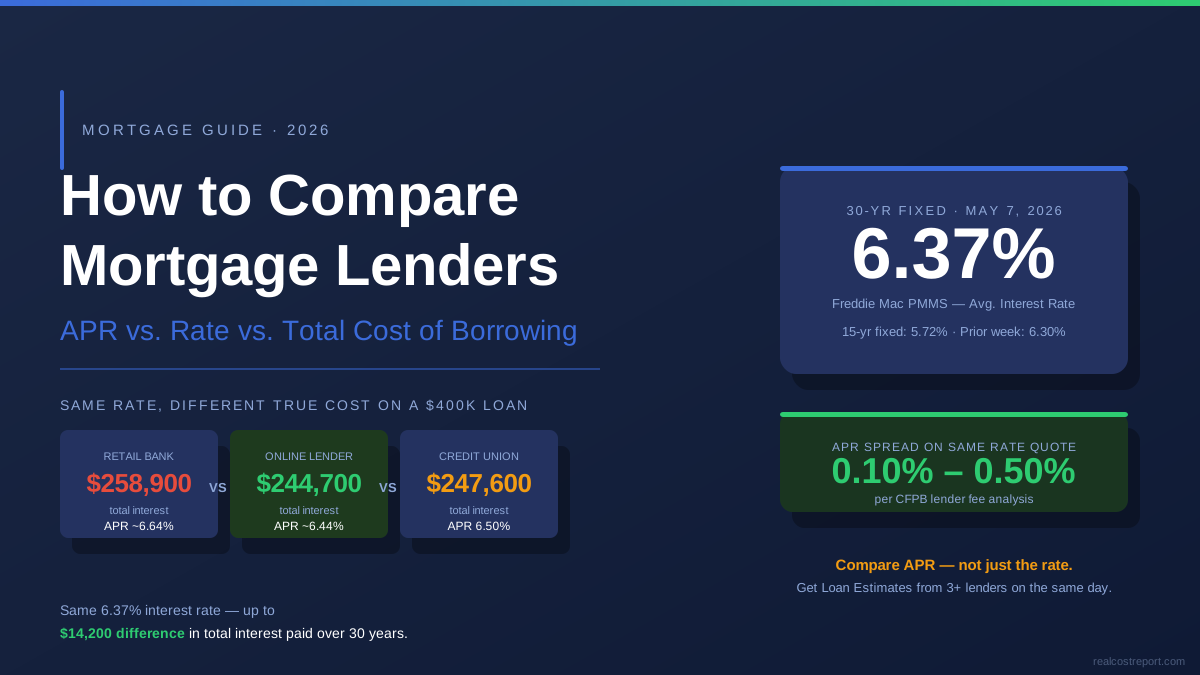
Every Thursday at noon Eastern, Freddie Mac releases its Primary Mortgage Market Survey (PMMS) — the most cited weekly benchmark for conforming mortgage rates in the United States. As of May 7, 2026, the 30-year fixed rate averaged 6.37% and the 15-year fixed averaged 5.72%, per Freddie Mac’s PMMS. That same week, the Federal Reserve’s H.15 release showed the 10-year Treasury constant maturity yield hovering near 4.4%. The arithmetic gap between those two figures — approximately 2.0 percentage points — is called the spread, and it is the central variable that most borrowers never examine.
Context matters here. The Mortgage Bankers Association documented that between 1990 and 2021, the spread between the 30-year fixed rate and the 10-year Treasury averaged around 170 basis points (1.7 percentage points). Today’s 200-basis-point gap is not catastrophic by historical standards, but it is meaningfully above normal — and it translates directly into borrower cost. On a $350,000 loan, a spread of 2.0% versus the historical average of 1.7% adds roughly $60 per month. On a $500,000 loan, that gap exceeds $85 per month, compounding over a 30-year term into real money.
Sources: Freddie Mac Primary Mortgage Market Survey (freddiemac.com); Federal Reserve H.15 Statistical Release (federalreserve.gov); Mortgage Bankers Association Chart of the Week, May 2024 (verify at mba.org)
Rates shown are sample averages. Your premium varies by risk profile, state, and insurer.
The February 2026 reading of 5.98% — the first time the 30-year rate dropped below 6% in three and a half years, per Freddie Mac — illustrates how quickly these numbers move when Treasury yields pull back. By early May 2026 the rate had climbed back to the mid-6% range, driven not by any Fed policy change but by renewed upward pressure on the 10-year yield.
How the Mortgage Rate Machine Actually Works: Treasuries, MBS, and the Spread
The path from a Federal Reserve meeting to the rate on your Loan Estimate involves four distinct steps, and the Fed controls only the first one — partially.
Step 1: The Fed sets the overnight rate. The federal funds rate is the interest rate at which banks lend reserves to each other overnight. As of May 2026, that target range sits at 3.50% to 3.75%, per the Federal Reserve. This rate governs credit cards, home equity lines of credit (HELOCs), and car loans — all shorter-duration instruments. It has a negligible direct effect on the 30-year fixed.
Step 2: The bond market prices long-term expectations. The 10-year Treasury yield reflects what investors collectively believe about inflation, economic growth, and the path of interest rates over the next decade. When inflation expectations rise, investors demand higher yields to compensate — and the 10-year moves up. When recession fears climb, investors pour money into Treasuries as a safe haven, pushing prices up and yields down. The Federal Reserve Bank of Richmond has documented that mortgage rates and 10-year Treasury yields have moved in tandem for more than 30 years.
Step 3: Mortgage-backed securities add a premium. When you take out a 30-year mortgage, your lender almost always sells that loan within weeks to Fannie Mae, Freddie Mac, or Ginnie Mae — the government-sponsored enterprises (GSEs) that pool those loans into mortgage-backed securities (MBS). Those MBS are then sold to institutional investors — pension funds, insurance companies, sovereign wealth funds. MBS investors demand a yield premium above Treasuries to compensate for two risks unique to mortgage debt: prepayment risk (borrowers refinance when rates fall, cutting off future interest income) and credit risk (the possibility of default). This premium is called the secondary mortgage spread.
Step 4: Lenders add their own margin. Lenders price your loan against wholesale MBS rates and add a margin for operational costs, profit, and your specific file — credit score, loan-to-value ratio, debt-to-income ratio, property type. Two borrowers can close on the same day with materially different rates if one has a 780 FICO and 20% down while the other carries a 680 FICO and 5% down.
Consider a concrete scenario. In March 2026, the 10-year Treasury yielded approximately 4.09%. The secondary spread added roughly 1.5–1.6 percentage points, pushing MBS yields to about 5.6–5.7%. Lenders added their margin of 30–40 basis points, producing a conforming rate of approximately 6.00% — exactly where Freddie Mac’s PMMS landed that week. No Fed action required.
Fed Rate Cuts vs. 10-Year Treasury: Which Is Better for Timing a Lock?
This is the question that costs borrowers the most. The 2024–2025 rate-cut cycle offers a near-perfect case study in why tracking the Fed produces wrong answers.
Between September and December 2024, the Federal Reserve cut its benchmark rate by 100 basis points — a full percentage point in under four months. Standard financial intuition says mortgage rates should have fallen. They rose. Over that same window, the 10-year Treasury yield surged by 114 basis points, according to documented market data cited across Federal Reserve commentary. The bond market, unconvinced that inflation was fully tamed, sold off long-dated Treasuries. Mortgage rates followed Treasuries, not the Fed. Borrowers who had been holding off on locking, waiting for a Fed cut to arrive, watched rates climb instead.
Source: Analysis based on Federal Reserve H.15 data (federalreserve.gov) and Fannie Mae Housing Insights (verify at fanniemae.com)
Verdict
For borrowers timing a rate lock, the 10-year Treasury yield is the only number that matters in the short run. The Federal Reserve is relevant as a signal of where Treasuries may head over the medium term — not as a direct rate-setter. If the 10-year is falling and MBS demand is healthy, lock. If it’s rising while the Fed is cutting, lock anyway — the market is overriding the Fed.
What Most Borrowers Get Wrong About Mortgage Rates
Five persistent misconceptions cost borrowers money or cause them to miss optimal windows.
Mistake 1: Waiting for the Fed meeting before locking. The FOMC meets eight times a year. By the time the committee issues a decision, bond markets have already priced in the expected outcome weeks in advance. Waiting for the meeting to lock your rate means you’ve already missed the move. In October 2023, when the 10-year peaked near 5%, the market had telegraphed that move for months through inflation data releases — not through Fed announcements. Consequence: borrowers who locked in mid-2023 on a rising rate environment paid rates in the 7.5–7.8% range when they could have acted earlier or later. Correct action: monitor the 10-year daily through the Federal Reserve’s H.15 release at federalreserve.gov and set a lock target based on yield levels, not meeting dates.
Mistake 2: Assuming a lower Fed rate guarantees lower mortgage rates. Documented and confirmed: the 10-year Treasury yield rose 114 basis points while the Fed cut by 100 basis points in late 2024. The bond market does not defer to the Fed. It prices inflation expectations independently. If cutting looks inflationary to bond investors, yields rise regardless of Fed action. Consequence: borrowers who delayed locking, expecting mortgage rates to fall after FOMC cuts, saw rates climb 0.5–0.75 percentage points. Correct action: track the 10-year yield and PCE inflation data. When core PCE is cooling and the 10-year is retreating, rate lock windows open.
Mistake 3: Ignoring the MBS spread as a separate variable. The spread between MBS yields and the 10-year Treasury — the secondary spread documented by Fannie Mae — averaged about 0.71 percentage points between 2012 and 2019 during the post-crisis QE period. After the Fed began quantitative tightening (QT) in mid-2022 and stopped acting as a buyer of last resort for MBS, private investors demanded more compensation, and that spread widened to an average of 1.4 percentage points through 2024. The spread itself peaked above 3.0 percentage points in late 2022 — the widest since 1986. Consequence: even if the 10-year drops to 3.75%, as Morgan Stanley strategists projected for mid-2026, a 2.0-point spread still produces a 5.75% mortgage rate. Correct action: watch both the Treasury yield and the MBS spread. Sites like Mortgage News Daily publish the spread daily.
Mistake 4: Treating all lenders as quoting the same rate. Lender margins vary. Two borrowers with identical financial profiles can receive quotes that differ by 0.25–0.50 percentage points on the same day depending on lender overhead, pipeline capacity, and pricing strategy. On a $400,000 loan, a 0.375-percentage-point difference costs or saves roughly $90 per month — $32,400 over 30 years before refinancing. Correct action: get at minimum three pre-approval quotes within the same 45-day window (credit pulls within that window count as one inquiry for FICO scoring purposes).
Mistake 5: Assuming rates move predictably around economic announcements. The 10-year Treasury trades globally around the clock. Geopolitical events, foreign central bank policy, and U.S. Treasury auction results all move yields before U.S. markets open. A strong 10-year Treasury auction (high demand, lower yield) can drop mortgage rates 0.125 percentage points overnight with no corresponding economic data release. Correct action: if you’re within 60 days of closing, talk to your loan officer about float-down provisions and daily rate volatility — not just the weekly Freddie Mac PMMS average.
Who Should Lock Now vs. Float: A Scenario-by-Scenario Analysis
No universal answer applies. The right move depends on your timeline, loan size, and risk tolerance — not on what the Fed does next.
If you close within 30 days: Lock immediately. At 6.37% on a $400,000 30-year loan, your principal-and-interest payment is approximately $2,495. A 0.25-point rate increase to 6.62% pushes that to $2,554 — a $59/month difference. The cost of a rate lock is zero compared to floating into a rising yield environment. Sentiment data as of early May 2026 showed the 10-year yield pushing back toward 4.4% after a brief dip, creating upward pressure on conforming rates for the near term.
If you close in 60–90 days: Consider a 60-day lock with a float-down provision if your lender offers one. The Federal Reserve is expected to hold rates steady through at least Q3 2026, per current market pricing. That removes one source of near-term MBS volatility, but global factors — particularly Treasury supply concerns and tariff-related inflation data — could push the 10-year higher before your closing date. A float-down costs roughly 0.125–0.25 points but protects against the scenario where Treasuries drop meaningfully before you close.
If you are refinancing a 2020–2021 vintage loan at 2.75–3.25%: The math does not work at 6.37%. A refinance to a rate more than 3 percentage points above your current rate roughly doubles your payment on the same balance. Wait for a different reason to refinance — accessing equity, removing PMI, or shortening the term — rather than rate reduction.
If you are a pre-retiree choosing between a 15-year and 30-year loan: At current rates, the 15-year fixed averages 5.72% versus 6.37% for the 30-year — a 65-basis-point advantage. On a $300,000 loan, the 15-year payment is approximately $2,497 versus $1,873 for the 30-year. That $624 monthly premium eliminates the loan 15 years sooner and saves over $140,000 in total interest. For borrowers within 15–20 years of a target retirement date who can absorb the higher monthly payment, the 15-year is structurally superior at current spread differentials.
If you are a first-time buyer watching rates daily: Rate anxiety is real, but it should not override housing decisions entirely. Morgan Stanley strategists projected that a decline in the 10-year to approximately 3.75% by mid-2026 could pull the 30-year rate toward 5.50–5.75%. That projection has not materialized as of May 2026, but the principle holds: if rates do fall meaningfully, refinancing is an option. Locking in now with a credible refinance plan at a defined trigger point — say, if the 30-year drops below 5.75% — is a rational strategy for buyers who have found the right property.
What’s Changed in 2026: The Spread Finally Compresses
The most important structural shift in the mortgage market in 2026 is the slow normalization of the MBS spread that blew out in 2022. The MBA documented that between 1990 and 2021, the mortgage-to-Treasury spread averaged 170 basis points. From late 2022 through 2023, that spread exceeded 300 basis points in some weeks — the widest since 1986 — as the Federal Reserve exited the MBS market entirely under quantitative tightening and private investors demanded substantial risk premiums.
As of May 2026, the spread has compressed to approximately 1.97–2.00 percentage points — still above the long-term average but well below the 2022–2023 extremes. The Fed’s more measured QT posture on Treasury securities (though not on MBS), combined with stabilizing inflation expectations, has allowed the private MBS market to absorb supply without demanding crisis-era premiums. If spread normalization continues toward the historical 1.7% average, that single factor — independent of any Fed action or Treasury yield movement — could shave 25–30 basis points off the 30-year fixed rate without any change in the 10-year yield. On a $400,000 loan, 25 basis points is approximately $60 per month. Watch the spread, not just the yield.
How We Researched This Article
Rate data in this article was drawn from primary institutional sources verified before publication. Current mortgage rate figures — including the 6.37% 30-year fixed and 5.72% 15-year fixed as of May 7, 2026 — come from Freddie Mac’s Primary Mortgage Market Survey (PMMS), which has tracked conforming mortgage rates weekly since April 1971. Historical weekly PMMS data was cross-referenced against FRED (Federal Reserve Bank of St. Louis) for the 30-year fixed mortgage series (MORTGAGE30US).
Treasury yield data was sourced from the Federal Reserve’s H.15 Statistical Release, which publishes daily constant maturity Treasury yields including the 10-year benchmark used throughout this article. The Federal Reserve Board’s H.15 release for May 8, 2026 was reviewed to confirm current yield levels near 4.4%.
Historical spread analysis — specifically the 1.7 percentage point long-term average, the post-2022 widening beyond 300 basis points, and the secondary mortgage spread decomposition — was sourced from the Mortgage Bankers Association’s Chart of the Week (May 2024), Fannie Mae’s Housing Insights publication on the 30-year mortgage rate, and the Federal Reserve Bank of Richmond Economic Brief No. 23-27 (“Mortgage Spreads and the Yield Curve,” August 2023). The 114-basis-point Treasury yield increase during the 2024 Fed rate cut cycle was confirmed through multiple sources including Wolf Street and Fannie Mae economic commentary. The Morgan Stanley mid-2026 rate forecast was sourced from published strategist projections referencing a 3.75% 10-year yield scenario. Figures for the 2022 peak spread exceeding 300 basis points and the 1986 comparison were drawn from MBA and Fannie Mae primary research. All monthly payment calculations in this article were modeled using standard amortization formulas applied to current conforming rates and stated loan amounts. This research was conducted in May 2026. Regional rate variation is significant; rates quoted are national conforming averages for borrowers with 20% down and excellent credit. Jumbo, FHA, VA, and USDA loan rates will differ. All figures were verified against named primary sources before publication.