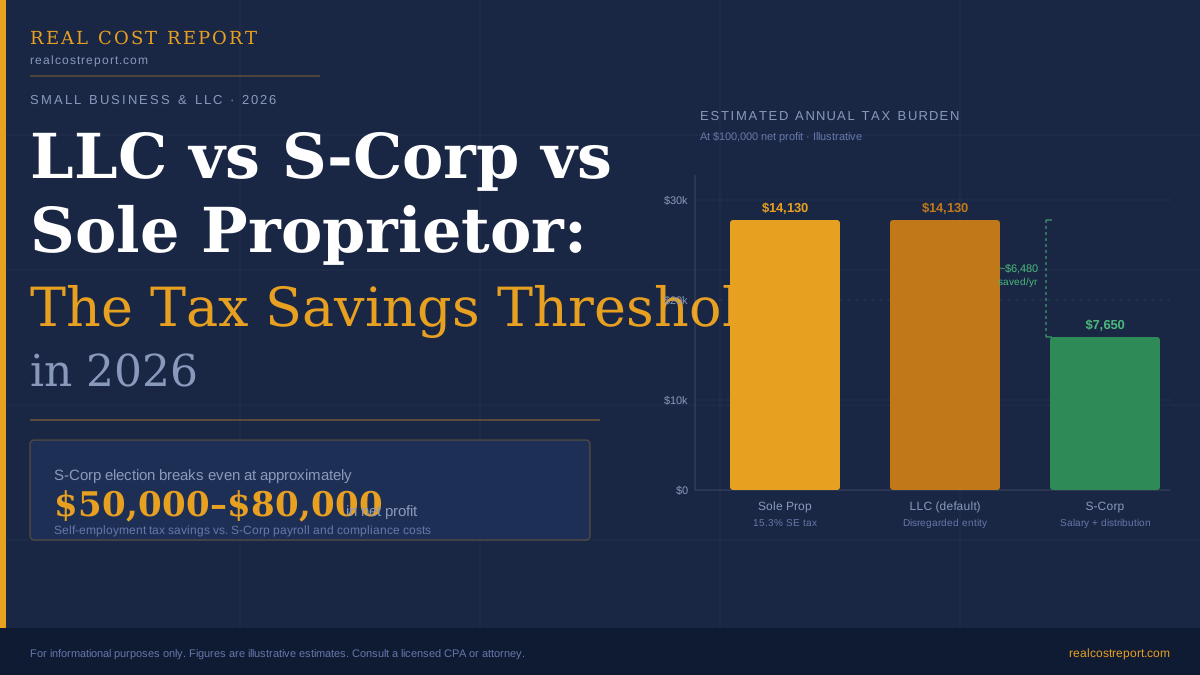
A sole proprietor earning $100,000 in net profit will owe approximately $14,130 in self-employment tax alone in 2026—before paying a single dollar of federal income tax. That figure, representing 15.3% of 92.35% of net earnings, is the silent cost most first-time business owners discover only after the fact. Choosing the right legal and tax structure from the start is one of the highest-leverage financial decisions a small business owner can make, yet the choice between a sole proprietorship, a single-member LLC, and an S corporation is routinely misunderstood. In this report, we analyze IRS self-employment tax mechanics, S-Corp reasonable compensation standards, and state-level compliance costs to identify the exact profit threshold at which each structure becomes the optimal choice for 2026.
Key Takeaways
- $50,000–$80,000 in annual net profit is the typical threshold at which an S-Corp election generates meaningful self-employment tax savings over a default LLC or sole proprietorship.
- 15.3% self-employment tax applies to 92.35% of net earnings for sole proprietors and single-member LLCs taxed as disregarded entities—costing a $100,000 earner roughly $14,130 per year.
- $1,500–$3,500 per year is the realistic cost of S-Corp compliance (payroll processing, quarterly filings, annual 1120-S return), which must be offset by SE tax savings before the election pays off.
- $0 in additional state-level liability protection does an S-Corp election add over a properly maintained LLC—the two concepts are legally separate and frequently confused.
- 2–4 months is the typical processing time for an IRS Form 2553 S-Corp election, meaning late filers in 2026 may need to request retroactive relief under Revenue Procedure 2013-30.
- 37% is the maximum 2026 federal income tax rate applicable to pass-through income, making income-splitting strategies via S-Corp salary and distribution especially valuable for high earners.
How the Self-Employment Tax Works in 2026—and Why Structure Changes Everything
Self-employment tax is the mechanism by which sole proprietors and single-member LLC owners pay both the employee and employer share of Social Security and Medicare taxes. In 2026, the combined SE tax rate remains 15.3%—12.4% for Social Security (capped at the wage base, which the Social Security Administration adjusts annually) and 2.9% for Medicare (uncapped, with an additional 0.9% surcharge on earnings above $200,000 for single filers). Because SE tax applies to 92.35% of net self-employment income—the IRS allows a deduction for the employer-equivalent portion—a sole proprietor netting $100,000 pays SE tax on $92,350, producing a bill of approximately $14,130.
This figure is in addition to federal income tax, which is assessed on net profit after the above-the-line deduction for 50% of SE tax paid. The practical result is that a sole proprietor or default-taxed LLC owner in the 22% federal income tax bracket, earning $100,000 net, faces a combined marginal effective rate substantially higher than the headline bracket rate suggests. None of this changes based on whether a person files a Schedule C as a sole proprietor or as a single-member LLC owner—the IRS treats both identically for income tax purposes absent a formal entity election.
The S-Corp Workaround: Splitting Salary from Distributions
An S corporation shareholder-employee can legally split business income into two streams: a W-2 salary and an owner distribution. FICA payroll taxes (equivalent to SE tax) apply only to the W-2 salary, not to distributions. If a business owner earns $120,000 in net profit and pays themselves a $60,000 salary—meeting the IRS “reasonable compensation” standard—the remaining $60,000 passes through as a distribution with no SE or FICA exposure. At 15.3% on $60,000, that represents approximately $9,180 in avoided payroll taxes. Against compliance costs of roughly $2,000–$3,000 annually, the net savings approach $6,000–$7,000 per year at that income level.
Sole Proprietor vs LLC vs S-Corp: Annual Tax Cost Comparison at Key Income Levels
The table below models estimated total self-employment or payroll tax liability across the three primary structures at four net profit benchmarks. Federal income tax is excluded to isolate the SE/FICA differential. State taxes, which vary significantly, are discussed separately. All figures assume a single-member business, no employees other than the owner, and—for S-Corp—a reasonable compensation ratio of approximately 50% salary to 50% distribution at lower income levels, scaled toward 60% at higher income levels consistent with IRS audit guidance.
| Net Profit | Sole Proprietor SE Tax | Default LLC SE Tax | S-Corp FICA (est.) | S-Corp Compliance Cost | Estimated Net Savings |
|---|---|---|---|---|---|
| $40,000 | $5,652 | $5,652 | $3,060 | $1,800–$2,500 | −$408 to +$792 (break-even zone) |
| $60,000 | $8,478 | $8,478 | $4,590 | $1,800–$2,500 | +$1,388–$2,088 |
| $100,000 | $14,130 | $14,130 | $7,650 | $2,000–$3,000 | +$4,480–$5,480 |
| $200,000 | $25,550* | $25,550* | $13,770 | $2,500–$4,000 | +$9,280–$10,780 |
*Social Security wage base cap reduces the effective SE rate above approximately $168,600 (2024 base; 2026 base TBD pending SSA announcement). Figures are modeled estimates for planning purposes only.
What “Reasonable Compensation” Actually Means—and What the IRS Audits
The S-Corp salary strategy is only legally defensible when the owner’s W-2 compensation meets the IRS reasonable compensation standard. The IRS has successfully challenged arrangements where shareholders paid themselves $0 or token salaries on six-figure profits—most famously in Watson v. Commissioner (8th Cir. 2012), where the Tax Court reclassified $24,000 in distributions as wages for a CPA netting over $200,000. The IRS does not publish a fixed formula for reasonable compensation, but its audit guidance and published court cases consistently reference comparable industry wages, the owner’s actual hours worked, and the relative contribution of capital versus labor to the business’s profitability.
Factors the IRS Considers in Reasonable Compensation Determinations
Tax practitioners generally recommend a compensation ratio in the range of 40%–60% of net profit for service-based businesses where the owner is the primary revenue generator. Capital-intensive businesses or those with significant non-owner assets may support lower ratios. Resources including the BLS Occupational Employment and Wage Statistics database and compensation surveys from organizations like the Risk Management Association provide defensible third-party benchmarks for establishing a salary range. Documenting the rationale in corporate minutes each year is considered best practice and significantly strengthens the position on audit.
| Business Type | Suggested Salary Range | Audit Risk Level | Key Documentation |
|---|---|---|---|
| Solo service provider (consultant, attorney, designer) | 50%–70% of net profit | Higher | Industry wage comparables, time logs |
| Product-based or e-commerce business | 30%–50% of net profit | Moderate | Role description, comparable salaries |
| Real estate or investment-holding LLC | Minimal to $0 (passive income) | Lower | Passive activity documentation |
| Multi-owner professional practice (medical, dental, legal) | 60%–80% of net profit | Highest | Shareholder agreements, outside comp study |
LLC vs S-Corp: The Compliance Cost Gap That Erases Savings Below $50,000
The friction cost of maintaining an S-Corp is substantial relative to a sole proprietorship or default LLC. A single-member LLC in most states requires only an annual report and a modest filing fee—often $50–$300 depending on state. An S-Corp requires payroll administration (including quarterly 941 deposits, W-2 issuance, and year-end reconciliation), an annual Form 1120-S corporate return, and often a separate state corporate return. When owners hire a bookkeeper and CPA to manage these requirements—the realistic scenario for most small business owners—annual costs typically range from $1,800 to $4,500 depending on transaction volume and the accountant’s rates.
Estimated Annual Compliance Costs by Structure and Provider Type
| Structure | DIY + Software | Bookkeeper + CPA | Full-Service Firm | State Filing Fees (avg.) |
|---|---|---|---|---|
| Sole Proprietor | $100–$400/yr | $500–$1,200/yr | $1,000–$2,500/yr | $0 (no entity) |
| Single-Member LLC | $150–$500/yr | $600–$1,400/yr | $1,200–$2,800/yr | $50–$300/yr |
| S-Corporation | $600–$1,200/yr | $2,000–$4,500/yr | $4,000–$8,000/yr | $50–$800/yr |
Payroll software providers including Gusto (which charges $40/month base plus $6/employee), ADP Run, and QuickBooks Payroll add ongoing subscription costs that a default LLC owner never incurs. At the $40,000 net profit level, these friction costs can entirely eliminate the theoretical tax advantage—a fact many online calculators understate by ignoring compliance overhead.
State Tax Treatment: Where an S-Corp Election Can Actually Cost You More
Federal tax analysis alone does not resolve the structure question. Eleven states impose a franchise tax or minimum annual tax on S corporations that may exceed the SE tax savings at lower income levels. California is the most punishing example: S corporations pay an 1.5% franchise tax on net income (minimum $800), and LLCs face a tiered gross receipts fee that can reach $11,790 annually for businesses generating over $5 million. New York City imposes a General Corporation Tax on S corporations that do not qualify for the city-level S election—a trap that catches many out-of-state businesses operating in the five boroughs.
State-by-State S-Corp Tax Treatment: High-Impact States
| State | S-Corp State Tax | LLC State Tax | Net S-Corp Advantage |
|---|---|---|---|
| California | 1.5% franchise + $800 min | $800 min + gross receipts fee | Often reduced or negative |
| New York | Pass-through entity tax (PTET) available | No state-level entity tax | Moderate (state-dependent) |
| Texas | Franchise tax 0.375% (retail/wholesale) or 0.75% | Same franchise tax applies | Full federal savings preserved |
| Florida | 5.5% corporate income tax (S-Corps exempt) | No state income tax | Full federal savings preserved |
| Illinois | 1.5% personal property replacement tax | 1.5% PPRT applies to LLCs too | Comparable; federal savings intact |
How and When to File the S-Corp Election in 2026
An S-Corp election is made by filing IRS Form 2553 and requires the signature of all shareholders. For the election to be effective for the entire 2026 tax year, a new entity must file within 75 days of formation, or an existing entity must file by March 15, 2026 (for calendar-year filers). Late elections are not automatically void—Revenue Procedure 2013-30 provides a simplified procedure for requesting relief, which the IRS grants in the majority of cases where the taxpayer establishes reasonable cause and has otherwise operated as though the election were in effect. State-level S-Corp elections are separate filings in states that require them, including New Jersey (Form CBT-2553), New York (Form CT-6), and Ohio.
S-Corp Election Timeline for 2026
| Scenario | Deadline | Form | Notes |
|---|---|---|---|
| New entity formed in 2026 (effective 2026) | Within 75 days of formation | Form 2553 | Must have EIN first |
| Existing LLC electing S-Corp for tax year 2026 | March 15, 2026 | Form 2553 + Form 8832 (if needed) | Must first elect C-Corp status if needed |
| Late filer seeking retroactive relief | Up to 3 years and 75 days after intended effective date | Form 2553 with Rev. Proc. 2013-30 statement | Must show reasonable cause |
| Terminating S-Corp election | Voluntary revocation: any time | Written statement to IRS | 5-year waiting period to re-elect |
Methodology
Self-employment tax figures in this report were calculated using the IRS’s published SE tax rate of 15.3% applied to 92.35% of net self-employment income, as specified in IRS Publication 334, Tax Guide for Small Business, which the agency updates annually and which governs Schedule SE calculations for sole proprietors and disregarded-entity LLCs. S-Corp payroll tax modeling used the employer and employee FICA rates published on the IRS Employment Tax page, applied to modeled reasonable compensation scenarios consistent with audit guidance and reported court decisions including Watson v. Commissioner. State franchise and minimum tax figures were drawn from individual state revenue agency publications, including the California Franchise Tax Board’s LLC Information Sheet and comparable publications from the New York State Department of Taxation and Finance. Compliance cost ranges reflect publicly available pricing disclosures from payroll service providers including Gusto and ADP, combined with CPA fee survey data published by the National Society of Accountants in its biennial survey of tax preparation fees. S-Corp election procedure and deadline information was verified against IRS Form 2553 and its instructions, as well as Revenue Procedure 2013-30. All modeled figures represent estimates based on 2025–2026 law as known at the time of publication; the Social Security wage base for 2026 had not been officially announced by the SSA and is based on projected adjustments. Geographic scope is United States federal tax law; state-level analysis is illustrative for selected high-population states and should not be generalized to all 50 states without jurisdiction-specific review.
This report is for informational purposes only and does not constitute legal, financial, or professional advice. Consult a licensed professional for guidance specific to your situation.