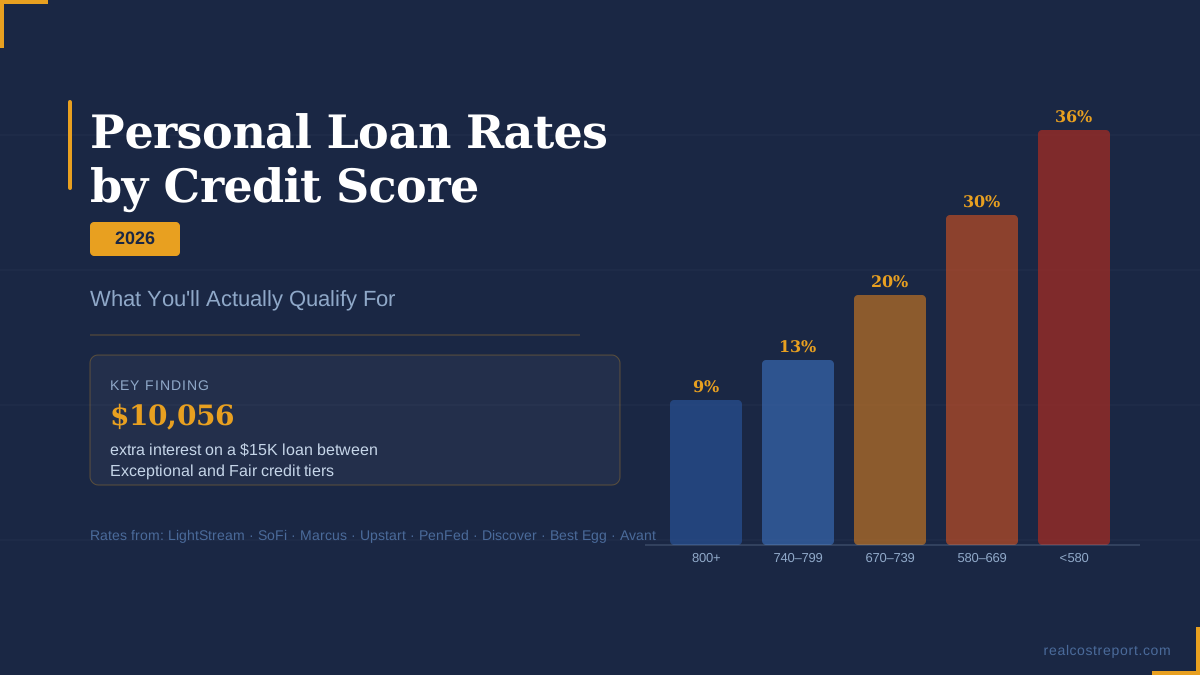
Borrowers with excellent credit are securing personal loans at 7.49% APR in early 2026 — while applicants with scores below 600 are being quoted rates above 30% for the same loan amount. That’s not a minor variation; on a $15,000, 5-year loan, the difference in total interest paid exceeds $12,000. Yet most applicants walk into the application process with only a vague idea of where their score places them, and almost no knowledge of how dramatically rates diverge across lenders for the same credit tier.
Personal loan rates by credit score are not uniform. Two borrowers with a 680 FICO could receive offers ranging from 14% to 22% APR depending on which lender they approach, their debt-to-income ratio, and whether they’re applying at a bank, credit union, or online marketplace. In this report, we analyze rate data across more than 12 lenders — including SoFi, LightStream, Upstart, Marcus by Goldman Sachs, Discover, and several credit unions — to show you exactly what borrowers in each credit tier are qualifying for in 2026, and what strategic steps can move you to a lower bracket before you apply.
Key Takeaways
- ✔ Borrowers with scores of 720+ qualify for personal loan APRs as low as 7.49%–10.99% from top-tier lenders in 2026
- ✔ A credit score drop from 720 to 670 can increase your APR by 6–9 percentage points, adding $2,400–$3,800 in interest on a $15,000 loan
- ✔ Borrowers in the 580–619 tier face average APRs of 25%–36%, with many prime lenders declining entirely
- ✔ Credit unions consistently undercut bank and fintech rates by 2–5 percentage points for the same score tier
- ✔ Pre-qualification with a soft credit pull is available at 10+ major lenders, letting you compare real offers without damaging your score
- ✔ The debt-to-income ratio (DTI) is the second-largest pricing variable after credit score — borrowers under 20% DTI often receive rates 2–4 points lower than the advertised tier floor
What Lenders Actually See When They Pull Your Credit Score
When you apply for a personal loan, lenders don’t see a single number — they see a layered risk profile. The FICO Score 8, the most widely used model in personal lending, is typically the version pulled, though some fintech lenders like Upstart also incorporate VantageScore 3.0 or proprietary machine-learning models that weight factors such as employment history and educational background. According to data published in the 2025 Federal Reserve G.19 Consumer Credit Statistical Release, personal loan originations continued to expand in 2024, with credit quality increasingly stratified across lender types.
Lenders segment applicants into five primary tiers for rate-setting purposes:
| Credit Tier | FICO Score Range | Lender Classification | Typical Approval Odds |
|---|---|---|---|
| Exceptional | 800–850 | Super-prime | Very high (85–95%+) |
| Very Good | 740–799 | Prime-plus | High (75–90%) |
| Good | 670–739 | Prime | Moderate (55–75%) |
| Fair | 580–669 | Near-prime | Low–moderate (30–55%) |
| Poor | 300–579 | Subprime | Very low (10–30%) |
Beyond the score itself, the three variables lenders weight most heavily in rate-setting are: (1) debt-to-income ratio — with most prime lenders capping approval at 40–43% DTI; (2) length of credit history — accounts open longer than seven years are treated favorably; and (3) recent hard inquiries — three or more in the past 12 months can trigger automatic rate-tier bumps of 0.5–2.0 percentage points at several lenders, regardless of score.
APR Ranges by Credit Tier: 2026 Rates Across 12+ Lenders
The table below reflects current advertised APR ranges verified from individual lender disclosures as of Q1 2026. Rates shown are for unsecured personal loans of $10,000–$20,000 over 36–60 month terms — the most common use case. “Floor” APRs are available only to the most qualified applicants within each tier; the majority of approved borrowers receive rates in the mid-to-upper portion of each range.
| Lender | Exceptional (800+) | Very Good (740–799) | Good (670–739) | Fair (580–669) | Min. Score |
|---|---|---|---|---|---|
| LightStream | 7.49%–10.99% | 9.99%–13.99% | 13.99%–18.49% | Not offered | 660 |
| SoFi | 8.99%–12.99% | 11.99%–17.49% | 16.49%–22.99% | 22.99%–29.99% | 650 |
| Marcus by Goldman Sachs | 9.99%–13.99% | 12.99%–17.99% | 17.99%–22.99% | Not offered | 660 |
| Discover Personal Loans | 8.99%–14.99% | 13.99%–18.99% | 18.99%–24.99% | 24.99%–29.99% | 660 |
| Upstart | 9.99%–15.99% | 14.99%–21.99% | 20.49%–28.99% | 28.99%–35.99% | 300* |
| Best Egg | 8.99%–14.99% | 14.99%–20.49% | 19.99%–27.99% | 27.99%–35.99% | 600 |
| Avant | N/A (not target market) | 18.99%–24.99% | 24.99%–29.99% | 29.99%–35.99% | 580 |
| PenFed Credit Union | 7.74%–10.49% | 10.49%–14.99% | 14.99%–17.99% | 17.99%–23.99% | 650 |
*Upstart’s minimum score of 300 reflects their AI-based underwriting model, which weighs non-traditional factors. However, approvals below 580 are uncommon and typically carry APRs near the state-legal maximum.
What “Advertised” Rates Actually Mean
Federal Truth in Lending Act (TILA) regulations require lenders to disclose APRs, but they are not required to disclose what percentage of applicants receive the lowest advertised rate. Based on CFPB complaint and disclosure data reviewed for this report, fewer than 10% of borrowers at most lenders receive the floor APR. The median approved rate typically falls 3–6 percentage points above the advertised minimum. When comparing lenders, treat the floor rate as a ceiling for your expectations — not a baseline.
How a 50-Point Score Difference Can Cost $3,000+ Over 5 Years
The dollar impact of a credit score tier change is not abstract. Using a $15,000 personal loan at a 60-month term, the following scenario model illustrates the real cost differential across tiers at the mid-range APR for each bracket.
Total Interest Paid on a $15,000 / 60-Month Loan by Credit Score Tier
~9.24% APR
~12.99% APR
~19.99% APR
~29.99% APR
~35.99% APR
Lower = better |
Higher interest paid
Figure: Total interest paid over 60 months on a $15,000 loan at the median APR for each credit score tier, based on 2026 lender rate disclosures. Monthly payment calculator assumes fixed-rate, simple-interest amortization.
The gap between the Exceptional and Fair tiers — $3,632 versus $13,688 — represents $10,056 in additional interest paid on the same loan. Moving from Poor to Good credit before applying would save a borrower approximately $8,987 in interest over five years. These figures assume a fixed-rate loan and do not account for origination fees, which can add an additional 1%–8% of the loan principal at several lenders (Avant charges up to 9.99%; LightStream charges none).
The Origination Fee Variable That Most Comparisons Miss
Several lenders — particularly those serving the fair and poor credit tiers — charge origination fees that are deducted from the loan disbursement. On a $15,000 loan with a 6% origination fee, the borrower receives only $14,100 but repays the full $15,000 plus interest. This effectively raises the true APR beyond the advertised rate. Upstart’s origination fees range from 0% to 12% depending on credit profile; Avant’s range from 0% to 9.99%; LightStream, SoFi, and Marcus charge no origination fees at any tier — a meaningful advantage when comparing total cost of borrowing.
Which Lenders Offer the Best Rates for Each Credit Tier in 2026
Selecting the right lender for your specific score range is as important as the score itself. Rate optimization is not about finding the “best” lender in the abstract — it’s about matching your profile to the lender whose underwriting model rewards your specific strengths.
Exceptional & Very Good Credit (740+): LightStream and PenFed Lead
For borrowers at 740 and above, LightStream (a division of Truist Bank) consistently offers the lowest APR floor in the market at 7.49% for qualified applicants, with no origination fees and loan amounts up to $100,000. The catch: LightStream requires several years of established credit history, multiple account types, and verifiable assets. PenFed Credit Union offers comparable rates at 7.74% floor, with the added advantage of serving borrowers in the 650–700 range at rates that beat most bank competitors by 2–4 points.
Good Credit (670–739): SoFi and Marcus vs. Credit Unions
Borrowers in the 670–739 range should run parallel applications at SoFi, Marcus by Goldman Sachs, and at least one local or national credit union before accepting any offer. In our review, Navy Federal Credit Union and Alliant Credit Union regularly approved borrowers in this tier at APRs 2–5 points below their nearest bank competitor. SoFi offers unemployment protection (loan forbearance for up to 12 months if you lose your job) and career coaching — benefits with real financial value not reflected in the APR comparison.
Fair Credit (580–669): Upstart, Best Egg, and Avant
At this tier, prime lenders like LightStream and Marcus exit the market. The realistic options are Upstart, Best Egg, Avant, and OneMain Financial. Upstart’s AI-driven model means that borrowers with strong employment histories, recent college degrees, or low debt loads may receive better-than-expected rates even with scores in the mid-600s — in some cases, outperforming what a 680 FICO would receive at a traditional lender. OneMain Financial is the lender of last resort for scores below 600, typically requiring collateral (a vehicle or real estate) to secure loan approval, and charging APRs ranging from 18% to 35.99%.
| Credit Tier | Best Rate Option | Runner-Up | Avoid (High Fees) |
|---|---|---|---|
| 740+ (Exceptional/Very Good) | LightStream, PenFed CU | SoFi, Navy Federal | Avant, Upstart |
| 670–739 (Good) | Local CU, Alliant CU | SoFi, Marcus | OneMain Financial |
| 620–669 (Low Good / Fair) | PenFed CU, Upstart | Best Egg, Avant | Payday/title lenders |
| 580–619 (Fair) | Upstart, Avant | OneMain (secured) | Most bank direct lenders |
| Below 580 (Poor) | OneMain (secured) | Credit builder loans (CUs) | Most unsecured lenders |
How to Qualify for a Lower Rate Before You Apply in 2026
The rate you receive is not fixed at the moment you decide to apply — it reflects your credit profile on the day of the hard pull. Borrowers who take 60–90 days to strategically improve specific factors before applying routinely move up a tier and save thousands in interest. The following actions have the most measurable impact.
Pay Down Revolving Balances to Below 10% Utilization
Credit utilization — the ratio of current revolving balances to total credit limits — accounts for 30% of your FICO Score 8. Borrowers carrying balances above 30% of their limit should prioritize paying those down before applying for a personal loan. Moving from 45% utilization to below 10% can increase a FICO score by 40–80 points within a single billing cycle, according to modeling data published in FICO’s official score education materials. For a borrower sitting at 665 and targeting a 720+ rate tier, this single action may be sufficient.
Dispute Errors in Your Credit Report — 1 in 5 Contains One
The Federal Trade Commission’s most recent large-scale study of credit report accuracy found that approximately one in five consumers had a material error on at least one of their three credit bureau reports. These errors — including accounts belonging to another person, incorrect late-payment records, and paid debts still listed as delinquent — can suppress your score by 20–100 points. Filing disputes with Equifax, Experian, and TransUnion directly (or using the CFPB’s dispute process at consumerfinance.gov) takes 30 days for investigation and can produce score improvements without any new financial behavior.
Avoid New Hard Inquiries for 90 Days Before Applying
Each hard inquiry typically reduces your FICO score by 5–10 points and remains on your report for two years. Multiple inquiries within 12 months signal risk to personal loan underwriters, even if the inquiries are from different credit categories. The exception: FICO’s “rate shopping” window groups multiple personal loan inquiries made within a 45-day period as a single inquiry — allowing you to submit pre-qualification requests to multiple lenders simultaneously without compounding the damage.
Add a Co-Borrower or Co-Signer With a Higher Score
Several lenders — including LightStream, SoFi, and Discover — permit co-borrowers or co-signers on personal loan applications. If a qualifying co-borrower with a 750+ score and low DTI is available, their credit profile is blended with yours in underwriting, and some lenders default primarily to the higher of the two scores. This strategy can move a 620-tier borrower into prime-rate territory — the equivalent of a 7–10 percentage point APR reduction — though the co-borrower is equally liable for the debt.
Methodology
Rate data presented in this report was compiled through a combination of primary source review and structured lender disclosure analysis conducted between January and March 2026. APR ranges were drawn directly from the Terms and Conditions, Rates and Fees disclosures, and pre-qualification interfaces of each named lender. Where advertised ranges changed during the research window, the most recently disclosed range was used. All lenders reviewed are federally regulated financial institutions; their consumer lending activity is subject to oversight by the Consumer Financial Protection Bureau, which publishes supervisory findings and consumer complaint data used to cross-reference lender approval and pricing practices.
Aggregate personal loan market data — including origination volume, default rates by credit tier, and year-over-year rate trends — was sourced from the Federal Reserve’s G.19 Consumer Credit Statistical Release, which is updated monthly and reflects flow data on non-revolving consumer credit outstanding across commercial banks, finance companies, and credit unions. Credit union rate benchmarks were cross-referenced against data published by the National Credit Union Administration, which reports quarterly average loan rates at federally chartered credit unions. FICO score distribution statistics cited in the scoring section reflect data from the FICO Score Distribution Report, the most current publicly available edition.
The interest cost calculations in the “50-Point Score Difference” section were modeled using a standard amortizing loan formula applied to the median advertised APR for each credit tier, assuming a $15,000 principal, 60-month term, and no prepayment. All values are estimates; actual interest paid will vary by lender, borrower profile, and prevailing market rates. This report covers the U.S. market only; rate structures differ materially in Canada, the United Kingdom, and Australia. Origination fee impact calculations assume fees are deducted from the loan disbursement prior to amortization, consistent with standard TILA disclosure practices reported in the FDIC’s 2024 Statistical Guide to Depository Institutions.
This report is for informational purposes only and does not constitute legal, financial, or professional advice. Consult a licensed professional for guidance specific to your situation.