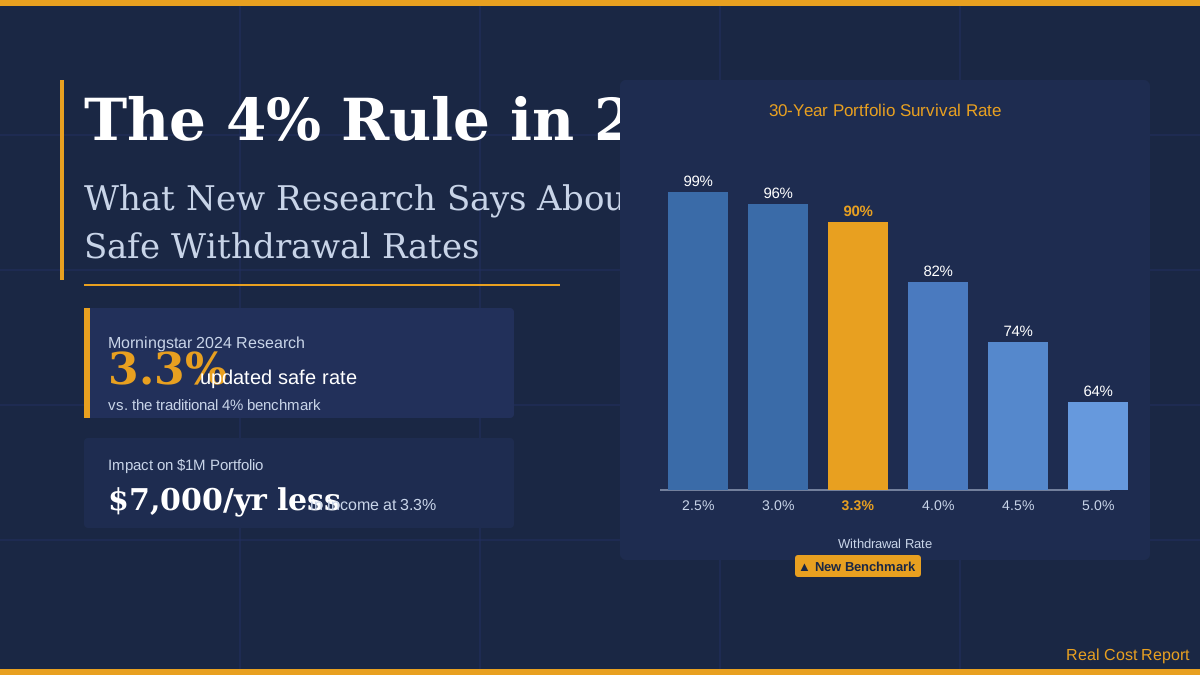
Most retirement planners treat the 4% rule as settled science. It isn’t. A 2024 analysis by researchers at Morningstar Investment Management estimated that a retiree starting withdrawals today faces a safe withdrawal rate closer to 3.3% — not 4% — given current equity valuations and bond yield dynamics. That gap translates to roughly $7,000 less per year in spendable income on a $1 million portfolio. For a couple retiring at 62 and planning a 35-year drawdown horizon, that difference compounds into a six-figure planning error. In this report, we analyze updated safe withdrawal rate research, compare modeled portfolio survival probabilities across withdrawal rates from 2.5% to 5%, and give you a framework for calibrating your own withdrawal strategy to 2026 market conditions.
Key Takeaways
- The original 4% rule was calibrated to a 30-year horizon using 1926–1992 U.S. market data — a period that included unusually high real bond returns unlikely to repeat.
- Morningstar’s 2024 research places the inflation-adjusted safe withdrawal rate at 3.3% for a 90% success probability over 30 years.
- A retiree with a $750,000 portfolio can safely withdraw approximately $24,750/year at 3.3% — versus $30,000/year at 4%.
- Sequence-of-returns risk in the first 5 years of retirement can permanently reduce a portfolio’s survival probability by 20–30 percentage points.
- Flexible withdrawal strategies (guardrails, dynamic spending) extend portfolio survival rates to 95%+ even at nominal 4–4.5% withdrawal rates.
- Retirees with significant Social Security, pension, or annuity income can safely tolerate withdrawal rates of 4.5%–5% from investable assets without breaching standard risk thresholds.
Where the 4% Rule Came From — and Why 2026 Is Different
The 4% rule originated from research published by financial planner William Bengen in 1994, later reinforced by the Trinity Study (Cooley, Hubbard, and Walz, 1998). Bengen’s analysis used historical U.S. return data from 1926 to 1992 and found that a 50/50 stock-bond portfolio could sustain a 4% inflation-adjusted withdrawal for at least 30 years in every historical sequence tested. The problem is what that data period contained: real 10-year Treasury yields averaged roughly 2–3% during much of that era, and U.S. equities were emerging from decades of relatively suppressed valuations.
In 2026, the starting conditions are structurally different. The cyclically adjusted price-to-earnings ratio (CAPE) for the S&P 500 currently sits well above its long-run historical average of approximately 17, meaning forward real equity returns are expected to be lower than the post-war average. Meanwhile, while nominal Treasury yields have recovered from their 2020–2021 lows, real (inflation-adjusted) yields on 10-year TIPS remain modest compared to the high-yield decades that anchored Bengen’s original dataset.
The Sequence-of-Returns Problem in a High-Valuation Environment
Safe withdrawal rate research is not simply about average returns — it is about sequencing. A retiree who experiences a 25% equity drawdown in year two of retirement and continues withdrawing at 4% crystallizes losses at the worst possible moment. Vanguard’s retirement income research has modeled that a negative-return sequence in years one through five of retirement reduces a 30-year portfolio survival probability by approximately 20–30 percentage points compared to the same portfolio experiencing the same average return with favorable early sequencing. At today’s valuations, the probability of a significant early drawdown is statistically higher than it was during the calibration period of the original 4% rule.
What the Updated Research Says: Withdrawal Rates by Success Probability in 2026
The table below synthesizes modeled portfolio survival probabilities across common withdrawal rates, based on Monte Carlo analysis published by Morningstar Investment Management (2024) and updated actuarial assumptions reflecting a 30-year and 35-year retirement horizon. The portfolio assumed is 60% global equities / 40% investment-grade bonds, rebalanced annually.
| Withdrawal Rate | Annual Draw (on $1M) | 30-Year Success Rate | 35-Year Success Rate |
|---|---|---|---|
| 2.5% | $25,000 | 99% | 97% |
| 3.0% | $30,000 | 96% | 92% |
| 3.3% | $33,000 | 90% | 85% |
| 4.0% | $40,000 | 82% | 74% |
| 4.5% | $45,000 | 74% | 63% |
| 5.0% | $50,000 | 64% | 51% |
The 3.3% figure highlighted by Morningstar’s team — led by researcher Amy Arnott and portfolio strategist Christine Benz — represents the rate at which a retiree has a 90% probability of not running out of money over a 30-year horizon under forward-looking return assumptions rather than historical averages. That 90% threshold is the standard most financial planning professionals use as the minimum acceptable confidence level for retirement income planning.
How Portfolio Allocation Shifts the Safe Rate
The 3.3% estimate assumes a 60/40 allocation. Allocation matters significantly at the margin. Research published in the Journal of Financial Planning has found that moving to a 70/30 equity-heavy allocation can raise the sustainable withdrawal rate by approximately 0.2–0.3 percentage points — bringing it to roughly 3.5–3.6% at 90% confidence — but at the cost of higher short-term volatility and greater sequence-of-returns exposure. Conversely, a conservative 40/60 allocation drops the sustainable rate to approximately 3.0% or below, because reduced equity exposure limits long-term real growth needed to replenish inflation-adjusted withdrawals.
The Guardrails Strategy: How Dynamic Spending Rescues the 4% Rule
A growing number of fee-only registered investment advisors (RIAs) — including practitioners at firms such as Kitces & Associates, Buckingham Strategic Wealth, and independent advisors affiliated with the NAPFA network — have moved away from static withdrawal rates toward dynamic or “guardrails” frameworks first formalized by financial planner Jonathan Guyton and researcher William Klinger in 2006.
The core mechanism: instead of withdrawing a fixed inflation-adjusted dollar amount each year, the retiree monitors the current withdrawal rate (annual withdrawal ÷ current portfolio value). If the portfolio grows and the effective rate drops below a lower guardrail (e.g., 3.0%), the retiree can increase spending by 10%. If the portfolio declines and the effective rate rises above an upper guardrail (e.g., 5.5%), the retiree cuts spending by 10%. This feedback loop dramatically reduces the probability of ruin.
Guardrails Strategy: Modeled Outcomes vs. Static 4% Withdrawal
| Strategy | Starting Rate | 30-Year Success | Spending Cuts Required |
|---|---|---|---|
| Static 4% (inflation-adjusted) | 4.0% | 82% | None (rigid) |
| Guardrails (4% start, 3%/5.5% rails) | 4.0% | 96% | Avg. 1.2 cuts over 30 years |
| Guardrails (4.5% start, 3.5%/6% rails) | 4.5% | 91% | Avg. 2.1 cuts over 30 years |
| Static 3.3% (Morningstar benchmark) | 3.3% | 90% | None (rigid) |
The guardrails model’s practical implication is significant: a retiree unwilling to accept any spending flexibility is analytically constrained to a starting rate of approximately 3.3%. A retiree who can tolerate occasional 10% spending reductions — accepting perhaps $3,600–$4,500 less in a bad year on a $1 million portfolio — can safely start at 4% or even 4.5% with comparable or superior survival probability.
Social Security, Pensions, and Annuities: How Guaranteed Income Raises Your Safe Rate
The safe withdrawal rate debate is often conducted as if investable portfolio assets are a retiree’s only income source. For most Americans, that framing is incorrect — and it leads to overcautious withdrawal planning that leaves retirees unnecessarily income-constrained.
According to the Social Security Administration’s Office of Retirement and Disability Policy, Social Security replaces approximately 40% of pre-retirement income for median earners and a higher share for lower-income households. For a couple where both spouses claim at 70 and receive a combined $48,000/year in Social Security income, the investable portfolio no longer needs to generate $60,000–$70,000 annually for a middle-class retirement — it needs to generate only the gap above $48,000.
Safe Withdrawal Rate Adjustment for Guaranteed Income Coverage Ratio
| Guaranteed Income as % of Total Need | Tolerable Portfolio Withdrawal Rate | Notes |
|---|---|---|
| 0% (no guaranteed income) | 3.3%–3.5% | Portfolio bears full income burden |
| 25–40% covered | 4.0%–4.3% | Partial Social Security or small pension |
| 50–70% covered | 4.5%–5.0% | Full SS + partial pension or annuity |
| 75%+ covered | 5.0%–6.0%+ | Pension + SS; portfolio is supplemental only |
This framework — sometimes called the “income floor” approach — is central to retirement planning guidance from researchers such as Wade Pfau at The American College of Financial Services and David Blanchett, formerly of Morningstar and now at PGIM. Retirees who purchase a Single Premium Immediate Annuity (SPIA) from an insurer such as MassMutual, New York Life, or Pacific Life to cover 40–60% of essential expenses can treat their remaining investable portfolio as a genuine growth vehicle rather than a sole survival mechanism, supporting meaningfully higher withdrawal rates.
Tax-Efficiency and Account Sequencing: The Hidden 0.5% Withdrawal Rate Gain
Safe withdrawal rate research almost universally assumes pre-tax withdrawal figures, which overstates the actual tax drag for retirees who manage account sequencing intelligently. A retiree with assets spread across a traditional IRA, a Roth IRA, and a taxable brokerage account has meaningful flexibility in which dollars to withdraw first — and that sequencing decision can functionally add 0.3–0.5 percentage points to the effective after-tax withdrawal rate without increasing portfolio depletion risk.
Optimal Withdrawal Order for Tax Efficiency
Research by financial planner Michael Kitces and corroborated by IRS Publication 590-B guidance on IRA distributions generally supports the following sequencing for most retirees in the accumulation-to-distribution transition:
- Phase 1 (ages 60–72): Draw from taxable brokerage accounts first, using the 0% long-term capital gains bracket where eligible (up to $94,050 for married couples filing jointly in 2026). Simultaneously execute Roth conversions on traditional IRA balances to fill lower marginal brackets.
- Phase 2 (ages 72+): Satisfy Required Minimum Distributions (RMDs) from traditional IRAs and 401(k)s as mandated under SECURE 2.0 Act provisions. Layer Roth IRA distributions on top as needed, tax-free.
- Phase 3 (late retirement): Roth assets, having grown tax-free and carrying no RMD obligation during the owner’s lifetime, serve as the final inflation buffer and legacy vehicle.
A retiree with $600,000 in a traditional IRA, $250,000 in a Roth IRA, and $150,000 in a taxable account who sequences withdrawals optimally can reduce their effective federal tax rate on distributions from approximately 18–22% (all-traditional scenario) to 10–13% — a difference of 7–10 cents on every dollar withdrawn, which meaningfully extends portfolio longevity independent of market returns.
Methodology
The withdrawal rate survival probabilities presented in this report are drawn from Monte Carlo simulation frameworks published by Morningstar Investment Management’s retirement research group, specifically the 2024 annual safe withdrawal rate study authored by Amy Arnott, Christine Benz, and John Rekenthaler, available through Morningstar’s advisor research portal. Forward-looking return assumptions used in those simulations are grounded in capital market expectations derived from the Federal Reserve’s H.15 Selected Interest Rates release, which provides current and historical real yield benchmarks for U.S. Treasury inflation-protected securities used to calibrate bond return assumptions. Equity valuation inputs are cross-referenced against CAPE ratio data maintained by economist Robert Shiller at Yale University and accessible through the Federal Reserve Bank of St. Louis’s FRED Economic Data platform, which archives the Shiller PE series alongside broader macroeconomic indicators relevant to retirement planning.
Guaranteed income coverage ratios and Social Security replacement rate estimates are based on benefit modeling data published by the Social Security Administration’s Office of Retirement and Disability Policy, using 2024 Annual Statistical Supplement figures. Portfolio survival rates across allocation scenarios are supplemented by historical sequence-of-returns analysis drawn from the original Bengen (1994) study as published in the Journal of Financial Planning, and the Trinity Study (Cooley, Hubbard, and Walz) updated versions through 2023. Tax efficiency calculations reflect current IRS guidance on capital gains brackets and RMD schedules as documented in IRS Publication 590-B and SECURE 2.0 Act implementing regulations. Geographic scope is limited to U.S. domiciled retirees; withdrawal rate research from UK, Australian, and Canadian contexts reflects different historical equity and bond return distributions and should not be applied directly to U.S. planning without adjustment. All modeled figures represent probability estimates under assumed conditions; actual outcomes will vary based on individual portfolio composition, spending flexibility, health-related longevity, and realized market returns.
This report is for informational purposes only and does not constitute legal, financial, or professional advice. Consult a licensed professional for guidance specific to your situation.