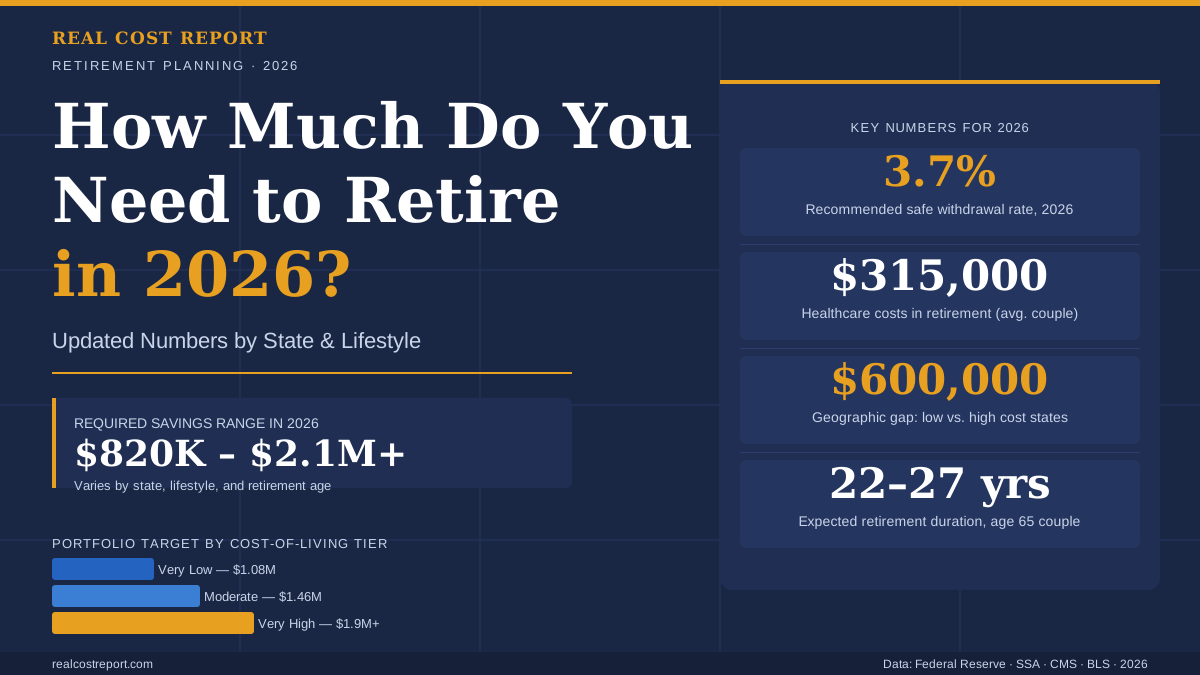
The median American household has saved just $87,000 for retirement — a figure that, by most actuarial models, covers fewer than four years of average retirement spending. Meanwhile, the financial services industry’s standard advice to “save 10–15% of your income” obscures a more urgent truth: how much you actually need depends heavily on where you live, what you spend, and when you plan to stop working. In high-cost states like California and New York, a $1 million portfolio can be exhausted within 15 years. In lower-cost states like Mississippi or Arkansas, that same portfolio may comfortably sustain 30 years of retirement. In this report, we analyze retirement savings benchmarks across all 50 states, three distinct lifestyle tiers, and four common retirement ages to give you a precise, defensible target — not a platitude.
Key Takeaways
- The average retirement savings needed in 2026 ranges from $820,000 (modest lifestyle, low-cost state) to $2.1 million+ (comfortable lifestyle, high-cost state).
- A 65-year-old couple retiring today needs to fund an expected 22–27 years of expenses, per the Social Security Administration’s 2024 period life tables.
- State-level differences in cost of living can shift your required nest egg by as much as $600,000 — more than most Americans currently have saved.
- The 4% withdrawal rule — widely used since William Bengen’s 1994 paper — implies a target of 25× your annual expenses; however, for 2026 retirees, updated sequence-of-returns research suggests 3.3%–3.7% as a more conservative floor.
- Social Security replaces only 40% of pre-retirement income for the average earner, leaving a significant gap that personal savings and pension income must fill.
- Retiring at 62 vs. 70 changes your required portfolio by an estimated $320,000–$540,000 due to reduced Social Security benefits, longer drawdown periods, and higher healthcare costs before Medicare eligibility.
What the 4% Rule Actually Means in 2026 — And Why It’s Being Revised
William Bengen’s landmark 1994 study, published in the Journal of Financial Planning, established that a retiree could withdraw 4% of their portfolio in year one, then adjust for inflation annually, and sustain those withdrawals for at least 30 years across historical market cycles. That finding became the bedrock of retirement planning for three decades. But in 2026, with elevated equity valuations, persistently above-target inflation, and historically compressed bond yields, several researchers — including a 2021 update from Morningstar’s David Blanchett — now recommend a more conservative initial withdrawal rate of 3.3% for new retirees seeking 90%+ confidence over a 30-year horizon.
The practical impact is significant. At a 4% withdrawal rate, a $50,000/year spending need requires a $1.25 million portfolio. At 3.3%, that same spending level requires $1.515 million — a $265,000 difference. For retirees who began accumulating wealth in the 2010s bull market, this adjustment may come as an unwelcome revision.
The Revised Safe Withdrawal Rate Framework for 2026
| Annual Spending Need | Portfolio at 4.0% | Portfolio at 3.7% | Portfolio at 3.3% |
|---|---|---|---|
| $35,000 | $875,000 | $946,000 | $1,061,000 |
| $50,000 | $1,250,000 | $1,351,000 | $1,515,000 |
| $70,000 | $1,750,000 | $1,892,000 | $2,121,000 |
| $90,000 | $2,250,000 | $2,432,000 | $2,727,000 |
For planning purposes in this report, we use a blended rate of 3.7% as our central assumption — more conservative than the original 4% rule but not as restrictive as worst-case scenario models. This rate reflects the recommendations published in the 2024 Morningstar State of Retirement Income report, which accounts for current valuation conditions while acknowledging that most retirees have some spending flexibility built into their budgets.
Retirement Savings Targets by State in 2026: The $600,000 Geographic Gap
Cost of living is the single largest variable in retirement planning, yet it is systematically underweighted in most generic retirement calculators. The Council for Community and Economic Research publishes quarterly Cost of Living Index (COLI) data showing that total living costs for a retired couple in Honolulu, Hawaii are approximately 93% higher than for the same couple in Jackson, Mississippi. That differential, compounded over 25 years of retirement, translates to a required nest egg that is roughly $600,000 to $700,000 larger — even before accounting for state income tax treatment of retirement income.
Estimated Portfolio Required: Modest Lifestyle ($40,000–$50,000/yr Spending), 65-Year-Old Couple, 2026
| State | COLI Tier | Est. Annual Spend | Portfolio Needed (3.7%) | State Tax on Retirement Income |
|---|---|---|---|---|
| Mississippi | Very Low | $39,800 | $1,076,000 | Exempt (retirement income) |
| Arkansas | Very Low | $41,200 | $1,114,000 | Partial exemption up to $6,000 |
| Tennessee | Low | $44,500 | $1,203,000 | No income tax |
| Texas | Low–Moderate | $48,000 | $1,297,000 | No income tax |
| Georgia | Low–Moderate | $47,200 | $1,276,000 | $65K exclusion per person |
| Illinois | Moderate | $52,400 | $1,416,000 | Exempt (pension, SS) |
| Virginia | Moderate–High | $55,800 | $1,508,000 | $12K exemption age 65+ |
| Washington | High | $60,100 | $1,624,000 | No income tax |
| New York | Very High | $67,900 | $1,835,000 | Partial pension exclusion |
| California | Very High | $70,300 | $1,900,000 | Fully taxed (all retirement income) |
| Hawaii | Extreme | $79,600 | $2,151,000 | Pension exempt; 401k taxed |
Note that the “state tax” column materially affects these figures. California, for instance, taxes all retirement income — including IRA and 401(k) distributions — at rates up to 13.3%, which can add $8,000–$15,000 per year to a retiree’s effective cost of living compared to tax-exempt states like Florida or Nevada. This distinction is frequently absent from generic retirement calculators. Retirees whose assets are held predominantly in pre-tax accounts (traditional 401(k), traditional IRA) in California effectively face a larger required nest egg than the headline numbers above suggest.
3 Lifestyle Tiers: How $820K, $1.4M, and $2.1M+ Translate to Daily Life
The retirement savings literature often treats spending as a single variable, but lived retirement experience falls into meaningfully distinct bands. Based on Bureau of Labor Statistics Consumer Expenditure Survey data for households headed by adults 65 and older, we define three lifestyle tiers. These are not arbitrary constructs — they represent empirically observed spending clusters that differ primarily in housing type, healthcare choices, discretionary travel, and gifting behaviors.
Tier 1: Modest ($35,000–$44,999/yr) — Portfolio Target: $946,000–$1.22M
At this tier, a retiree typically owns a paid-off home (or rents an affordable unit), drives one older vehicle, spends $400–$600/month on food and household supplies, and takes 1–2 domestic trips per year. Healthcare costs are managed through Medicare Part A and Part B plus a Medigap Plan G supplemental policy, which averaged $2,200–$3,100 annually in 2025 premiums for a 65-year-old, according to data from the Centers for Medicare & Medicaid Services (CMS). Entertainment and dining out are modest. This lifestyle is sustainable in low-to-moderate COLI states but becomes strained in high-cost metros even with a paid-off home.
Tier 2: Comfortable ($55,000–$74,999/yr) — Portfolio Target: $1.49M–$2.03M
This is the tier most financial planners target when asked to define a “middle-class retirement.” It includes one international or two domestic trips per year, a newer vehicle replaced every 8–10 years, dining out 2–3 times per week, and a budget that accommodates helping adult children or contributing to grandchildren’s 529 accounts. Healthcare is managed with Medicare plus a Medigap or Medicare Advantage plan, likely adding $4,000–$7,000 annually in out-of-pocket costs. Long-term care insurance — available from carriers such as Mutual of Omaha, Transamerica, or through hybrid life/LTC policies from Lincoln Financial — becomes a meaningful budget item at this tier, typically adding $2,500–$4,000 per year in premiums if purchased at age 60–65.
Tier 3: Affluent ($85,000–$120,000+/yr) — Portfolio Target: $2.3M–$3.24M+
At the affluent tier, retirees typically maintain two vehicles, own their primary residence and may have a second home or vacation property, travel internationally 2–3 times per year, and make regular charitable gifts or family transfers. Healthcare spending is higher — often including concierge medicine memberships ($1,500–$3,000/year from providers such as MDVIP or One Medical), premium Medicare Advantage plans, and more aggressive out-of-pocket spending on elective procedures not covered by insurance. Estate planning costs — trusts drafted by firms like Fidelity’s advisor network, Vanguard Personal Advisor Services, or independent fee-only RIAs — also become material at this tier. A $3 million+ portfolio in a moderate-COLI state can realistically sustain this lifestyle, but the same portfolio in San Francisco or New York City carries meaningful sequence-of-returns risk without careful drawdown management.
Retiring at 62 vs. 67 vs. 70: How $320,000–$540,000 Hinges on Timing
Retirement age is perhaps the most consequential single decision in retirement planning, yet it is often treated as a lifestyle preference rather than a financial variable with six-figure consequences. The Social Security Administration’s retirement benefit structure creates powerful incentives to delay claiming, while the tax treatment of retirement assets creates corresponding incentives to begin drawing down pre-tax accounts early. Navigating this tradeoff requires a precise accounting of three separate age-dependent variables.
Social Security Benefit Differential: Age 62 vs. 70
A worker claiming Social Security at age 62 in 2026 receives approximately 70% of their full retirement benefit (assuming a full retirement age of 67). Delaying to age 70 yields 124% of the full benefit — an 80% improvement in monthly income from the same earnings record. For an individual with a $3,000/month full benefit, this differential is $840/month, or $10,080 per year. Over a 20-year retirement, that cumulative difference — without even adjusting for inflation — exceeds $200,000 in nominal benefit income.
| Claiming Age | % of Full Benefit | Monthly Benefit (if full = $3,000) | Portfolio Gap to Fund Delay to 70 |
|---|---|---|---|
| 62 | 70% | $2,100/mo | $336,000 additional needed |
| 65 | 86.7% | $2,601/mo | $174,000 additional needed |
| 67 (FRA) | 100% | $3,000/mo | $86,400 additional needed |
| 70 | 124% | $3,720/mo | Baseline (highest benefit) |
The portfolio gap to fund the delay period — i.e., how much additional savings a retiree needs to bridge the gap between stopping work and claiming Social Security — assumes they must replace their income entirely from savings during the delay window. For a couple both delaying from 65 to 70, this bridge can require drawing down $200,000–$350,000 in additional pre-tax assets. However, the increased guaranteed lifetime income created by that delay functions as longevity insurance — particularly valuable if either spouse has a family history of living past age 85.
Healthcare Costs in Retirement: The $315,000 Expense Most Calculators Ignore
Fidelity Investments’ annual Retiree Health Care Cost Estimate — one of the most widely cited figures in the retirement planning industry — estimated in 2024 that a 65-year-old couple retiring that year would need approximately $315,000 in savings earmarked specifically for healthcare expenses throughout retirement. This figure assumes both spouses enroll in Medicare at 65, purchase supplemental coverage, and experience average utilization. It excludes long-term care costs, which are tracked separately.
Healthcare Cost Breakdown: What $315,000 Actually Covers
| Cost Category | Annual Estimate (2026) | 25-Year Total (2.5% annual inflation) |
|---|---|---|
| Medicare Part B premium (per person) | $2,090/yr ($174.70/mo) | $59,600 (couple) |
| Medigap Plan G (per person, age 65) | $2,400–$3,000/yr | $68,400–$85,500 (couple) |
| Medicare Part D (prescription drug) | $480–$960/yr | $13,700–$27,400 (couple) |
| Out-of-pocket (copays, dental, vision) | $3,000–$5,000/yr | $85,500–$142,600 (couple) |
| Long-term care (if needed, avg. 2.5 years) | $54,000–$108,000/yr (varies by state) | $135,000–$270,000 (per person) |
Retirees who stop working before age 65 face an additional healthcare financing challenge: the gap between leaving employer coverage and Medicare eligibility. Private marketplace ACA plans for a 63-year-old couple with moderate income can cost $1,800–$3,200 per month in premiums alone in 2026, depending on the state and income level. This pre-Medicare gap cost — sometimes $43,000–$77,000 over two to three years — must be factored into early retirement portfolios and is rarely addressed in generic “how much do I need to retire” tools.
How Much Has the Average American Saved? Comparing Benchmarks by Age Group in 2026
Actual savings balances in the United States fall dramatically short of the targets established in previous sections. The Federal Reserve’s 2022 Survey of Consumer Finances — the most recent triennial release available as of 2026 — found that median retirement account balances for households approaching retirement tell a sobering story. When we reviewed those figures against the savings targets generated by our state-cost model, the shortfall is not marginal: it is structural.
| Age Group | Median Retirement Savings (Fed Reserve 2022) | Fidelity Suggested Benchmark (×salary) | Estimated Shortfall (avg. earner) |
|---|---|---|---|
| 35–44 | $45,000 | 3× salary (~$180,000) | −$135,000 |
| 45–54 | $115,000 | 6× salary (~$360,000) | −$245,000 |
| 55–64 | $185,000 | 8× salary (~$480,000) | −$295,000 |
| 65–74 | $200,000 | 10× salary (~$600,000) | −$400,000 |
The gap between median savings and recommended benchmarks widens with age — a pattern consistent with the well-documented phenomenon of savings acceleration in the final decade of working life failing to close the structural deficit created by insufficient saving in earlier decades. Fidelity’s benchmarks, which are based on salary multipliers rather than absolute spending-based targets, have the advantage of scalability but the weakness of obscuring geographic variation. A $60,000-salary earner in Houston and a $60,000-salary earner in San Jose, California, face radically different retirement cost environments despite identical salary multiplier targets.
Methodology
The retirement savings targets presented in this report were developed through a multi-source quantitative framework. Annual spending estimates by state were derived from the Council for Community and Economic Research’s Cost of Living Index (COLI), with state-level adjustments applied to Bureau of Labor Statistics Consumer Expenditure Survey data for households 65 and older, which publishes detailed breakdowns of retirement-age spending across housing, transportation, healthcare, and discretionary categories. Portfolio sufficiency thresholds were calculated using a modified safe withdrawal rate approach, centering on a 3.7% initial withdrawal rate as recommended in updated research published by Morningstar’s Center for Retirement and Policy Studies, with sensitivity ranges at 3.3% and 4.0% to bracket conservative and standard assumptions.
Social Security benefit estimates by claiming age are based on the benefit reduction and delayed retirement credit schedules maintained by the Social Security Administration’s Retirement Benefits Planner, using a full retirement age of 67 applicable to individuals born in 1960 or later. Healthcare cost projections incorporate premium data from the Centers for Medicare & Medicaid Services for 2025–2026 plan year filings, including Medicare Part B standard premiums, Medigap Plan G pricing by state, and Medicare Part D benchmarks. Long-term care cost estimates reference the Genworth Cost of Care Survey, an annual study tracking nursing home, assisted living, and in-home care costs across U.S. markets.
Actual savings balance data cited in the age-group benchmarking section is drawn from the Federal Reserve’s Survey of Consumer Finances, conducted triennially with the most recent release covering 2022 data. State income tax treatment of retirement income was verified against state revenue department publications and the Kiplinger Retirement Tax Map, which aggregates state-level guidance. All modeled figures represent estimates for planning purposes; actual results will vary based on individual asset allocation, sequence of returns, healthcare utilization, and changes to Social Security solvency under projected 2033 trust fund scenarios as outlined by the Social Security Board of Trustees Annual Report. Geographic scope is limited to the 50 U.S. states; U.S. territories are not included. Figures are denominated in 2026 dollars unless otherwise noted.
This report is for informational purposes only and does not constitute legal, financial, or professional advice. Consult a licensed professional for guidance specific to your situation.