This article is for informational purposes only and does not constitute legal or tax advice; consult a licensed attorney or CPA before making formation decisions specific to your situation.
TL;DR — Quick Verdict
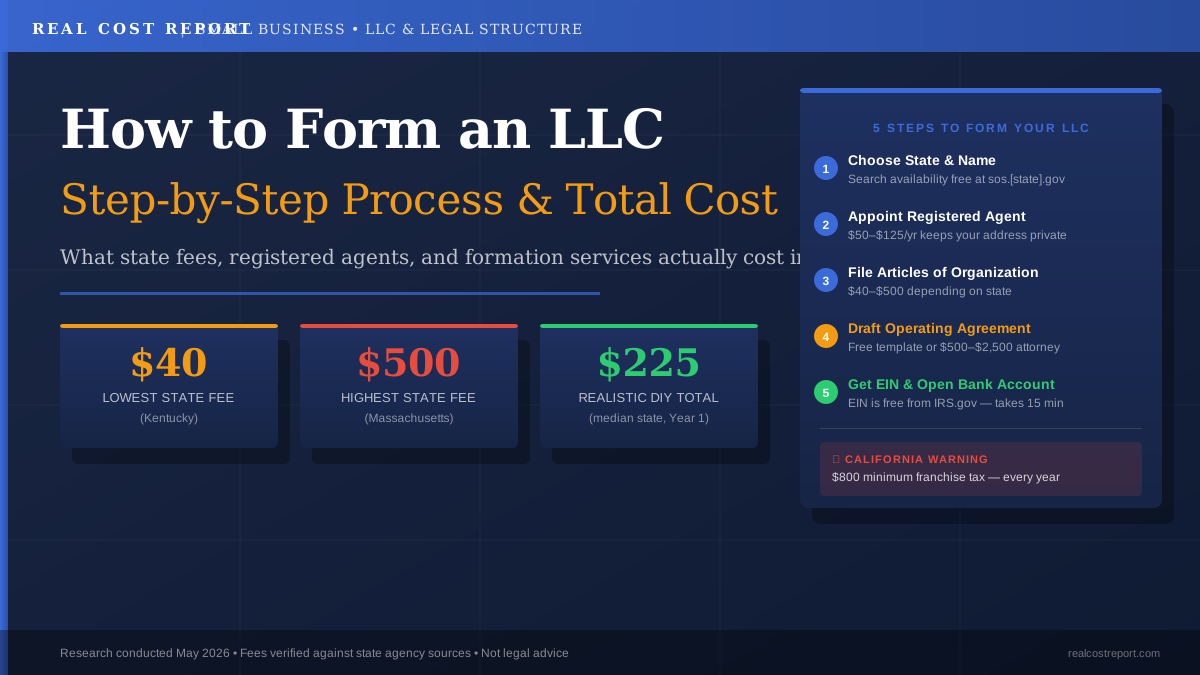
- State filing fees to form an LLC range from $35 (Kentucky) to $500 (Massachusetts), with the national median around $100–$130.
- DIY formation costs $35–$500 total; using a registered agent service like Northwest Registered Agent or ZenBusiness adds $0–$299/year.
- Formation services (LegalZoom, Incfile) charge $0–$299 in service fees on top of state fees — most of what they do you can replicate in 30 minutes.
- An operating agreement is legally required in some states and strategically critical in all of them; skipping it is the single most expensive mistake owners make.
- Annual report fees — often $25–$800/year — are a permanent recurring cost most first-timers miss entirely.
- Recommendation: File directly with your state, hire a registered agent for ~$50–$125/year, and spend the money you save on a real attorney to draft your operating agreement.
Forming an LLC sounds bureaucratic. The actual process — file some paperwork, pay a fee, get a piece of paper — takes most people under an hour. But the total cost of doing it right, sustainably, and in a way that actually protects you is a different number than the one most formation services quote on their homepage. According to the U.S. Small Business Administration, there were 33.2 million small businesses in the United States as of 2023, and the LLC remains the dominant structure for new formation precisely because it separates personal assets from business liability at relatively low cost. What the SBA doesn’t tell you is that the $49 “basic plan” from LegalZoom covers the state filing fee they pass through to your state — and that’s largely it. This guide models the real total cost across five scenarios, names the line items most formation guides omit, and tells you exactly when paying a professional is worth it and when it’s not.
What It Actually Costs to Form an LLC: State Filing Fees by State
The only mandatory cost to form an LLC is the state filing fee paid to your Secretary of State (or equivalent agency) when you submit your Articles of Organization. Every other cost — registered agent, operating agreement, EIN, business bank account — is either optional, free through the IRS, or can be done yourself. That said, ignoring the optional costs is exactly how LLCs lose their liability protection in court.
The table below reflects fees current as of early 2026. Always verify directly with your state agency before filing, as legislatures adjust these figures regularly.
Source: Individual Secretary of State offices (verify at sos.[state].gov or equivalent). Annual report figures reflect 2025–2026 published schedules.
New York’s publication requirement deserves a separate callout: state law requires new LLCs to publish a notice of formation in two newspapers for six consecutive weeks. In Manhattan and surrounding counties, this can cost $1,200–$2,000 alone. In Albany County, costs drop to $150–$300. The county where your registered agent is located determines which newspapers qualify — a fact that drives many New York LLCs to maintain their registered agent in a lower-cost county.
How LLC Formation Actually Works: The Five Required Steps
Formation services market complexity that doesn’t exist. Here is the actual process for the overwhelming majority of single-state domestic LLCs.
Step 1: Choose a State and Name
Form in the state where you primarily do business. The Delaware/Wyoming strategy makes sense for multi-member LLCs with complex asset protection needs or for companies raising institutional capital — not for a sole proprietor consultant or a three-person service business. If you form in Delaware but operate in California, you pay Delaware fees and California foreign qualification fees (~$70) plus California’s $800 annual franchise tax. You’ve now spent more while gaining no meaningful benefit.
Check name availability on your state’s Secretary of State website — the search tool is free. Your name must include “LLC,” “L.L.C.,” or “Limited Liability Company” and cannot duplicate an existing registered entity.
Step 2: Appoint a Registered Agent
Every LLC must designate a registered agent: a person or entity with a physical street address in the formation state available during business hours to receive legal and government documents. You can serve as your own registered agent if you have a physical address in the state and are consistently available — but this means your home address appears in the public record and you must be present during business hours. Most small business owners pay $50–$125/year to outsource this to services like Northwest Registered Agent ($125/yr), ZenBusiness ($199/yr), or Registered Agents Inc. ($200/yr first year, then discounts). Harbor Compliance charges $99/yr and has strong reviews for multi-state operations.
Step 3: File Articles of Organization
This is the document that legally creates your LLC. It typically asks for: LLC name, registered agent name and address, principal office address, member/manager names (varies by state), and the organizer’s signature. Most states offer online filing. Processing time ranges from same-day (many online filings) to 10 business days for paper submissions. Expedited processing typically costs an additional $25–$100.
Step 4: Draft an Operating Agreement
No federal law requires an operating agreement, but California, Delaware, Maine, Missouri, Nebraska, and New York require one. More importantly, without one, your LLC is governed by your state’s default LLC statute — which may not reflect what you actually want regarding profit distributions, voting rights, or what happens when a member leaves. For single-member LLCs, the operating agreement also reinforces the separation between business and personal assets that makes the liability shield meaningful. Free templates exist; a competent business attorney charges $500–$2,500 to draft one tailored to your situation.
Step 5: Get an EIN and Open a Business Bank Account
An Employer Identification Number (EIN) is free from the IRS at IRS.gov and takes 15 minutes online. You need it to open a business bank account, hire employees, and file taxes. Any service charging you to “obtain your EIN” is charging for a free government service — typically $50–$79. Bank account requirements vary: most banks want your Articles of Organization, EIN letter, and operating agreement. Monthly fees range from $0 (Relay, Mercury, Bluevine for online-only accounts) to $15–$25/month for traditional banks. Chase Business Complete Banking charges $15/month (waivable) and is a common choice for businesses that need in-person branch access.
DIY vs. Formation Service vs. Attorney: Total Cost Comparison
The decision isn’t purely financial — it’s about where your time is worth more than the fee, and whether the document quality of a formation service actually approaches what an attorney produces.
Ranges compiled from published pricing of LegalZoom, ZenBusiness, Northwest Registered Agent, and Incfile (now Bizee) as of Q1 2026. Verify current pricing at legalzoom.com, zenbusiness.com, northwestregisteredagent.com, and bizee.com.
Verdict
For a single-member LLC with one service line and no partners: DIY the filing, pay Northwest Registered Agent $125/year for registered agent service, and use your state’s official free template for the operating agreement. Total: ~$225 first year. For a multi-member LLC with more than two owners, real estate holdings, or any kind of equity arrangement: pay an attorney $1,500–$2,500 for a properly drafted operating agreement. The operating agreement is where the money is either saved or lost — not on the filing itself.
What Most People Get Wrong When Forming an LLC
Formation errors rarely surface immediately. They show up two years later when a business partner dispute goes to court, when a creditor argues your LLC is actually a sole proprietorship, or when your accountant asks for the document that should have been drafted on day one.
Mistake 1: Forming in Delaware or Wyoming for No Structural Reason
The consequence: You pay two sets of state fees — Delaware’s $300/year franchise tax and your home state’s foreign qualification fee — for zero benefit if you’re a small operating business. Delaware’s Court of Chancery advantage is real for corporations with complex shareholder disputes; it’s largely irrelevant for an LLC with two members running a consulting firm.
Correct action: Form in the state where you live and operate. The only exceptions worth considering: Wyoming for asset protection-focused holding companies, New Mexico for maximum privacy (no member names in public record, no annual report), or Delaware if you’re planning a future conversion to a C-corp for fundraising.
Mistake 2: Skipping the Operating Agreement
The consequence: Without one, your state’s default LLC statute governs everything. In many states, that means profits are split equally regardless of capital contribution, all members have equal voting power regardless of ownership percentage, and a member’s death or bankruptcy can trigger dissolution. For a two-member LLC where partners contributed 70%/30% of startup capital, equal profit-splitting under default rules is a guaranteed conflict.
Correct action: Draft one before the LLC takes on any revenue, opens a bank account, or brings on a second member. Even a simple template is better than nothing.
Mistake 3: Commingling Personal and Business Funds
The consequence: Courts apply “piercing the corporate veil” doctrine — if your business and personal finances are indistinguishable, the liability shield disappears. One California appellate case, Sonora Diamond Corp. v. Superior Court, is frequently cited by attorneys as an example of how thin the protection becomes when owners treat LLC accounts as personal checking accounts.
Correct action: Open a dedicated business bank account the same week you file. Run all business income and expenses through it exclusively. Pay yourself via documented owner draws or salary.
Mistake 4: Missing Annual Report Deadlines
The consequence: Late fees range from $25 (Georgia) to $400 (Florida). Chronic non-filing leads to administrative dissolution — your LLC ceases to exist in the eyes of the state, voiding your liability protection retroactively for the period of non-compliance. Reinstatement fees add another $50–$500.
Correct action: Calendar your annual report deadline at formation. Florida’s is May 1. California’s is every two years from formation anniversary. Wyoming’s is the first day of the anniversary month of formation.
Mistake 5: Treating Formation Service Upsells as Necessary
The consequence: A $0 basic plan from Incfile can balloon to $350+ once you add “rush filing” ($50), “operating agreement” ($99), “EIN service” ($70), and “business license research” ($99) — all of which are either free through government agencies or purchasable independently for less.
Correct action: Use formation services for their core value: handling state paperwork if you find the process confusing. Decline every add-on individually and source those services directly.
Is Forming an LLC Worth It? When the Structure Actually Protects You
The liability shield is the primary reason to form an LLC. But it isn’t absolute, and for some business owners, it provides less protection than assumed.
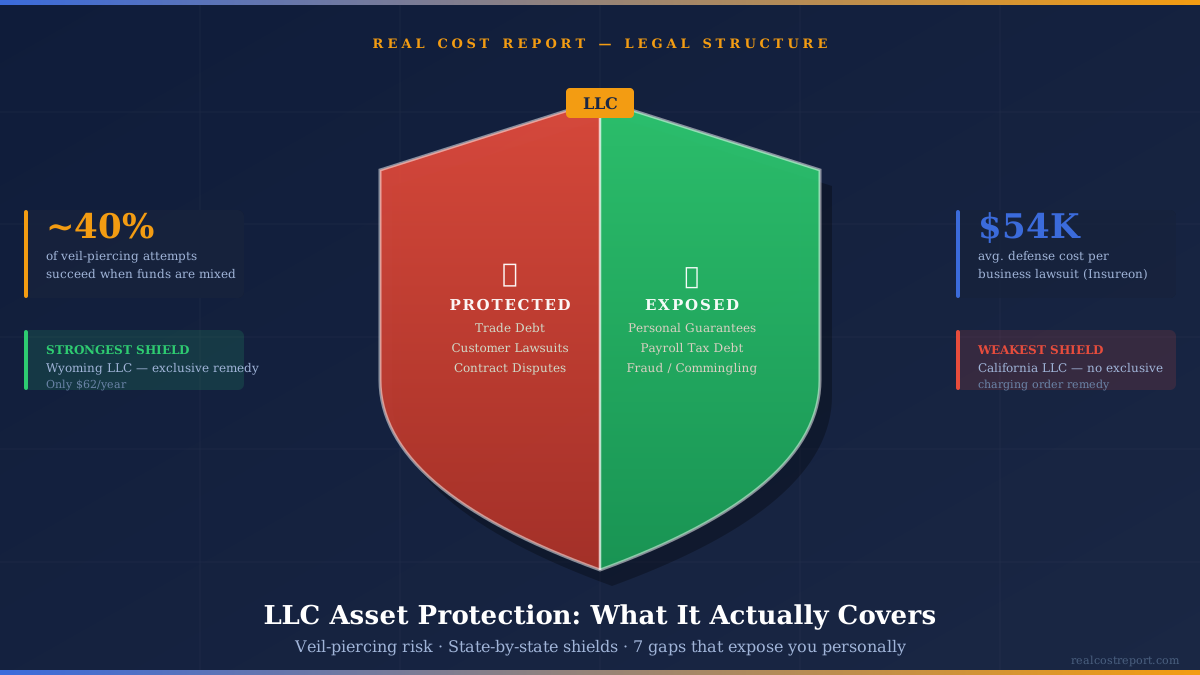
The LLC protects you from: Business debts where you haven’t personally guaranteed the debt, lawsuits brought against the business for actions taken by employees or contractors in the scope of their work, and contract disputes where only the business (not you personally) is a party.
The LLC does not protect you from: Personal guarantees on business loans (most small business lenders require them), your own professional malpractice (attorneys, physicians, CPAs need a PLLC or malpractice insurance), payroll tax obligations (the IRS can pierce to collect), and fraudulent or intentional wrongdoing.
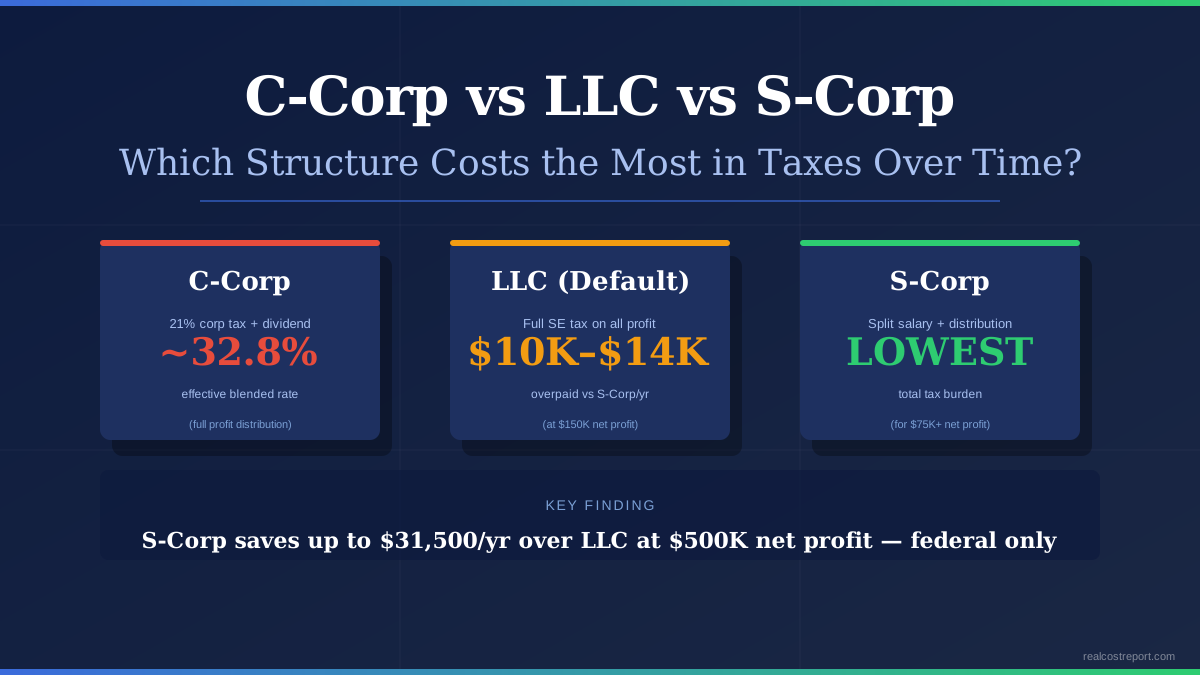
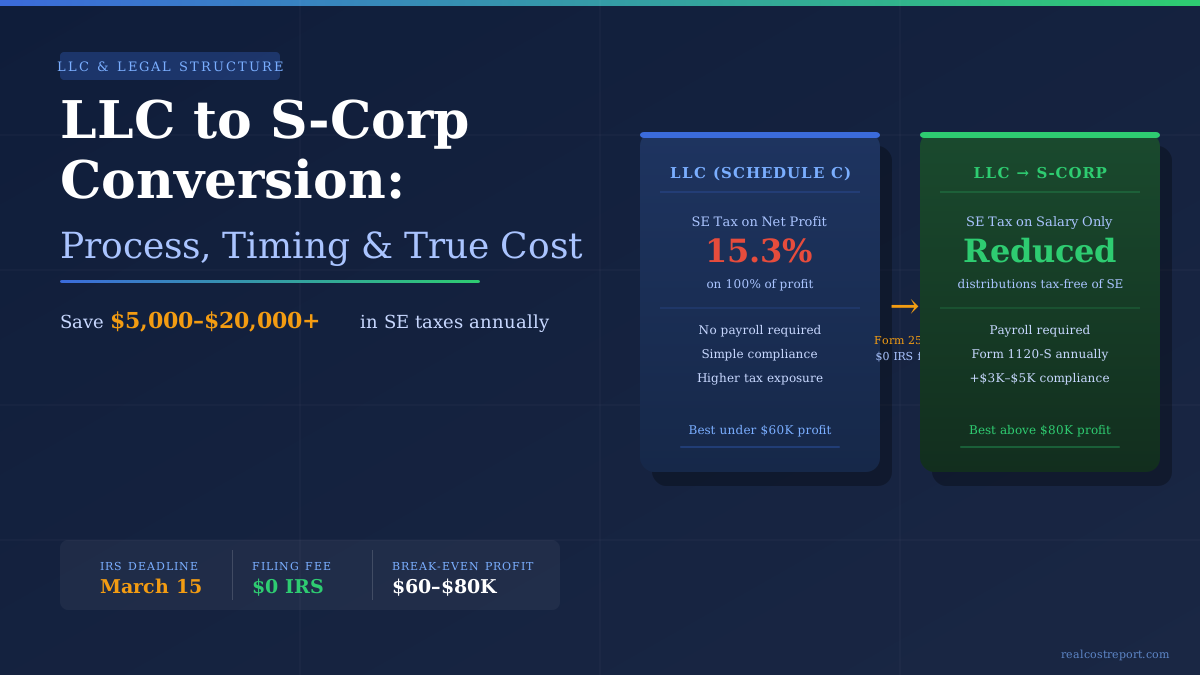
For freelancers billing under $75,000/year with no employees and no physical products: the protection is real but modest. The primary benefit at that income level may actually be tax flexibility — an LLC taxed as an S-corp can reduce self-employment tax liability once net profit exceeds roughly $40,000–$50,000. This isn’t a formation decision; it’s a tax election filed separately with the IRS (Form 2553), typically worth modeling with a CPA once you’re consistently profitable.
For businesses with employees, physical locations, client contracts, or real estate: an LLC (or LLC with S-corp election) is almost always worth the formation cost. The annual compliance cost — registered agent, annual report, basic bookkeeping separation — is $200–$1,000/year for a structure that could prevent a lawsuit from wiping out personal savings.
Bottom line math: If your business generates $80,000/year and you face one employment lawsuit that settles for $30,000, and your LLC documentation was airtight, the suit stays with the business. If your personal assets are exposed because you commingled funds or never executed an operating agreement, that $30,000 comes from your personal accounts. The total cost of doing the LLC correctly — $1,500 over five years — is a rounding error relative to that exposure.
How We Researched This Article
This article was researched and written in May 2026. All state filing fees and annual report requirements were verified directly against each state’s official Secretary of State or equivalent agency portal. For states with franchise taxes rather than flat annual fees — California (Franchise Tax Board), Texas (Comptroller of Public Accounts) — fee structures were pulled from agency-published schedules, not third-party aggregators.
Formation service pricing for LegalZoom, ZenBusiness, and Northwest Registered Agent was captured via direct site review of published pricing pages, not promotional materials. EIN application procedures were verified against the IRS EIN online application page. Small business population data cited in the introduction is drawn from the U.S. Small Business Administration’s 2023 Small Business FAQ.
New York’s publication requirement was verified against New York LLC Law Section 206, which mandates publication in two newspapers for six consecutive weeks following formation. County-level cost estimates reflect published rates from Albany County and New York County (Manhattan) newspaper legal notice rate cards as publicly posted.
Operating agreement requirements by state were cross-referenced against the Uniform Limited Liability Company Act (ULLCA) as adopted in individual states. The veil-piercing doctrine reference cites Sonora Diamond Corp. v. Superior Court, 83 Cal.App.4th 523 (2000), a California appellate decision accessible via public court records.
The S-corp election income threshold ($40,000–$50,000 net profit) reflects commonly modeled breakeven estimates based on self-employment tax rates (15.3% on net earnings) compared to reasonable salary requirements for S-corp shareholders — this is a modeled range, not a fixed statutory figure, and individual results depend on state tax treatment, salary determination, and payroll costs. Consult a CPA before making any entity classification election.
This analysis distinguishes between mandatory costs (state filing fees) and optional costs (formation services, attorney fees) throughout. “Total Year 1” figures in the comparison table represent median-state scenarios; individual totals will vary significantly based on state of formation. All figures were verified against named primary sources before publication.