Past performance does not indicate future results. This is not investment advice. This article is for informational purposes only; consult a licensed attorney and financial advisor before making decisions about retirement asset division in divorce.
TL;DR — Quick Verdict
- A Qualified Domestic Relations Order (QDRO) is legally required to divide employer-sponsored retirement plans — 401(k)s and pensions — without triggering the 10% early withdrawal penalty or immediate tax liability.
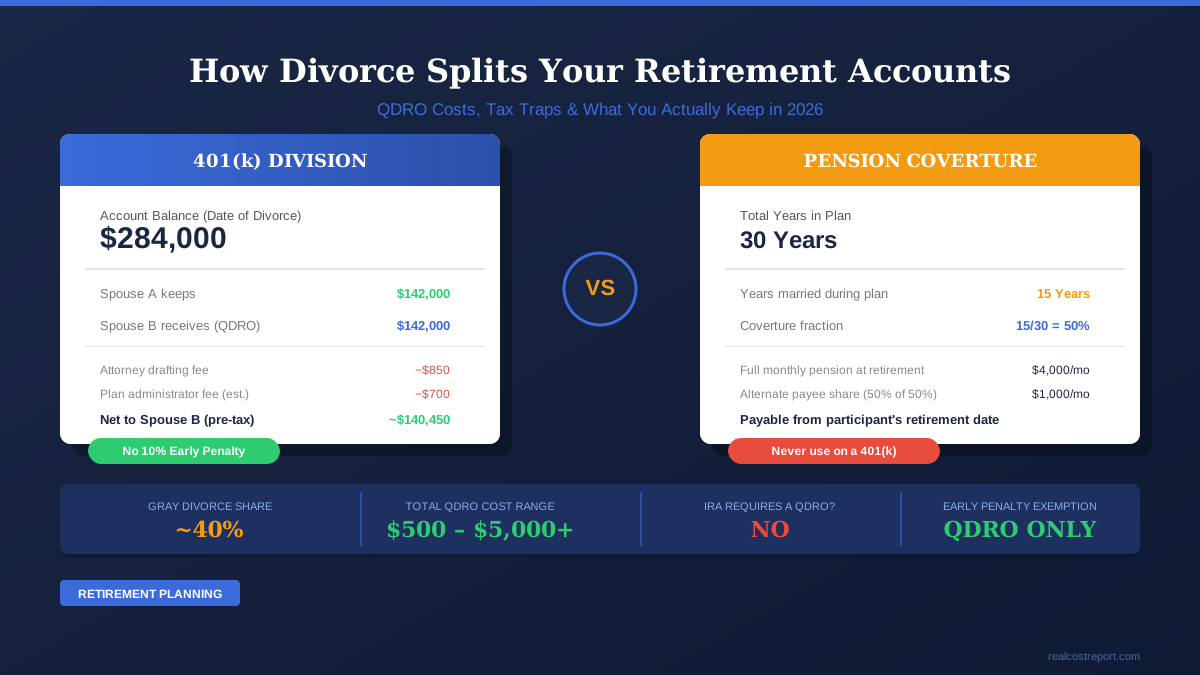
- Total QDRO costs range from $500 to over $5,000: attorney drafting fees run $500–$1,750 for flat-rate services; plan administrators (Fidelity, Vanguard) charge an additional $500–$1,200+ on top.
- IRAs do not require a QDRO — a divorce decree plus a “transfer incident to divorce” instruction suffices, saving $1,000+ in fees.
- Pensions use a coverture fraction to determine the marital share; 401(k)s are split by dollar amount or percentage as of a specific date — using the wrong method for the wrong plan type is one of the costliest errors in divorce.
- Rolling a 401(k) QDRO distribution into a Roth IRA instead of a Traditional IRA triggers a taxable conversion — potentially adding tens of thousands of dollars in tax bills in one year.
- Recommendation: Retain a QDRO-specialist attorney (not a general divorce lawyer) during the divorce, not after, and request plan pre-approval before the judge signs the order.
Adults 50 and older now account for nearly 40% of all U.S. divorces, up from just 8.7% in 1990, according to Bowling Green State University’s National Center for Family and Marriage Research — and unlike younger couples fighting over car payments and furniture, this cohort is splitting retirement assets that took decades to accumulate. A single 401(k) or pension can represent the largest marital asset on the table, worth hundreds of thousands of dollars. Get the paperwork wrong and the IRS becomes an uninvited third party, claiming up to 37% of the transfer in income taxes plus a 10% early-withdrawal penalty. The mechanism that prevents that outcome is a Qualified Domestic Relations Order (QDRO) — a court order, separate from the divorce decree, that instructs your plan administrator (Fidelity, Vanguard, your employer’s pension fund) exactly how to divide the account. This article maps every cost in that process, shows the math on pension coverture fractions versus 401(k) percentage splits, identifies the tax traps that swallow thousands in settlement value, and tells you precisely which accounts require a QDRO and which do not.
What a QDRO Is — and What It Is Not
A QDRO is a court judgment, decree, or order that instructs a qualified retirement plan to pay a portion of a participant’s benefits to a former spouse, child, or other dependent — called the “alternate payee.” The Internal Revenue Service defines a qualifying order as one that contains the participant’s and each alternate payee’s name and last known mailing address, and specifies the amount or percentage of benefits to be paid. The IRS’s guidance on this is published at irs.gov under “Retirement Topics — QDRO.”
Three details are frequently misunderstood. First, a QDRO is never part of your divorce decree; it is a separate legal document that must be drafted, signed by a judge, and then formally approved by the retirement plan administrator. If the plan administrator rejects it — and plan-specific quirks mean rejections are common — the division stops until a conforming order is resubmitted. Second, a QDRO applies only to employer-sponsored plans governed by ERISA: 401(k)s, 403(b)s, 457 plans, TSPs, and pension plans. It does not apply to IRAs. Third, QDRO distributions paid to a former spouse are reported by the recipient as if they were the plan participant — meaning the former spouse, not the employee, owes the income tax on withdrawals. Under the IRS rules, those distributions are also exempt from the 10% early-withdrawal penalty that would otherwise apply before age 59½.
Government retirement plans — federal FERS and CSRS pensions, state and municipal pensions — are divided by a similar but technically distinct instrument. Federal plans use a “Court Order Acceptable for Processing” (COAP). Illinois public employees require a Qualified Illinois Domestic Relations Order (QILDRO). These orders follow the same logic as a QDRO but must conform to different statutory frameworks. Budget an additional $200–$400 in drafting fees for these variants, and verify the plan’s specific requirements before drafting begins.
QDRO Costs in 2026: Attorney Fees, Plan Fees, and Hidden Charges
The total bill for a QDRO has two distinct components: the legal drafting fee and the plan administrator’s processing fee. Most people budget only for the first and are blindsided by the second.
Sources: QDRO Helper (qdrohelper.com), QDRO, INC. (qdrotime.com), QDRO Masters (qdromasters.com), McKain Law (mckainlawpllc.com) — fee schedules verified May 2026. (verify at each firm’s official domain)
The math on a typical gray-divorce scenario: a couple with one 401(k) and one pension retains a QDRO specialist at $850 per account. The 401(k) administrator charges $700 and the pension administrator charges $1,000. Total all-in: $3,400 — before any court filing fees, which range from $30 to $450 depending on jurisdiction. Splitting the QDRO fee equally is conventional practice, but the party with higher income often absorbs more in negotiated settlements.
One structural cost-saver: initiating the QDRO during the divorce rather than after. McKain Law notes in published guidance that post-divorce QDROs cost materially more because the attorney must independently trace assets, address potential loans or withdrawals the participant may have taken, and navigate the court system without the cooperative framework active divorce proceedings provide. Once a plan administrator receives notice of a pending divorce, the participant legally cannot move or liquidate the funds — a protection that disappears the moment the decree is final without an accompanying QDRO.
401(k) vs. Pension: Which Division Method Applies — and Why It Matters
Using the wrong division formula on the wrong account type is among the most expensive errors in divorce financial planning. The two plan types require fundamentally different approaches, and a QDRO drafted with pension language applied to a 401(k) can create an unintended windfall for one party.
Source: IRS.gov (irs.gov/retirement-plans), Kiplinger (kiplinger.com), ValueYourPension.com — compiled May 2026.
The coverture fraction calculation for a pension works as follows. Suppose a spouse spent 30 total years in a pension plan and 15 of those years occurred during the marriage. The coverture fraction is 15/30, or 50%. The alternate payee is then entitled to an agreed share — typically 50% — of that marital fraction. So the alternate payee receives 50% × 50% = 25% of the total pension benefit. If the full monthly pension at retirement is $4,000, the alternate payee receives $1,000/month. The denominator of this fraction is unknown until retirement, which is why pension QDROs require the plan administrator to “plug in the numbers” at the time of retirement.
For 401(k) plans, the division is cleaner: the QDRO specifies a dollar amount or percentage as of a specific valuation date, plus whether investment earnings and losses on that amount will be attributed to the alternate payee between the valuation date and the actual transfer date. Omitting this earnings-and-loss clause is a common drafting error that can cost the alternate payee tens of thousands of dollars in a rising market.
Verdict
For 401(k)s, always specify a percentage with an earnings-and-losses adjustment clause. For pensions, use the coverture fraction with the shared-interest approach if you want payments to start at the participant’s retirement — or a present-value offset if you need cash-equivalent compensation now. Never use coverture fraction language on a defined contribution plan.
The Tax Traps: What Triggers Penalties and What Doesn’t
The single most expensive mistake in QDRO-related distributions is confusing what is tax-free at the point of transfer with what becomes taxable later. The IRS’s rules here are both precise and unforgiving.
A distribution made directly to a former spouse under a properly qualified QDRO carries no 10% early-withdrawal penalty, regardless of the recipient’s age. The Internal Revenue Service confirms this in its retirement topics guidance: amounts included in income under a QDRO are not subject to the 10% early distribution tax. This is a one-time exemption available only to the alternate payee — not to the participant spouse.
But “no penalty” does not mean “no tax.” The alternate payee who receives a QDRO distribution and does not roll it over into a qualifying account owes ordinary income tax on the full amount in the year received. For someone receiving a $150,000 distribution and already earning $80,000 in salary, that payment could push their marginal federal rate to 32% or higher, generating a $48,000+ tax bill. Charles Schwab’s published guidance on divorce and taxes confirms that under a QDRO, assets roll over like any standard plan distribution, preserving tax-deferred status only if the recipient immediately directs them into a Traditional IRA or another qualified plan.
The Roth IRA rollover trap is particularly dangerous. Rolling a pre-tax 401(k) QDRO distribution into a Roth IRA is a legal taxable conversion — the entire transferred amount becomes gross income in the year of the conversion. A $200,000 conversion for someone in the 24% bracket costs $48,000 in federal tax alone, before state taxes. That amount is due even if the money never left a retirement account. The correct path for preserving tax deferral is a direct rollover — a check made payable to the new custodian (e.g., “Fidelity FBO [Recipient Name] IRA”), not to the individual. Indirect rollovers, where the check is made payable to the individual, trigger mandatory 20% federal withholding and a 60-day deadline to deposit the full original amount — including the withheld 20% — into the new account.
IRA transfers work differently. Because IRAs are not ERISA-governed plans, no QDRO is required. The IRS permits a tax-free transfer incident to divorce, provided the divorce decree or separation agreement explicitly identifies the transfer as such. The most efficient method is a trustee-to-trustee transfer to a new IRA in the alternate payee’s name. If the divorce judgment does not specify a “transfer incident to divorce,” both parties may owe tax and penalties on the transaction — a drafting error with no retroactive correction available.
What Most People Get Wrong About Dividing Retirement Accounts
After reviewing guidance from the IRS, the U.S. Department of Labor, and practitioner literature, five errors appear consistently — each with a quantifiable cost.
Error 1: Assuming the divorce decree is enough. Many people finalize their divorce with language in the decree promising a share of a retirement plan, then never file a QDRO. The plan administrator has no legal obligation to honor a decree alone. If the plan participant subsequently takes loans against the 401(k), withdraws funds, or dies, the alternate payee may have no recourse. The Government Accountability Office’s 2020 report on retirement security found that many divorce participants never complete the QDRO even when it is the sole mechanism for equitable division. The consequence: losing the entire awarded benefit. The correct action: file the QDRO and obtain plan administrator qualification before the divorce is finalized.
Error 2: Hiring a general divorce lawyer instead of a QDRO specialist. Plan administrators maintain their own model QDRO language and rejection criteria. A generalist attorney unfamiliar with a specific plan’s requirements may draft an order that gets rejected, requiring a complete redraft at additional cost. A rejected QDRO also leaves the alternate payee’s funds unprotected during the re-drafting period. The correct action: retain a QDRO specialist — an attorney who works with retirement plan administrators daily — either separately or in coordination with your divorce attorney.
Error 3: Exchanging pre-tax and post-tax accounts as if they’re equal. A $100,000 traditional 401(k) and a $100,000 Roth IRA are not equivalent in after-tax value. The 401(k) carries a deferred tax liability of up to $24,000–$37,000 depending on the recipient’s future tax bracket. Agreeing to swap one for the other without “tax-effecting” the values leaves one party materially worse off. The correct action: calculate after-tax present value for each account before agreeing to an offset.
Error 4: Failing to address outstanding 401(k) loans in the QDRO. If a participant has borrowed against their 401(k), that loan reduces the available balance. A QDRO that awards 50% of the account without specifying whether the loan balance is deducted first can dramatically reduce what the alternate payee actually receives. The correct action: request a current plan statement showing any outstanding loan balance and explicitly state in the QDRO whether the division is calculated before or after the loan balance.
Error 5: Forgetting to update beneficiary designations after the QDRO. A completed QDRO assigns retirement benefits, but it does not automatically remove an ex-spouse listed as a beneficiary. Federal courts process cases annually where a remarried participant dies and the original ex-spouse, still listed as beneficiary, receives the death benefit over the participant’s current spouse or children. The IRS explicitly advises contacting the plan administrator to update beneficiary forms following any divorce. The correct action: submit updated beneficiary designation forms to every plan administrator within 30 days of the divorce being finalized.
Is a QDRO Worth It? Who Should Pursue Full Division vs. Offset Strategies
Not every divorcing couple needs to divide every retirement account through a QDRO. The process costs money, takes 90–120 days in straightforward cases and considerably longer for pension plans, and introduces administrative complexity. Under some circumstances, an offset strategy — where one spouse keeps the full retirement account and the other receives equivalent marital assets — is more efficient.
Pursue a QDRO if: The retirement account is the largest marital asset. The alternate payee has minimal retirement savings of their own. The marriage lasted more than 10 years (below this threshold, some Social Security survivor benefit rules also apply). The participant is within 10–15 years of retirement, meaning a pension’s present value is relatively predictable. One spouse will not have meaningful earned income in retirement.
Consider an offset instead if: The retirement account is modest relative to other marital assets (home equity, taxable brokerage accounts, business interests). Both parties have comparable retirement savings. The QDRO fees represent more than 3–5% of the account value being divided. The pension is a government plan with high actuarial complexity that would require expensive present-value calculation.
A concrete illustration: a couple has a $280,000 marital home (equity $140,000) and a $180,000 traditional 401(k) accumulated entirely during the marriage. The offset approach: spouse A keeps the full 401(k), spouse B receives the full home equity. No QDRO required — no $2,400+ in fees, no 90-day processing wait. The after-tax comparison is critical, however: the $140,000 in home equity is generally tax-free under the principal residence exclusion (IRS Section 121), while the $90,000 that would have been transferred via QDRO carries a deferred tax liability of roughly $18,000–$27,000 at eventual withdrawal. A straight dollar-for-dollar swap in this scenario subtly favors the 401(k) holder. A Certified Divorce Financial Analyst (CDFA) can model these trade-offs before any agreement is signed.
Gray divorce adds urgency. Adults 50 and older, now comprising nearly 40% of divorcing couples per Bowling Green State University data, have less time to rebuild depleted retirement savings after the split. The Federal Reserve Bank of St. Louis documented in February 2024 analysis that recently divorced workers earn on average 12% less than their non-divorcing counterparts across all ages, compressing the recovery window further. For this demographic, getting the QDRO right the first time — rather than renegotiating or litigating a flawed order years later — carries outsized financial stakes.
How We Researched This Article
This article draws on primary regulatory sources, published fee schedules from practicing QDRO attorneys and preparation services, and peer-reviewed demographic research. Research was conducted in May 2026.
QDRO legal requirements and tax treatment were sourced directly from the IRS Retirement Topics — QDRO page and the IRS guidance on filing taxes after divorce. Both pages were accessed and read in full in May 2026. Tax implications of QDRO rollovers were cross-referenced with Charles Schwab’s published analysis of divorce and taxes, a DA 90+ financial institution whose guidance reflects current IRC treatment.
Cost data for attorney drafting fees were drawn from publicly published fee schedules at QDRO Helper (qdrohelper.com), QDRO, INC. (qdrotime.com), QDRO Masters (qdromasters.com), and McKain Law PLLC (mckainlawpllc.com). Administrator processing fee ranges ($500–$1,200+) were sourced from attorney commentary published at The Marks Law Firm (themarkslawfirm.com). All fee data reflect publicly stated 2025–2026 pricing; individual plan fees vary and should be verified directly with each plan administrator.
Pension division methodology — including the coverture fraction and defined benefit vs. defined contribution distinction — was sourced from ValueYourPension.com’s technical guide on pension division in divorce and corroborated by Kiplinger’s September 2024 coverage of QDROs. Demographic data on gray divorce and divorce rates were drawn from Bowling Green State University’s National Center for Family and Marriage Research (2024 analysis cited via divorce.law) and the Bureau of Labor Statistics Monthly Labor Review, September 2024. Income effects of divorce were sourced from the Federal Reserve Bank of St. Louis On the Economy blog, February 2024.
Limitations: QDRO attorney fees vary significantly by geography and case complexity; the ranges cited reflect national data from published fee schedules and may not reflect rates in high-cost metropolitan areas. Plan administrator fees are not uniformly disclosed and the ranges cited represent reported practitioner experience, not a comprehensive survey. All figures were verified against named primary sources before publication.