Past performance does not indicate future results. This article is for informational purposes only and does not constitute investment advice. Consult a licensed financial advisor or tax professional before making retirement withdrawal decisions.
TL;DR — Quick Verdict
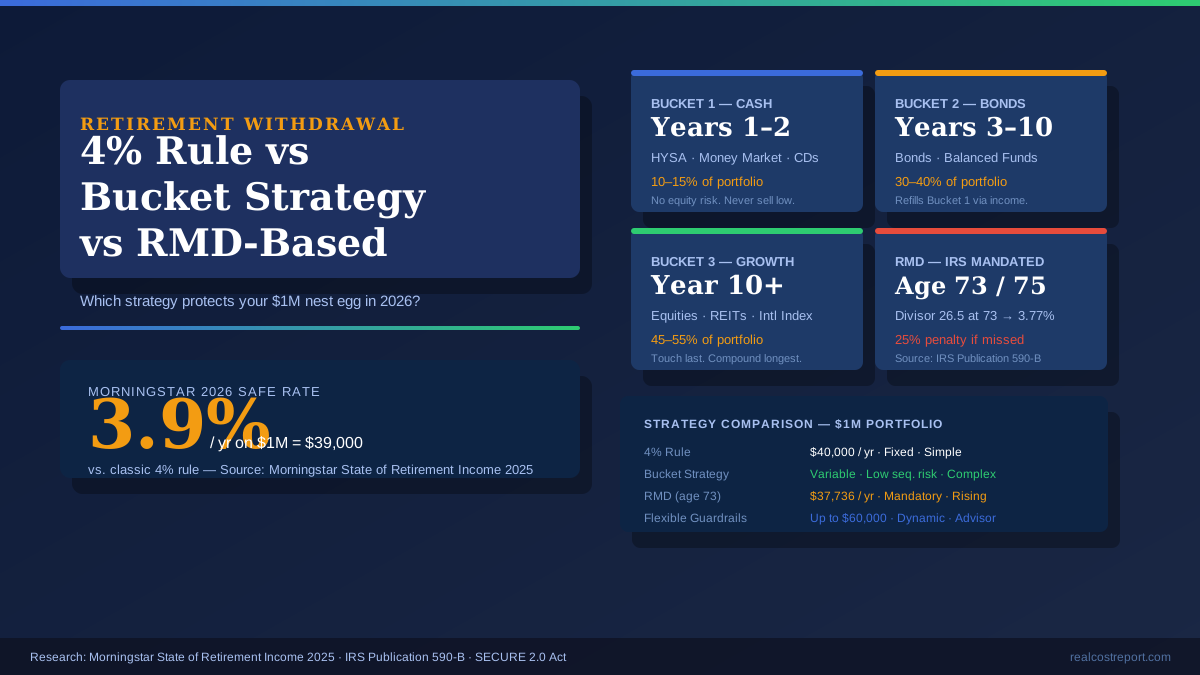
- Morningstar’s 2025 State of Retirement Income report sets the safe starting withdrawal rate at 3.9% for 2026 — up from 3.7% in 2025, but still below the classic 4% rule for a 30-year horizon with a 40/60 portfolio.
- On a $1 million portfolio, the difference between 3.9% ($39,000/year) and 4% ($40,000/year) is $1,000 in year one — but compounds into a $47,000+ gap over 20 years under inflation adjustment.
- The Bucket Strategy outperforms the 4% rule for most retirees under 70 by separating liquidity risk from growth assets, reducing panic-selling exposure during early-retirement bear markets.
- RMD-based withdrawal is mandatory for traditional IRA and 401(k) holders starting at age 73 (or 75 for those born in 1960 or later) — it produces rising withdrawal percentages that start near 3.8% and climb past 5.5% by age 85.
- Flexible strategies — Guardrails or RMD-linked withdrawals — can safely increase starting rates to approximately 6% per Morningstar’s 2025 research, but require annual recalibration.
- Best fit: Bucket Strategy for retirees aged 60–72 with $500,000 or more; RMD-based for those 73 and older with primarily tax-deferred assets; 4% rule only as a quick planning benchmark, not a live withdrawal policy.
One number has guided American retirement planning for 30 years: 4%. Researcher Bill Bengen introduced it in 1994, and for decades it served as the default answer to “how much can I spend?” But Morningstar’s 2025 State of Retirement Income report — published December 3, 2025, by Amy Arnott, Christine Benz, and Jason Kephart — pegged the safe starting withdrawal rate for 2026 retirees at 3.9%, assuming a 40/60 stock-to-bond portfolio, a 30-year time horizon, and a 90% probability of success. That 0.1 percentage point gap sounds trivial. On a $2 million nest egg, it is $2,000 per year — and compounds into real spending shortfalls over time.
Meanwhile, two other strategies compete for retirees’ attention: the three-bucket approach, popularized by financial planner Harold Evensky and now widely promoted by Fidelity, Vanguard, and Schwab; and RMD-based withdrawal, which the IRS mandates starting at age 73 for traditional IRA and 401(k) account holders. This analysis builds scenario models for each strategy across a $1 million portfolio, compares tax exposure, survivability odds, and administrative complexity, and tells you which approach wins for your situation.
What the 4% Rule Actually Says — And What It Doesn’t
Bill Bengen’s original research, published in the Journal of Financial Planning in 1994, used historical U.S. market returns from 1926 onward. He found that a retiree with a 50/50 stock-to-bond portfolio could withdraw 4% of the starting balance annually — adjusted upward each year for inflation — and survive any 30-year retirement period in the historical record. That ceiling of durability was later confirmed by the Trinity Study (Cooley, Hubbard, and Walz, 1998), which showed 4% sustaining a portfolio 95% of the time over 30 years.
The critical flaw in applying this today: Bengen used backward-looking returns. Morningstar’s updated methodology embeds forward-looking capital market assumptions. With muted expected equity returns and inflation projected at 2.46% (per Morningstar Investment Management’s 2025 assumptions, up from 2.29% in 2024), the math lands at 3.9%. That figure assumes no Social Security, pension, or annuity income supplements portfolio withdrawals — a worst-case setup that overstates how aggressively most retirees must draw down.
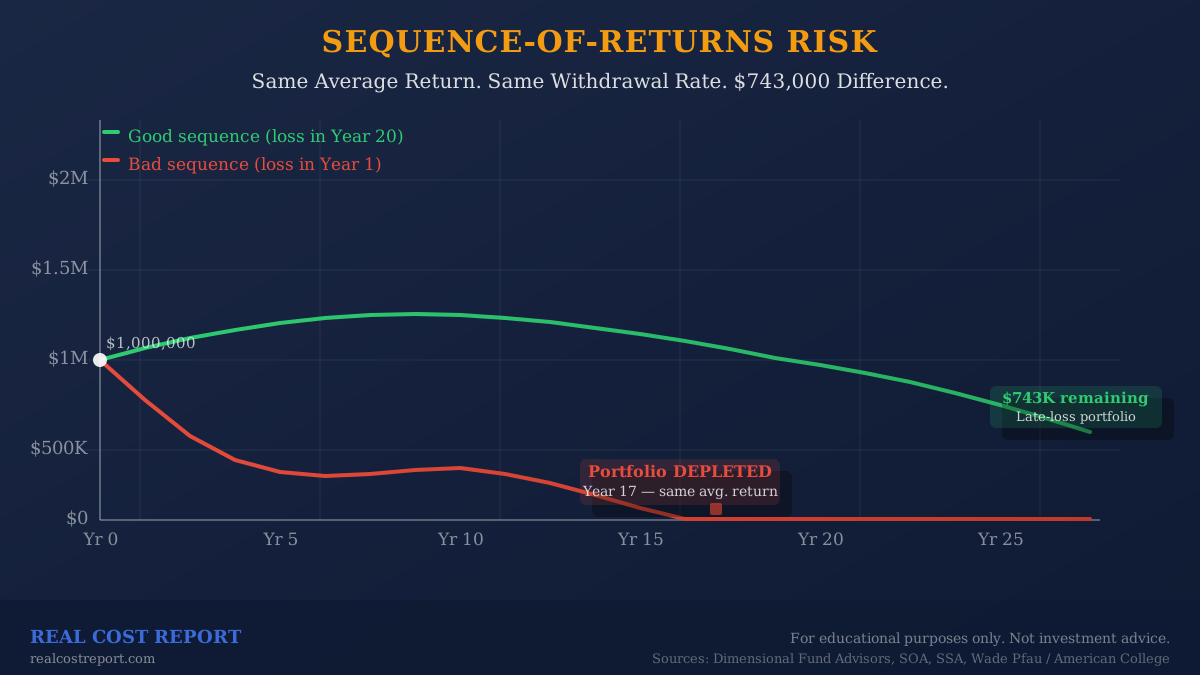
Two findings from Morningstar’s 2025 research deserve attention. First, higher equity allocations do not raise the safe withdrawal rate — they lower it, because sequence-of-returns risk dominates early retirement outcomes. A 70/30 portfolio produces a lower safe withdrawal rate than a 40/60 portfolio under Morningstar’s model. Second, older retirees with shorter time horizons can spend significantly more: a retiree planning for a 20-year horizon can safely withdraw more than 5%, and one with a 15-year horizon can approach 7%, per Morningstar’s 2025 report.
Source: Morningstar, “What’s a Safe Retirement Withdrawal Rate for 2026?” — morningstar.com (published December 3, 2025). The ~6.8% estimate for a 15-year horizon is derived from Morningstar’s published range; verify the precise figure at morningstar.com.
How the Bucket Strategy Works — And What It Costs to Run It
The three-bucket strategy was developed by financial planner Harold Evensky and popularized through Morningstar’s model bucket portfolios, which Morningstar’s Christine Benz has refined annually since 2012. The core principle: match assets to the timeframe in which they will be spent, so that long-term growth assets are never sold at a loss to fund near-term expenses.
Bucket 1 (Years 1–2): Cash, money-market funds, short-term CDs, high-yield savings. No equity exposure. Goal: zero nominal loss. Size: typically 10–20% of total assets, or 1–3 years of annual spending minus guaranteed income. On a $1 million portfolio with $50,000 annual spending needs (after Social Security), this bucket holds $50,000–$100,000.
Bucket 2 (Years 3–10): High-quality bonds, short-to-intermediate bond funds, dividend-paying equities, balanced funds. Goal: income production and inflation protection. Size: roughly 30–40% of investable assets. Distributions from this bucket refill Bucket 1 as cash is depleted. On the same $1 million portfolio, this bucket holds $300,000–$400,000.
Bucket 3 (Years 10+): Broad equity index funds, REITs, international equity, alternative assets. Goal: long-term growth to combat longevity risk. Size: the remainder — typically 40–60% of investable assets. This bucket is left untouched during early retirement, allowing compounding to continue while Buckets 1 and 2 fund spending.
The strategy requires annual rebalancing and ongoing maintenance. The total-return approach underpins a key mechanical insight from Morningstar’s model portfolios: income distributions from Bucket 2 — bond coupon payments and dividends — flow first into replenishing Bucket 1, before principal in Bucket 2 is touched. This maintains the ladder’s integrity for up to eight years without requiring any sale of Bucket 3 equities, covering most historical bear market durations.
Source: Morningstar, “The Bucket Approach to Building a Retirement Portfolio” — morningstar.com. Dollar ranges are illustrative based on a $1,000,000 base portfolio assuming $50,000 annual spending needs after guaranteed income; individual allocations vary.
RMD-Based Withdrawal: How the IRS Sets Your Withdrawal Rate for You
Required Minimum Distributions are not a strategy a retiree chooses — they are a legal obligation. Under the SECURE 2.0 Act of 2022, traditional IRA, SEP-IRA, SIMPLE IRA, and most 401(k) account holders must begin withdrawing annually starting at age 73 (for those born 1951–1959) or age 75 (for those born in 1960 or later). The IRS enforces this with a 25% excise tax on any shortfall, reduced to 10% if corrected within two years, per IRS Publication 590-B.
The annual RMD equals the prior December 31 account balance divided by a life expectancy factor from the IRS Uniform Lifetime Table. At age 73, that factor is 26.5, producing an effective withdrawal rate of approximately 3.77%. The factor shrinks each year, automatically increasing the mandatory withdrawal percentage as the retiree ages. At 80, the factor is 20.2 (approximately 4.95%). At 85, it drops to roughly 16.0 (approximately 6.25%). This means the RMD method forces spending to accelerate — a feature, not a bug, from the IRS perspective, but a potential tax burden problem if not planned for.
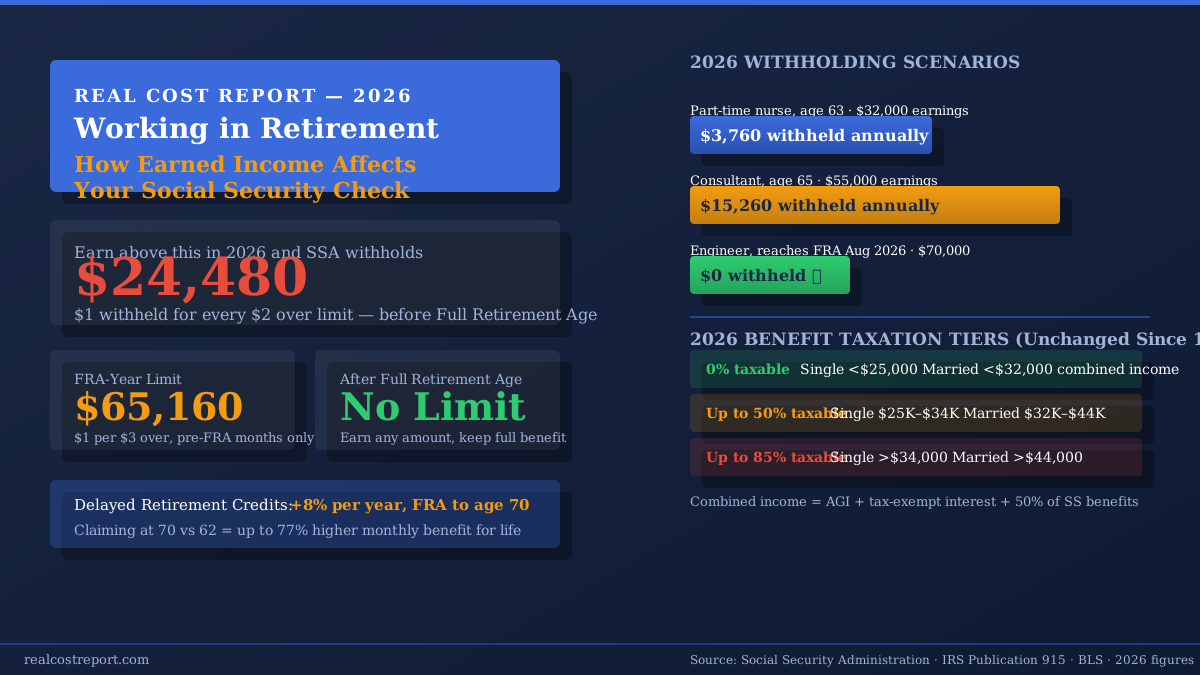
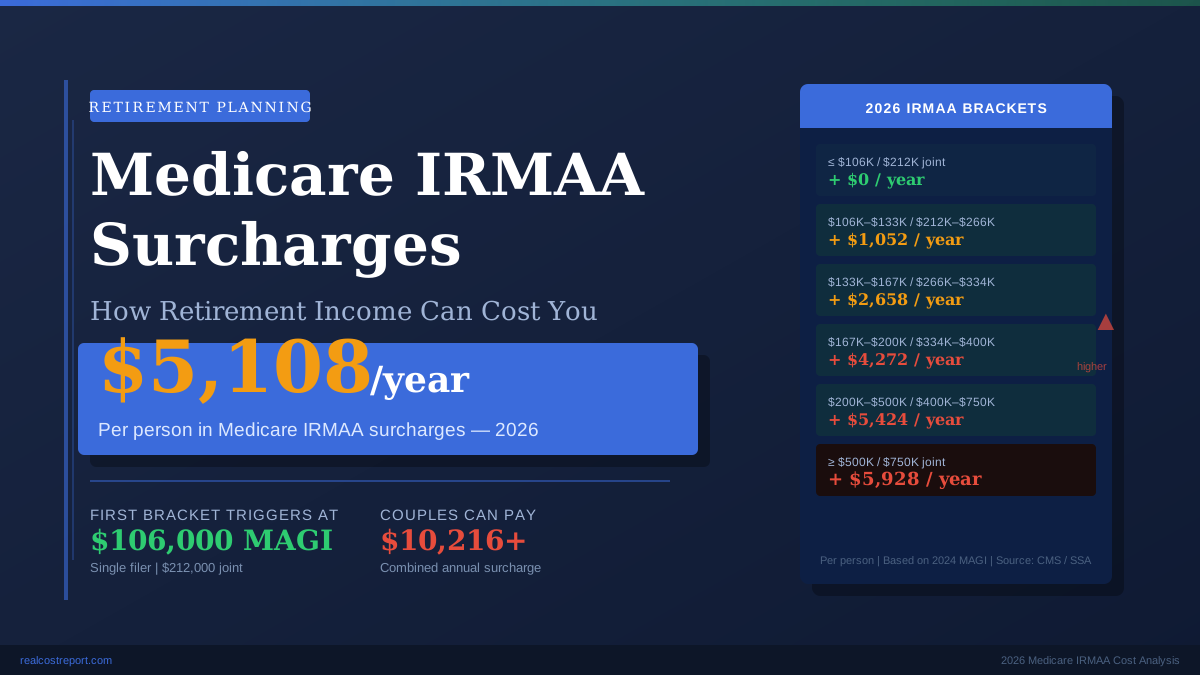
The calculation is straightforward. A 73-year-old with $800,000 in a traditional IRA divides $800,000 by 26.5 to get a 2026 RMD of $30,189. A 80-year-old with $500,000 divides by 20.2, yielding $24,752. Both amounts are added to taxable income for the year. If either retiree also receives Social Security, the combined income may trigger taxation of up to 85% of Social Security benefits and push Medicare premiums higher through IRMAA surcharges — a cost most retirees do not model in advance.
Source: IRS Uniform Lifetime Table, IRS Publication 590-B — Internal Revenue Service (irs.gov, verify at irs.gov/publications/p590b). RMD figures assume $1,000,000 starting balance; real account values will differ based on market returns and prior withdrawals.
4% Rule vs Bucket Strategy vs RMD-Based: Which Is Better for Your Situation?
Each strategy solves a different problem. The 4% rule is a planning heuristic — it tells you how much you can save before retirement, not how to manage cash flow after it. The Bucket Strategy is an operational framework for drawdown that addresses liquidity and sequence-of-returns risk simultaneously. RMD-based withdrawal is a tax compliance obligation that can serve as an ad-hoc spending floor but was not designed as a financial plan.
To compare them fairly, consider a 65-year-old retiree, Maria, with $1.2 million in a traditional IRA, $25,000 per year in Social Security, and $65,000 in annual spending needs. Her portfolio gap — the amount she must pull from savings annually — is $40,000.
Under the 4% rule, Maria draws $48,000 in year one (4% of $1.2M) — more than her $40,000 gap. She adjusts upward for inflation each year regardless of portfolio performance. In a flat or down market in years 1–5, she may be selling equities at depressed prices to fund the fixed withdrawal. By year 10, if the portfolio has not grown sufficiently, she faces sequence-of-returns damage that becomes difficult to reverse.
Under the Bucket Strategy, Maria parks $80,000 in Bucket 1 (two years of her $40,000 gap), $320,000 in Bucket 2 (bonds, approximately eight years of coverage), and leaves $800,000 in Bucket 3 (equity funds). In a bear market, she draws from Bucket 1 and waits — never forced to sell equities at a loss. Bond income from Bucket 2 continuously refills Bucket 1. The psychological benefit is real and measurable.
Under an RMD-based approach, Maria is not yet obligated at 65. When she reaches 73, her $1.2 million IRA (likely grown significantly over eight years) will generate a mandatory withdrawal she must take regardless of need. If her portfolio has grown to $1.8 million by age 73, her first RMD is $67,925 ($1.8M ÷ 26.5) — nearly $28,000 more than her annual spending gap, generating unnecessary taxable income.
Verdict
The Bucket Strategy wins for retirees aged 60–72 with $500,000 or more in assets, particularly those with significant equity exposure. It structurally prevents the worst retirement outcome — panic-selling in early bear markets — without sacrificing long-term growth. The 4% rule is a useful planning benchmark but a poor operational policy; it ignores market conditions and produces fixed draws that can devastate a portfolio after a bad sequence of early returns. RMD-based withdrawal is unavoidable from age 73 onward for most retirees, but using it as the sole withdrawal strategy ignores tax efficiency, Social Security coordination, and Roth conversion opportunities in the pre-RMD window.
What Most Retirees Get Wrong About Withdrawal Strategy
After reviewing Morningstar’s annual retirement income reports and IRS Publication 590-B, five specific planning errors recur. Each carries a measurable financial cost.
Mistake 1: Treating 4% as a live withdrawal policy, not a planning estimate. The 4% rule was calibrated on a fixed starting balance. Applying it as a permanent annual formula — drawing exactly 4% of whatever the portfolio happens to be worth each year — actually reduces long-term sustainability, because it forces higher nominal withdrawals after portfolio growth and cuts spending when you can least afford it. The correct use: treat 4% as a pre-retirement savings target (you need 25x your annual spending gap), then switch to a more dynamic system once retired.
Mistake 2: Ignoring the RMD tax torpedo. Retirees who defer all withdrawals until age 73, allowing a large traditional IRA to compound untouched, often face RMDs so large they push into the 22% or 24% federal bracket, trigger 85% Social Security taxation, and activate Medicare IRMAA surcharges worth $594 to $3,317 per person annually (2026 IRMAA brackets; verify at cms.gov). Strategic Roth conversions in the years between 60 and 73, when income is lower, can significantly reduce this exposure.
Mistake 3: Over-funding Bucket 1 in the Bucket Strategy. Holding three or more years of expenses in cash, rather than one to two, creates a drag on long-term returns. Cash held above the level needed to survive a two-year bear market produces negative real returns after inflation, which silently erodes portfolio longevity over a 30-year retirement.
Mistake 4: Applying a single withdrawal rate to a blended portfolio (taxable + Roth + traditional). Each account type has a different after-tax value. Drawing from a traditional IRA and a Roth IRA at the same rate ignores the fact that traditional IRA dollars are worth approximately 75–80 cents on the dollar after federal taxes at common rates. A $1 Roth withdrawal is worth $1 after tax. Withdrawal sequencing — taxable accounts first, then traditional, Roth last — is not universally optimal and must be modeled against each retiree’s marginal tax bracket year by year.
Mistake 5: Skipping annual recalibration. Morningstar’s researchers explicitly state in their 2025 report that a retiree who set their withdrawal rate in 2021 at 3.3% should not mechanically reset to 3.9% in 2026. The starting rate locks in a spending floor; what matters in subsequent years is whether actual spending and portfolio performance stay within the modeled guardrail bands. Retirees who refuse to cut spending modestly after a bad market year — even by 5–10% temporarily — are statistically far more likely to exhaust their portfolio early, per Morningstar’s 2025 scenario modeling.
Who Should Use Each Strategy — And Is It Worth the Complexity?
Retirement withdrawal decisions are not one-size-fits-all. The right answer depends on age at retirement, account composition, guaranteed income sources, tax bracket, and estate planning goals.
Use the 4% Rule if: You are 10 or more years from retirement and need a quick savings target. Multiply your expected annual spending gap (expenses minus Social Security, pension, and annuity income) by 25. That is your portfolio target. Stop using the 4% rule as a withdrawal method the moment you retire.
Use the Bucket Strategy if: You are retiring between age 60 and 72, have $400,000 or more in investable assets, carry significant equity exposure, and want a structured, psychologically manageable system that does not require constant market-watching. This approach works especially well when paired with Roth IRA assets held in Bucket 3, because Roth distributions are tax-free and can serve as the last-resort growth bucket with no RMD pressure during the owner’s lifetime.
Use an RMD-linked approach if: You are 73 or older, your spending needs roughly align with your required minimum distributions, and simplicity matters more than optimization. Many retirees in this group effectively live on Social Security plus their RMD, which is a perfectly workable plan — provided they managed the Roth conversion window earlier. Those who did not should use Qualified Charitable Distributions (QCDs), which allow up to $105,000 per year (2025 limit; confirm for 2026 at irs.gov) to go directly from a traditional IRA to charity, satisfying RMD requirements without increasing adjusted gross income.
Use a flexible Guardrails approach if: You have a financial advisor, are comfortable with variable spending, and want to maximize the starting withdrawal rate — potentially up to 5.7% per Morningstar’s 2025 research — by committing to reducing spending by 10% if the portfolio falls below a trigger threshold, or increasing it if the portfolio substantially outperforms. This hybrid approach requires the most discipline and communication but produces the highest expected lifetime spending for sophisticated retirees.
Portfolio size matters enormously for strategy selection. Below $250,000 in investable assets, the complexity of the Bucket Strategy exceeds its benefit — simplify to a conservative total-return portfolio and maximize guaranteed income from Social Security and annuities. Above $2 million, RMD management and Roth conversion optimization become the dominant concerns, and a flat-rate withdrawal policy becomes largely irrelevant.
How We Researched This Article
This analysis was conducted in May 2026, drawing on primary regulatory sources, peer-reviewed financial research, and institutional reports published within the preceding 18 months.
Withdrawal rate data comes directly from Morningstar’s State of Retirement Income: 2025 Edition, published December 3, 2025, authored by Amy C. Arnott, CFA, Christine Benz, and Jason Kephart. We accessed the summary findings through Morningstar’s public research portal at morningstar.com. Safe withdrawal rates for varying time horizons (15-year, 20-year, 30-year) were drawn from Morningstar’s published tables, which appear in the report itself and in the related February 2026 article at morningstar.com/retirement.
RMD calculations and IRS Uniform Lifetime Table factors were sourced from IRS Publication 590-B (2025 edition), which governs distributions from Individual Retirement Arrangements. Penalty rates (25% standard, 10% if corrected within two years) were verified against the SECURE 2.0 Act of 2022 via the IRS’s official RMD FAQ page at irs.gov.
Bucket Strategy structure was analyzed using Morningstar’s model bucket portfolio framework, outlined in Christine Benz’s publicly accessible research at morningstar.com/portfolios. Figures on bucket allocation percentages reflect common practitioner implementations and do not represent a single authoritative standard; allocation ranges vary based on portfolio size and spending rate.
The scenario modeling in this article (Maria, aged 65, $1.2M IRA) is illustrative and based on published IRS divisors and Morningstar’s reported withdrawal rates. It is not a projection of actual market outcomes. No financial advisor or investment firm sponsored this analysis. Limitations: we did not independently replicate Morningstar’s Monte Carlo simulations; we relied on published summary findings. Tax rates used for qualitative discussion reflect 2026 federal income brackets; state taxes were not modeled. All figures were verified against named primary sources before publication.