This article is for informational purposes only and does not constitute legal or insurance advice; consult a licensed attorney and insurance professional for guidance specific to your situation.
TL;DR — Quick Verdict
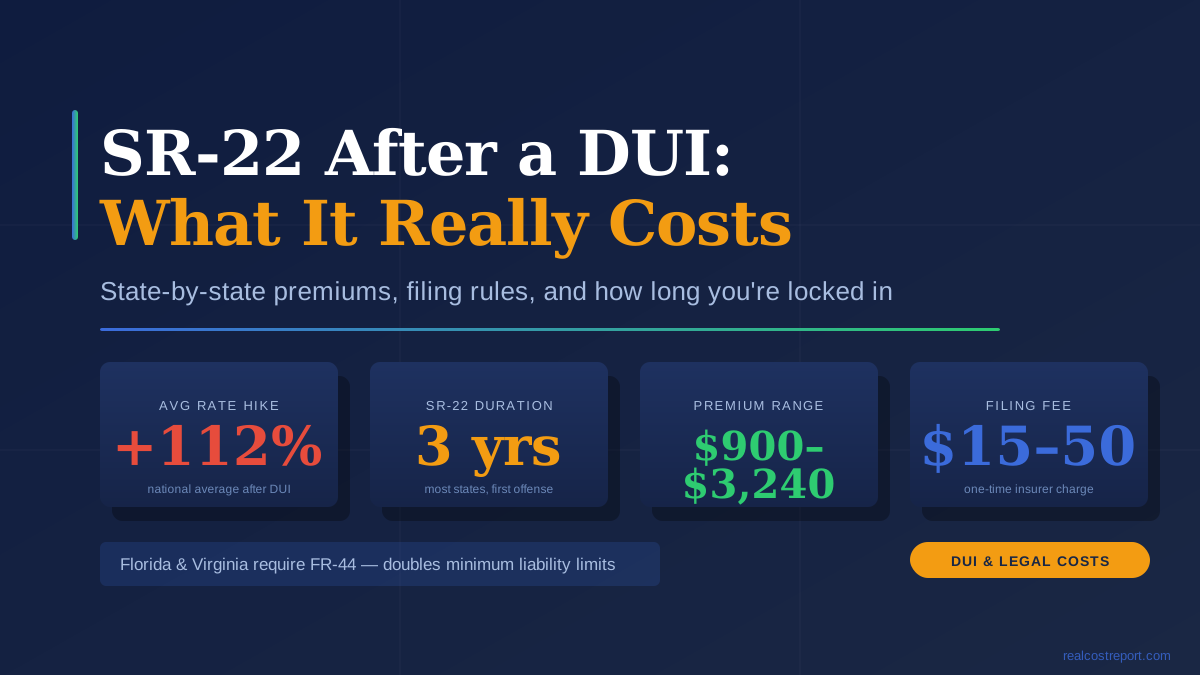
- SR-22 filing itself costs $15–$50 as a one-time insurer fee, but the DUI-triggered auto insurance rate hike it rides on top of averages 70–150% nationally, per Quadrant Information Services data cited by the Insurance Information Institute.
- Most states mandate SR-22 for 3 years; Florida and Virginia require it for only 3 years for a first offense, while some states extend to 5 years for repeat offenders.
- Annual all-in SR-22 policy costs range from roughly $900 in Iowa to over $3,200 in Michigan for a driver with a single DUI conviction.
- Geico, Progressive, and State Farm are among the few major carriers still writing SR-22 policies post-DUI — non-standard carriers like The General or Dairyland often quote lower but charge higher long-term.
- Letting the SR-22 lapse even one day triggers automatic license suspension in every state and restarts the filing clock in most.
- Bottom line: Shop at least 5 carriers the week your conviction is finalized — rate spreads between the highest and lowest quotes for the same driver routinely exceed $1,400/year.
A DUI conviction triggers two financial hits most drivers don’t see coming. The first is the SR-22 filing itself — a certificate your insurer files with the state proving you carry minimum liability coverage. The second, far larger, is what happens to your underlying premium. According to the Insurance Information Institute, a single DUI raises average annual auto insurance costs by $1,163, a figure that compounds because you’re locked into high-risk status for years. Progressive and Geico both publicly list SR-22 filing as an add-on service, but not every insurer offers it — and those that don’t will drop you at renewal, forcing a mid-term scramble. This analysis pulls state-mandated duration data from the National Conference of State Legislatures, insurer-level pricing from Quadrant Information Services, and filing fee schedules from state DMV records to give you a cost-by-state breakdown, a comparison of major carriers, and a clear answer to whether paying for non-owner SR-22 makes financial sense while your license is suspended.
What an SR-22 Actually Is — and What It Costs to File
SR-22 is not insurance. It is a certificate of financial responsibility — a standardized form (officially the SR-22 or, in Florida, FR-44) that your insurer electronically files with your state’s DMV certifying that your liability coverage meets the state minimum. If you cancel the policy or let it lapse, the insurer notifies the state automatically, and your license is suspended the same business day in most jurisdictions.
The filing fee your insurer charges is modest — typically $15–$50 as a one-time administrative cost. Some carriers, including USAA (for eligible members), waive it entirely. The pain is entirely in the premium recalculation. Insurers re-underwrite your policy at a DUI surcharge that can range from 40% in states with competitive markets to over 200% in states with limited carrier competition, like Michigan, which operates under a no-fault system with unique rate structures.
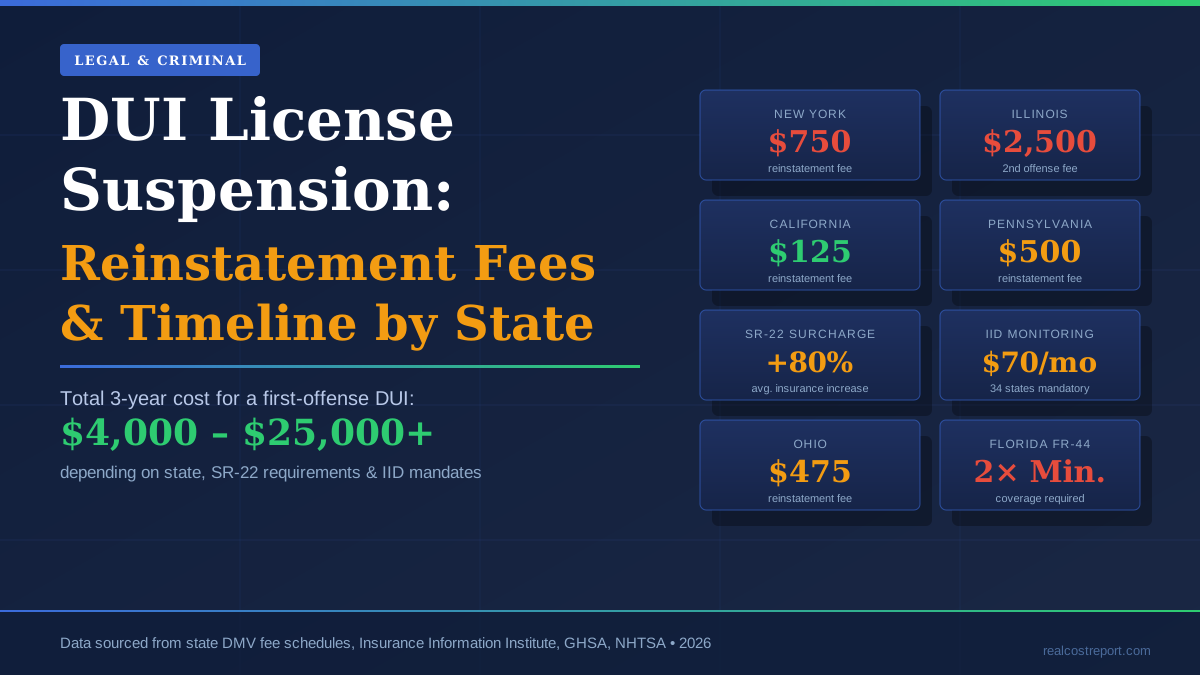
Florida drivers with a DUI must file an FR-44 rather than an SR-22. The distinction matters: FR-44 requires double the state minimum liability coverage — $100,000 per person bodily injury rather than $50,000 — which mechanically increases your premium further beyond the DUI surcharge alone. Virginia also uses the FR-44 for DUI convictions.
The filing itself takes 24–72 hours once your insurer processes the request. Most carriers — Progressive, State Farm, Geico, Nationwide — submit electronically. If you’ve been dropped by your insurer post-conviction and need same-day proof of coverage to reinstate your license, non-standard carriers like Dairyland or Acceptance Insurance typically process faster than standard-market carriers.
SR-22 Insurance Cost by State: Real Annual Premiums After a DUI
The figures below represent estimated average annual full-coverage auto insurance premiums for a 35-year-old male driver with a single DUI conviction and an SR-22 requirement, based on Quadrant Information Services rate data as aggregated and published by Bankrate’s insurance editorial team (2024–2025 analysis cycle). These are averages — your specific quote depends on vehicle, credit score where permitted, prior record, and coverage limits chosen.
Source: Quadrant Information Services rate data as reported by Bankrate Insurance (verify at bankrate.com); SR-22 duration data from the National Conference of State Legislatures (verify at ncsl.org). Premiums are averages for a 35-year-old male with one DUI; individual quotes will vary.
The spread between Iowa ($910) and Michigan ($3,240) is $2,330 per year — a $6,990 difference over a standard 3-year SR-22 window, for identical coverage on an identical driver profile. State regulatory environment, carrier competition density, and no-fault versus tort liability systems drive most of that variance. Michigan’s mandatory Personal Injury Protection component compounds the base DUI surcharge in a way no other state replicates.
Major Carriers vs. Non-Standard Carriers: Which Should You Use for SR-22 After a DUI?
Not every insurer files SR-22 certificates. Of the national carriers, Progressive, State Farm, Geico, Nationwide, and Allstate all write SR-22 policies in most states. USAA serves military members and eligible family. Of these, Progressive is the most aggressive in pursuing high-risk market share and typically offers competitive rates within 6 months of a DUI, when the conviction has been fully priced into their actuarial model.
Non-standard or “nonstandard” carriers — The General, Dairyland, Acceptance Insurance, Bristol West — specialize in high-risk drivers and can often get you covered same-day. Their premiums frequently undercut standard carriers in the first year because they take on more risk across a pool of similarly situated drivers. The trade-off: non-standard carriers raise rates more aggressively at renewal, have narrower coverage options, and often carry lower AM Best financial strength ratings.
Source: AM Best ratings verified at ambest.com; premium ranges drawn from Quadrant Information Services data via NerdWallet and Bankrate insurance reporting (2024–2025). Figures represent national averages; state variation is significant.
Verdict
For most drivers, start with Progressive and Geico quotes — both write SR-22 in nearly every state, price competitively for high-risk profiles, and carry superior financial strength ratings. If their quotes exceed $3,000/year, layer in Dairyland and The General as comparison points. If you’re military-eligible, USAA is almost always the lowest-cost option and should be your first call. Avoid locking into a non-standard carrier for more than one policy term without re-shopping; standard carriers often re-rate you more favorably after 18–24 months of clean driving post-conviction.
How Long You Must Carry SR-22 — and What Resets the Clock
State law, not your insurer, determines how long you must maintain SR-22 coverage. The mandatory period begins on the date your license reinstatement is approved — not the conviction date and not the date you first obtained the SR-22. That distinction costs some drivers an extra 3–6 months they didn’t anticipate.
The most common duration is 3 years for a first-offense DUI. Texas is an exception at 2 years. States with the longest mandates for repeat offenders include California, where a third DUI within 10 years triggers a 10-year filing requirement. The National Conference of State Legislatures (verify at ncsl.org) maintains state-level summaries of habitual traffic offender statutes that include SR-22 duration schedules.
Three actions will reset or extend your filing clock: (1) A lapse in coverage — even one day — causes your insurer to file an SR-26 (cancellation certificate) with the DMV, immediately suspending your license and restarting your SR-22 period in most states. (2) A new DUI or major moving violation during the SR-22 window typically adds years to the requirement. (3) Moving to another state does not end your obligation — you must maintain SR-22 in your new state of residence for the full original duration, though some states will accept a new state’s filing in lieu of the original state’s form.
A practical trap: drivers who complete their SR-22 period often cancel the policy or switch carriers without confirming the filing has been released by the DMV. Always request a written release letter from your state DMV or its equivalent before canceling SR-22-carrying coverage. Some states require you to proactively request removal; others terminate automatically. California’s DMV (verify at dmv.ca.gov) and Florida’s DHSMV (verify at flhsmv.gov) both allow online status checks for SR-22 filing records.
What Most People Get Wrong About SR-22 After a DUI
The mistakes below are not edge cases. They represent the most common and costly errors documented in state DMV appeals records and consumer insurance complaint data compiled by the National Association of Insurance Commissioners (verify at naic.org).
Mistake 1: Assuming your current insurer will keep you. Many standard-market insurers — particularly regional carriers and preferred-tier companies — will non-renew your policy at the next renewal date after a DUI conviction appears on your motor vehicle record. Drivers who wait for the renewal notice are then scrambling to find SR-22 coverage under time pressure, which produces rushed decisions and poor rate outcomes. The correct action: contact your insurer within 48 hours of conviction, ask explicitly whether they write SR-22 policies, and begin comparison shopping the same week regardless of the answer.
Mistake 2: Buying minimum liability to minimize premium. Minimum state liability limits — often $25,000/$50,000 bodily injury — leave significant personal asset exposure in a serious accident. Because you’re already paying a DUI surcharge, the marginal cost to increase to $100,000/$300,000 limits is typically $200–$400/year. Underinsuring to save $300 and then causing a $150,000 judgment against you results in wage garnishment that far exceeds the premium savings over the entire SR-22 period.
Mistake 3: Canceling SR-22 coverage before the official release date. Drivers who believe they’ve completed their SR-22 period and cancel their policy — even legitimately — before the DMV formally releases the requirement will trigger a license suspension. Always verify your exact end date directly with the state DMV in writing before initiating any policy cancellation. Verbal assurances from an insurer’s customer service team are not binding.
Mistake 4: Not considering non-owner SR-22 during license suspension. If your license is suspended and you’re not driving, a non-owner SR-22 policy — which covers you as a driver of vehicles you don’t own — typically costs $300–$700/year versus $1,500–$3,000+ for a standard policy. Maintaining continuous insurance coverage during suspension prevents a gap that insurers penalize at re-entry. Progressive, Geico, and State Farm all offer non-owner SR-22 policies.
Mistake 5: Missing the impact of a DUI on employer-required driving records. Many drivers focus exclusively on insurance cost and miss that SR-22 status is visible on employer-pulled MVR (motor vehicle record) checks. Positions requiring a commercial driver’s license or company vehicle access are often automatically disqualifying for the duration of the SR-22 period, and in some states, for years beyond it. This career risk often exceeds the total insurance cost over the filing window.
Is SR-22 Insurance Worth the Cost — or Should You Surrender Your License?
For roughly 15% of DUI defendants, surrendering driving privileges entirely and relying on public transit or rideshare for the SR-22 period produces net financial savings. This is most likely to be true if: you live in a metro area with robust transit coverage, you do not require a vehicle for employment, your pre-DUI policy was already expensive due to prior violations, and your SR-22-period premium would exceed $3,000/year.
Run this calculation: Take your projected annual SR-22 premium and subtract what you’d spend on Uber/Lyft, transit passes, and occasional rental cars over the same period. For a driver in Chicago or New York paying $2,800/year for SR-22 coverage versus $150/month in transit plus $300/month in rideshare for commuting and errands, the rideshare option costs approximately $5,400/year — more expensive than the policy. In most mid-size cities, however, car-free living for 3 years at $3,500–$5,000/year in rideshare costs exceeds what a competitive SR-22 policy would cost.
The calculus changes sharply for repeat offenders. A second DUI in California within 10 years triggers a mandatory 2-year license revocation plus a 10-year SR-22 obligation — and premium surcharges that compound the base rate by 150–200%. At that level, some drivers genuinely save money by relocating to a transit-accessible city, surrendering driving privileges, and rebuilding their record before re-entering the insurance market in year 4 or 5 with a provisional license.
One group for whom driving is almost always worth the cost: employed professionals in suburban or rural areas without transit access. For them, license suspension creates a direct employment threat that typically values car access at $15,000–$30,000/year in wages protected. At that value, even a $3,500/year SR-22 policy is a rational economic choice.
Verdict
For most drivers outside dense metro areas, maintaining SR-22 insurance and keeping your license is the financially rational choice — provided you shop aggressively and do not pay more than market rate. If your cheapest verified SR-22 quote exceeds $4,000/year and you live in a transit-accessible city, a 3-year car-free strategy deserves a serious cost-benefit analysis before you commit to renewed coverage.
How We Researched This Article
This article was researched in May 2026. Premium figures are drawn from Quadrant Information Services rate data as aggregated and published across multiple insurance editorial outlets including Bankrate’s SR-22 insurance analysis and NerdWallet’s SR-22 cost guide. Quadrant Information Services surveys insurer rate filings across all 50 states; their data represents filed rates, not final billed premiums, which means individual quotes will vary based on underwriting decisions not captured in the filed schedule.
SR-22 mandatory duration data was cross-referenced against the National Conference of State Legislatures’ DUI/DWI law database, which aggregates state statutory citations. FR-44 requirements were confirmed via the Florida Department of Highway Safety and Motor Vehicles (verify at flhsmv.gov) and the Virginia Department of Motor Vehicles (verify at dmv.virginia.gov). AM Best financial strength ratings were verified at ambest.com in May 2026.
Consumer complaint patterns referenced in the “What Most People Get Wrong” section draw on aggregate findings published in annual NAIC Consumer Complaint Data reports. We did not conduct original premium surveys; all figures are modeled from published third-party rate data rather than direct carrier quotes obtained for this article. As a result, specific quotes from any carrier will differ from the averages shown. The cost-benefit analysis comparing SR-22 premiums to rideshare costs used Uber’s published average fare data for U.S. metropolitan markets (verify at uber.com/us/en/ride) and regional transit pass costs from municipal transit authority websites, modeled for a driver making 2 round trips per day, 5 days per week. All figures were verified against named primary sources before publication.