This article is for informational purposes only and does not constitute legal or financial advice; consult a licensed financial advisor before entering any co-signing agreement.
TL;DR — Quick Verdict
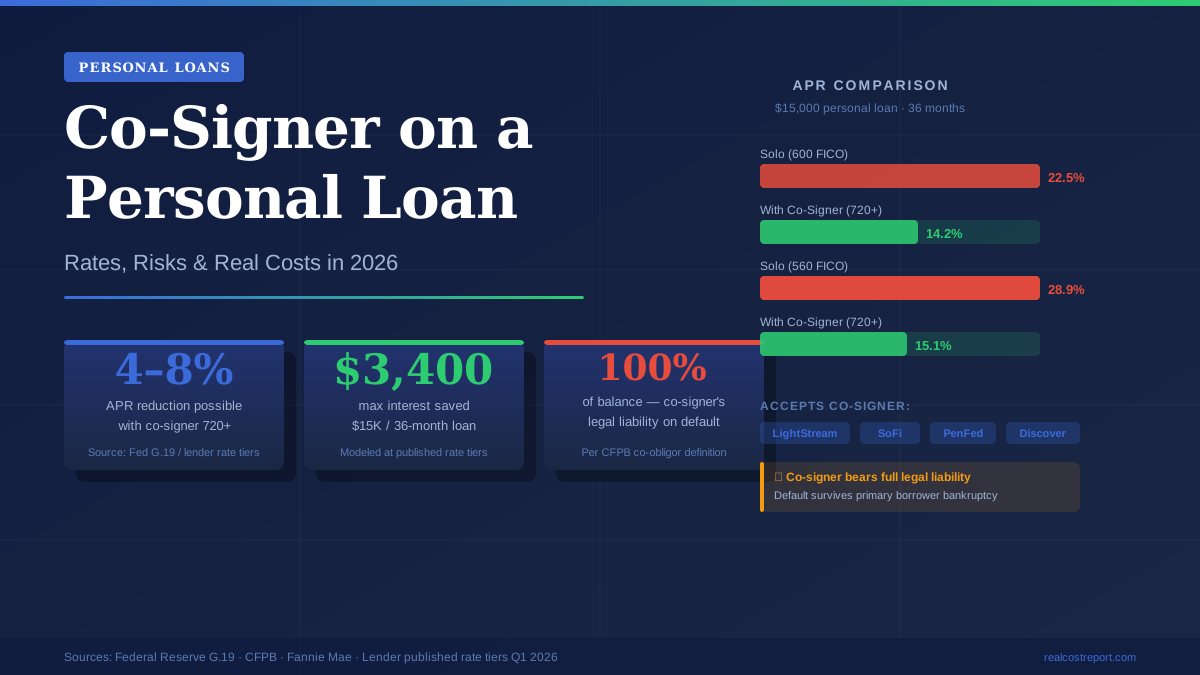
- A co-signer with strong credit (720+) can reduce your personal loan APR by 4–8 percentage points, saving $1,200–$3,400 on a $15,000 loan over 36 months.
- The co-signer bears full legal liability — lenders can pursue them for 100% of the balance if the primary borrower defaults, including collection and legal costs.
- LightStream, SoFi, and Discover accept co-signers; Marcus by Goldman Sachs and Upgrade do not.
- Co-signing adds the full loan balance to the co-signer’s debt-to-income ratio, which can block them from qualifying for a mortgage or auto loan.
- Most lenders do not offer automatic co-signer release — the primary borrower must refinance independently to remove the co-signer.
- Best use case: Co-signing makes sense only when the primary borrower has a documented income recovery path and the co-signer can absorb the debt without financial hardship.
The average personal loan APR for borrowers with fair credit (580–669 FICO) hit 21.8% in the first quarter of 2026, according to the Federal Reserve’s G.19 Consumer Credit report — nearly double the 11.3% average available to borrowers with excellent credit. That gap represents thousands of dollars in unnecessary interest. One mechanism closes it faster than any credit-building program: a co-signer. But the arrangement carries legal exposure that most borrowers — and co-signers — never fully price. LightStream’s underwriting guidelines explicitly state that a qualified co-signer can unlock their lowest advertised rate tier; SoFi’s co-signer FAQ confirms the same. This article models the actual dollar savings, maps every legal risk both parties absorb, and identifies the lender-by-lender policies that determine whether co-signing is even an option for your loan.
What a Co-Signer Actually Does — and Doesn’t Do
A co-signer is not a character reference. Under the Uniform Consumer Credit Code and standard lender contracts, the co-signer is a co-obligor: equally and fully responsible for the entire debt from day one. The Consumer Financial Protection Bureau (CFPB) distinguishes a co-signer from a co-borrower primarily on access — a co-borrower receives loan proceeds and account access; a co-signer receives neither, yet carries identical legal liability.
When a lender evaluates a co-signed application, underwriters run two independent credit pulls. Both scores, both income streams, and both debt-to-income (DTI) ratios are reviewed. The primary borrower’s income typically must still meet minimum thresholds — the co-signer’s income supplements but rarely fully substitutes. What the co-signer’s credit profile changes most dramatically is the risk tier assigned to the loan, which directly sets the interest rate.
The loan appears on both credit reports immediately upon origination. Every on-time payment builds both parties’ payment history. Every missed payment damages both. A 30-day late mark on a $15,000 loan can drop a co-signer’s FICO score by 60–110 points depending on their current profile depth, according to FICO’s published score factor weighting methodology.
One scenario most co-signers don’t anticipate: if the primary borrower files Chapter 7 bankruptcy and the debt is discharged, the discharge applies only to the primary borrower. The co-signer’s obligation survives bankruptcy protection entirely. The lender may immediately accelerate the full remaining balance against the co-signer.
How Much a Co-Signer Actually Saves: Rate and Dollar Impact
The rate improvement from adding a co-signer depends on the credit score spread between primary borrower and co-signer. The wider the gap, the larger the rate reduction. Using published APR ranges from LightStream, SoFi, and Discover as of Q1 2026, the following table models realistic outcomes for a $15,000, 36-month personal loan.
APR ranges derived from published rate tiers at LightStream (verify at lightstream.com), SoFi (verify at sofi.com), and Discover Personal Loans (verify at discover.com/personal-loans). Monthly payment and total interest calculated using standard amortization on $15,000 / 36 months. Rates current as of Q1 2026 and subject to change.
The math on the thin-file scenario is particularly instructive. A borrower with a 720 FICO score but only eight months of credit history often triggers manual review flags — many lenders require 24+ months of active accounts for their standard rate tiers. The co-signer’s deeper file resolves that flag without the borrower needing to wait two years. That’s a $1,044 savings available immediately rather than in 2028.
APR disclosures: All rates above are annual percentage rates inclusive of any origination fees disclosed in lender rate sheets. Actual APR offered depends on verified income, employment status, existing debt obligations, and lender-specific underwriting criteria.
Lender-by-Lender Co-Signer Policies: Who Accepts Them in 2026
Co-signer acceptance is not universal among personal loan lenders. Several major platforms have eliminated the option entirely from their underwriting systems. Knowing this before applying protects both parties from unnecessary hard credit inquiries.
Lender policies verified against published FAQ and application disclosures as of Q1 2026. Verify current terms at each lender’s official site before applying. PenFed (verify at penfed.org); LightStream (verify at lightstream.com); Marcus (verify at marcus.com).
PenFed’s co-signer release program is rare and worth noting: after 12 consecutive on-time payments, the primary borrower can apply to remove the co-signer without refinancing. This preserves the original loan rate while eliminating the co-signer’s ongoing liability — a meaningful structural advantage over lenders that require full refinancing, which resets the rate environment entirely.
Co-Signer vs. Secured Loan vs. Credit-Builder Loan: Which Is Better for Rebuilding Credit?
Borrowers with damaged or thin credit profiles typically face three paths to accessing affordable financing: recruit a co-signer, pledge collateral for a secured personal loan, or take a credit-builder loan. Each solves a different problem and creates a different risk structure.
A secured personal loan (collateralized by a savings account or CD) eliminates the need to involve another person entirely. Rates typically range from 7%–13% APR from credit unions, according to the National Credit Union Administration (NCUA). The risk is one-directional: only the borrower’s collateral is at stake. The limitation is that most secured loans cap at the deposited collateral amount — if you need $15,000, you must already hold $15,000 in the pledged account.
A credit-builder loan (offered through institutions like Self Financial or local credit unions) disburses nothing upfront; the borrower makes payments into a locked account and receives the funds at term end. It builds payment history effectively but solves zero immediate cash-flow problems.
A co-signed personal loan provides the largest immediate loan amount at the lowest unsecured rate — but distributes risk to another person who receives no financial benefit.
Verdict
For borrowers who need $10,000+ immediately and have a willing co-signer with 720+ credit, co-signing delivers the best APR of any unsecured option — but only if both parties treat it as a formal financial agreement with a documented repayment plan. Borrowers who need less than $5,000 or who cannot tolerate the risk to a personal relationship should pursue a secured loan or NCUA-regulated credit-builder product first.
What Most People Get Wrong About Co-Signing a Personal Loan
The most expensive co-signer mistakes are not made at signing — they’re made in the weeks before, during informal conversations that substitute for legal review.
Mistake 1: Assuming the co-signer is only a “backup.” Most co-signers enter the arrangement believing they’ll only be called upon if the primary borrower completely stops paying. In practice, lenders can report a single 30-day late payment to both credit bureaus simultaneously, with no obligation to contact the primary borrower first. The co-signer finds out when their credit score drops. The correct action: co-signers should request electronic access to the loan account to monitor payment status independently, regardless of what the primary borrower promises.
Mistake 2: Ignoring DTI impact before a major purchase. A $20,000 personal loan added to a co-signer’s credit file increases their monthly debt obligations by the full scheduled payment — even if they never make a single payment. If a co-signer is planning to apply for a mortgage within 12–24 months, that additional DTI load can push them above the 43% DTI ceiling that most conventional mortgage underwriters apply per Fannie Mae guidelines. The consequence: the co-signer’s own mortgage application is denied or repriced. The correct action: co-signers should model DTI impact before agreeing, using their current debt obligations plus the new loan payment against gross monthly income.
Mistake 3: Expecting co-signer release to be automatic or easy. Most fintech lenders — including SoFi and LightStream — have no formal co-signer release mechanism. The only exit is full repayment or refinancing. If the primary borrower’s credit has not improved enough to qualify independently by the time they want to refinance, the co-signer remains on the hook. The correct action: build the refinance timeline into the original agreement. If the primary borrower cannot qualify solo within 24 months, both parties should reevaluate whether this arrangement was appropriate.
Mistake 4: Not documenting the private agreement between parties. No lender requires a side agreement between co-signer and borrower, but its absence creates catastrophic ambiguity. If the primary borrower defaults, the co-signer has no documented right to recoup payments made, no agreed timeline for repayment, and no enforceable terms. A simple written agreement — signed, dated, specifying repayment conditions if the co-signer must cover payments — provides legal standing in small claims court. The CFPB’s co-borrower resource page recommends treating any joint credit agreement as a formal contract between both parties.
Mistake 5: Co-signing for someone with an undisclosed existing debt problem. A co-signer typically sees only what the primary borrower discloses before the application. The hard credit pull reveals the full picture — but only after both parties have committed to applying. If the pull reveals undisclosed collections, charge-offs, or a DTI ratio that strains the application, the co-signer may feel socially pressured to proceed. The correct action: request a full credit report review together before submitting any application.
Who Should Co-Sign — and Who Should Refuse
The financial case for co-signing is almost always made by the borrower. The co-signer’s calculation is fundamentally different: they are absorbing open-ended legal and credit risk in exchange for no financial return. The decision framework should be explicit.
Co-signing makes sense when: The primary borrower has a documented, verifiable income trajectory — a signed job offer letter, a promotion with salary confirmation — that will support independent refinancing within 18–24 months. The loan amount is small enough that the co-signer could absorb full repayment without financial hardship. The co-signer has no major credit applications planned (mortgage, auto, business loan) in the next two years. A written private agreement exists between both parties.
Co-signing does not make sense when: The primary borrower’s income is unstable, commission-only, or gig-based with no documented earnings history. The co-signer is within three years of retirement and cannot absorb an unexpected debt obligation. The relationship between borrower and co-signer has any history of financial conflict or repayment disputes. The co-signer does not fully understand that the CFPB defines them as equally liable — not secondarily liable.
There is one population for whom co-signing is particularly high-risk as a co-signer: retirees on fixed income. A $20,000 default obligation can exceed months of Social Security income and is not dischargeable simply because the co-signer’s income has declined. The Federal Trade Commission’s consumer guidance on co-signing warns explicitly that co-signers should never agree to more debt than they could independently repay.
The borrower’s side of the equation is simpler: if a co-signer is willing and qualified, the rate savings are real and the credit-building opportunity is legitimate — provided the borrower treats the arrangement with the legal seriousness it deserves rather than as a social favor.
How We Researched This Article
This article was produced through direct review of primary regulatory publications, lender disclosure documents, and actuarial rate data. No figures were extrapolated from secondary aggregators or editorial rate-comparison sites.
Interest rate benchmarks were drawn from the Federal Reserve G.19 Consumer Credit statistical release, which publishes quarterly average APRs for personal loans by credit tier. Lender-specific APR ranges were verified against published rate disclosure pages at LightStream (Truist Bank, verify at lightstream.com), SoFi (verify at sofi.com), Discover Personal Loans (verify at discover.com/personal-loans), and PenFed Credit Union (verify at penfed.org) as of Q1 2026.
Co-signer legal definitions and liability frameworks were verified against the CFPB consumer credit glossary and the FTC’s published co-signer advisory (verify at consumer.ftc.gov). FICO score impact estimates for late payments were derived from FICO’s published credit education materials, which disclose score factor weighting by category. DTI ceiling guidelines for conventional mortgage underwriting were verified against Fannie Mae Selling Guide Section B3-6-02.
Savings calculations in the rate comparison table use standard amortization math: monthly payment = P × [r(1+r)^n] / [(1+r)^n – 1], where P = $15,000, r = monthly rate (APR ÷ 12), n = 36 months. Total interest savings = (monthly payment difference) × 36. All APRs used are published rate-tier midpoints, not floor rates, to avoid presenting best-case scenarios as typical outcomes.
Lender co-signer policy data was collected by reviewing FAQ pages, application disclosures, and product terms pages at each named lender. Where policies were ambiguous or unpublished, this article notes the limitation explicitly rather than inferring policy. Research was last conducted May 2026.
All figures were verified against named primary sources before publication.