This is not legal advice. Consult a licensed attorney in your state.
TL;DR — Quick Verdict
- The median personal injury settlement in the U.S. is approximately $31,000, but moderate-to-severe injury cases routinely settle between $40,000 and $100,000 — meaning the first offer you receive is almost never the right one.
- Insurance adjusters use a multiplier formula (1.5x–5x your economic damages) to calculate offers; knowing this math before you respond is your single biggest negotiating advantage.
- Attorney contingency fees run 33%–40% of your final recovery, depending on case stage — a fact that should inform both your minimum acceptable number and your decision to hire representation.
- Accepting before you reach Maximum Medical Improvement (MMI) is the most costly mistake injured claimants make; once you sign a release, you cannot return for more compensation even if your injuries worsen.
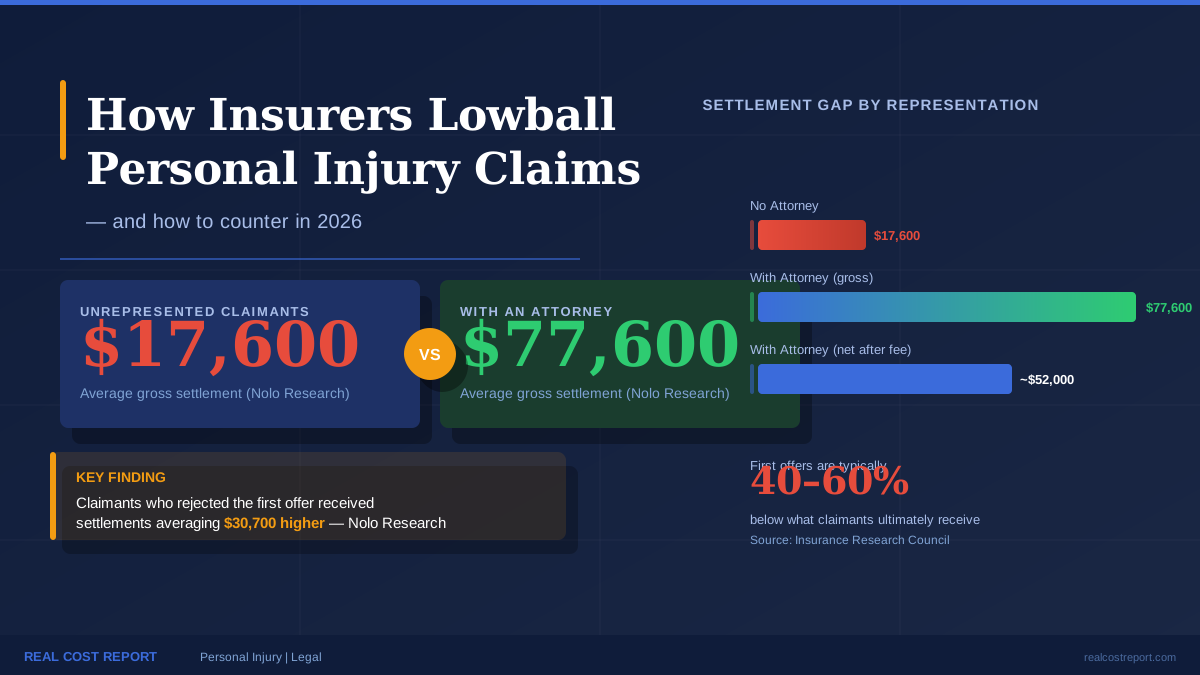
- Represented claimants consistently receive higher settlements than those who negotiate alone — the leverage shift alone often justifies the contingency fee.
- Reject any offer that arrives before treatment is complete, excludes pain and suffering, or comes with artificial urgency — these are textbook lowball tactics.
A $28,500 settlement offer lands in your email. Your medical bills total $19,000. That leaves roughly $9,500 — before attorney fees and before accounting for the six weeks of work you missed. Is it enough? For most claimants, the answer is no, but the pressure to say yes is intense and deliberate. Insurance companies resolve thousands of claims every year and they know that financial stress, physical pain, and unfamiliarity with the legal process push injured people toward early, undervalued settlements. According to data compiled across multiple law firm datasets and the Insurance Research Council, the median personal injury payout in 2025 sits near $31,000 for all case types combined — but that figure masks enormous variation by injury severity, jurisdiction, and whether the claimant had legal representation. This guide gives you the analytical framework to compare any offer against what your claim is actually worth: the damage multiplier method, a breakdown of what insurers are — and are not — counting, the fee math you need to understand before you sign anything, and the specific warning signs that tell you to walk away from the table.
What Personal Injury Settlements Actually Pay in 2025: A Range Breakdown by Injury Type
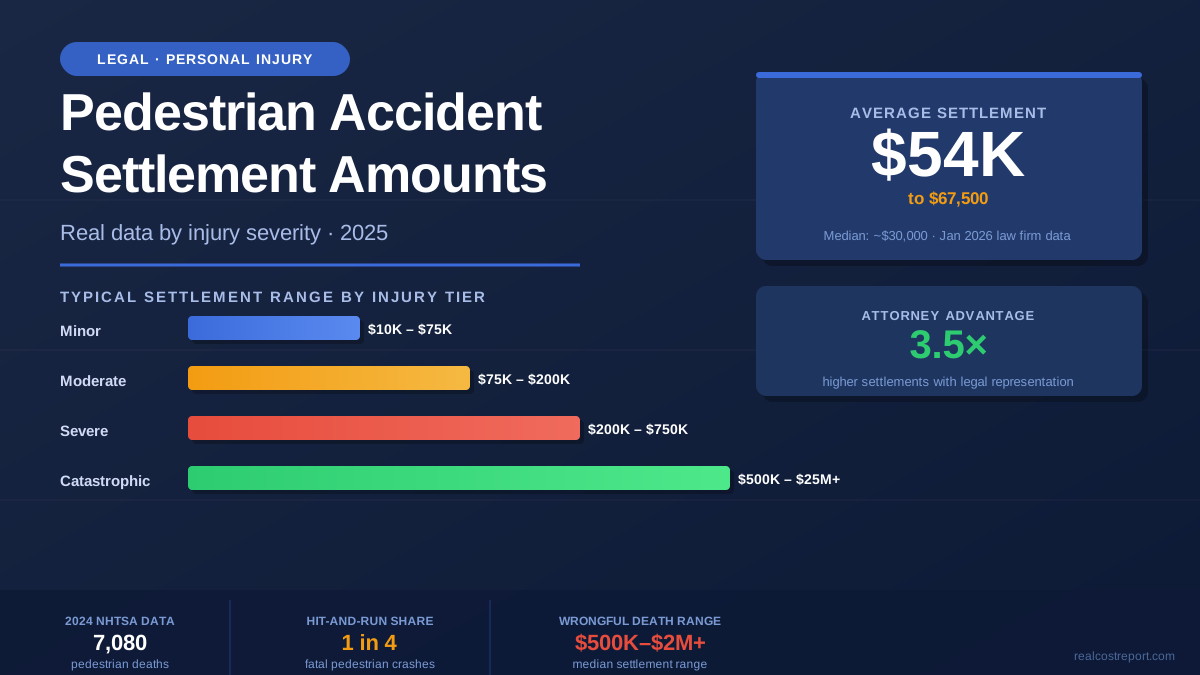
Settlement data is notoriously fragmented because most agreements include confidentiality clauses. Still, cross-referencing publicly reported law firm data with National Practitioner Data Bank figures and InsuranceResearch Council analyses produces consistent ranges by injury category. The numbers below reflect 2024–2025 outcomes across the most common claim types.
This is not legal advice. Consult a licensed attorney in your state.
Sources: Brown & Crouppen case data (2021–2024); National Practitioner Data Bank 2024 malpractice reports; Insurance Research Council injury severity analyses. Individual outcomes vary significantly by jurisdiction, liability strength, and insurance policy limits.
Two dynamics shape where any specific offer lands within these ranges. The first is liability clarity: when fault is unambiguous — a rear-end collision with dashcam footage, for example — adjusters have little to argue and offers come in higher. The second is treatment completeness. Offers made before a claimant finishes medical care are almost always calculated on incomplete records, which structurally undervalues the claim. The $31,000 median cited widely in legal press is heavily influenced by the large volume of minor-injury auto claims that settle quickly at lower numbers. If your injuries are moderate to severe, that figure is a floor, not a benchmark.
How Insurers Calculate Your Settlement Offer: The Multiplier Method Explained
Insurance adjusters do not guess. They use a structured calculation that has become so standardized across the industry that understanding it gives claimants direct negotiating leverage. The dominant method is the damage multiplier formula.
The formula works in two steps. First, total all economic damages: medical bills paid to date, projected future medical costs, lost wages, and out-of-pocket costs like transportation to appointments and prescription medications. Second, multiply that economic total by a severity factor — typically 1.5x to 5x — then add it back to the economic damages total to produce the overall compensation figure.
Source: Multiplier methodology consistent with American Bar Association guidance on non-economic damage calculation and Insurance Research Council claim valuation analysis.
An alternative method called per diem assigns a daily dollar value to pain and suffering — often equal to your daily wage — and multiplies it by the number of days your recovery takes. A $250/day rate applied to a 180-day recovery adds $45,000 in non-economic damages on top of economic losses. Neither method is legally required, but both are standard negotiating tools. When an insurer’s offer implies a multiplier below 1.5 on a documented moderate injury, that gap is the starting point for your counteroffer — not a reason to sign.
Settling vs. Going to Trial: Which Option Wins for Your Situation?
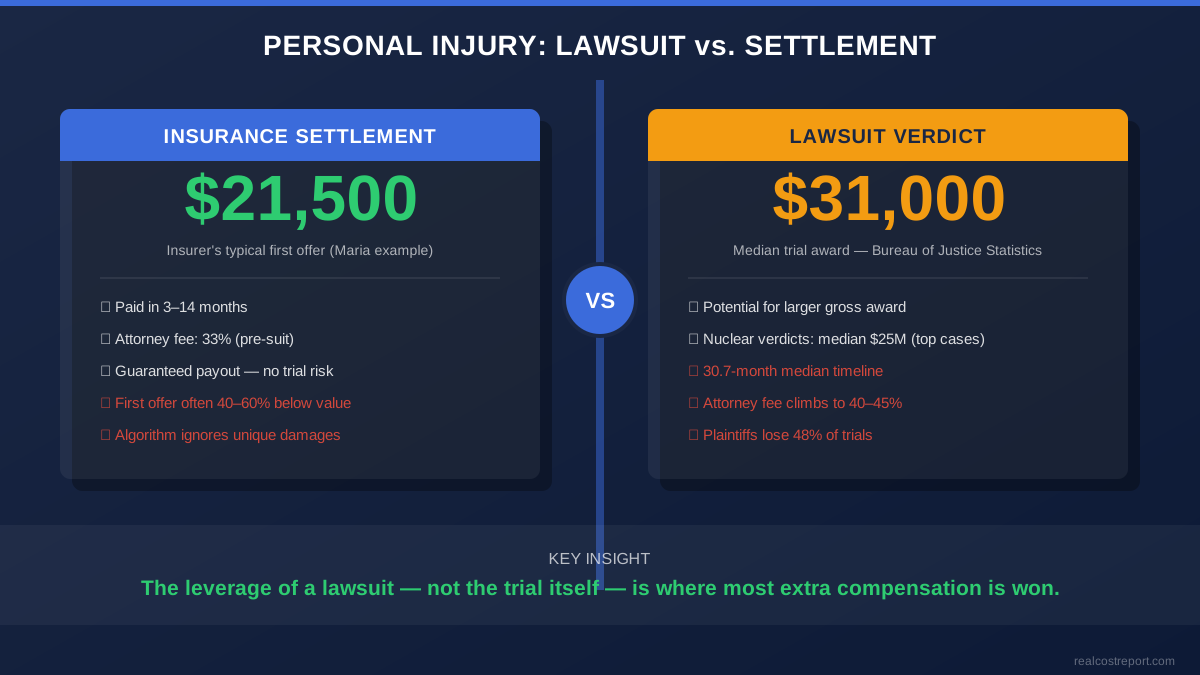
The data on this question is unambiguous but widely misunderstood. Only 4%–5% of personal injury cases ever reach a jury verdict. The remaining 95%+ resolve through negotiation, mediation, or arbitration. That does not mean trial is irrelevant — the credible threat of trial is exactly what drives insurers to improve their offers. The choice is rarely binary, but understanding the trade-offs determines your negotiating posture.
Source: Trial rate figures from Grow Law Firm 2025 personal injury statistics; fee structure data from American Bar Association contingency fee guidance (americanbar.org).
Verdict
For most moderate-injury claimants with clear liability and documented losses under $300,000, negotiating a fair settlement is the superior path — faster, certain, and net-higher after accounting for the extra attorney fees and litigation costs a trial adds. Trial becomes worth the risk when an insurer refuses to value a catastrophic, permanent injury near its actual damages, or when punitive conduct (drunk driving, repeat negligence) could produce an award that dwarfs any policy-limit settlement. Filing a lawsuit often triggers better offers without ever entering a courtroom.
What Most Claimants Get Wrong When Evaluating a Settlement Offer
The mistakes below are not hypothetical. They appear in the same sequence across thousands of personal injury negotiations each year, and each one directly reduces the check the claimant ultimately receives.
Mistake 1: Settling before Maximum Medical Improvement (MMI)
MMI is the point at which your treating physician confirms your condition has stabilized. Accepting any offer before that date means you are calculating future medical costs on speculation rather than evidence. A herniated disc that initially seems manageable can require a $40,000–$80,000 surgical intervention months later. Once you sign the release, that future expense is yours alone. The insurer offering quickly before treatment ends is doing so for one reason: it keeps the total lower.
Mistake 2: Treating the first offer as the real number
First offers from insurance adjusters are opening bids in a structured negotiation, not fair valuations. Adjusters are trained to test whether claimants will accept a low figure without pushback. Accepting an insurer’s opening demand before sending any counteroffer is the single most reliable signal that a claim settled below its actual value. If the adjuster accepts your opening demand immediately, that is equally diagnostic — you asked for too little.
Mistake 3: Ignoring non-economic damages entirely
Economic damages — medical bills, lost wages — are straightforward to document. Non-economic damages — pain, suffering, emotional distress, loss of enjoyment of life — are not itemized on any invoice, which leads many unrepresented claimants to omit them from their counteroffer or accept an offer that contains no line for them at all. Non-economic damages routinely equal or exceed economic damages on moderate-to-severe cases. Accepting an offer with no pain and suffering component on a documented injury lasting more than 90 days is a material undervaluation.
Mistake 4: Signing a release before clearing medical liens
When your health insurer or Medicare paid your medical bills, they hold a subrogation lien — a legal right to recover those payments from your settlement. If you accept a settlement and sign the release before resolving outstanding liens, you may owe a significant portion of your net proceeds back to your insurer immediately after receiving the check. A $45,000 settlement with a $12,000 Medicare lien and a 33% attorney fee leaves you $18,150 — not the $45,000 on the check.
Mistake 5: Letting urgency pressure drive the decision
When an adjuster tells you an offer “expires in 72 hours” or insists you decide before consulting an attorney, that pressure is tactical, not procedural. Most states allow two years from the date of injury to file a lawsuit (statute of limitations varies by state and claim type). The insurer faces no deadline forcing a quick close. You do not either. Artificial urgency is the clearest signal that the offer is underpriced.
The Attorney Fee Calculation: What You Actually Take Home
Evaluating a settlement offer in isolation — without calculating the net figure after attorney fees, case costs, and medical liens — produces a misleading picture of your real recovery. Personal injury lawyers almost universally work on contingency, meaning they collect a percentage of whatever the case resolves for, with no upfront cost to the client. The American Bar Association describes the standard contingency fee as often running one-third (33%) to 40% of the recovery, depending on case stage.
Source: American Bar Association contingency fee guidance (americanbar.org); fee ranges consistent with GJEL Accident Attorneys and Saeedian Law Group published structures (2025).
The fee structure creates a practical calculation every claimant should perform before accepting or rejecting any offer. Take the settlement figure. Subtract the attorney fee percentage applicable at the current case stage. Then subtract any outstanding medical liens — Medicaid, Medicare, and private health insurer subrogation claims. Then subtract reimbursable case expenses (expert witness fees, filing fees, deposition costs) that were fronted by the attorney and are owed regardless of outcome. The remainder is your actual take-home. Run this math before you react to the gross number on any offer letter.
There is a secondary implication worth noting: represented claimants tend to receive meaningfully higher gross settlements than those who negotiate alone. The leverage shift alone — an insurer knows a represented claimant can credibly threaten litigation — often produces an improvement that exceeds the contingency fee cost, leaving the represented claimant with a higher net figure even after attorney fees than they would have reached independently. The decision to hire a personal injury attorney should be evaluated on net recovery, not on the fee itself.
Who Should Accept the First Offer — and Who Should Push Back?
Not every rejection is strategic. There are situations where a first or second offer fairly reflects what a case is worth, and dragging out negotiations simply costs time and emotional energy without improving the outcome. The framework below identifies which profile benefits from acceptance and which demands aggressive negotiation.
Accept if: Your injury is genuinely minor and fully resolved. You have reached MMI. All medical bills are paid and no liens are outstanding. The offer covers 100% of economic damages plus a reasonable multiplier of at least 1.5x for a soft-tissue, full-recovery case. You have no future medical costs projected. The offer arrived after treatment ended, not before. And the settlement net after legal fees and liens still covers your actual losses with something left over.
Push back if: You are still in active treatment or have not reached MMI. The offer excludes any component for pain and suffering on an injury lasting longer than 30 days. The offer arrived within the first 30–60 days of your claim on a moderate or severe injury. The adjuster cited your contributory fault without a detailed liability analysis. Future medical costs, lost earning capacity, or permanent disability are part of your documented damages. The offer implies a multiplier below 1.5x on documented moderate injuries. Or the insurer invoked urgency to push a decision.
Permanent and catastrophic injuries — spinal cord damage, traumatic brain injury, paralysis, severe burns — occupy a distinct category. These claims have a present value and a future value, and those two numbers are rarely equal. A claimant with a TBI who accepts $150,000 without projecting lifetime medical and care costs could be forfeiting $700,000 or more in legitimate damages. For any claim involving permanent impairment, an attorney and a life-care planner are not optional advisors — they are core to calculating what the claim is actually worth before a single number is discussed with the insurer.
How We Researched This Article
This article draws on publicly available settlement data from multiple law firm case analyses, federal agency databases, and insurance industry research organizations. Settlement range figures were cross-referenced across Brown & Crouppen’s analysis of cases resolved between 2021 and 2024, the National Practitioner Data Bank’s 2024 medical malpractice payment reports (which recorded $4.33 billion in payments across 10,000 claims), and the Insurance Research Council’s injury severity classification methodology. Median settlement figures cited ($31,000) derive from aggregate data published by Consumer Shield and corroborated across RunSensible, CasePeer, and TrustAnalytica analyses of 2024–2025 outcomes.
Multiplier methodology is consistent with guidance published by the American Bar Association on contingency fee structures and non-economic damage valuation. Attorney fee ranges were verified against published fee structures from GJEL Accident Attorneys, Saeedian Law Group, and Urban Thier & Federer (2025), and are consistent with the ABA’s written guidance that contingency fees are “often one-third to 40 percent.” Statute of limitations references reflect general state-law norms; claimants should verify their specific state’s limitation period with a licensed attorney.
Trial rate data (4%–5% of personal injury cases reach verdict) was sourced from Grow Law Firm’s 2025 personal injury statistics report, consistent with figures cited by the American Bar Association and the Bureau of Justice Statistics. Medical malpractice payout averages reflect 2024 National Practitioner Data Bank reports (verify at npdb.hrsa.gov). All figures were verified against named primary sources before publication. Research was last conducted in May 2026. Regional variation is significant: settlement values, statute of limitations periods, and contributory fault rules differ substantially by state. Figures here represent U.S. national averages and ranges and should not be used as precise benchmarks for any individual case without legal counsel.