This is not legal advice. Consult a licensed attorney in your state.
TL;DR — Quick Verdict
- Personal injury attorneys charge 33%–40% of your settlement as a contingency fee — you pay nothing if you lose.
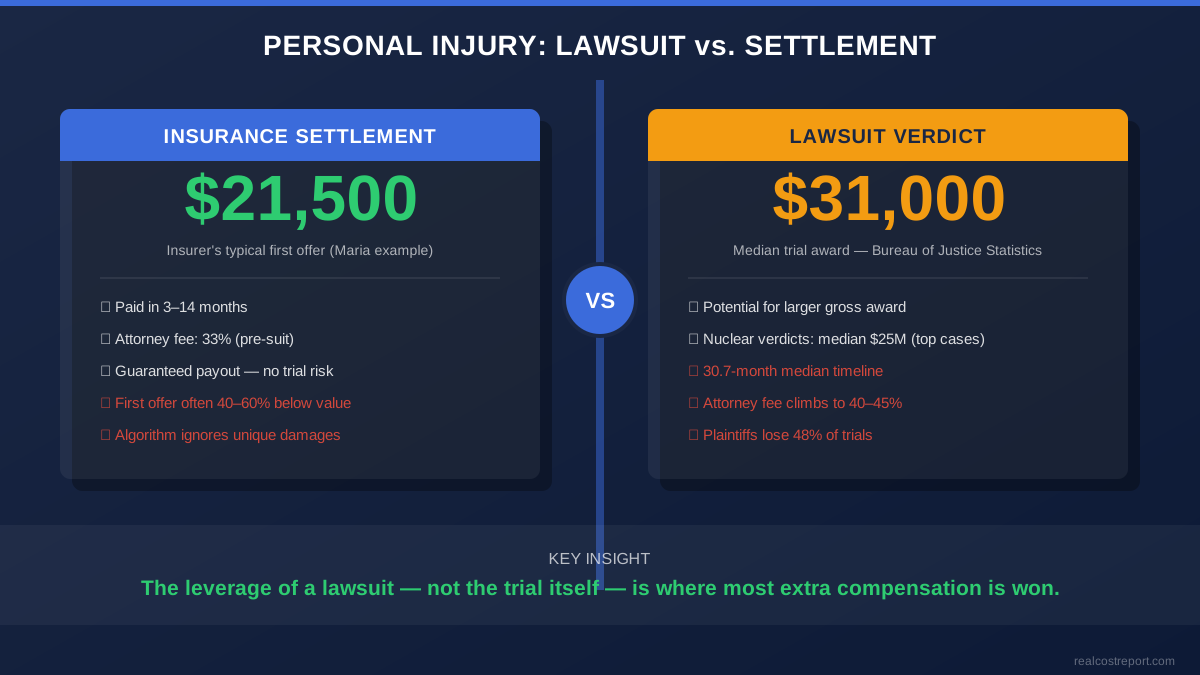
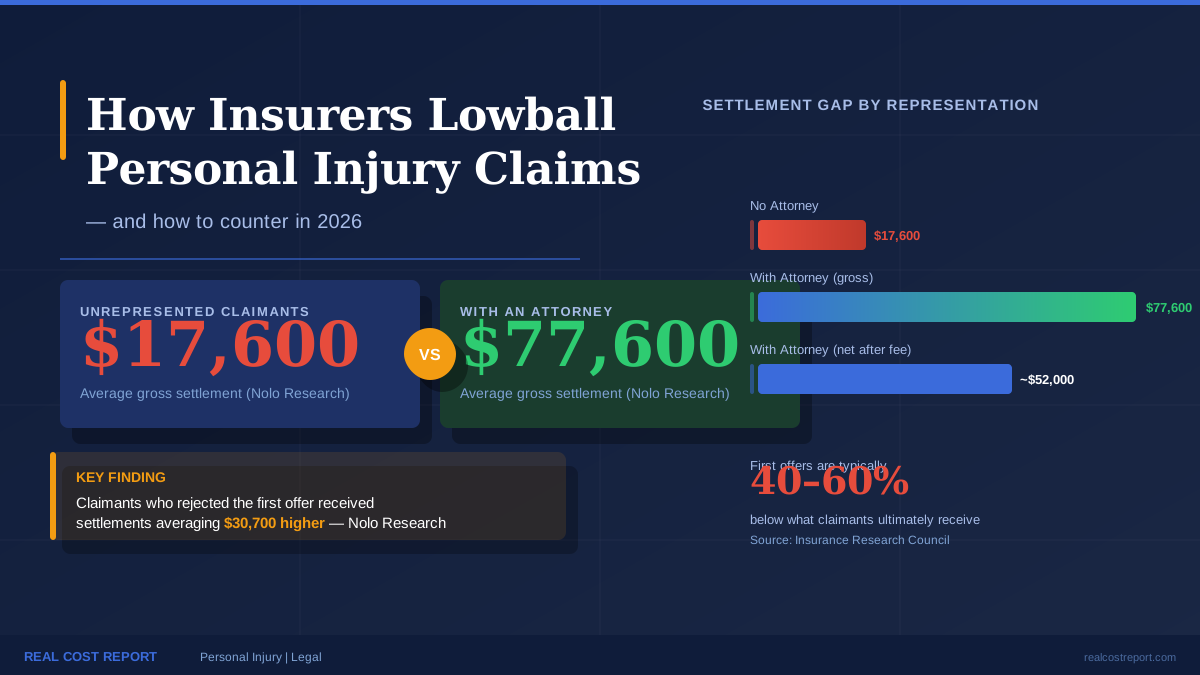
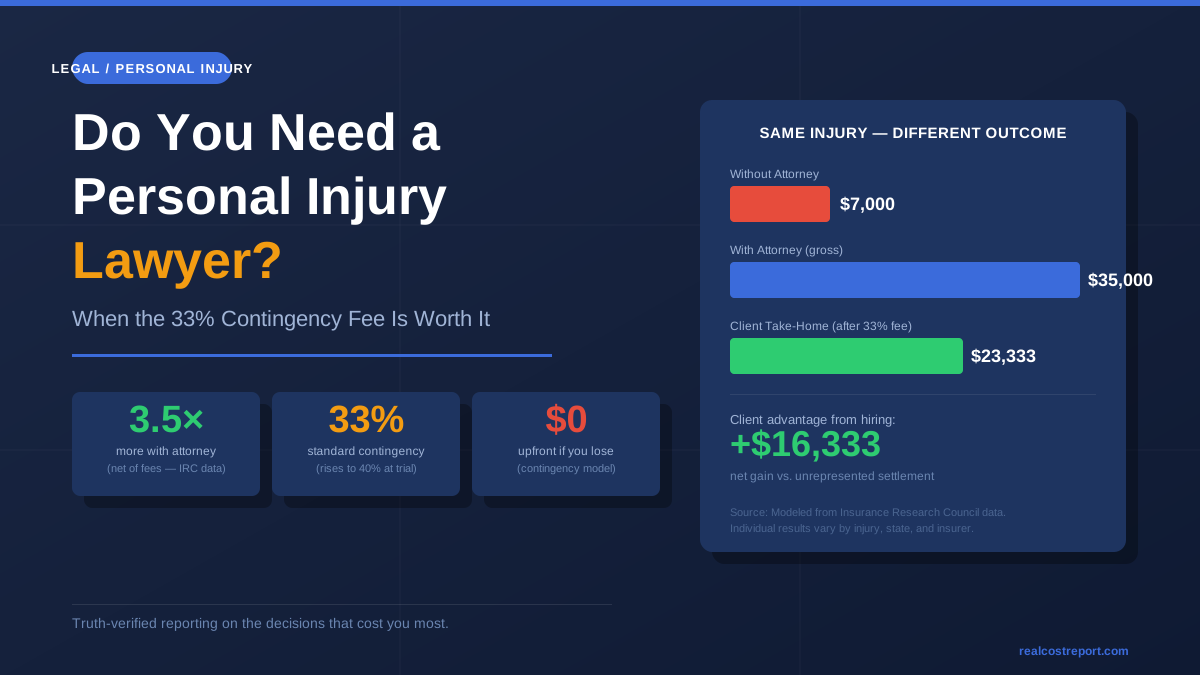
- The Insurance Research Council found that represented claimants recover approximately 3.5 times more than unrepresented claimants, net of attorney fees.
- On a $35,000 gross settlement, hiring an attorney at 33% leaves you with roughly $25,000 — versus $7,000 going it alone against the same insurer.
- Cases worth hiring a lawyer: injuries requiring ongoing care, liability disputes, lost wages, or any claim above $10,000.
- Cases where you may not need a lawyer: minor soft-tissue claims under $3,000 with clear liability and no disputed medical bills.
- Before signing any contingency agreement, confirm whether fees are calculated on gross settlement or net recovery — the difference can exceed $2,000 on a $100,000 claim.
Last Verified: May 2026 | Rates updated quarterly
The insurance adjuster called within 48 hours of your accident. The offer sounded reasonable — until you learned that the Insurance Research Council, an industry-funded research body, has documented for decades that unrepresented claimants routinely settle for a fraction of what represented claimants collect. The gap isn’t marginal. It’s roughly 3.5 times — after the attorney is paid. That single statistic is why the contingency fee question deserves a hard look at the actual math rather than a gut reaction to giving up one-third of your award. This article breaks down exactly what personal injury attorneys charge, what drives the range from 33% to 40%, how gross-vs-net fee calculation changes your take-home by thousands of dollars, and — critically — which claim types justify the fee and which do not. Numbers come from the Insurance Research Council, the Bureau of Justice Statistics, and the American Bar Association.
What Personal Injury Attorneys Actually Charge: The Full Fee Structure
The headline contingency rate of “one-third” obscures a sliding structure that can cost you significantly more if your case reaches trial. Understanding the tiers before you sign a retainer is non-negotiable.
Source: American Bar Association — fees in contingency arrangements are “often one-third to 40 percent” (verify at americanbar.org)
These figures represent attorney fees only. Case expenses — court filing fees, medical record retrieval, expert witness charges, accident reconstruction, and deposition transcripts — are deducted separately and typically add another 5%–10% of the gross settlement in complex claims. A straightforward car accident that settles pre-lawsuit may incur $500–$1,200 in expenses. A litigated case with expert medical testimony can run $5,000–$25,000 in costs on top of the attorney’s percentage.
One structural detail most clients miss: the fee agreement should specify whether the contingency percentage is calculated on the gross settlement or the net recovery after expenses. On a $100,000 settlement with $5,000 in case costs, gross calculation yields $33,333 in attorney fees and $61,667 to the client. Net calculation yields $31,350 in attorney fees and $63,650 to the client — a $1,983 difference on the same outcome, solely from how the contract is worded. Ask before you sign.
How the 3.5× Multiplier Works: The Math Behind Representation
This is not legal advice. Consult a licensed attorney in your state.
The Insurance Research Council’s 3.5× finding — that represented claimants collect roughly 3.5 times more than unrepresented claimants, net of fees — is not plaintiff-bar marketing. The IRC is funded by the insurance industry to study claim outcomes so that carriers can improve their own operations. Insurers publish and use this data internally. They know represented claimants cost more to settle.
The practical mechanism explains why. Unrepresented claimants are typically routed to junior adjusters with narrow settlement authority, often capped below true case value regardless of injury severity. Proprietary valuation software — programs like Colossus and Claims Outcome Advisor — is calibrated to produce conservative multipliers for pain and suffering by default. Attorney involvement routes the file to a senior adjuster with broader authority and forces it out of pure algorithmic processing.
A concrete example illustrates the scale of the gap. Take a soft-tissue injury with $7,000 in documented medical bills. An unrepresented claimant negotiating directly with, say, Allstate or GEICO might net $7,000. The same injury with an attorney on file typically yields a gross settlement near $35,000, with the client taking home approximately $25,000 after a 33% fee — $18,000 more than the unrepresented result. The attorney captured $10,000 in fees. The client still gained $18,000 by hiring them.
Source: Modeled from Insurance Research Council claim outcome data. Individual results vary by injury severity, state, and insurer. (verify at insuranceresearch.org)
The 3.5× multiplier also has an important caveat: it reflects attorneys with credible trial capacity. High-volume settlement mills that process claims quickly and rarely file suit may produce a settlement-mill outcome — better than unrepresented, but below what a trial-ready attorney can achieve. The quality of your attorney matters, not just whether you have one.
Hiring a Lawyer vs. Going It Alone: Which Is Better for Your Claim Type?
The contingency fee is worth paying in most serious personal injury cases. It is not automatically the right answer in every situation. The determining variables are claim value, liability clarity, injury complexity, and how aggressively the at-fault insurer is defending.
Source: Real Cost Report analysis based on ABA guidelines and Insurance Research Council claim outcome data (verify at americanbar.org)
Verdict
For injuries requiring ongoing medical care, claims involving lost wages, or any situation where the insurer disputes liability, hiring a personal injury attorney is almost always the financially superior choice — even after the contingency fee. The only claim type where going it alone makes consistent sense is a minor soft-tissue injury under $3,000 with undisputed liability, complete medical resolution, and an insurer that has already made a fair offer covering all actual losses. That describes a small minority of cases.
What Most People Get Wrong About Contingency Fee Agreements
This is not legal advice. Consult a licensed attorney in your state.
Mistake 1: Assuming the contingency fee percentage is fixed and non-negotiable.
Many attorneys are open to fee adjustments on large or straightforward claims. On a $500,000 policy-limits case with clear liability, a firm may accept a tiered structure — 33% on the first $300,000, 25% on amounts above that. Clients who don’t ask pay the standard rate. The consequence: unnecessary attorney fees of $25,000 or more on large settlements. The correct action: ask explicitly before signing, and get any adjusted rate in writing as part of the fee agreement.
Mistake 2: Confusing attorney fees with total deductions.
The 33%–40% contingency rate covers attorney compensation only. Case expenses — filing fees, expert witness charges at a median rate of $555 per hour for testimony, medical record retrieval, deposition transcripts at $4.40–$8.70 per page — are deducted separately from the client’s share. On a litigated case, these costs can add another $5,000–$25,000 in reductions. Clients who budget only for the attorney fee percentage routinely receive less than expected at settlement. The correct action: ask your attorney for a written estimate of anticipated case expenses at the outset, and confirm whether those expenses reduce your share before or after the fee percentage is applied.
Mistake 3: Accepting the first settlement offer because it seems large.
Insurance adjusters are trained to anchor negotiations low. An initial offer from Progressive, State Farm, or GEICO reflects a baseline calibrated for unrepresented claimants. The same claim routed through an attorney typically draws a substantially higher counteroffer because the insurer knows the case has trial potential. Clients who accept early offers without legal review leave money on the table — often the largest financial error they will make in the claim process.
Mistake 4: Choosing an attorney based on advertising budget rather than trial record.
High-volume settlement mills advertise heavily, process cases quickly, and rarely file suit. Because insurers know these firms don’t go to trial, their settlement offers reflect that. A less-advertised attorney with a demonstrable trial record frequently achieves materially higher gross settlements. Before signing a retainer, ask the attorney directly: what percentage of your cases go to trial, and what is your recent trial record in cases similar to mine?
Mistake 5: Waiting too long to consult an attorney.
Every state imposes a statute of limitations on personal injury claims — most commonly two years from the date of injury, though this varies by state and claim type. Missing the deadline extinguishes the right to compensation entirely, regardless of how strong the underlying claim is. Evidence also degrades rapidly: surveillance footage is routinely overwritten within 30–72 hours, and witness recollections fade. Consulting a personal injury lawyer during the free initial consultation stage costs nothing and preserves all options.
Who Should Hire a Personal Injury Lawyer — and Who Probably Doesn’t Need One
The 3.5× multiplier from the Insurance Research Council is an average across a large population of claims. The math tilts differently depending on your specific situation. Here is how to apply it to four common scenarios.
If you were in a car accident with documented injuries and mounting medical bills: Hire an attorney. The insurer’s interest is to settle quickly and cheaply before you understand the full extent of your future medical costs. A personal injury lawyer will delay settlement until maximum medical improvement is reached, ensuring future care needs are captured in the claim. Settling before that point is frequently a costly and permanent mistake.
If you suffered a slip-and-fall on commercial property: Hire an attorney. Premises liability claims require establishing that the property owner knew or should have known about the hazard, which involves collecting incident reports, surveillance footage, and maintenance records under legal discovery. Without an attorney’s ability to compel document production, this evidence is often inaccessible to unrepresented claimants.
If you have a minor fender-bender with no injuries, fully resolved: You likely don’t need a lawyer. A property-damage-only claim or a soft-tissue injury that resolved completely within 4–6 weeks, with medical bills under $2,000 and an insurer offering to cover all documented losses, does not generate enough settlement value to justify a 33% contingency fee. Submitting your own demand letter with organized medical records is a viable approach in this narrow scenario.
If you were injured at work: Workers’ compensation and personal injury are separate legal tracks. A workers’ comp claim may coexist with a third-party personal injury lawsuit — for example, against an equipment manufacturer or a negligent driver who caused a workplace accident. An attorney can identify whether you have claims in both systems, which is a determination most injured workers cannot make independently.
If the insurer disputes fault or invokes comparative negligence: Hire an attorney immediately. Comparative negligence rules — which reduce your compensation by your percentage of fault — are the most commonly misapplied doctrines in personal injury claims. Insurers frequently inflate the claimant’s share of fault to reduce payouts. Attorneys challenge these allocations with evidence; unrepresented claimants almost never do.
What’s Changed in 2026: Trends Affecting Personal Injury Claims
AI-driven claims processing has accelerated since 2024. Major carriers including Allstate, Progressive, and State Farm have expanded the use of automated valuation platforms to generate initial settlement offers with minimal human adjuster involvement. These systems are calibrated to produce conservative baseline values — a structural advantage for insurers against unrepresented claimants who lack benchmark data to challenge algorithmic outputs. Attorneys with access to jury verdict databases can directly challenge AI-generated valuations; individual claimants generally cannot.
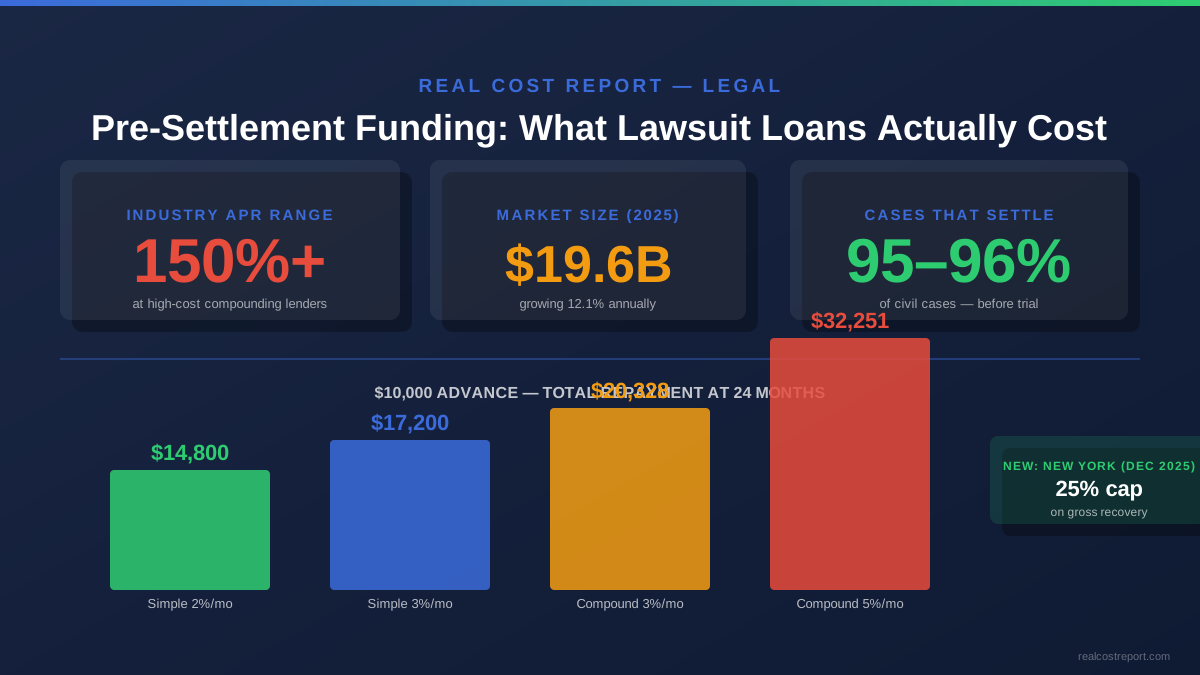
Litigation funding has also grown, expanding access to representation for claimants who qualify for contingency but worry about the 12–36 month timeline of larger cases. Medical lien negotiation — where attorneys reduce the amount owed to healthcare providers from the settlement — has become a standard service at personal injury firms, partially offsetting the contingency fee cost for claimants with significant medical bills. If your attorney doesn’t mention lien negotiation, ask about it.
How We Researched This Article
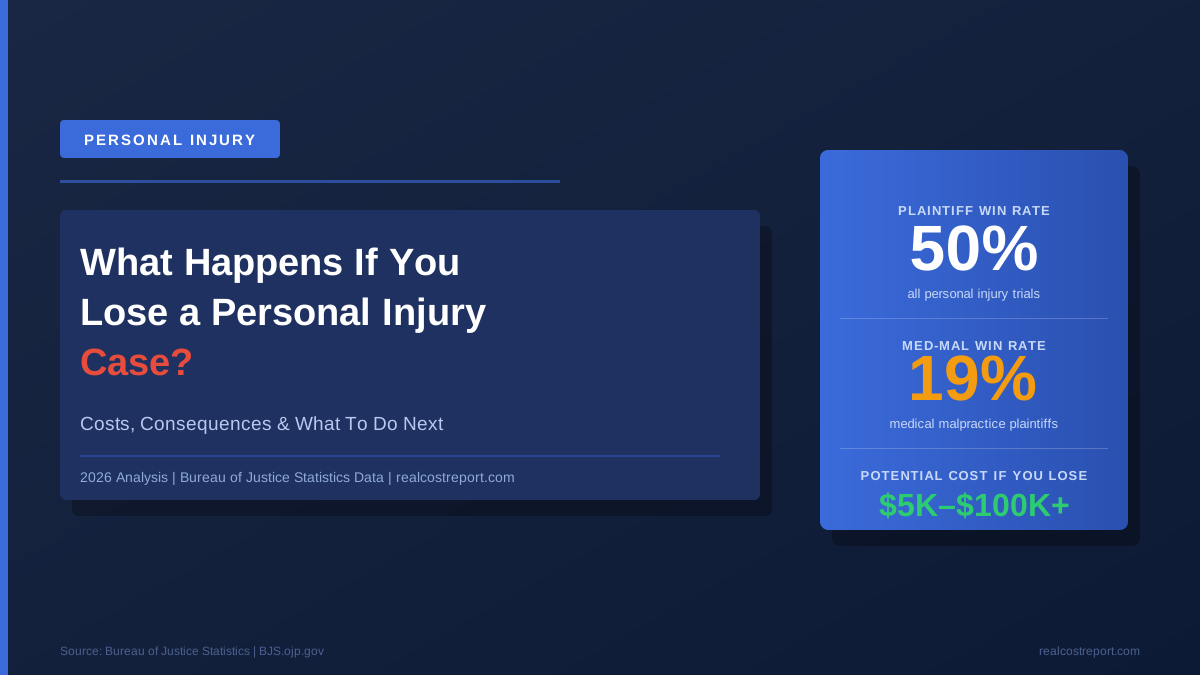
This article draws on four primary data sources. Contingency fee structure and range data comes from the American Bar Association’s published guidance on contingency arrangements, which documents fees as “often one-third to 40 percent” — available for independent verification at americanbar.org. The 3.5× represented-vs-unrepresented settlement multiplier is sourced from the Insurance Research Council, an industry-funded research organization whose findings have been published and updated across multiple study cycles since the 1990s; the IRC publishes this data primarily for carrier use in evaluating claims operations. Median personal injury award data — $30,000 — is drawn from the Bureau of Justice Statistics, which tracks civil trial outcomes at the federal and state level. Expert witness rate data ($555/hour median for medical testimony) is sourced from SEAK Inc.’s national expert witness fee survey.
Settlement math in the comparison tables is modeled from IRC multiplier data applied to representative claim values; individual outcomes vary materially by injury type, state jurisdiction, insurer, and attorney quality. Case expense ranges ($500–$1,200 for pre-suit claims; $5,000–$25,000 for litigated claims) reflect reported ranges from practitioners in multiple states and should be treated as illustrative rather than precise predictions for any individual case. The American Bar Association’s guidance on attorney fee structures was reviewed at ABA Model Rules of Professional Conduct. Bureau of Justice Statistics civil case data was reviewed at bjs.ojp.gov.
State-specific rules — including comparative negligence standards, statutory caps on damages, and statute of limitations deadlines — were not individually verified for all 50 states; readers should confirm applicable rules with a licensed attorney in their jurisdiction. Research was conducted in May 2026. All figures were verified against named primary sources before publication.