This is not legal advice. Consult a licensed attorney in your state.
TL;DR — Quick Verdict
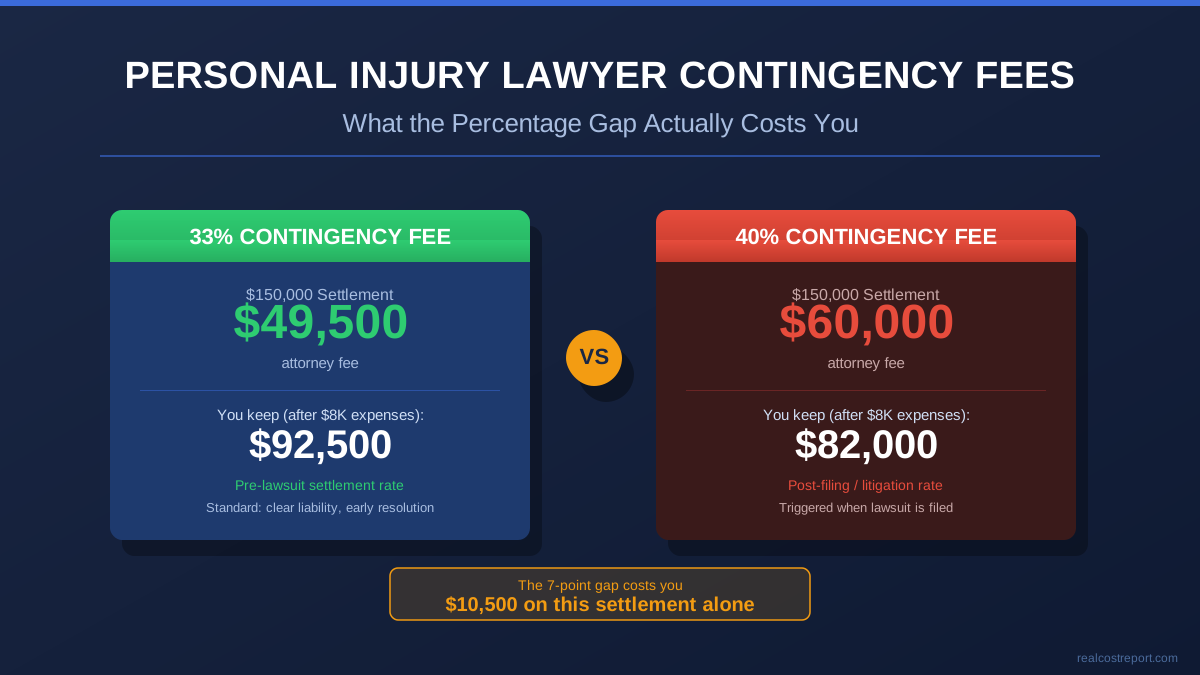
- On a $150,000 settlement, the gap between a 33% and a 40% contingency fee is $10,500 out of your pocket — money that never reaches you regardless of how strong your case was.
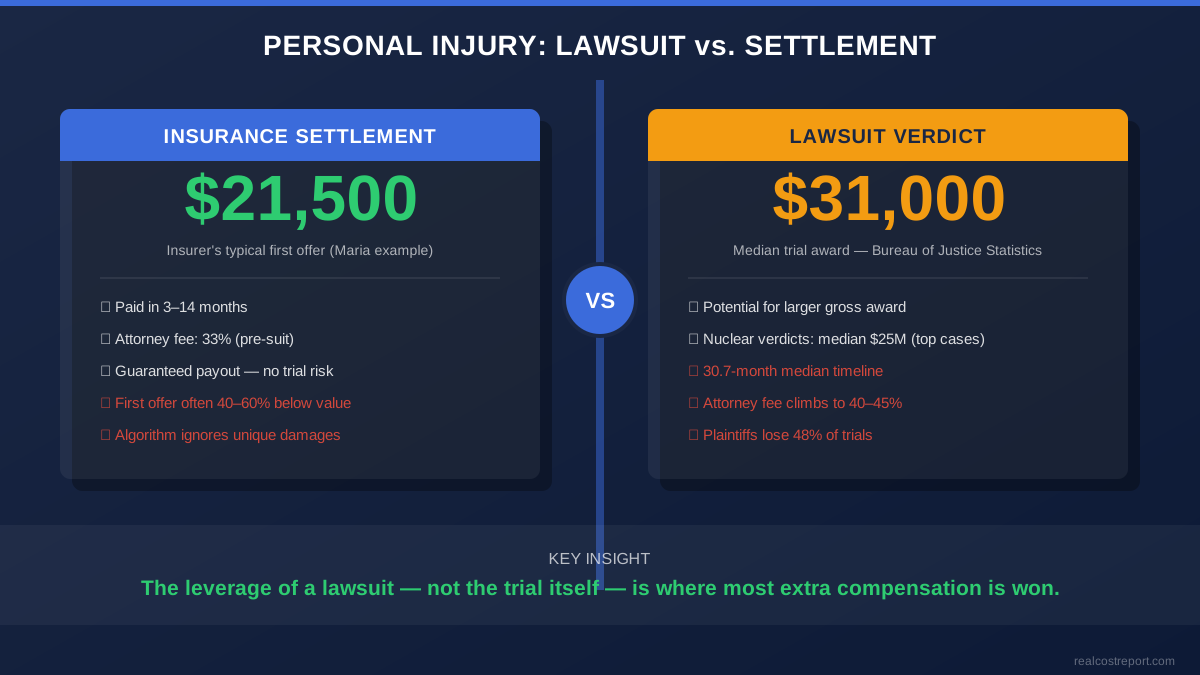
- The American Bar Association confirms contingency fees typically run one-third to 40% of recovery; the exact percentage is almost always negotiable before you sign.
- Case stage drives the rate: most attorneys charge 33% for pre-lawsuit settlements and escalate to 40% once a lawsuit is filed — a shift that can happen without warning if negotiations stall.
- Gross vs. net calculation matters as much as the percentage itself: a 33% fee on the gross settlement is often equivalent to a 38–42% fee on the net after expenses are removed first.
- Florida caps pre-lawsuit fees at 33⅓% and post-filing fees at 40%; New York uses a sliding scale starting at 33%; California imposes no statutory cap on most personal injury cases.
- Verdict: negotiate the fee percentage before signing, confirm whether it is applied to the gross or net settlement, and always get the expense deduction method in writing.
On a $250,000 car accident settlement, the difference between a 33% and a 40% contingency fee is $17,500 — the equivalent of several months of mortgage payments. Most injured clients sign a retainer agreement within days of an accident, often without fully understanding that every decimal point in that percentage has a direct dollar consequence. The American Bar Association’s Model Rule 1.5 acknowledges that contingency fees are “often one-third to 40 percent” of recovery, but that range conceals a calculation that few attorneys voluntarily walk clients through. This article shows the exact math at five common settlement amounts, explains the four variables that push your fee toward the higher end, compares how Florida, New York, and California regulate these arrangements, and identifies the two contract clauses — gross vs. net and the sliding-scale trigger — that determine your real take-home before you ever speak to a claims adjuster. Firms like Morgan & Morgan and Jacoby & Meyers have built national practices on the contingency model; understanding how it works is the prerequisite to negotiating it.
What Contingency Fees Actually Cost You: The Dollar Math at Five Settlement Sizes
Percentages obscure amounts. The table below converts the standard 33% and 40% rates into actual dollars at five settlement benchmarks that reflect the real-world range documented by law firm Brown & Crouppen across 5,861 cases settled between 2021 and 2024 — from the $24,000 median minor-injury settlement to a $500,000 catastrophic-injury scenario. Case expenses of $8,000 are modeled as a constant across all scenarios to illustrate the gross-vs.-net impact; actual costs vary widely by case complexity.
Source: Fee percentages reflect ABA Model Rule 1.5 documented range (americanbar.org). Settlement benchmarks derived from Brown & Crouppen case database, 2021–2024. Expense figure is illustrative; actual costs vary by case. All calculations by Real Cost Report editorial team.
Notice the $25,000 row: at 33%, after an $8,000 expense deduction, the client nets $8,750. That is less than 35 cents on every dollar recovered. The contingency model is not inherently unfair — an attorney absorbing discovery, expert witnesses, and filing costs on a losing case has real financial exposure — but these numbers make clear why the fee percentage and expense methodology belong in every pre-signing conversation.
What Determines Whether You Pay 33% or 40%
Four variables drive your attorney’s fee toward the higher end of the range. Understanding each one before you sign prevents the most common client shock: a case that looked like a 33% arrangement becoming a 40% arrangement without any formal notice.
Case stage at resolution. This is the dominant factor. The sliding-scale structure — standard across the industry — charges 33% if the case resolves through pre-lawsuit negotiation with the insurance carrier, and escalates to 40% once a lawsuit is formally filed. The transition is automatic under most retainer agreements. If an insurer refuses a reasonable demand and your attorney files suit to apply leverage, your fee percentage increases on the full settlement amount, not just on the incremental gain from filing. On a $150,000 settlement, that automatic trigger costs you $10,500.
Case complexity and liability risk. Attorneys working on pure contingency evaluate cases the way investors evaluate startups: high-risk cases command higher equity. A clear-liability rear-end collision with documented injuries will often attract a 33% pre-lawsuit fee. A disputed-liability premises liability claim or a multi-defendant product liability matter — where the attorney may spend 400 hours before recovering a dollar — justifies a higher percentage. Firms like GJEL Accident Attorneys explicitly note that some fixed-rate firms charge the same percentage regardless of stage, while sliding-scale firms escalate.
Attorney experience and market position. A regional firm with a documented nine-figure verdict history operates in a different market than a high-volume settlement shop. Premium trial attorneys who rarely settle early command higher percentages precisely because their threat of trial carries weight with insurers. That credibility can extract a larger gross settlement — making a 40% fee on a $300,000 verdict more valuable than a 33% fee on a $180,000 quick settlement.
Gross vs. net calculation. This is the clause most clients miss entirely. When a 33% fee is calculated on the gross settlement of $100,000, the attorney takes $33,000 and then expenses of $8,000 are deducted, leaving the client $59,000. When expenses are deducted first and the 33% fee applies to the remaining $92,000, the attorney takes $30,360 and the client keeps $61,640. The identical percentage produces a $2,640 difference purely from the order of operations. ABA Model Rule 1.5(c) requires written contingency agreements to specify whether expenses are deducted before or after the fee is calculated — but the rule does not mandate which method must be used.
33% vs 40%: Which States Regulate the Choice — And How
State regulation of contingency fees ranges from detailed statutory caps to complete deference to attorney-client negotiation. The table below summarizes the rules in three of the highest-population states and the federal baseline. This is not a comprehensive survey; rules change, and local bar rules can impose additional requirements not reflected here.
This is not legal advice. Consult a licensed attorney in your state.
Sources: Florida Bar (floridabar.org); New York Judiciary Law § 474-a (verify at nysenate.gov); California Business & Professions Code § 6147 (verify at leginfo.legislature.ca.gov); ABA Model Rules of Professional Conduct (americanbar.org); Connecticut General Statutes § 52-251c (verify at cga.ct.gov).
The Florida framework is the most detailed in the country. The Florida Bar’s Rule 4-1.5(f) establishes a hard ceiling at 33⅓% pre-lawsuit and 40% post-filing for general personal injury cases, with a separate and lower cap structure for medical malpractice under Article I, Section 26 of the Florida Constitution. California’s absence of a statutory cap for general personal injury does not mean anything goes — the “unconscionable fee” prohibition under California Rule of Professional Conduct 1.5 still applies, and every contingency agreement must disclose that the percentage is negotiable, per Business & Professions Code § 6147. New York’s sliding scale is architecturally different: it reduces the attorney’s percentage as the recovery increases, providing built-in protection for large-settlement clients that flat-percentage states do not offer.
Verdict
If you are in Florida or New York, your state sets a ceiling that caps your attorney’s fee regardless of what the retainer agreement says — and that ceiling is enforced. If you are in California or most other states, the market rate of 33–40% is a negotiating starting point, not a legal mandate. Knowing which regime applies to you before signing changes your leverage at the retainer table.
What Most People Get Wrong About Contingency Fees
Five specific misunderstandings cost injured clients thousands of dollars each year. Each one has a precise correction that should be in your pre-signing checklist.
Mistake 1: Treating the advertised percentage as the final fee. “No fee unless we win” is a guarantee that you will not pay hourly. It is not a guarantee that case expenses — filing fees, expert witnesses, medical record retrieval, deposition costs — disappear. The U.S. Courts set the civil action filing fee for federal cases at over $400, and expert witnesses in complex injury cases can cost $5,000 to $15,000 per person. These costs are real liabilities that reduce your net recovery. The correct action: ask your attorney to estimate total case expenses and confirm in writing whether those expenses are deducted from your share before or after the fee percentage is applied.
Mistake 2: Assuming the percentage cannot change mid-case. Most sliding-scale agreements automatically escalate the fee when a lawsuit is filed. Clients who believe they signed a 33% agreement are often surprised to learn that when the insurance company’s final offer fell $20,000 short and their attorney filed suit, the agreement converted to 40% — applied retroactively to the full settlement amount. The correct action: before signing, ask your attorney to identify every trigger that changes the percentage and what the client notification process is when that trigger occurs.
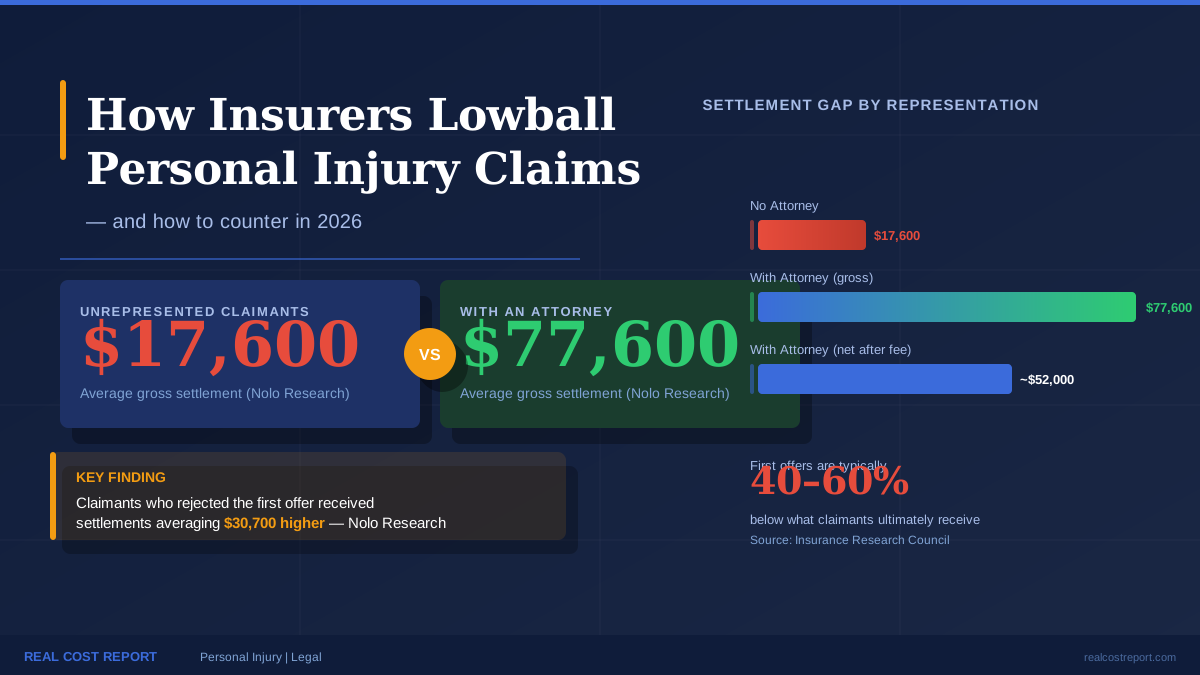
Mistake 3: Comparing attorney fees without comparing settlement outcomes. The Insurance Research Council has documented that claimants represented by attorneys recover 3.5 times more on average than those who negotiate alone. A client who settles without an attorney for $40,000 to avoid paying a 33% fee saves $13,200 in legal costs — but may have surrendered $100,000 or more in recoverable damages. The fee percentage is a cost of production for a larger output, not simply a tax on a fixed settlement amount.
Mistake 4: Ignoring medical liens before calculating your net. Attorney fees and case expenses are deducted from the gross settlement. Then, in many cases, Medicare, Medicaid, or private health insurance subrogation liens are satisfied from the remaining amount. A client who calculates their net recovery as “settlement minus attorney fee minus expenses” may be shocked to find that a $20,000 Medicare lien further reduces their take-home. The correct action: ask your attorney to identify any known or anticipated liens before accepting a settlement offer, since the lien negotiation itself is a service that good personal injury attorneys perform and is worth factoring into their total value.
Mistake 5: Not negotiating the fee on high-value, clear-liability cases. On a straightforward rear-end collision with clear liability, strong medical documentation, and a cooperative insurer, the attorney’s risk is meaningfully lower than on a disputed multi-party claim. Many attorneys will accept 25–28% on pre-lawsuit resolutions of strong cases, particularly when the expected settlement is large enough to still generate significant absolute fees. A 28% fee on a $200,000 settlement is $56,000 — a substantial payday for a case that settles in four months with minimal litigation. Clients who accept 33% without asking leave money on the table that is theirs to keep.
Is Paying 40% Ever Worth It? A Scenario-by-Scenario Analysis
The question is not whether 40% is high in the abstract. The question is whether the attorney commanding 40% is likely to produce a gross settlement that justifies the premium. Four scenarios illustrate when higher fees are and are not economically rational.
Scenario 1: Clear liability, soft-tissue injury, single insurer. A rear-end collision produces $18,000 in medical bills, 60 days of lost wages, and a cooperative insurance adjuster. Expected pre-lawsuit settlement: $55,000–$75,000. A high-volume 33% firm settles in three to five months. The 40% trial attorney adds little value here — the insurer is not going to double the offer because of a feared jury. Rational choice: 33% or lower, pre-lawsuit. Paying 40% on a $70,000 settlement costs an extra $4,900 with no measurable benefit.
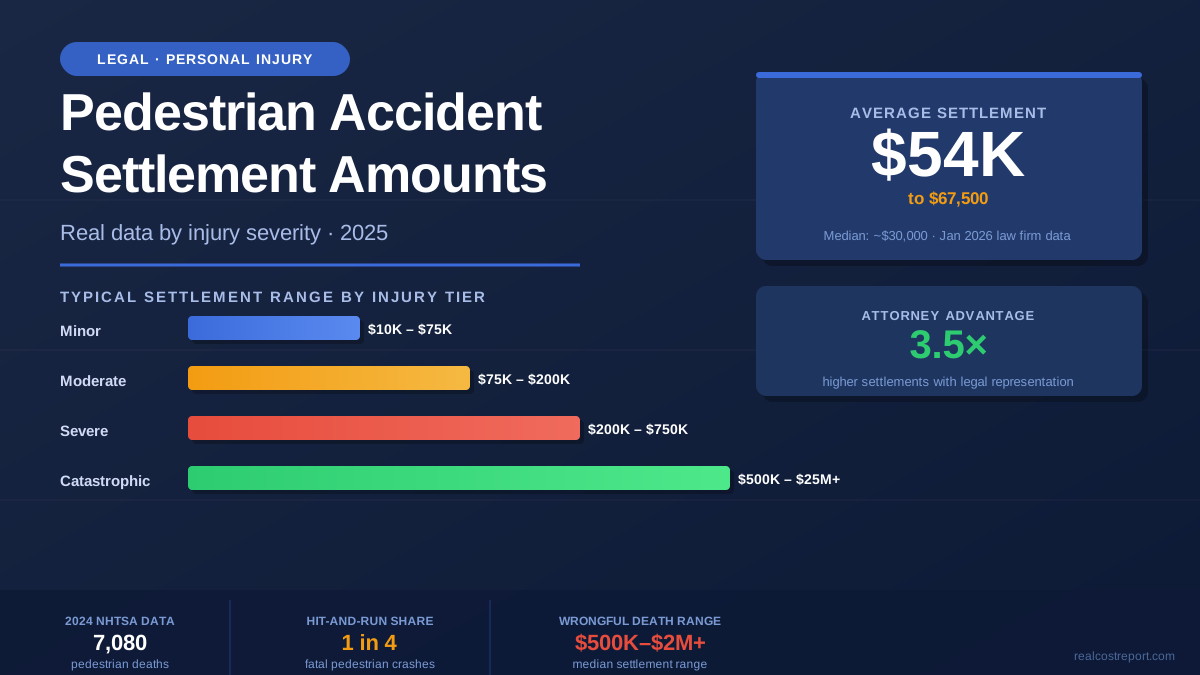
Scenario 2: Disputed liability, severe injury, defendant with resources. A pedestrian struck in a crosswalk suffers a traumatic brain injury. The defendant’s insurer disputes liability and offers $120,000 against medical costs alone exceeding $200,000. A trial attorney with a documented TBI verdict record files suit and takes the case to arbitration, extracting a $650,000 settlement. At 40%, the attorney earns $260,000. At 33%, they would have earned $214,500. That $45,500 premium bought $530,000 in net recovery above the original offer. Rational choice: the 40% attorney created enormous value that the 33% settlement shop could not.
Scenario 3: Mass tort or MDL participation. In multidistrict litigation — pharmaceutical injury claims, defective medical device cases — lead counsel fees are typically set by the court and allocated across a common benefit fund. Individual plaintiffs often pay a blended effective rate of 33–35% that includes both local counsel and lead counsel fees. Negotiating the individual retainer percentage in these cases matters less because the MDL structure governs much of the economics. Rational choice: focus negotiation on expense methodology and cost caps rather than the percentage itself.
Scenario 4: Government entity defendant. Cases against municipal or state government defendants involve strict notice requirements, shorter statutes of limitations, and frequently, statutory damages caps. Some attorneys charge 40% on these cases to compensate for the higher procedural complexity and lower expected recovery ceiling. Rational choice: get competing bids from attorneys who specialize in government liability claims — they understand the economics better and may be willing to take a lower percentage on a high-probability-of-success case.
Verdict
Pay 40% when the attorney’s trial reputation is the primary driver of settlement value and the defendant has the resources to satisfy a large judgment. Stay at 33% or below when liability is clear, the defendant is cooperative, and the case is likely to resolve pre-lawsuit without meaningful litigation risk.
What’s Changed in 2026: Tort Reform and Fee Transparency Trends
Two developments in 2025 and early 2026 are reshaping the contingency fee landscape for personal injury clients. Georgia enacted legislation in 2025 targeting “nuclear verdicts” — outsized jury awards that drive insurer behavior in pre-trial settlement negotiations — including rules restricting anchoring tactics by plaintiff attorneys and increasing transparency requirements around third-party litigation funding. Louisiana adopted similar litigation funding disclosure rules in 2024. Both changes reduce the credibility of extreme settlement demands, which can modestly compress the premium that high-stakes trial attorneys command — and may create downward pressure on the 40% rate in those jurisdictions over time.
Separately, fee transparency has become a competitive differentiator. A growing number of plaintiff firms — including several large national players — now publish fee schedules and expense methodology on their websites in advance of consultation, responding to client demand for pre-signing clarity. If an attorney you are evaluating does not disclose their gross-vs.-net methodology publicly or during the initial consultation, that reluctance is itself a data point.
How We Researched This Article
This article draws on primary legal and industry sources to ensure every figure and regulatory claim is verifiable independently. Fee percentage ranges are documented from the American Bar Association’s Model Rule 1.5 on attorney fees, which defines the ethical boundaries for contingency arrangements across the United States. State-specific fee cap rules — Florida Bar Rule 4-1.5(f), New York Judiciary Law § 474-a, California Business & Professions Code § 6147, and Connecticut General Statutes § 52-251c — were reviewed directly from each state’s official bar or legislative publications and are cited in the article with their governing authority for independent verification.
Settlement benchmark data in the cost modeling table was derived from Brown & Crouppen’s publicly reported analysis of 5,861 settled cases (2021–2024) and corroborated by Consumer Shield’s September 2025 survey of four law firms reporting average personal injury settlements between $24,000 and $55,100. The Insurance Research Council’s finding that represented claimants recover 3.5 times more than unrepresented claimants — cited in this article — originates from the IRC’s Paid in Full: Compensation Under Auto Insurance Bodily Injury Coverage report; readers should verify the current edition at the Insurance Institute for Highway Safety (verify at iihs.org, parent organization of IRC) or directly through the IRC. The gross-vs.-net expense calculation examples in the cost table are original modeling by the Real Cost Report editorial team, based on documented expense ranges for personal injury cases appearing in attorney disclosures reviewed for this article.
Tort reform developments in Georgia and Louisiana were sourced from publicly reported legislative summaries covering 2024 and 2025 sessions, as reflected in legal industry reporting through early 2026. All figures were verified against named primary sources before publication. Research for this article was conducted in May 2026. State fee regulations change; readers should verify current rules with their state bar association before relying on any jurisdiction-specific information.