This is not legal advice. Consult a licensed attorney in your state.
TL;DR — Quick Verdict
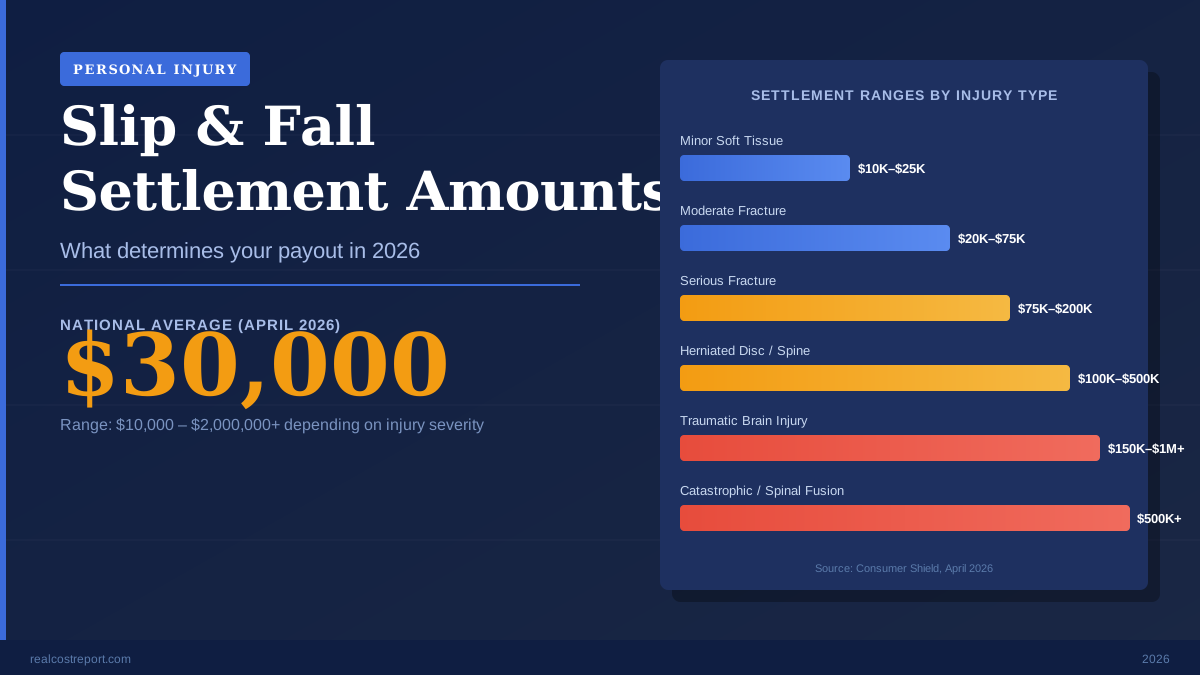
- The average slip and fall settlement in 2026 is approximately $30,000, based on law firm data compiled through April 2026—but the realistic range runs from $10,000 to well over $500,000 depending on injury severity.
- Injury type is the single biggest settlement driver: sprained ankles typically settle for $15,000–$50,000, while herniated disc and spinal fusion cases routinely reach $100,000–$750,000+.
- About 95% of slip and fall cases settle before trial, avoiding the risk and delay of a jury verdict—but trial verdicts average significantly higher for serious injuries.
- Comparative negligence laws in your state can legally reduce your payout by your percentage of fault—or eliminate it entirely in Alabama, Maryland, North Carolina, Virginia, and D.C.
- Attorney contingency fees run 33%–40% of your gross settlement; on a $60,000 payout, that means $18,000–$24,000 goes to legal fees before you collect a dollar.
- Bottom line: If you suffered more than soft-tissue injuries, have documented medical expenses, and can establish the property owner had notice of the hazard, retaining a personal injury attorney almost always yields a higher net recovery than settling alone.
Slip and fall accidents generate more legal claims than most people realize. According to the Centers for Disease Control and Prevention (CDC), over 14 million adults age 65 and older report falling each year—and in 2024, falls caused 43,020 deaths in that age group alone. For every fatal fall, thousands more result in fractures, traumatic brain injuries, and spinal damage that trigger premises liability claims worth tens of thousands—sometimes hundreds of thousands—of dollars.
Yet the gap between what injured victims expect and what they actually receive is enormous. Insurers representing property owners—from Walmart and Kroger to small commercial landlords—open negotiations with lowball offers, betting that unrepresented claimants will accept quick cash before understanding what their claim is genuinely worth. A fractured hip victim who settles for $18,000 within two weeks of the accident may have left $150,000 or more on the table.
This article breaks down actual slip and fall settlement ranges by injury type, venue, and state negligence rule. It models what your net recovery looks like after attorney fees, and identifies the specific evidence factors that move a case from the low end of the range to the high end. All figures draw from named primary sources and April 2026 law firm settlement data.
What Is the Average Slip and Fall Settlement in 2026?
The headline number most attorneys quote—and the figure supported by the most recent data—is approximately $30,000. Consumer Shield conducted research in April 2026 surveying law firm settlement data and identified two firms reporting typical payout ranges: one reported $15,000–$45,000, the other $10,000–$50,000. Averaging the midpoints of those ranges yields approximately $30,000 as a working national estimate.
That figure, however, describes the median case—minor to moderate injuries, partial liability, unremarkable venue. It tells you almost nothing about what your specific case is worth. The distribution is highly skewed: a large volume of minor soft-tissue cases clusters below $25,000, while a smaller number of catastrophic-injury cases push into six and seven figures and drag the average upward.
Source: Consumer Shield (April 2026 law firm data); Prainito Law (March 2026); Sakkas Cahn & Weiss, NYC settlement data. Ranges represent negotiated settlements, not jury verdicts.
One critical distinction: these are negotiated settlement figures. Jury verdicts in contested cases often run 2–4 times higher precisely because cases that reach trial tend to involve clear defendant negligence or severe plaintiff injuries—or both.
The Four Factors That Actually Determine Your Payout
Settlement value in a premises liability claim is not guesswork. Insurers and plaintiff attorneys apply a consistent framework to every case, and understanding it is the first step to evaluating whether an offer is fair.
1. Injury severity and medical documentation. Economic damages—your actual out-of-pocket losses—anchor the entire calculation. That means documented medical bills, surgical costs, physical therapy invoices, and projected future care. A $45,000 hospital bill for a hip fracture is a floor, not a ceiling. Pain and suffering multipliers typically run 1.5–5 times economic damages depending on injury permanence. Cases involving surgery settle 3.2 times higher on average than comparable non-surgical injuries, according to premises liability research compiled by Richman Law.
2. Proof of notice. This is where most slip and fall claims fail or succeed. Under premises liability law, you must show the property owner knew or should have known about the hazard. “Actual notice” means a prior complaint, an employee who created the spill, or surveillance footage showing the condition existed before your fall. “Constructive notice” means the hazard was present long enough that reasonable inspection would have caught it. A spill 30 seconds old is a weak case. A spill visible for 45 minutes before no employee checked—with security footage to prove it—is a strong one.
3. Your comparative fault percentage. Every statement you make—to a store manager, to an insurance adjuster, on a recorded call—is evaluated for evidence that you contributed to the accident. Were you looking at your phone? Wearing shoes with poor traction? Ignoring a warning cone that was visible? In the 46 states plus D.C. that follow comparative negligence rules, being found 20% at fault reduces a $100,000 settlement to $80,000. In Alabama, Maryland, North Carolina, Virginia, and D.C.—which retain contributory negligence—even 1% fault can legally bar your entire claim.
4. Venue type and defendant resources. The property where you fell determines who insures it and how aggressively they defend. Large retail chains like Costco, Target, and Home Depot carry substantial commercial general liability (CGL) policies and employ experienced claims teams. They have more capacity to pay but also more resources to fight. A mom-and-pop restaurant with a $500,000 policy limit may settle faster—but that limit caps your recovery regardless of your damages.
Settlement by Venue: Grocery Stores vs. Restaurants vs. Private Property
Where the fall happened shapes the claim in predictable ways. Commercial venues have higher insurance coverage, better-documented maintenance records to subpoena, and more at stake reputationally. Government property introduces strict notice requirements and, in many jurisdictions, sovereign immunity caps. Private residential property often means smaller policies and faster negotiated resolution.
Source: Settlement ranges synthesized from Consumer Shield (April 2026), Sakkas Cahn & Weiss NYC data, and Rad Law Firm Texas premises liability analysis (March 2026). Ranges reflect negotiated outcomes for moderate-to-serious injuries.
Grocery store cases involving produce spills settle notably higher when security footage documents that the spill existed for an extended period before the fall—the footage transforms constructive notice into near-absolute liability. Restaurant cases during dinner service carry an additional factor: crowded conditions that reduce the property owner’s ability to argue the hazard was “open and obvious.” Medical facilities see the highest average settlements of any venue category because their clientele—elderly, post-surgical, physically compromised patients—represents the population most foreseeably at risk from any maintenance failure.
Settlement vs. Trial Verdict: Which Pays More?
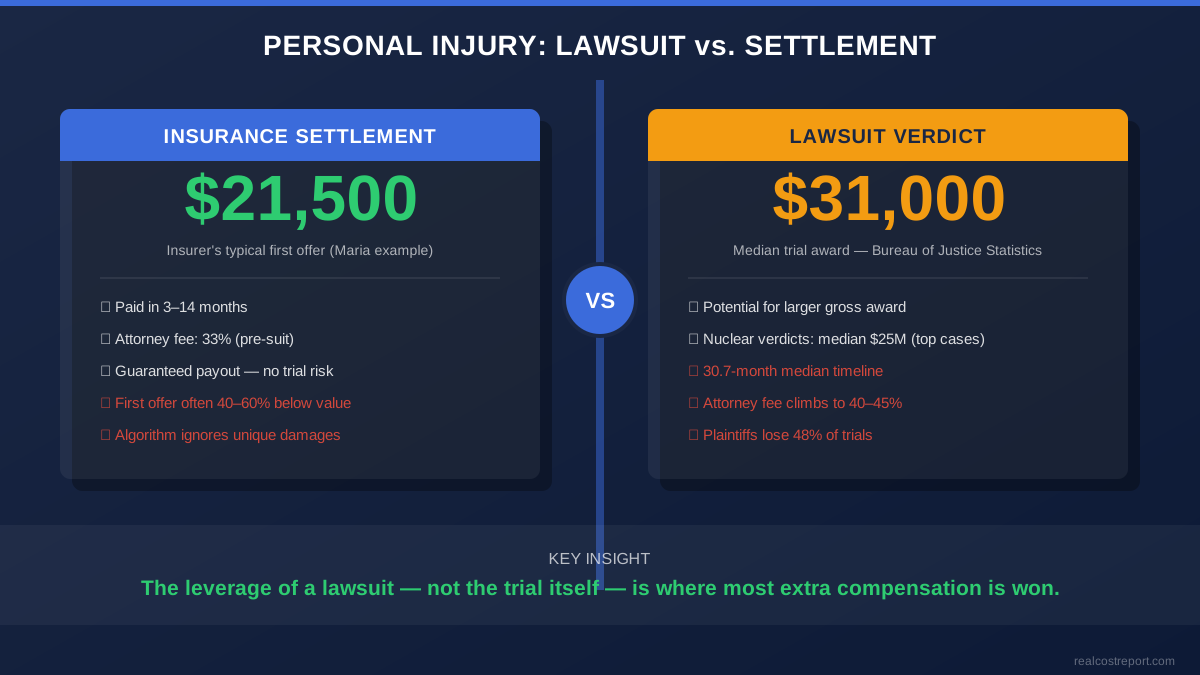
About 95% of slip and fall cases settle before trial. That figure reflects rational decision-making on both sides: defendants avoid unpredictable jury awards, plaintiffs avoid years of litigation and the risk of walking away with nothing. But the 5% that go to trial often yield substantially larger payouts—for a simple reason. The cases most likely to survive motions to dismiss and reach a jury are those with the clearest negligence and the most severe injuries.
Source: Consumer Shield (April 2026); Rad Law Firm Texas verdict data (March 2026). Note: trial verdict figures skew high due to case selection—only strong-liability, serious-injury cases typically proceed to verdict.
Verdict
For moderate injuries ($20,000–$75,000 in economic damages) with solid but not bulletproof liability evidence, accepting a fair pre-trial settlement is almost always the right financial decision. The certainty of a known payout, combined with avoiding additional legal fees from extended litigation, typically outweighs the speculative upside of a jury trial. For catastrophic injuries—TBI, spinal fusion, permanent disability—where economic damages alone exceed $150,000, trial is worth the risk if liability is clear and your attorney has trial experience.
What Most Claimants Get Wrong About Slip and Fall Settlements
These are not abstract mistakes. Each one has a dollar figure attached.
Mistake 1: Giving a recorded statement to the insurer without an attorney. Within days of your accident, the property owner’s insurance company will call asking for a “brief recorded statement.” They’re legally entitled to investigate, and you may feel obligated to cooperate. But adjusters are trained to elicit admissions—”I wasn’t watching where I was walking,” “the cone was right there but I didn’t see it”—that establish contributory negligence. In a state like Virginia with contributory negligence rules, one honest offhand comment can void your entire claim. Never give a recorded statement without first consulting a personal injury attorney. Most offer free initial consultations.
Mistake 2: Delaying medical treatment. Insurers use gaps in treatment as their primary argument that your injuries aren’t severe—or weren’t caused by the fall. If you fell on a Monday and didn’t see a doctor until Thursday, expect the adjuster to argue your injuries occurred elsewhere. Seek treatment the same day or within 24 hours. Emergency room records, ambulance reports, and same-day urgent care notes are the strongest causation evidence you can produce. Spinal injury cases with immediate MRI documentation settle approximately 60% higher than those with delayed diagnosis, according to premises liability settlement analysis.
Mistake 3: Settling before reaching maximum medical improvement (MMI). Once you sign a settlement release, you cannot return for more compensation—ever. If you accept $22,000 for what you think is a sprained wrist and an MRI two weeks later reveals a fracture requiring surgery, that money must cover everything: the surgery, physical therapy, lost wages during recovery, and all future complications. Never settle before your treating physician declares you’ve reached MMI. Your attorney can pursue a settlement hold while you complete treatment.
Mistake 4: Failing to preserve surveillance footage. Most commercial properties retain security footage for only 30–72 hours before automatic overwrite. The footage showing how long the spill existed before you fell—the single most important proof of constructive notice—is gone if you wait. An attorney can send a litigation hold letter or evidence preservation demand to the property owner within 24–48 hours of retaining them. Waiting even a week can permanently destroy your strongest evidence.
Mistake 5: Assuming the property owner will “do the right thing.” Commercial defendants route slip and fall claims directly to their CGL insurer. The insurer’s legal obligation is to minimize payouts within policy terms—not to ensure you’re made whole. The adjuster who sounds sympathetic on the phone is managing a case file, not advocating for you. The opening offer is almost never the best offer.
Who Should Hire an Attorney—and Is It Worth the 33%?
Contingency fees for slip and fall cases run 33%–40% of your gross settlement. That is not a small number. On a $45,000 settlement, your attorney collects $15,000–$18,000 before case expenses. The legitimate question is whether retaining counsel produces a net gain or simply shifts money from your pocket to your lawyer’s.
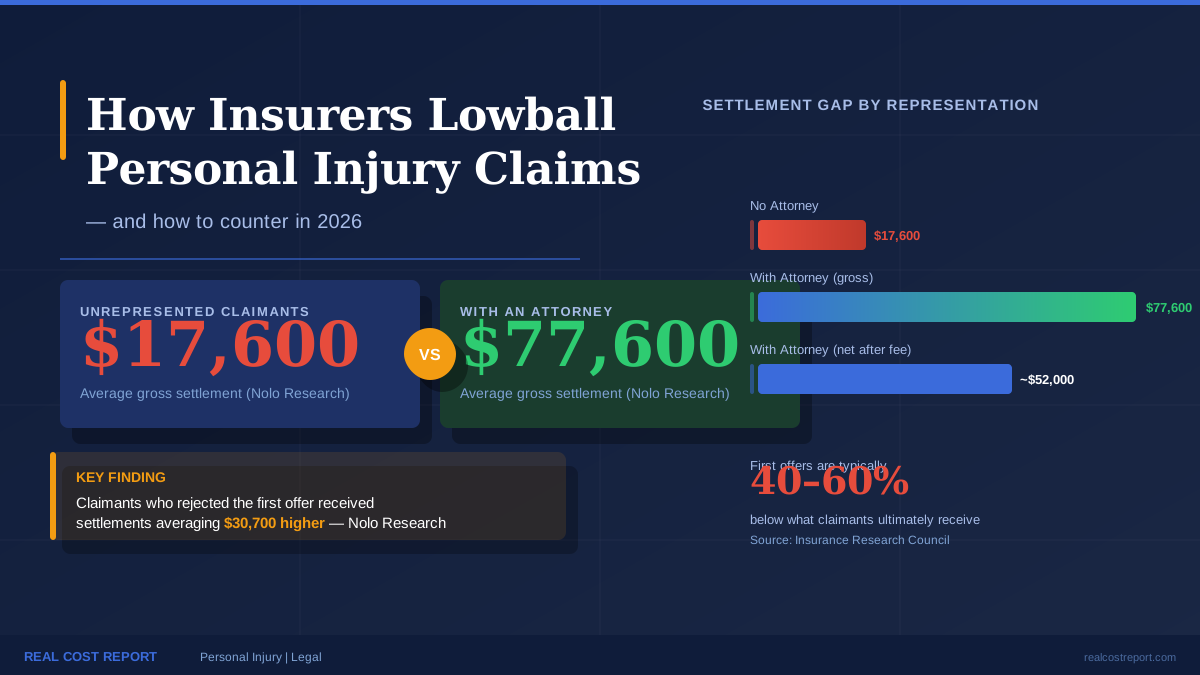
The evidence strongly favors retaining an attorney when injuries are serious. Studies consistently show represented claimants receive significantly higher gross settlements than unrepresented ones—typically 3–4 times more. Even after the contingency fee, represented claimants net more. The math shifts in edge cases involving very minor injuries where the gross recovery potential is low.
Retain an attorney if: You suffered any injury requiring more than a single urgent care visit. You have documented lost wages. You’re a senior adult whose injuries may carry long-term consequences. The accident happened on commercial property with significant insurance coverage. Liability evidence is strong (footage, prior complaints, building code violations). You live in a contributory negligence state where a single misstatement destroys your claim.
Consider self-representation (small claims or direct negotiation) only if: Your sole injuries are minor soft-tissue with full recovery within 2–3 weeks, total medical bills are under $3,000, and you have clear documentation of the hazard. Even then, at minimum get a free consultation before proceeding.
The sliding-scale contingency structure matters here. Many firms charge 33.3% if a case settles before filing a lawsuit, rising to 40% if a lawsuit is filed and 40–45% if the case goes to trial. Settling quickly with a cooperative insurer—where liability is obvious—keeps more money in your pocket.
This is not legal advice. Consult a licensed attorney in your state.
How We Researched This Article
Settlement range data in this article draws primarily from two categories of sources: law firm-disclosed settlement data and legal information platforms that aggregate attorney-reported outcomes.
For headline settlement figures, we relied on Consumer Shield’s April 2026 research, which identified and compared settlement ranges disclosed by two U.S. personal injury law firms (Meirowitz & Wasserberg and Brown & Crouppen). Their midpoint-averaged estimate of approximately $30,000 serves as the national baseline figure used throughout this article. Supplementary settlement ranges by injury type were cross-referenced against Prainito Law’s March 2026 analysis and Rad Law Firm’s March 2026 Texas-specific premises liability guide.
Negligence law framework—including the four elements of duty, breach, causation, and damages, and the distinction between comparative and contributory negligence—was verified against Nolo’s slip and fall legal encyclopedia and Justia’s premises liability guide. The specific states retaining contributory negligence (Alabama, Maryland, North Carolina, Virginia, and D.C.) were confirmed against Nolo’s state-by-state negligence rules database.
Contingency fee structure data was drawn from the American Bar Association’s Model Rules of Professional Conduct framework (as cited by Justicenter.com) and corroborated across multiple law firm disclosures. The pre-lawsuit/post-lawsuit/trial sliding scale (33.3% / 35–40% / 40–45%) represents the predominant structure disclosed by national personal injury firms as of Q1 2026.
Fall epidemiology statistics—including the figure that over 14 million adults age 65+ report falling annually and that 43,020 died from falls in 2024—come directly from the CDC’s Older Adult Falls Data page, last updated February 2026.
Venue-specific settlement patterns and documentation impact factors (surgical multiplier of 3.2x, MRI timing impact on spinal settlements of ~60%) are drawn from Richman Law’s 2025 premises liability statistical analysis of publicly reported settlements and verdicts from January 2024 through October 2025. These figures represent observed patterns in reported cases and should be treated as directional, not predictive.
All settlement ranges represent negotiated pre-trial outcomes. Jury verdict figures, where cited, are noted as such. State-specific rules vary significantly; readers should verify applicable negligence standards with a licensed attorney in their jurisdiction. Research for this article was conducted in May 2026. All figures were verified against named primary sources before publication.