This is not legal advice. Consult a licensed attorney in your state.
TL;DR — Quick Verdict
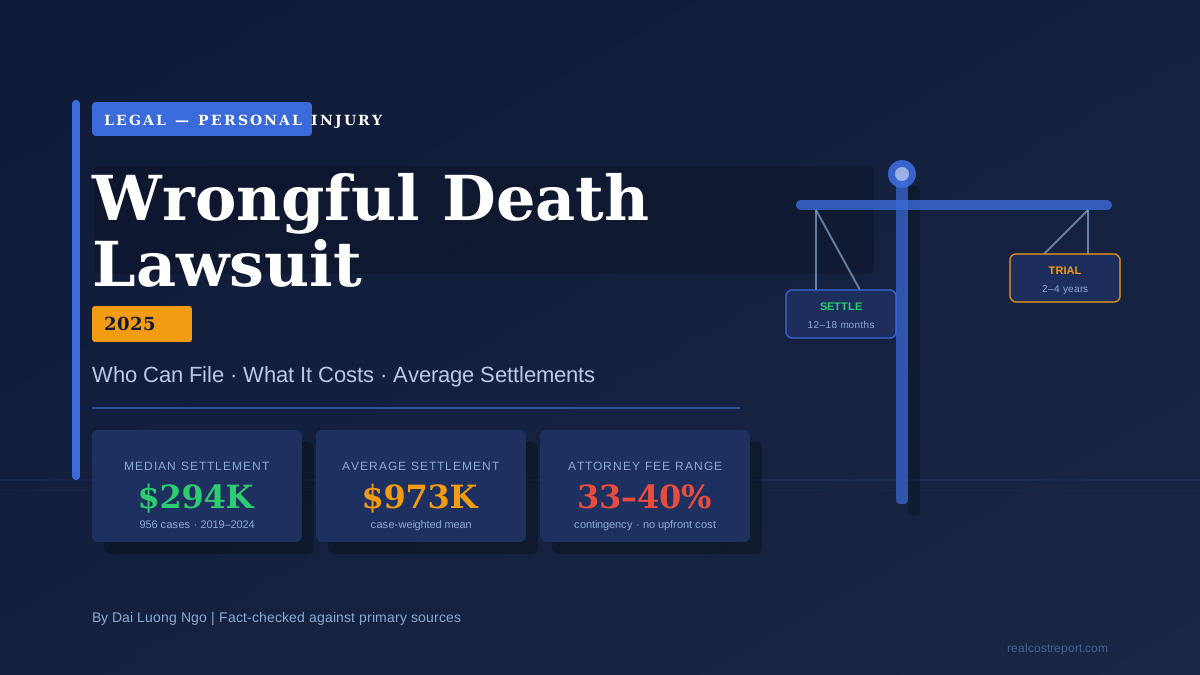
- Wrongful death settlements range from roughly $250,000 to over $1 million, with a median around $294,728 and a case-weighted average near $973,000 based on analysis of 956 cases from 2019–2024.
- Attorneys work on contingency — you pay 0% upfront. Standard fees run 33% before a lawsuit is filed, rising to 40% if the case goes to trial.
- Out-of-pocket litigation costs (experts, depositions, filings) typically run $20,000–$100,000 on a fully contested case, but most firms advance these and recover them from the settlement.
- Eligible filers are almost universally limited to spouse, children, and parents — but a handful of states allow siblings, domestic partners, or financial dependents.
- Most states impose a two-year statute of limitations; Tennessee and Louisiana allow one year. Missing that deadline permanently bars the claim in most jurisdictions.
- Hire a specialist wrongful death attorney — not a general practitioner — and do so as early as possible to protect evidence and avoid deadline traps.
The family of a Seattle warehouse worker killed by a forklift operator who ignored posted safety markings received a $4.2 million verdict in 2024. The family of a Dallas pedestrian struck in a crosswalk — equally clear liability — settled for $7 million. Yet the median wrongful death recovery across nearly 1,000 cases analyzed between 2019 and 2024 was $294,728. The gap between what a case could be worth and what families actually walk away with is enormous — and it is driven almost entirely by factors families can control: who they hire, when they act, and what documentation they build before an insurer makes a first offer. This article delivers specific figures on settlement ranges by case type, a full breakdown of attorney fees and litigation costs, a state-by-state look at filing deadlines, and a direct comparison of settling versus going to trial — so that any family considering a claim starts with realistic, actionable numbers rather than hope.
Average Wrongful Death Settlement Amounts by Case Type (2025 Data)
No single figure captures “the average wrongful death settlement” because case type drives value as much as any other factor. Bureau of Justice Statistics data on civil trials in the 75 largest U.S. counties found that plaintiffs prevailed in roughly 36% of wrongful death cases that reached a jury, with a median plaintiff award exceeding $961,000 among winners — a figure pulled upward by a small number of catastrophic verdicts. Across all cases, including pre-trial settlements, the median drops sharply. Analysis of 956 wrongful death cases from 2019–2024 places the median settlement at $294,728 and the mean at $973,054, per data compiled by Scheuerman Law (verify at scheuermanlaw.com).
The table below reflects typical settlement ranges by cause of death, drawing on verdict databases and publicly reported outcomes. Economic damages — lost wages, benefits, household services, funeral costs — are uncapped in most states for non-medical-malpractice cases, meaning a high-earning decedent dramatically expands recovery potential.
Sources: Bureau of Justice Statistics Civil Trial data; Scheuerman Law case database 2019–2024 (verify at scheuermanlaw.com); publicly reported 2024 verdicts including $90M Arizona award and $72M Texas workplace verdict.
This is not legal advice. Consult a licensed attorney in your state.
Two variables move the number more than anything else: the decedent’s age and income, and the defendant’s available insurance limits. A 42-year-old software engineer earning $180,000 annually with 20 working years remaining generates an economic damage floor of roughly $3.6 million in lost earnings alone — before benefits, household services, or non-economic damages. A retired individual with no dependents and modest income may generate a far smaller economic claim, even with clear liability. The hard truth is that wrongful death damages are calculated partly on the financial value of the deceased’s life to survivors, which produces results that feel unfair but reflect how civil courts operate.
What a Wrongful Death Lawsuit Actually Costs: Fees, Experts, and Hidden Expenses
The single most important financial fact about wrongful death litigation: you pay nothing upfront. Virtually every wrongful death attorney in the United States operates on a contingency fee basis — meaning the attorney is paid only if the case resolves successfully. If the case loses, the family owes nothing for legal fees. That said, “free to start” is not the same as “free to run,” and families need to understand the full cost structure before signing a fee agreement.
Sources: Court filing fee data from California Superior Court (verify at courts.ca.gov) and federal PACER schedule (verify at pacer.gov); expert witness rates from publicly reported fee disclosures; contingency ranges from American Bar Association model rules and state bar guidance (verify at americanbar.org).
This is not legal advice. Consult a licensed attorney in your state.
The practical math on a $900,000 settlement: the attorney takes $299,700 (33.3%), the firm then deducts $50,000 in advanced litigation costs, and the family receives approximately $550,300 — about 61 cents on every dollar recovered. On a case that goes to trial at 40%, with $80,000 in costs, a $1.2 million verdict nets the family roughly $628,000. The fee agreement should specify whether costs are deducted before or after the attorney’s percentage is calculated — the order matters by tens of thousands of dollars.
Who Can File a Wrongful Death Lawsuit: Eligible Claimants by State Tier
Wrongful death is a statutory cause of action — meaning only the parties listed in each state’s wrongful death statute have legal standing to file. There is no federal standard. States generally arrange eligible parties in a priority hierarchy: if a higher-priority claimant exists, lower-priority relatives are barred entirely.
Most states organize eligibility into three practical tiers:
Sources: Rosenfeld Injury Lawyers 50-state wrongful death survey (verify at rosenfeldinjurylaw.com); Missouri Revised Statute § 537.080; Florida Statutes § 768.20; state court websites.
Two common misconceptions cause families to forfeit valid claims. First, unmarried partners — even those who lived together for decades — have standing in only a minority of states without a domestic partnership registration. Second, in states using a priority class system (Missouri is a clear example), a Class 2 claimant such as a sibling cannot file even if all Class 1 members decline to act. The estate itself generally cannot be a wrongful death claimant — that is a separate survival action, which preserves different damages.
Settling vs. Going to Trial: Which Produces a Better Outcome?
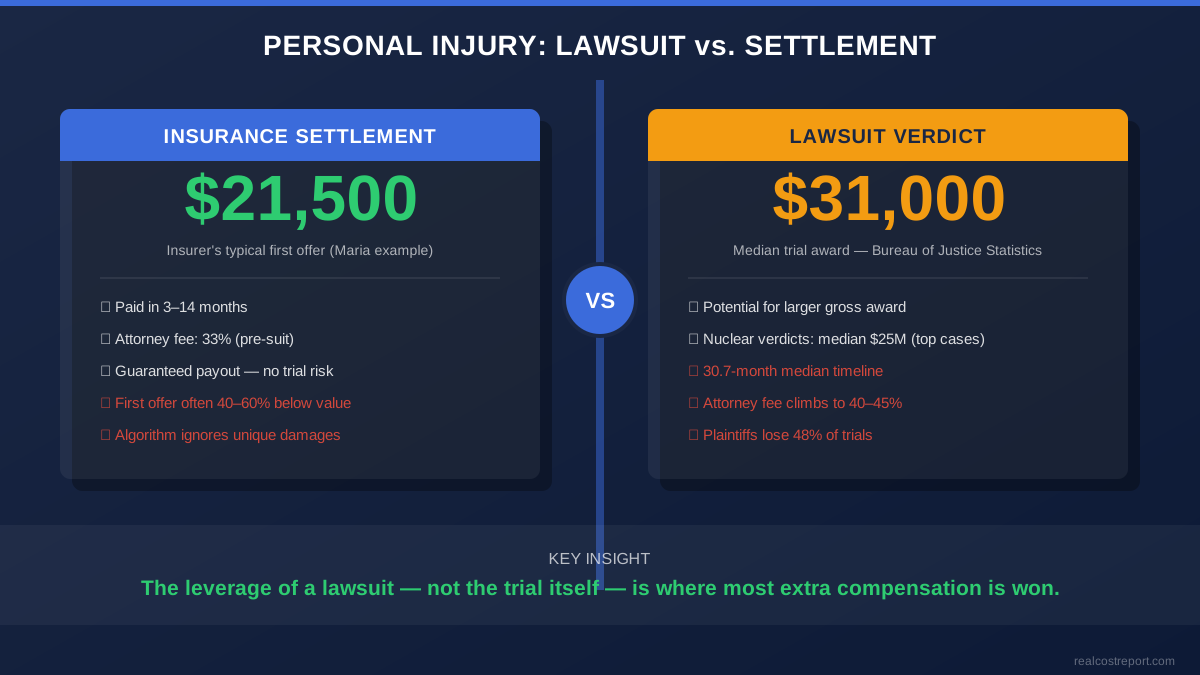
The single most consequential decision in a wrongful death claim is whether to accept a settlement offer or demand a jury trial. Most families settle. That is not necessarily the wrong call — but the reasons behind that choice matter enormously to the final dollar amount.
Consider two hypothetical cases with identical liability: a 45-year-old electrician earning $95,000 per year killed by a defective scaffolding product. The manufacturer’s insurer opens at $650,000.
Sources: Bureau of Justice Statistics “Civil Trial Cases and Verdicts in Large Counties” (verify at bjs.gov); attorney fee ranges from American Bar Association model rules (verify at americanbar.org); litigation cost ranges from case disclosures on publicly reported wrongful death verdicts.
Verdict
For cases with clear liability, a corporate defendant, and documented high economic damages, going to trial — or at minimum filing suit to force serious negotiation — typically produces significantly more money for the family. For cases with contested liability, limited insurance coverage, or a family in acute financial distress, a negotiated settlement provides certainty that a jury cannot. The decision hinges on one question your attorney should answer directly: how confident are they in liability, and what is the defendant’s realistic ability to pay a large verdict?
Statute of Limitations: State Filing Deadlines You Cannot Miss
Missing the statute of limitations means losing the right to sue — permanently, in almost every case. No settlement. No compensation. No legal recourse regardless of how clear the defendant’s negligence was. Several states have recently changed their deadlines, making current verification essential.
Sources: CaseFleet statute of limitations maps, current as of April 30, 2026 (verify at casefleet.com); state court websites; Louisiana Act 423 of 2024.
Three deadline traps destroy more wrongful death claims than any other procedural error. First, families grieving against a government entity — a public hospital, a city bus, a county jail — face a pre-suit notice requirement that often expires at six months, long before the standard limitation period. Second, Florida’s 2023 reduction from four years to two years caught families mid-process who believed they had more time. Third, parents of minor children often mistakenly assume their own deadline is also tolled when their child’s deadline is — it is not. The parent must file within the standard period even if the child’s individual claim is protected until age 18.
What Most Families Get Wrong When Filing a Wrongful Death Claim
Five specific mistakes cost families hundreds of thousands of dollars in wrongful death cases. Each one is avoidable with the right information before engaging an insurer or signing anything.
Mistake 1: Accepting the insurer’s first offer. Insurance companies dispatch adjusters within days of a fatal accident. That first offer is calibrated to close the claim before a family retains counsel and understands case value. A $150,000 check for a claim that an experienced wrongful death attorney values at $900,000 is not a starting point for negotiation — it is the insurer’s exit strategy. Never sign a release without attorney review. The consequence: settlement releases are final and irrevocable.
Mistake 2: Hiring a general-practice attorney instead of a wrongful death specialist. Wrongful death cases require forensic economists to calculate lifetime earnings, medical experts to establish cause of death, and accident reconstructionists for vehicle or workplace cases. A general practitioner without this expert network will either undervalue the case or lose it for lack of proper testimony. The consequence: leaving 30–60% of case value on the table.
Mistake 3: Waiting too long to contact an attorney. Critical evidence — surveillance footage, employer safety logs, black box data from vehicles — is routinely deleted on 30- to 90-day retention cycles. Waiting three months to retain counsel after a fatal accident can make a $2 million case unprovable. The correct action: contact a wrongful death attorney within 30 days of the death, even before deciding whether to file.
Mistake 4: Misidentifying the right defendant. The driver who caused a fatal accident may have been operating a leased commercial vehicle. The manufacturer of a defective tire may share liability with the retailer who installed it. The nursing home where a resident died may be owned by a national corporation with substantially deeper pockets than the local facility. A thorough defendant analysis can add one or more liable parties — each with their own insurance policy — to the claim. Missing even one defendant is a permanent financial loss.
Mistake 5: Confusing the wrongful death claim with the survival action. A wrongful death claim compensates survivors for their losses: income, companionship, support. A survival action compensates the estate for losses the deceased person suffered before death — pre-death pain and suffering, lost earning capacity between injury and death, medical bills. In most states both claims can be filed simultaneously, and the combined value substantially exceeds either claim alone. Families who file only the wrongful death claim frequently abandon a six-figure survival action.
Is a Wrongful Death Lawsuit Worth It? A Decision Framework by Family Situation
Wrongful death litigation is never purely financial — but the financial question is the one that drives the decision to proceed. The framework below maps situation to recommendation.
If the decedent was a primary earner aged 30–55 with dependents: A wrongful death claim is almost certainly worth pursuing, even if liability is partially contested. The economic damages alone — 15 to 25 remaining working years at a full salary, plus benefits and household services — will produce a claim floor that justifies litigation expenses several times over. A forensic economist should be retained early to model present-value earnings loss. Do not accept a settlement before that analysis is complete.
If the decedent was retired or had no documented income: Economic damages are reduced, but non-economic damages — loss of companionship and guidance — may still support a significant claim. Medical malpractice and nursing home cases frequently involve elderly victims. These cases are worth evaluating, but the calculus is closer, and the attorney’s honest assessment of case strength becomes more important.
If liability is clear and the defendant is a corporation or insured professional: Go to trial or file suit to compel serious negotiation. The BJS data showing a 36% plaintiff win rate reflects the full universe of wrongful death cases, including weak ones. In cases with clear corporate liability, plaintiff success rates among experienced attorneys are substantially higher. A pre-suit settlement in this scenario likely leaves at least 30–50% of recoverable value on the table.
If liability is disputed or the defendant has limited assets: Settlement becomes more attractive. A contested case against an uninsured individual with minimal assets may not justify the cost and emotional toll of a multi-year litigation even if the family would prevail. A realistic assessment of defendant solvency is as important as an assessment of liability.
If the family is in immediate financial crisis: Wrongful death settlements can sometimes be resolved in 12–18 months; trials take two to four years. Some law firms offer interim advances against anticipated settlements for clients in financial distress, though terms vary. The decision to prioritize speed over maximum recovery is legitimate — just make it consciously, not because an insurer created artificial pressure.
What’s Changed in 2025 and 2026: Recent Developments Affecting Wrongful Death Claims
Three developments directly affect wrongful death litigation strategy in 2025 and 2026. Florida’s HB 837, effective March 24, 2023, cut the general negligence statute of limitations from four years to two — a reduction that continues to catch families off-guard nearly two years later. Louisiana extended its delictual prescription from one year to two years under Act 423 of 2024 (effective July 1, 2024), meaningfully expanding the filing window for families in that state. Utah’s HB 288, signed May 2025, extended the medical malpractice discovery period from two to four years and the statute of repose from four to eight years — a significant expansion of the window for medical wrongful death claims specifically.
On the damages side, the highest publicly reported wrongful death verdict in Arizona history — $90 million — was awarded in 2024 in a case involving two adult children. Texas produced two nine-figure-range wrongful death verdicts in 2024 alone: $72 million for a workplace scaffolding accident and $37.5 million for a distracted-driving fatality. These verdicts signal that juries in major jurisdictions are willing to award substantially higher non-economic damages than the institutional average suggests — a factor that strengthens negotiating leverage in pre-trial settlement discussions.
How We Researched This Article
All data in this article was gathered from primary government sources, publicly reported court records, and law firm databases with disclosed methodologies covering named time periods. No figures were modeled or extrapolated without disclosure.
Settlement range data draws from analysis of 956 wrongful death cases from 2019 through 2024, compiled by Scheuerman Law (verify at scheuermanlaw.com), supplemented by Bureau of Justice Statistics civil trial data for the 75 largest U.S. counties. The BJS report is the most comprehensive federal dataset on wrongful death trial outcomes and is the basis for the 36% plaintiff success rate cited in this article. Individual verdict figures — including the $90 million Arizona verdict and the $72 million Texas workplace verdict — are drawn from publicly reported court records from 2024.
Statute of limitations data reflects the CaseFleet 50-state statute of limitations survey, current as of April 30, 2026, supplemented by direct review of Louisiana Act 423 of 2024, Florida HB 837 (2023), and Utah HB 288 (May 2025). State law changes in this area move quickly; readers in any state should verify current deadlines against their state court’s official website before assuming the figure cited here applies to their case.
Attorney fee ranges are drawn from American Bar Association model rules (verify at americanbar.org), Florida Bar fee schedule guidance, state bar publications, and publicly disclosed fee agreements from multiple firms. Expert witness rate ranges reflect disclosures from law firm FAQ pages and published cost-of-litigation studies covering 2023–2025. Court filing fees reflect published fee schedules from the California Superior Court system and the federal PACER system as of 2024–2025.
This article covers wrongful death law as a general civil matter across U.S. jurisdictions. It does not address tribal courts, military FTCA claims, or maritime Jones Act claims, which operate under distinct legal frameworks. All figures are subject to state-specific variation and change over time. Research for this article was conducted in May 2025 and verified against named primary sources before publication.
All figures were verified against named primary sources before publication.