Past performance does not indicate future results. This is not investment advice. Consult a qualified tax professional or financial advisor before acting on any information in this article.
TL;DR — Quick Verdict
- RMDs begin at age 73 under the SECURE 2.0 Act; the IRS Uniform Lifetime Table divides your prior December 31 account balance by a life-expectancy factor to set your annual withdrawal floor.
- A $1,000,000 traditional IRA triggers a roughly $36,496 RMD at age 73 — potentially pushing a married couple into the 22% federal bracket or higher depending on other income sources.
- Missing a full RMD carries a 25% excise tax on the shortfall (reduced to 10% if corrected within two years), one of the steepest penalties in the tax code.
- Roth conversions before age 73, Qualified Charitable Distributions (QCDs) up to $105,000 per year, and strategic aggregation across accounts are the three highest-leverage mitigation tools.
- Inherited IRA rules changed sharply after SECURE 2.0: most non-spouse beneficiaries now face a 10-year depletion rule, not life-expectancy stretching.
- Verdict: Anyone with a traditional IRA or 401(k) balance above $500,000 should model RMD projections at least five years before age 73 — the tax cost of waiting is almost always higher than the cost of acting early.
The IRS will eventually collect taxes on every dollar sitting in your traditional IRA or 401(k) — and Required Minimum Distributions are the mechanism it uses to ensure that happens on schedule. According to the IRS, Americans held approximately $13.6 trillion in IRAs as of recent Federal Reserve Flow of Funds data, much of it in pre-tax accounts that have never been taxed. Starting at age 73, the federal government mandates annual withdrawals whether you need the money or not. For a retiree with $1.5 million in a rollover IRA, that first RMD alone can exceed $54,000 — enough to trigger Medicare IRMAA surcharges, erode Social Security tax exemptions, and push ordinary income into a higher bracket all at once. This article shows exactly how the IRS calculates RMDs using its Uniform Lifetime Table, models the real tax cost across three realistic retiree scenarios, compares a Roth conversion strategy against a QCD strategy, and identifies the five mistakes that cost retirees the most money.
How the IRS Calculates Your RMD: The Exact Formula
The IRS RMD formula is deceptively simple: divide your account balance on December 31 of the prior year by the distribution period (life-expectancy factor) found in the applicable IRS table. For most account owners, that table is the Uniform Lifetime Table published in IRS Publication 590-B. The exception: if your sole beneficiary is a spouse more than 10 years younger, you use the Joint and Last Survivor Table, which produces lower RMDs.
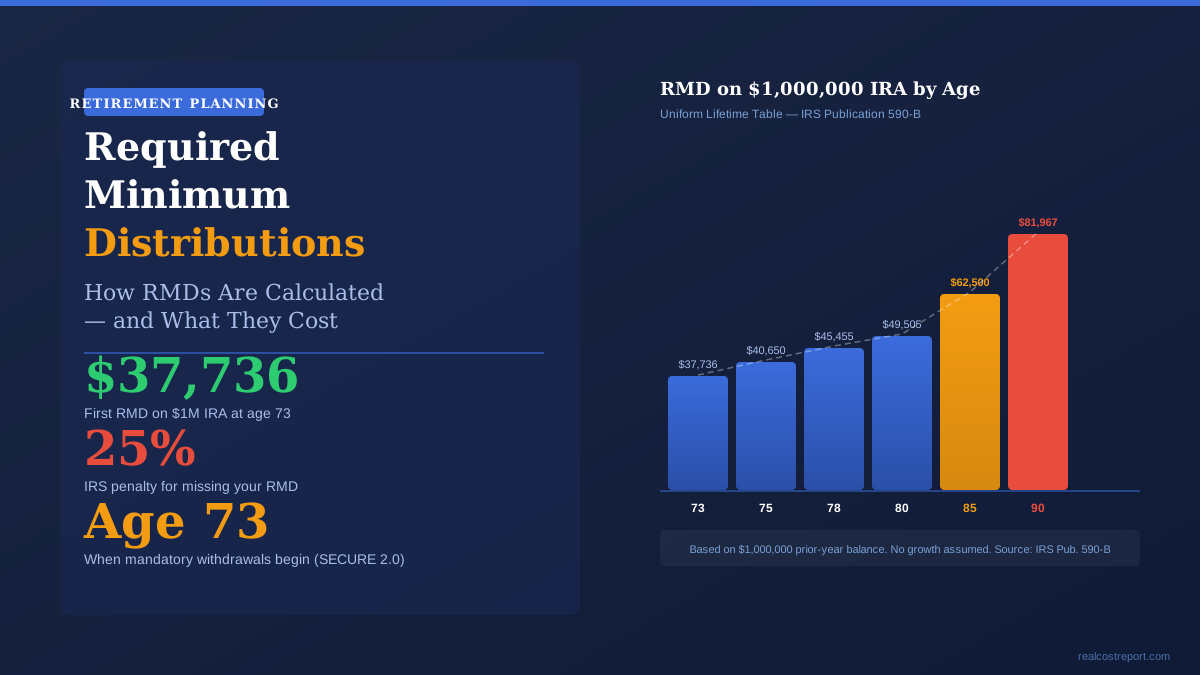
At age 73, the Uniform Lifetime Table assigns a distribution period of 26.5. A $1,000,000 balance therefore yields an RMD of $37,736 (rounded; $1,000,000 ÷ 26.5). At age 80, the factor drops to 20.2, so the same balance — assuming no growth and no prior withdrawals — produces $49,505. By age 90, the factor is 12.2, pushing the RMD to $81,967. The account does not have to grow at all for your mandatory withdrawals to escalate; the shrinking divisor alone drives the increase.
If you hold multiple traditional IRAs, you calculate each account’s RMD separately but may aggregate and withdraw the total from any single IRA — a rule that creates planning flexibility. 401(k) plans do not aggregate; each plan requires its own separate distribution. Roth IRAs have no RMD requirement during the original owner’s lifetime under current law.
Source: IRS Uniform Lifetime Table, IRS Publication 590-B (verify at irs.gov). RMD amounts calculated using prior-year December 31 balance ÷ distribution period. Figures rounded to nearest dollar. Assumes no account growth or prior withdrawals.
What RMDs Actually Cost in Federal Taxes: Three Realistic Scenarios
The raw RMD dollar amount is only half the story. The real cost depends on what else lands in your taxable income that year — Social Security benefits, pension income, capital gains, and interest. The 2026 federal tax brackets reflect TCJA provisions that are currently scheduled to sunset after December 31, 2025, which could push marginal rates higher for many retirees. The scenarios below use 2025 brackets (the last fully confirmed figures available at time of publication) for a married couple filing jointly; readers should verify 2026 bracket thresholds with IRS Revenue Procedure announcements or a qualified CPA.
Each scenario assumes $36,000 in Social Security benefits, of which 85% ($30,600) is taxable under the combined income formula, and $24,000 in pension income — totaling $54,600 in pre-RMD ordinary income against the 2025 standard deduction of $30,000 for taxpayers 65+.
Source: IRS Revenue Procedure 2024-40 (2025 tax brackets, verify at irs.gov); IRS Publication 590-B (RMD factors). Tax estimates are illustrative models for a married couple filing jointly, age 73, with $36,000 Social Security and $24,000 pension. State income taxes not included. Consult a CPA for your specific situation.
The high-saver scenario reveals a secondary cost that the raw RMD dollar amount conceals: IRMAA. Medicare Part B and Part D premiums surcharge above income thresholds that the Centers for Medicare and Medicaid Services (CMS) adjusts annually. In 2025, a married couple with Modified Adjusted Gross Income above $212,000 pays an IRMAA surcharge of $594 per person per year on Part B alone. An $1,800,000 IRA at age 78 (factor 22.0) produces a $81,818 RMD — which, combined with Social Security and pension, can easily breach that threshold. IRMAA is assessed two years in arrear, so a large RMD in 2026 raises 2028 premiums, an effect most retirees do not anticipate.
Roth Conversion vs. Qualified Charitable Distribution: Which Cuts Your RMD Tax Bill More?
Two strategies dominate the RMD tax-reduction conversation: converting traditional IRA funds to a Roth IRA before age 73, and using Qualified Charitable Distributions (QCDs) to satisfy RMDs tax-free. They are not mutually exclusive, but their economics differ sharply depending on your timeline and charitable intent.
Roth Conversion Strategy
A Roth conversion moves pre-tax IRA dollars into a Roth IRA. The converted amount is taxable in the year of conversion but shrinks the traditional IRA balance, directly reducing future RMDs. A retiree who converts $100,000 per year from ages 65 to 72 at a 22% rate ($22,000 in annual tax) and earns 6% on remaining funds will reduce their age-73 RMD by roughly $17,000–$22,000 annually — depending on the starting balance and rate of return. The break-even point typically falls within 8 to 12 years, meaning taxpayers who live into their mid-to-late 80s usually come out ahead. Fidelity and Vanguard both offer Roth conversion calculators that model this break-even using your own inputs.
Qualified Charitable Distribution (QCD) Strategy
A QCD allows IRA owners aged 70½ or older to transfer up to $105,000 directly from an IRA to a qualified charity in 2025 (indexed for inflation under SECURE 2.0). The transfer counts toward the RMD but is excluded from gross income entirely — meaning it never appears on line 4b of Form 1040. For a retiree in the 22% bracket donating $20,000 via QCD instead of writing a check from a taxable account, the federal tax saving is $4,400. Unlike itemized charitable deductions, QCDs reduce AGI directly, which can also reduce IRMAA exposure and lower the taxable portion of Social Security benefits.
Verdict
For retirees with strong charitable giving habits, QCDs deliver immediate, certain tax relief with zero planning lead time — use them first. For retirees with limited charitable intent who are still in a lower bracket before RMDs begin, Roth conversions in the 12%–22% window during ages 60–72 typically produce greater lifetime tax savings, especially if heirs will face high marginal rates on inherited balances. The two strategies compound each other: reducing the traditional IRA through conversions lowers the QCD you need to deploy in later years.
What Most Retirees Get Wrong About RMDs
The five most costly RMD errors are not obscure — they appear repeatedly in IRS data on excise tax penalties and in financial planning casework.
1. Treating the RMD Deadline as December 31 in All Years
Mistake: The IRS grants a one-time extension for your very first RMD — you may delay it until April 1 of the year following the year you turn 73. Consequence: Most retirees interpret this as a benefit and take it, only to discover they must take two RMDs in the same calendar year (the delayed first-year RMD plus the current-year RMD). Both are taxable, potentially doubling the bracket impact in that single year. Correct action: Model both years before deciding to defer. In many cases, taking the first RMD in the year you turn 73 and spreading taxable income is the lower-tax outcome.
2. Missing Inherited IRA Rules Post-SECURE 2.0
Mistake: Assuming the stretch IRA strategy — taking distributions over a beneficiary’s full life expectancy — still applies universally. Consequence: Most non-spouse beneficiaries who inherited after January 1, 2020 must now fully deplete the inherited IRA within 10 years. The IRS issued final regulations in 2024 clarifying that, for beneficiaries of account owners who had already reached their required beginning date, annual distributions within the 10-year window are mandatory, not optional. Failing to take those annual distributions in years 1–9 concentrates the entire taxable balance into year 10 at potentially the highest rate. Correct action: Consult the IRS’s final 2024 RMD regulations (verify at irs.gov) or a tax attorney immediately if you inherited an IRA after 2019.
3. Calculating the RMD on the Wrong Date’s Balance
Mistake: Using a mid-year or current account balance rather than the December 31 prior-year closing balance. Consequence: An under-withdrawal triggers a 25% excise tax on the shortfall. A $5,000 shortfall costs $1,250 in penalty — before income tax on the amount not yet withdrawn. Correct action: Request the December 31 account statement from your custodian in early January and retain it. Vanguard, Fidelity, and Schwab all provide year-end tax documents that include the RMD calculation or the balance used to derive it.
4. Forgetting Aggregation Rules — Or Misapplying Them to 401(k)s
Mistake: Either withdrawing from each IRA separately (unnecessary) or trying to aggregate 401(k) RMDs across plans (prohibited). Consequence: Over-complex recordkeeping at best; a penalty for failing to take a plan-level 401(k) RMD at worst. Correct action: Aggregate and satisfy from one IRA for IRA-type accounts; take separate distributions for each 401(k) or 403(b) plan.
5. Ignoring State Income Tax on RMDs
Mistake: Modeling only federal tax on RMD income. Consequence: Twelve states fully tax IRA distributions, including California (up to 13.3%) and Minnesota (up to 9.85%). A retiree in California with a $1,500,000 IRA paying $56,604 in RMDs faces an additional $4,000–$7,500 in state tax depending on total income — a cost that can exceed the federal liability for moderate-income retirees. Correct action: Run state-specific projections or consider whether a pre-retirement relocation makes financial sense. Thirteen states, including Florida, Texas, and Nevada, levy no state income tax on retirement income.
Is Delaying or Minimizing RMDs Actually Worth It for Your Situation?
RMD reduction strategies carry their own costs — conversion taxes paid early, reduced flexibility, and planning complexity. The decision depends on three conditional factors.
If your estate will pass to high-income heirs: Roth conversions are almost always worth executing before age 73. An heir in the 37% federal bracket who inherits a $2,000,000 traditional IRA and must deplete it within 10 years faces a lifetime tax bill that frequently exceeds $600,000 on the full balance. Converting even $200,000 at your 22% rate saves the estate roughly $30,000 in that example — and the break-even is immediate for the next generation.
If you have significant charitable intent: QCDs are the single most efficient giving vehicle in the tax code for IRA owners over 70½. Donating via QCD rather than a post-tax check delivers a dollar-for-dollar AGI reduction with no itemization required. Anyone giving more than $5,000 per year to qualified charities and not using QCDs is leaving tax savings on the table unconditionally.
If your income is modest and RMDs will stay in the 12% bracket: The math for aggressive Roth conversions weakens. Paying 22% today to avoid 12% later rarely makes mathematical sense unless the primary motivation is estate simplification or Medicaid planning. In this scenario, taking RMDs as required and spending or reinvesting them efficiently is a perfectly rational strategy.
If TCJA provisions expire after 2025: The 22% bracket would revert to 25%, the 24% bracket to 28%, and the top rate would return to 39.6%. Anyone currently in the 22%–24% range who expects to remain near that threshold into RMD years has a narrowing window to convert at current rates. This is not speculative — it is a scheduled statutory change subject to congressional action, and advisors at firms including Fidelity Investments and Vanguard have publicly modeled the impact on pre-retiree Roth conversion decisions.
How We Researched This Article
This article draws exclusively on primary government and regulatory sources. RMD life-expectancy factors are taken directly from the IRS Publication 590-B, Distributions from Individual Retirement Arrangements, which was updated following the IRS’s final RMD regulations issued under Treasury Decision 10001 in July 2024. Federal tax bracket thresholds are sourced from IRS Revenue Procedure 2024-40, the official inflation adjustment announcement for tax year 2025. IRMAA thresholds and Medicare surcharge tiers are published annually by the Centers for Medicare and Medicaid Services (CMS). The SECURE 2.0 QCD limit of $105,000 reflects the inflation-indexed figure under the SECURE 2.0 Act of 2022 (Division T of the Consolidated Appropriations Act, 2023); current-year figures should be verified at IRS.gov.
Tax cost scenarios were modeled using bracket mathematics applied to the specified income assumptions; they are illustrative and do not account for individual deductions, credits, state taxes, or investment growth beyond the stated assumptions. IRMAA and Social Security taxability calculations follow published CMS and IRS combined-income formulas respectively. The inherited IRA 10-year rule analysis references the IRS’s final 2024 regulations (TD 10001), which resolved years of interim guidance ambiguity. State income tax data was drawn from the Tax Foundation’s comparison of state retirement income tax policies (verify at taxfoundation.org). Research for this article was last conducted May 2026. All figures were verified against named primary sources before publication.