Past performance does not indicate future results. This is not investment advice. Social Security rules are subject to legislative change; verify all figures with the Social Security Administration before making claiming decisions.
TL;DR — Quick Verdict
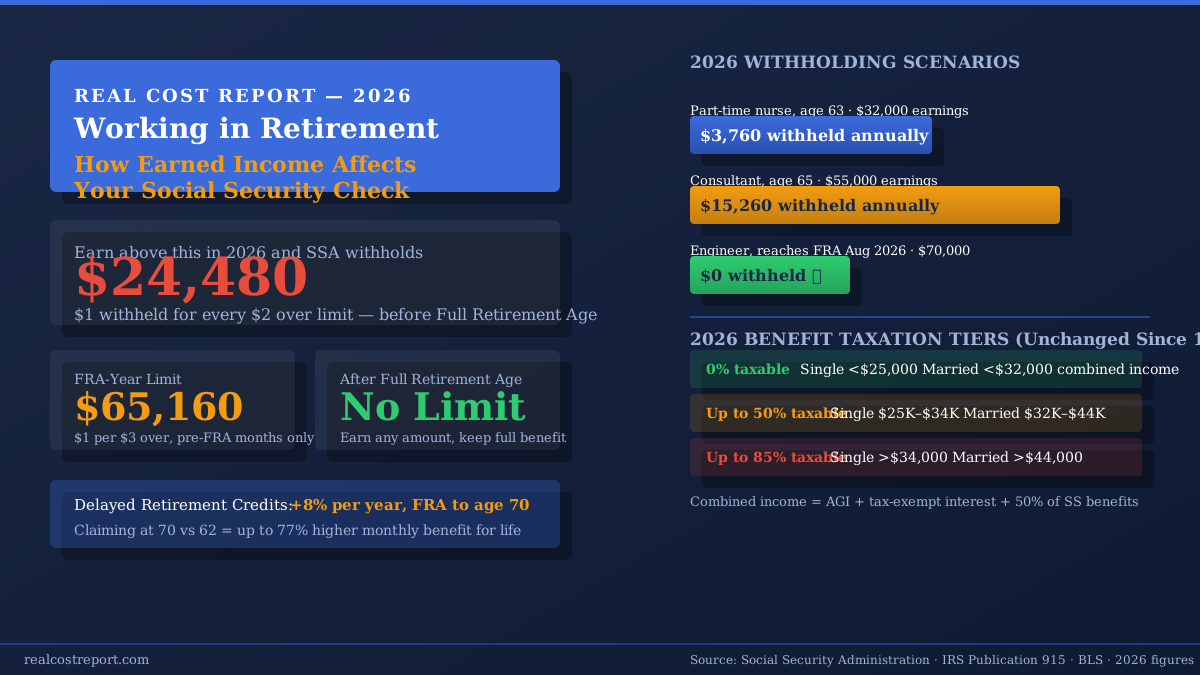
- In 2026, if you claim Social Security before your Full Retirement Age (FRA), SSA withholds $1 for every $2 you earn above $24,480 — a rule that surprises nearly every new retiree who keeps working.
- In the year you reach FRA, the limit rises to $65,160, and the penalty drops to $1 withheld per $3 earned above that threshold — only for months before your birthday month.
- Once you hit FRA, earned income has zero effect on benefit payments — you can earn $300,000 and collect every dollar of your Social Security check.
- Withheld benefits are not lost: SSA permanently raises your monthly payment at FRA to credit back withheld months, making the earnings test a timing adjustment, not a tax.
- Working after FRA can increase your benefit a second way — replacing a low-earning year in your top-35 earnings record triggers an automatic annual recalculation (AERO), typically adding $25–$75/month per replaced year.
- The smarter strategy for most pre-FRA earners above $40,000: delay claiming to 67 or later and avoid the withholding math entirely, since delayed credits add 8% per year up to age 70.
More than one in five Americans aged 65 and older were still in the workforce as of 2024, according to a LendingTree analysis of U.S. Census Bureau Household Pulse Survey data — more than double the rate recorded in 1987. Yet millions of those workers are drawing Social Security benefits at the same time, often without realizing that earned income can trigger immediate, dollar-for-dollar reductions in their monthly checks. The Social Security Administration’s retirement earnings test (RET) is one of the most misunderstood rules in retirement planning, routinely costing early claimers thousands of dollars in suspended payments before they understand what hit them.
This article delivers the exact 2026 thresholds sourced directly from the Social Security Administration, three real-dollar withholding scenarios, a tax overlay showing how earned income stacks with benefit taxation, and a direct comparison of the two most common strategies — claiming early while working versus delaying to FRA. Whether you’re weighing a part-time consulting role, a bridge job, or full-time re-employment, every number here is actionable before you make a claiming decision you cannot easily undo.
The 2026 Social Security Earnings Test: Exact Thresholds and Withholding Rates
The retirement earnings test applies only to beneficiaries who have not yet reached their Normal Retirement Age (NRA), which the Social Security Administration defines as Full Retirement Age — currently 67 for anyone born in 1960 or later. Two separate thresholds govern how much you can earn before SSA starts reducing your monthly benefit.
Source: Social Security Administration — Benefits Planner: Receiving Benefits While Working and SSA Retirement Earnings Test Exempt Amounts, 2026.
What counts as “earnings” under the RET is narrower than most people assume. Only wages and net self-employment income qualify. The test excludes investment income, rental income, pension distributions, IRA withdrawals, annuity payments, and interest. A retiree pulling $60,000/year from a 401(k) while working part time for $18,000 in wages faces only the $18,000 in the earnings test calculation — well below the $24,480 threshold.
SSA does not reduce individual monthly payments proportionally. Instead, it suspends whole monthly checks until the withheld amount is covered. A beneficiary whose benefits are reduced by $3,900 for the year will lose roughly three months of a $1,300/month benefit, then receive full payments for the remaining nine months.
Three Real-Dollar Withholding Scenarios for 2026
Abstract percentages obscure the real impact. These three scenarios use SSA’s 2026 rules to show exactly what a working retiree loses — and recovers — depending on when they claimed and how much they earn.
Calculations based on 2026 exempt amounts per Social Security Administration (verify at ssa.gov). Withholding = (earnings over limit) ÷ 2 for under-FRA; (earnings over limit) ÷ 3 for FRA year. Engineer scenario assumes 7/12 of $70,000 annualized = $40,833 pre-FRA earnings.
Scenario 2 illustrates the scenario most financial planners warn against: a consultant earning $55,000 who claimed at 62 will have $15,260 withheld — nearly 8.5 months of checks gone. Yet that same consultant would face zero withholding if they had simply delayed claiming until reaching FRA at 67. Scenario 3 reveals a counterintuitive planning opportunity: someone reaching FRA mid-year who earns a full $70,000 still escapes withholding because SSA counts only pre-FRA month earnings against the higher $65,160 threshold.
Claiming at 62 While Working vs. Delaying to FRA: Which Is Better for the Active Earner?
The most consequential decision a working retiree faces is whether to claim Social Security early or delay. At 62, your benefit is permanently reduced to approximately 70% of your full retirement amount. At 67 (FRA for those born 1960 or later), you receive 100%. At 70, the benefit reaches 124% due to delayed retirement credits of 8% per year between FRA and 70. Layering the earnings test on top of early claiming creates a compounding disadvantage that many planners argue is almost never worth it for someone earning more than $35,000 annually.
Consider a worker born in 1963 whose full retirement benefit at 67 would be $2,000/month. They claim at 62, reducing that check to $1,400/month. They earn $45,000 in 2026 from part-time consulting. The earnings test withholds $10,260 ($45,000 − $24,480 = $20,520 ÷ 2). That is roughly 7.3 months of benefits forfeited — and SSA will credit those months back by raising the FRA benefit modestly. But the 30% permanent early-claim reduction remains baked in for life.
Now model the delay scenario. The same worker claims at 67 instead, collecting $2,000/month with no earnings test. Over a 20-year retirement (to age 87), they collect $480,000 versus $336,000 under the early-claim path — a $144,000 gap, before factoring in COLA increases. The breakeven point typically falls between ages 78 and 82 for healthy retirees, according to SSA actuarial tables.
Verdict
For any retiree earning more than $35,000/year from work, delaying Social Security to FRA dominates early claiming in nearly every scenario. The earnings test effectively cancels much of the benefit of claiming early, while the 30% permanent reduction for claiming at 62 lingers for decades. Early claiming makes mathematical sense only if health is severely compromised, life expectancy is short, or the earner is certain earnings will stay below $24,480. For high earners above $65,000, delaying past FRA to age 70 adds another 24% in permanent benefit — the most risk-free 8%/year return in retirement planning.
The Tax Overlay: How Earned Income Pushes Social Security Into Taxable Territory
The earnings test is only the first financial cost of working while collecting Social Security. The second is benefit taxation — and it strikes at much lower income levels than most retirees expect. The IRS determines what portion of your Social Security benefits are taxable using a “combined income” formula: Adjusted Gross Income + nontaxable interest + 50% of your Social Security benefits. The thresholds that trigger taxation have not been indexed for inflation since 1984.
Source: IRS Publication 915, 2026 thresholds confirmed unchanged per IRS and Social Security Administration. See IRS Publication 915 (verify at irs.gov). Note: The 2026 One Big Beautiful Bill Act added a temporary $6,000 senior deduction (age 65+) that may reduce taxable income but does not change these statutory thresholds.
The practical impact is severe for working retirees. A single filer receiving $20,400/year in Social Security ($1,700/month) and earning $30,000 in wages has a combined income of: $30,000 + $0 interest + $10,200 (50% of SS) = $40,200 — pushing 85% of their Social Security benefit into taxable income. At a 22% marginal rate, that adds roughly $3,808 in federal taxes on benefits alone. Municipal bond interest compounds the problem: it is tax-free for ordinary income purposes but still counts toward the combined income formula, a trap that catches retirees who shift to muni bonds specifically to reduce their tax burden.
The 2026 COLA increase of 2.8% exacerbates the taxation problem because higher benefit payments mechanically raise combined income even if wages stay flat, pushing borderline filers across the $25,000 or $34,000 threshold without any corresponding legislative adjustment.
What Most Working Retirees Get Wrong About the Earnings Test
These are the five most consequential errors financial planners and SSA representatives encounter from clients trying to manage work income alongside Social Security benefits.
Mistake 1: Assuming withheld benefits are permanently lost. Nearly 40% of retirees surveyed by AARP reported believing that withheld benefits are gone forever. They are not. SSA recalculates your monthly benefit at FRA, crediting back every month in which benefits were fully withheld. If SSA withheld 10 months of benefits between age 62 and FRA, your FRA benefit is recalculated as though you claimed 10 months later — permanently raising your monthly payment for the rest of your life. The recalculation is automatic; no application is required.
Mistake 2: Counting all income against the earnings limit. The earnings test counts only gross wages and net self-employment income. Investment returns, pension income, 401(k) distributions, rental income, annuities, interest, and dividends are explicitly excluded. A retiree with $50,000 in IRA withdrawals and $20,000 in part-time wages faces only $20,000 against the $24,480 threshold — no withholding occurs.
Mistake 3: Ignoring the monthly grace rule in the first year of retirement. SSA offers a special first-year rule that lets you receive a full benefit for any month in which your earnings fall below the monthly threshold ($2,040 for under-FRA beneficiaries in 2026), regardless of your annual total. A teacher who retires mid-year after earning $60,000 in the first half can still collect full Social Security for every month in the second half if they earn under $2,040/month after retiring. This rule applies only in the first year benefits are paid.
Mistake 4: Not updating SSA when income projections change. SSA estimates your anticipated annual earnings when you apply. If you earn less than projected, SSA may have withheld too much and owes you a refund; if you earn more, you may owe repayment. Proactively notifying SSA of material income changes — a job loss, reduced hours, or a windfall project — avoids a year-end true-up that produces an unexpected overpayment notice.
Mistake 5: Forgetting that working after FRA can raise your benefit. SSA runs the Automatic Earnings Recomputation Operation (AERO) each October, recalculating benefits for anyone whose most recent year’s earnings replace a lower-earning year in their top-35 record. Working a year past FRA at $90,000 could replace a lean year at $25,000 from the 1990s, adding $25–$75/month to your check permanently. The adjustment is automatic and requires no action from the beneficiary.
Who Should Work in Retirement While Collecting Social Security — And Who Should Not
The earnings test is not uniformly harmful. Whether working while collecting benefits makes financial sense depends on four factors: your age relative to FRA, your earned income level, your health and projected longevity, and whether the work itself replaces lower earnings years in your record.
Work while collecting makes sense if: You are already past FRA (no earnings test, possible AERO upside from high earnings years), your earnings are comfortably below $24,480/year, your health is poor and a longer benefit collection window outweighs the reduced monthly amount, or you are in the grace-rule window in your first year of retirement and can manage to keep monthly earnings below $2,040.
Delay claiming and keep working if: You are under FRA and earning more than $35,000/year, you are in good health with a family history of longevity past 82, your spouse has a lower earning record and will rely on your benefit as a survivor benefit (delay maximizes the survivor amount), or your earned income would trigger the 85% SS taxation tier anyway — in which case the combined impact of withholding and taxation effectively produces negative net benefit from early claiming.
The break-even math is decisive for most scenarios. Claiming at 62 versus 67 for a beneficiary with a $2,000 FRA benefit means accepting $1,400/month for life versus $2,000/month starting five years later. The cumulative payment amounts converge at approximately age 79–80. Anyone who lives past 80 — and Social Security’s own actuarial life expectancy tables show that a 65-year-old woman has a 50% probability of living to 87 — comes out ahead by delaying. Working at a meaningful income level before FRA while collecting early simultaneously triggers the earnings test and locks in a permanently reduced benefit, the worst of both outcomes.
Is It Worth It?
Working in retirement while collecting Social Security is financially optimal only after FRA, or while earning below the $24,480 threshold. For most pre-FRA earners above $40,000/year, the combination of the earnings test, benefit taxation at up to 85%, and the permanent early-claiming reduction produces a net outcome inferior to delaying. The single highest-return action most healthy, working pre-retirees can take is suspending a Social Security application until 67 — or 70 — rather than accepting a reduced check they will be unable to fully collect anyway.
How We Researched This Article
This article draws exclusively on primary government and regulatory sources. All 2026 earnings test thresholds — the $24,480 lower exempt amount, the $65,160 higher exempt amount, and the $2,040 and $5,430 monthly grace-rule figures — were sourced directly from the Social Security Administration’s Benefits Planner: Receiving Benefits While Working, the SSA Retirement Earnings Test Exempt Amounts table, and the SSA’s official 2026 Special Earnings Limit Rule page. The 2026 COLA figure of 2.8% was drawn from the SSA 2026 Cost-of-Living Adjustment Fact Sheet.
Federal income tax thresholds for Social Security benefit taxation — $25,000/$34,000 for single filers, $32,000/$44,000 for married filing jointly — were confirmed against IRS Publication 915, Social Security and Equivalent Railroad Retirement Benefits (verify at irs.gov), with multiple secondary confirmations including Mercer Advisors and the IRS’s own 2026 update documentation confirming these thresholds remain unchanged for the 2026 tax year. The $6,000 senior bonus deduction was noted per the One Big Beautiful Bill Act as reported by multiple tax-guidance sources.
Labor force participation statistics for Americans 65 and older were drawn from a LendingTree analysis of U.S. Census Bureau Household Pulse Survey data (March 2024), cross-referenced against Bureau of Labor Statistics data published in the May 2025 BLS Beyond the Numbers report and Pew Research Center’s December 2023 report on the growth of the older workforce. The AERO (Automatic Earnings Recomputation Operation) recalculation mechanism was verified against SSA program documentation and SSA’s own published example calculations in the EN-05-10069 publication.
Dollar-scenario modeling in the withholding table was constructed by the editorial team applying SSA’s published formulas to representative income levels. These are illustrative calculations, not SSA-issued figures. Break-even analysis uses SSA actuarial life expectancy tables and is modeled, not measured from individual claimant data. Taxation scenarios use 2026 IRS brackets and standard deduction amounts and are designed for educational illustration only.
Research was last conducted in May 2026. All figures were verified against named primary sources before publication.