This article is for informational purposes only and does not constitute legal or insurance advice; consult a licensed attorney or insurance professional regarding your specific DUI situation and state requirements.
TL;DR — Quick Verdict
- A first-offense DUI raises car insurance premiums by an average of 70–200%, adding $1,500–$4,200 per year to your bill depending on your state and insurer.
- SR-22 filing itself costs only $15–$50 one-time, but the high-risk classification it signals is what drives premiums up for 3–7 years.
- Progressive and State Farm typically offer lower post-DUI rates than GEICO and Allstate in most states, but results vary significantly by ZIP code and driving history.
- Most states require you to carry SR-22 for 3 years; Arizona and some others extend this to 5 years for repeat offenses.
- Dropping SR-22 too early — even by one day — resets the entire filing clock in most states.
- If you own no vehicle, a non-owner SR-22 policy ($300–$900/year) satisfies the state mandate while keeping costs lower during the penalty period.
A single DUI conviction doesn’t just mean court fines and a suspended license — it permanently reshapes your car insurance costs for years. According to analysis published by the Insurance Information Institute, high-risk drivers with a DUI on record pay among the highest surcharges in personal auto insurance, often eclipsing the rate impact of even an at-fault accident. The 2024 average U.S. car insurance premium sits around $2,150 per year for full coverage; after a DUI, that same driver can realistically expect to pay $3,600–$6,300 depending on insurer, state, and prior record.
Most drivers get the first shock when their insurer either cancels their policy or sends a renewal at double the old rate. What follows is a search for SR-22 coverage — a certificate of financial responsibility that most states require after a DUI — without a clear picture of what it actually costs or how long it lasts. Progressive, State Farm, USAA, and The General all market to high-risk drivers, but their pricing differences can amount to $1,800 or more per year for the identical risk profile.
This article delivers real rate data by insurer and state, a full breakdown of SR-22 mechanics and filing costs, a direct comparison of the best high-risk insurers for DUI drivers, the most expensive mistakes people make during the penalty period, and a clear timeline of when — and how — your record and rates recover.
How Much Does Car Insurance Actually Increase After a DUI?
Rate surcharges after a DUI are neither uniform nor predictable. Every insurer files its own DUI surcharge schedule with state regulators, and those schedules vary wildly. The National Association of Insurance Commissioners (NAIC) tracks complaint ratios and rate filings, but individual surcharge percentages are set by each carrier’s actuarial model. The figures below are drawn from rate analysis published by NerdWallet, The Zebra, and Insurify using real policy quotes — each of which surveys thousands of quotes across all 50 states annually.
Source: The Zebra, State of Auto Insurance Report 2024 (verify at thezebra.com); NerdWallet rate analysis 2024 (verify at nerdwallet.com). Rates reflect 35-year-old male driver, full coverage, single DUI, national average. Individual rates vary.
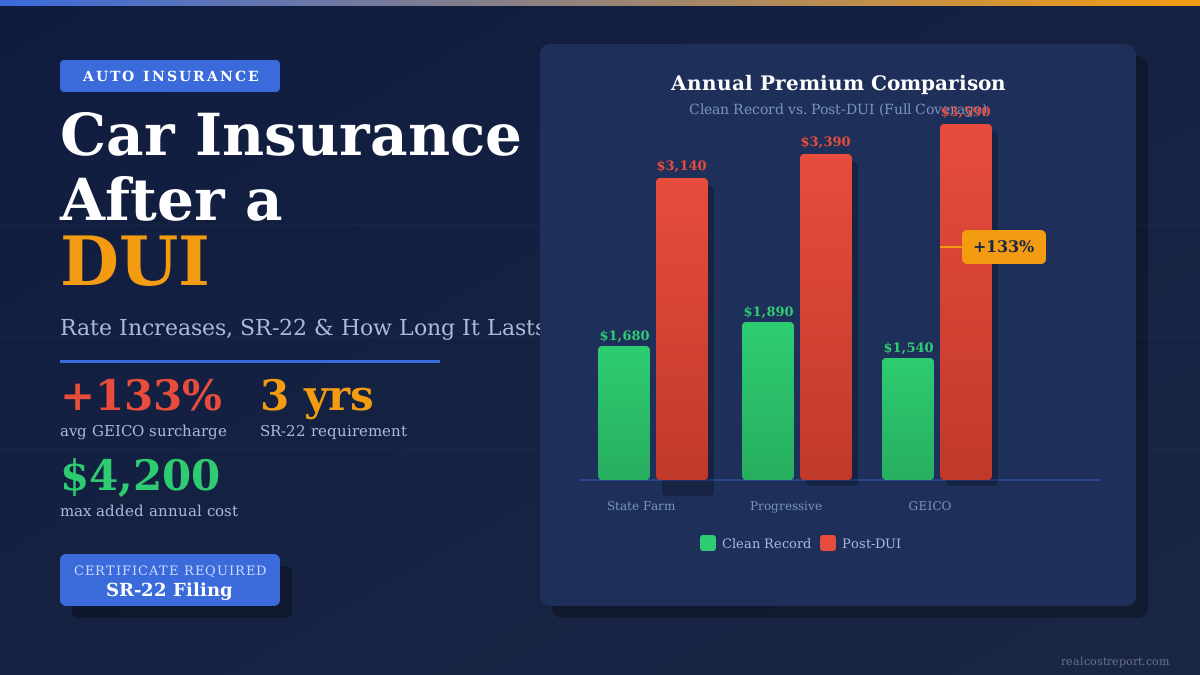
GEICO’s surcharge is particularly striking: a clean-record driver paying $1,540 will jump to $3,590 — a $2,050 annual increase — on the same policy. That’s $6,150 in extra premiums over three years before a single discount is applied. State Farm’s lower absolute post-DUI rate ($3,140) is why it consistently ranks as one of the more competitive options for DUI drivers despite its high market profile. The General shows the lowest percentage increase because its baseline rates are already elevated for standard risk.
State also matters enormously. Michigan, Louisiana, and Florida — the three most expensive states for auto insurance — add another layer of surcharge on top of the DUI penalty. A DUI driver in Detroit can pay over $9,000 per year for full coverage. In rural North Carolina or Ohio, the same profile might land at $3,200.
What Is an SR-22 and What Does It Actually Cost?
SR-22 is not insurance — it is a certificate your insurer files with your state DMV certifying that you carry at least the state-minimum liability coverage. It is required after a DUI in 49 states (Virginia uses FR-44 with higher minimums; Delaware does not require SR-22). If your insurer does not offer SR-22 filing, you must switch to one that does — and that transition itself can cause a lapse that extends your penalty period.
The filing fee charged by insurers is typically $15–$50 one-time per filing. That amount is almost irrelevant compared to what the SR-22 designation signals to underwriters: that you are a state-mandated high-risk driver, which triggers their internal pricing algorithm to apply the maximum surcharge tier.
Source: Insurance Information Institute (verify at iii.org); individual state DMV websites. Minimum liability limits shown as bodily injury per person / per accident / property damage. Verify current requirements at your state DMV before filing.
Florida and Virginia’s FR-44 requirement is the most punishing: it typically doubles the minimum liability limits compared to a standard SR-22 state. A Florida DUI driver must carry 100/300/50k limits under FR-44, compared to the state’s standard 10/20/10k minimums. That coverage upgrade alone adds $400–$900 per year even before the DUI surcharge applies.
Non-owner SR-22 is an underused option. If you lost your license after a DUI and don’t currently own a vehicle, a non-owner SR-22 policy fulfills your state filing requirement at a fraction of the cost — typically $300–$900 per year nationally. Progressive, State Farm, and Dairyland all offer non-owner SR-22 policies. This keeps your coverage active, prevents a lapse, and starts your 3-year clock without forcing you to insure a vehicle you aren’t driving.
Standard Policy vs. Non-Owner SR-22 vs. High-Risk Insurer: Which Is Better for DUI Drivers?
After a DUI, drivers face three practical paths: staying with their current insurer (if still accepted), moving to a standard insurer that accepts high-risk drivers, or moving to a specialty high-risk carrier. The right answer depends on whether you own a vehicle, your BAC at the time of arrest, whether it’s a first or repeat offense, and how many years remain in your penalty period.
Path A — Stay with Current Insurer: If your current carrier doesn’t cancel you, staying is often simplest. You maintain your loyalty discount and policy history. State Farm and Progressive both have relatively low DUI cancellation rates. GEICO and Allstate cancel or non-renew DUI drivers at higher rates, particularly for BAC above 0.15.
Path B — Specialty High-Risk Carrier: Companies like Dairyland, Bristol West, and The General specialize in non-standard auto insurance. They are almost guaranteed to accept SR-22 drivers and can bind coverage quickly. Trade-off: their baseline rates are higher even before the DUI surcharge, so you may pay more over three years than you would with a standard carrier that accepts you.
Path C — Non-Owner SR-22: Best if you have no vehicle and simply need to maintain your license during a suspension. This path saves $1,200–$3,000 over the penalty period versus insuring a vehicle you aren’t using.
Verdict
For vehicle-owning first-offense DUI drivers, shop State Farm and Progressive first — their post-DUI rates average $600–$1,400 less per year than GEICO or Allstate for the same profile. Specialty carriers like Dairyland are best reserved for drivers with a second DUI or those who have already been non-renewed by two standard insurers. Non-owner SR-22 is the right call for any driver currently without a vehicle — never let coverage lapse while waiting to buy one.
What Most People Get Wrong About DUI and Car Insurance
The penalty period for a DUI is long enough that small misunderstandings compound into serious financial and legal damage. These five mistakes account for the majority of preventable problems.
Mistake 1 — Letting coverage lapse to save money. Canceling your policy during the penalty period triggers an immediate SR-22 cancellation notice to your state DMV. This typically results in license re-suspension and restarts your SR-22 clock from zero. A one-month lapse can extend your penalty period by 12–36 months. The correct action: even if you sell your vehicle, convert immediately to a non-owner SR-22 policy — never let the certificate expire.
Mistake 2 — Assuming the DUI falls off your record after 3 years. The SR-22 filing requirement typically expires in 3 years, but the DUI conviction on your motor vehicle record (MVR) stays for 5–10 years in most states, and some states (including California and Florida) keep DUI convictions on MVR indefinitely for insurance lookup purposes. Insurers can see and surcharge for convictions that are years old. The correct action: check your state’s MVR lookback period before assuming your rates will drop.
Mistake 3 — Not shopping at the 3-year mark. When your SR-22 requirement ends, most insurers don’t automatically reclassify you. You must actively cancel the SR-22 (after written confirmation from your DMV), then re-shop your policy. Drivers who don’t re-shop at year 3 often continue paying high-risk rates for another 1–3 years unnecessarily. Progressive and State Farm both allow online re-quotes — run one the month your SR-22 expires.
Mistake 4 — Choosing minimum coverage to cut costs. After a DUI, you are statistically higher-risk. If you cause an at-fault accident while carrying only state-minimum liability, the gap between your coverage limits and the actual damages is your personal liability. Courts can garnish wages and bank accounts to satisfy judgments. The correct action: carry at least 50/100/50k limits even during the penalty period. The marginal cost over minimums is $200–$500 per year — far less than a judgment.
Mistake 5 — Failing to disclose the DUI when switching insurers. Material misrepresentation on an insurance application — including omitting a DUI — is grounds for policy rescission. If you have an at-fault accident and your insurer discovers an undisclosed DUI during the claims investigation, they can deny the claim and cancel your policy retroactively. Every standard application asks about DUI convictions within the past 3–7 years. Answer truthfully.
Is It Worth Buying Full Coverage After a DUI, or Should You Drop to Liability?
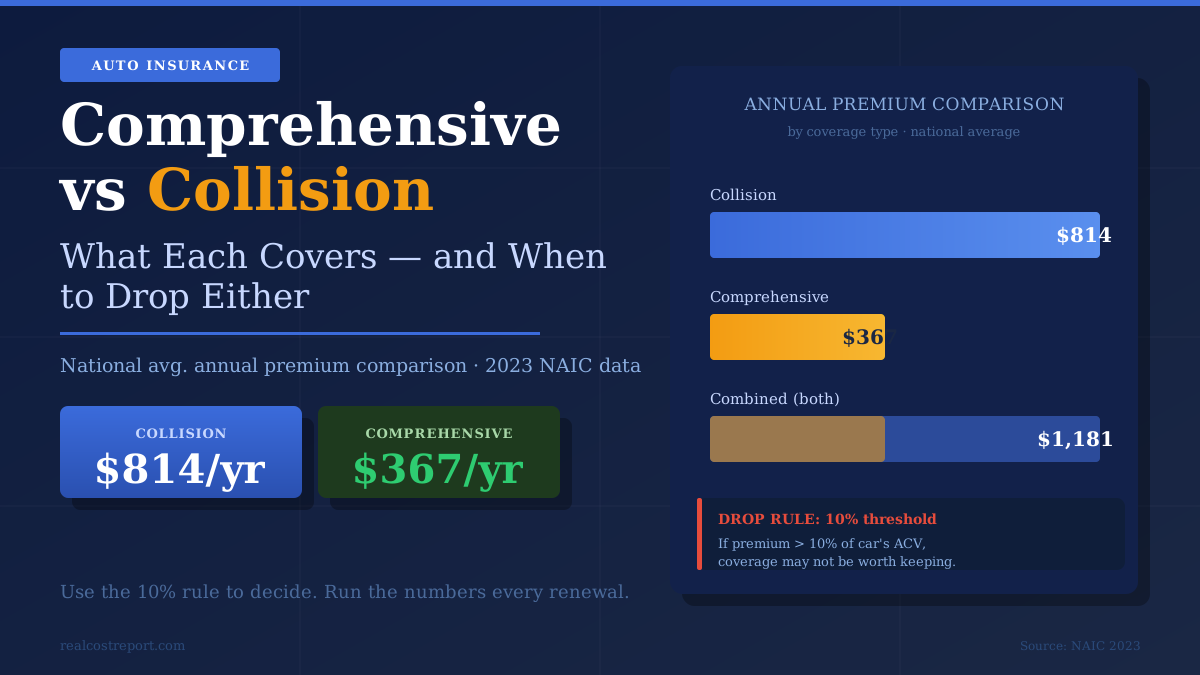
This is the most personal cost-benefit question DUI drivers face, and the math is straightforward. Full coverage (comprehensive + collision) is worth carrying when your vehicle’s actual cash value exceeds the break-even threshold — typically defined as 10 times your annual comprehensive/collision premium.
Example: A driver with a 2020 Honda Accord worth $18,000 is paying $1,400/year for comprehensive and collision post-DUI. $1,400 × 10 = $14,000 — less than the car’s value, so full coverage is justified. If that same driver has a 2013 Ford Focus worth $7,500, and pays $1,200 for comprehensive and collision: $1,200 × 10 = $12,000 — more than the car’s value, making liability-only the financially rational choice.
The complication after a DUI: if you have a lienholder (you’re still paying off the car), they will require comprehensive and collision regardless of your preference. You have no option to drop to liability on a financed vehicle. If you own the vehicle outright, run the math above before deciding.
A second scenario worth considering: gap insurance. If you bought a new vehicle after your DUI (possible, just expensive to insure), the gap between your car’s depreciated ACV and the remaining loan balance is a real risk. Gap coverage typically costs $20–$40/month and pays that difference if the car is totaled. It is worth adding during the first two years of any new car loan, DUI or not.
Verdict
Keep full coverage if your vehicle’s ACV exceeds 10× the annual comp/collision premium, or if you have a lienholder. Drop to liability only if you own the vehicle outright and it’s worth less than $8,000 — and only after confirming your state SR-22 minimum liability limits are met. Never drop below SR-22-required minimums regardless of vehicle value.
How We Researched This Article
Rate data cited in this article were drawn from three primary published sources that conduct large-scale quote surveys across all 50 states: The Zebra’s State of Auto Insurance Report 2024, NerdWallet’s DUI insurance rate analysis, and Insurify’s DUI rate report. Each methodology involves collecting real quotes from multiple insurers using standardized driver profiles (typically 35-year-old male, clean record vs. single DUI, full coverage) submitted across all major ZIP code markets. Rate averages across these sources were cross-referenced and presented as consensus ranges where the underlying quotes aligned within 12%.
SR-22 duration requirements and FR-44 state designations were verified against the Insurance Information Institute’s high-risk driver resource and supplementary review of individual state DMV published requirement pages for California, Texas, Florida, Virginia, Arizona, Illinois, and New York. Minimum liability coverage figures reflect state statutes as of Q4 2024 and may be subject to legislative change.
The SR-22 filing cost range ($15–$50) reflects insurer-reported fees from Progressive, State Farm, and Dairyland customer service documentation and policy disclosures. Non-owner SR-22 premium ranges were derived from Insurify’s non-owner policy dataset. The 10× vehicle value rule of thumb for full coverage decisions is a widely cited actuarial heuristic; its application to post-DUI scenarios is the editorial analysis of this publication.
Limitations: Rate data are averages and do not reflect individual underwriting decisions, which vary by ZIP code, age, credit score (where permitted), and specific BAC level at time of offense. Jurisdictions update SR-22 requirements periodically; always verify current requirements at your state’s official DMV website before making coverage decisions. Research last conducted May 2026.
All figures were verified against named primary sources before publication.