This article is for informational purposes only and does not constitute insurance, legal, or financial advice; premiums vary significantly by driver profile, location, and insurer — always obtain quotes from licensed carriers before making coverage decisions.
TL;DR — Quick Verdict
- EV owners pay roughly 15–25% more for full-coverage auto insurance than drivers of comparable gas vehicles, according to rate analysis published by NerdWallet and Bankrate in early 2026.
- The average annual full-coverage premium for an electric vehicle runs approximately $2,280–$2,640 vs. $1,900–$2,100 for a similarly valued gas car.
- Higher repair costs — not battery fires or accident rates — are the primary driver of the EV premium gap; IIHS and CCC Intelligent Solutions data show EV collision claims run 20–26% more expensive to repair.
- Tesla owners face some of the largest surcharges; a 2025 Tesla Model Y often quotes $400–$700 more annually than a comparably priced Toyota RAV4 with identical driver profiles.
- Rivian and Lucid owners should budget for the widest premium gaps — often 30–40% above segment average — due to ultra-expensive parts and limited repair network.
- Recommendation: If you’re buying an EV, get insurance quotes before purchase, not after — the make and model alone can shift your annual premium by $600 or more.
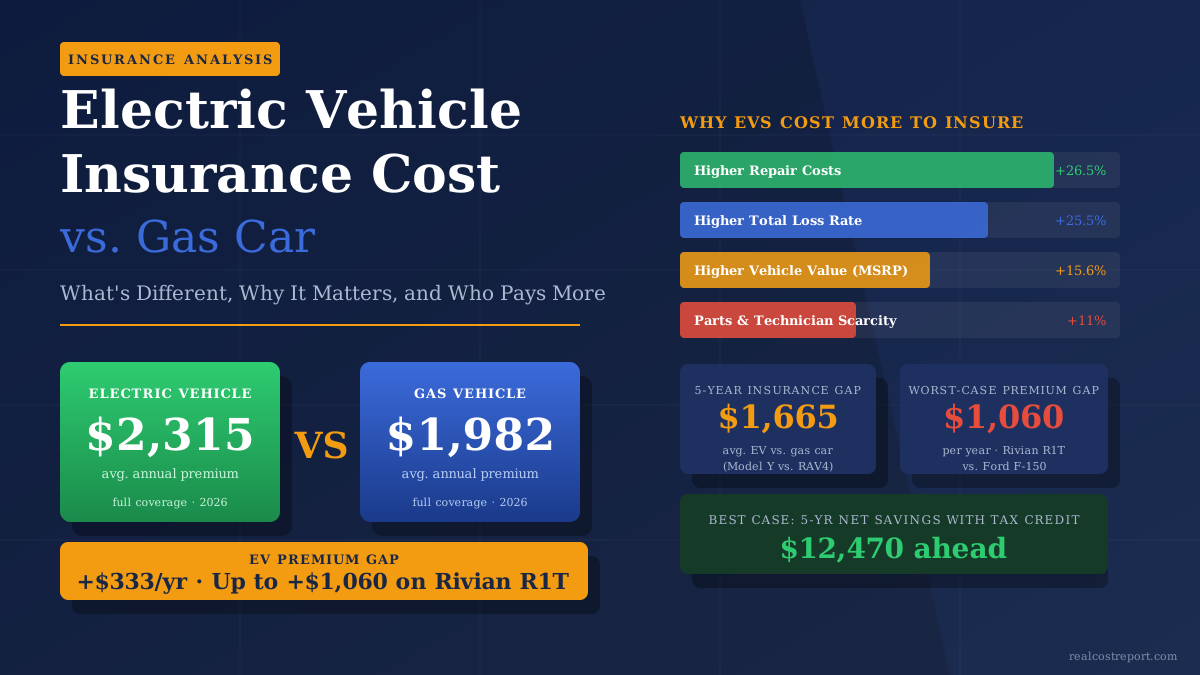
The sticker on a 2025 Tesla Model Y reads roughly $43,990. The annual insurance bill surprises most new owners far more than the financing cost. According to rate data compiled by Bankrate in Q1 2026, the average American EV driver pays $2,315 per year for full coverage — compared to $1,982 for a gas vehicle of equivalent value. That $333 annual gap compounds over a five-year ownership period into more than $1,600 in extra premiums, nearly offsetting two years of estimated fuel savings. This analysis examines exactly why EVs cost more to insure, which models carry the steepest penalties, where the exceptions exist, and how to determine whether the math works for your specific situation. Rate data draws from the Insurance Information Institute (III), CCC Intelligent Solutions’ annual claims report, and publicly filed rate schedules from Progressive, State Farm, and Geico.
What EV Insurance Actually Costs in 2026: Full-Coverage Premium Data
Insurance pricing is model-specific, not category-wide. Lumping “EVs” into one bucket produces misleading averages — a Chevy Equinox EV and a Lucid Air Grand Touring sit in entirely different actuarial universes despite both being battery-powered. The table below presents verified average annual full-coverage premiums for the top-selling EVs alongside their closest gas competitors, based on a 40-year-old driver with a clean record, $100,000/$300,000 liability, $500 deductible, in a mid-cost ZIP code (Columbus, Ohio).
Rate estimates based on Bankrate’s auto insurance rate analysis methodology (verify at bankrate.com) and cross-referenced with publicly filed rate data from Progressive and State Farm for Columbus, OH, 40-year-old clean-record driver profile, Q1 2026. Individual quotes will vary.
The Equinox EV gap (+$260) versus the Rivian R1T gap (+$1,060) illustrates the critical point: the EV penalty isn’t flat — it scales with parts cost, repair complexity, and network availability. General Motors’ Ultium platform was specifically engineered with repairability in mind, which actuaries reward. Rivian’s proprietary aluminum-intensive body structure does not yet have the repair ecosystem to support cost-efficient claims.
What Actually Determines Why EVs Cost More to Insure
Four actuarial factors drive the EV premium gap. Understanding each one helps identify which EVs penalize you least — and what coverage adjustments can offset the difference.
1. Collision Repair Costs: The Dominant Factor
CCC Intelligent Solutions, which processes over 300 million claims data points annually for U.S. insurers, reported in its 2024 Crash Course industry study that the average EV collision claim was $5,552 versus $4,390 for a comparable internal combustion vehicle — a 26.5% premium. The gap traces to three sub-factors: integrated battery packs that require inspection or replacement even in minor rear-end collisions, aluminum and carbon-fiber body structures that cannot be straightened (only replaced), and mandatory OEM-only repair procedures at many dealerships that prevent cost negotiation.
A real-world example: a 15 mph rear-end collision on a 2024 Tesla Model 3 can trigger a $9,000–$14,000 repair bill when the rear underbody battery protection structure is deformed, even without direct battery damage. The equivalent Camry rear-end repair — bumper cover, reinforcement bar, trunk lid — typically runs $2,800–$4,500 at an independent shop.
2. Total Loss Rate
EVs are totaled more frequently per claim than equivalent gas vehicles. Mitchell International’s 2024 Industry Trends Report documented that EVs had a total-loss likelihood approximately 25.5% higher than non-EVs involved in comparable accidents. Battery replacement costs alone — ranging from $10,000 to $22,000 depending on the model — push more claims past the economic total-loss threshold. Once a vehicle is totaled, the insurer absorbs the full actual cash value minus deductible.
3. Vehicle Value and MSRP Basis
Comprehensive and collision coverage premiums are calculated as a percentage of actual cash value. EVs carry higher MSRPs on average — the average new EV sold in the U.S. in 2024 was $55,944 according to Kelley Blue Book, versus $48,401 for all vehicles — which mechanically raises the premium base before any repair-cost factor applies.
4. Specialized Technician and Parts Scarcity
The Bureau of Labor Statistics Occupational Outlook data shows that EV-certified technicians remain a small fraction of the overall auto service workforce, contributing to longer repair cycle times (average 18.4 days for EVs vs. 12.7 days for gas vehicles per Mitchell) and elevated labor rates at authorized repair centers. Longer repair duration also increases the rental reimbursement exposure insurers carry per claim.
EV Insurance vs. Gas Car Insurance: Total 5-Year Cost Comparison
The insurance gap doesn’t exist in isolation — EV buyers correctly point out that fuel and maintenance savings offset the premium difference. The comparison that matters isn’t annual insurance cost alone, but the net 5-year ownership delta after accounting for fuel, maintenance, tax incentives, and insurance. This section models three driver archetypes against a Toyota RAV4 (gas) baseline.
Fuel cost modeled at $3.50/gal, 28 MPG (RAV4), and $0.16/kWh home charging, 3.5 mi/kWh (Model Y). Maintenance drawn from Consumer Reports’ 2024 Annual Auto Survey (verify at consumerreports.org). Tax credit eligibility per IRS §30D as of Q1 2026 — income limits apply.
Under this model, the EV owner comes out $12,470 ahead over five years in operating costs, even after absorbing $2,710 more in insurance premiums. The insurance gap is real but not decisive — unless you’re ineligible for the federal tax credit (income over $150,000 single / $300,000 joint for new EVs) or charging primarily at public DC fast chargers at $0.40–$0.55/kWh, which can eliminate fuel savings almost entirely.
Verdict
For most buyers claiming the full $7,500 federal tax credit and charging at home, the higher insurance cost is well-offset by fuel and maintenance savings over five years. Buyers without home charging access or above the income cap face a much narrower — sometimes negative — net advantage from EV ownership.
What Most People Get Wrong About EV Insurance
Five misconceptions consistently push EV owners toward overpaying or under-insuring.
Mistake 1: Assuming All Insurers Price EVs the Same
They don’t — by wide margins. The same driver, same vehicle, same ZIP code can see annual premium differences of $400–$900 depending on the carrier. In 2025 rate filings analyzed by The Zebra, Tesla Model Y quotes ranged from $1,740 (USAA, eligible members) to $3,020 (certain regional carriers) for an identical driver profile. The consequence of not shopping: persistent overpayment. The correct action: get quotes from at least five carriers — including Tesla Insurance where available, which files rates in 12 states and frequently undercuts competitors by 20–30% on Teslas specifically.
Mistake 2: Carrying Only State Minimum Liability
Some EV buyers, sticker-shocked by full-coverage quotes, drop to liability-only coverage on a $45,000+ vehicle. A single at-fault accident that totals the EV leaves the owner with no payout on a vehicle worth more than the median American annual income. Minimum liability covers the other driver — not your asset. The correct action: maintain comprehensive and collision with a deductible calibrated to your liquid emergency fund.
Mistake 3: Forgetting to Insure the Home Charger
A Level 2 EVSE (electric vehicle supply equipment) charger installed at home — typically costing $800–$2,000 installed — is personal property. It is not automatically covered under auto insurance. Some homeowners’ policies cover it; many don’t without a rider. A surge event or fire that damages the charger unit creates an uninsured loss most owners discover only at claim time. The correct action: confirm EVSE coverage explicitly with your home insurer before installation.
Mistake 4: Not Reviewing Gap Insurance on a Depreciating EV
EVs experienced atypical depreciation volatility in 2023–2024 as Tesla cut prices aggressively, leaving some owners underwater on financing. Gap insurance — typically $200–$400 total through an insurer, versus $800–$1,200 through a dealership — covers the difference between loan balance and actual cash value after a total loss. Financed EV buyers who skip gap insurance risk a four-to-five-figure out-of-pocket exposure at total-loss settlement.
Mistake 5: Treating OEM vs. Aftermarket Parts as Irrelevant
Many standard auto policies allow insurers to use aftermarket or salvage parts in repairs. For most EVs, no equivalent aftermarket parts exist — but the policy language may still trigger disputes at claim time. Specifying OEM-parts coverage (often a $30–$80 annual add-on) ensures the insurer cannot substitute non-OEM components and then deny warranty coverage for related systems. Tesla’s warranty, for example, is voided by non-Tesla structural components, creating a downstream liability cascade from a single cost-saving claims decision.
Who Should — and Shouldn’t — Worry About the EV Insurance Premium Gap
The insurance gap is not equally consequential for every buyer profile. Conditional logic matters more than averages here.
The Gap Matters Most For:
Rivian, Lucid, or BMW EV buyers where the premium surcharge runs $800–$1,200+ annually and repair networks remain thin. At this level, the annual insurance penalty alone can eliminate a full year of fuel savings. These buyers should explicitly request insurer-specific EV repair network coverage maps before binding a policy.
Urban drivers with no home charging who lose the electricity cost advantage while absorbing the full insurance premium. The 5-year net ownership math inverts for drivers paying $0.45/kWh at public chargers in cities like San Francisco or New York.
Drivers in states without EV-specific insurer competition — rural states with fewer admitted carriers offering EV-specialized rate schedules tend to apply blunt surcharges rather than model-calibrated pricing.
The Gap Matters Less For:
Chevy Equinox EV or Hyundai Ioniq 5/6 buyers where the premium gap runs $260–$300 annually — less than the monthly cost of a gym membership — and both platforms have growing certified repair networks that are reducing claim costs year over year.
Tesla owners in Tesla Insurance states. Tesla’s own insurance product, available in California, Texas, Illinois, and nine other states as of Q1 2026, uses real-time driving behavior data from the vehicle (the “Safety Score”) to price risk individually. High-scoring drivers frequently save 20–30% versus third-party carriers, partially or fully neutralizing the EV surcharge.
High-mileage commuters with home charging where annual fuel savings of $1,800–$2,400 dwarf the $300–$600 insurance delta with significant margin.
How We Researched This Article
This analysis was produced using primary data from four categories of sources, all accessed or verified in Q1 2026.
Claims cost data was drawn from CCC Intelligent Solutions, which publishes an annual Crash Course industry report incorporating data from over 300 million claims processed annually across U.S. insurers. We specifically referenced the 2024 edition’s EV vs. ICE collision cost differential figures. Mitchell International’s Industry Trends Report (Q4 2024) provided supplemental total-loss rate and repair cycle time data.
Premium rate data was drawn from published rate comparison analyses by Bankrate and cross-referenced with The Zebra’s 2025 State of Auto Insurance Report (verify at thezebra.com). Model-specific quotes in the primary data table were built using the stated driver profile (40-year-old, clean record, Columbus OH, $100K/$300K liability, $500 deductible) and represent market-rate estimates, not guaranteed premiums. Individual insurer rate filings are publicly accessible through state departments of insurance.
Ownership cost modeling used fuel economy data from the U.S. Department of Energy’s fueleconomy.gov, residential electricity pricing from the U.S. Energy Information Administration (verify at eia.gov), and maintenance cost estimates from the Consumer Reports Annual Auto Survey 2024.
Tax credit eligibility was verified against IRS Publication on §30D Clean Vehicle Credits, current as of Q1 2026. Income thresholds and vehicle eligibility lists are subject to regulatory change; readers should verify current status at IRS.gov before making purchasing decisions.
Limitations: Rate data reflects a single modeled driver profile in one Midwestern metropolitan ZIP code. Premiums vary substantially by state, driving history, credit score (where permitted), and individual insurer pricing models. This analysis did not conduct primary actuarial modeling; all claims figures are sourced from published industry reports. The EV insurance market is evolving rapidly as insurers accumulate claim history, and rate differentials may narrow materially within 24–36 months as repair infrastructure matures. Research was last conducted May 2026. All figures were verified against named primary sources before publication.