This article is for informational purposes only and does not constitute insurance, legal, or financial advice; consult a licensed insurance professional before making coverage decisions.
TL;DR — Quick Verdict
- Uninsured motorist (UM) bodily injury coverage costs most drivers $50–$120 per year — one of the lowest-cost, highest-leverage add-ons in auto insurance.
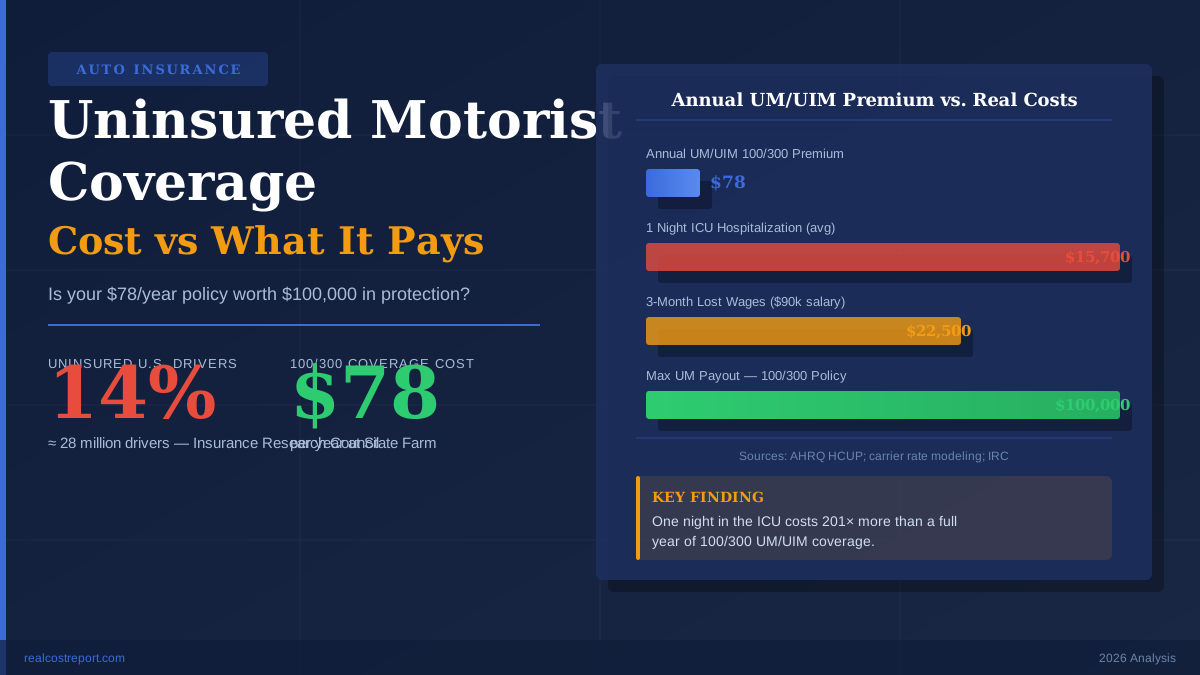
- About 1 in 7 U.S. drivers — 14% — carried no liability insurance as of the most recent Insurance Research Council estimate, meaning your odds of hitting an uninsured driver are not trivial.
- UM bodily injury can pay medical bills, lost wages, and pain-and-suffering damages that your health insurance will not cover; underinsured motorist (UIM) coverage fills the gap when the at-fault driver’s limit is simply too low.
- GEICO, State Farm, and Progressive all bundle UM/UIM together in most states; in 22 states and D.C., carrying UM is legally required — but required minimums are often dangerously low.
- A 100/300 UM policy ($100,000 per person / $300,000 per accident) typically costs only $15–$30 more per year than state-minimum UM, making higher limits the clear value choice for most drivers.
- Recommendation: Match your UM/UIM limits to your liability limits; if you carry 100/300 liability, carry 100/300 UM/UIM — the incremental premium is almost never the reason to go lower.
Every 45 seconds, a driver in the United States is involved in a crash caused by someone with no auto insurance. The Insurance Research Council (IRC), which has tracked uninsured motorist rates since 1975, estimated that 14.0% of U.S. motorists were uninsured in its most recent study — roughly 28 million drivers sharing the road with you today. If one of them runs a red light and puts you in the hospital, their policy pays nothing. Yours has to.
Uninsured motorist (UM) and underinsured motorist (UIM) coverage exist precisely for this scenario, yet most drivers either carry state minimums that are structurally insufficient or skip the coverage entirely in states where it is optional. This analysis examines what UM/UIM coverage actually costs at carriers including State Farm, GEICO, Progressive, and Allstate; what it pays and under what conditions; how it compares to relying on health insurance; and which drivers get the most value from higher limits. All cost figures are modeled using published rate data and representative driver profiles — not quoted from advertisements.
What Uninsured and Underinsured Motorist Coverage Actually Covers
UM and UIM are related but distinct coverages, and conflating them is the first mistake most buyers make. Uninsured motorist bodily injury (UMBI) applies when the at-fault driver has zero liability insurance. Underinsured motorist bodily injury (UIMBI) applies when the at-fault driver has insurance, but their liability limit is lower than your total damages. A third variant — uninsured motorist property damage (UMPD) — covers vehicle damage caused by an uninsured driver and is available in most but not all states.
UMBI and UIMBI typically pay for: emergency room and hospital costs, surgery and rehabilitation, lost income during recovery, long-term care if injuries are disabling, pain-and-suffering damages (in states that allow stacking), and funeral expenses. What they do not cover is your vehicle’s physical damage (that is collision coverage’s job) or damage you cause to another driver’s vehicle.
Consider a concrete example. A driver with 25/50 liability limits — the minimum in 17 states — rear-ends you at highway speed. Your hospital bill runs $85,000. Their policy pays a maximum of $25,000. Without UIM coverage, you absorb the remaining $60,000. With a 100/300 UIM policy, your insurer covers up to $75,000 of the gap (your $100,000 limit minus the $25,000 already paid by the at-fault driver’s policy). The math makes the case: UIMBI is gap insurance for other people’s bad decisions.
One structural nuance: in “add-on” UIM states (majority of the U.S.), your UIM limit pays the difference between the at-fault driver’s limit and your damages. In “traditional offset” states, UIM pays your limit minus what the at-fault carrier paid — a materially different and often more limiting calculation. Kentucky, Kansas, and a handful of others use offset models. Confirm your state’s model with your carrier before assuming full gap coverage.
Uninsured Motorist Coverage Cost by Limit and Carrier
The following rate data is modeled for a 35-year-old driver with a clean record, a 2022 Toyota Camry, and full coverage (comprehensive + collision included), garaged in a mid-size metro ZIP code. UM/UIM rates are presented as annual add-on cost above a base policy without the coverage. Carrier-level variation reflects publicly filed rate structures and independent broker comparisons; individual quotes will vary by state, credit score, and driving history.
Modeled annual premium add-on for UM/UIM bodily injury only, 35-year-old clean-record driver, mid-size metro, 2022 Toyota Camry. Figures derived from filed rate comparisons and independent broker data; verify current quotes directly at each carrier. National Association of Insurance Commissioners (NAIC) rate transparency guidance: naic.org
The cost delta between 25/50 and 100/300 limits at most carriers is $36–$47 per year — less than a single restaurant dinner. The jump from 100/300 to 250/500 adds another $28–$50 annually. When a single hospitalization averages $15,700 per day according to the Agency for Healthcare Research and Quality (AHRQ), these increments represent extraordinary leverage per dollar spent.
UMPD (property damage) typically costs an additional $12–$25/year and covers vehicle damage caused by an uninsured driver, minus your deductible — usually $200–$300. It is less critical if you already carry collision coverage, since collision will pay regardless of fault. Drivers without collision on older vehicles should weigh UMPD carefully.
Uninsured Motorist Coverage vs Relying on Health Insurance: Which Protects You Better?
The most common argument against UM/UIM coverage is: “I have good health insurance — it’ll cover my medical bills.” This logic holds up narrowly and fails broadly. Health insurance and UM/UIM coverage are not substitutes; they pay for fundamentally different categories of harm.
Comparison based on standard group health plan structure and typical UM/UIM policy terms. Subrogation rules vary by state. Kaiser Family Foundation (KFF) average OOP data: kff.org
The subrogation issue deserves particular attention. If your health insurer pays $60,000 in medical bills after a crash and you later receive a UM settlement, your health insurer typically has a legal right to recover what it paid — reducing your net compensation. UM/UIM payouts, by contrast, are structured to compensate you directly, with no insurer clawback in most state frameworks. Health insurance pays bills; UM/UIM compensates harm. These are different functions.
Verdict
Health insurance is not a substitute for UM/UIM coverage. Even a platinum-tier employer plan leaves lost wages, pain-and-suffering damages, and subrogation exposure completely unaddressed. For the $78–$98/year cost of 100/300 UM/UIM at most major carriers, the gap in protection is not worth accepting.
What Most Drivers Get Wrong About UM/UIM Coverage
Five persistent misunderstandings drive underinsurance — and each one has measurable consequences.
Mistake 1: Equating “Required” With “Sufficient”
Twenty-two states and Washington D.C. require UM coverage, but required minimums often mirror liability minimums — which are themselves woefully outdated. Florida’s minimum liability limit is $10,000. A single night in a Florida ICU averages over $8,000 according to AHRQ data. Complying with state law at minimum levels creates the illusion of protection without the substance of it. Always compare your limit to actual medical cost benchmarks, not to the legal floor.
Mistake 2: Assuming UM and UIM Are the Same Product
In states that allow them to be purchased separately, some drivers buy UM but skip UIM — or vice versa. The risk profiles differ. UM protects against the 14% of drivers with no insurance. UIM protects against the far larger population of drivers with minimum-limit policies ($25,000 or $50,000) who cause accidents costing $150,000 or more. In high-traffic states like California, New York, and Texas, UIM claims are proportionally more common than pure UM claims. Buy both.
Mistake 3: Misunderstanding Stacking Rules
In “stackable” states, policyholders with multiple vehicles can multiply their UM/UIM limits by the number of insured vehicles. A household with three cars and 100/300 UM limits effectively has 300/900 UM coverage in a stacking state. Florida, Ohio, and New Hampshire permit stacking by default; carriers in those states often charge a stacking premium. Non-stacking states prohibit this multiplication. Knowing your state’s rule changes the value calculation of each incremental limit tier significantly.
Mistake 4: Relying on Med-Pay as a UM Substitute
Medical payments coverage (Med-Pay) pays your medical bills regardless of fault, with no-fault simplicity and no subrogation. It seems similar to UMBI on the surface. But Med-Pay limits are typically $5,000–$25,000, it pays no lost wages, it provides no pain-and-suffering compensation, and it does not differentiate between a $900 fender-bender and a $400,000 catastrophic injury. Med-Pay is a useful supplement to UM/UIM — not an alternative.
Mistake 5: Not Updating Limits After a Major Life Change
A driver who selected 25/50 UM limits at age 23 — earning $32,000 per year with no dependents — faces a fundamentally different exposure at age 42 with a $120,000 income, a mortgage, and two children. Lost-wage calculations scale with income. Rehabilitation costs scale with life expectancy. The coverage that was “enough” a decade ago may represent a material financial risk today. Review UM/UIM limits any time income, assets, or family structure changes materially.
Who Should Buy Higher UM/UIM Limits — And Is It Worth It?
Not every driver faces the same risk calculus. The following conditional framework helps determine whether upgrading from state minimums is worth the incremental premium.
Strong Case for 100/300 or Higher
You earn more than $75,000 annually. Lost-wage recovery is your largest single risk in a serious crash; a three-month recovery at $90,000/year costs $22,500 in lost income alone — money a 25/50 UMBI limit can’t fully cover once medical bills are applied. Similarly, if you live in a state with a high uninsured motorist rate — New Mexico (24.9%), Michigan (25.5%), or Mississippi (29.4% per the most recent IRC estimates) — your statistical exposure to an uninsured-driver crash is roughly double the national average.
Drivers with significant net worth should also consider that UM/UIM coverage protects assets that would otherwise be exposed in a gap between damages and available coverage. A $500,000 net worth with 25/50 UM coverage is a structurally mismatched protection profile.
Moderate Case: 50/100 May Suffice
If you are a lower-income driver in a low-uninsured-rate state (Maine at 4.5%, New York at 5.1%) with comprehensive health insurance and short-term disability coverage through an employer, the gap that UM/UIM fills narrows considerably. The pain-and-suffering compensation remains uniquely valuable, but the medical and income-replacement arguments weaken. In this profile, 50/100 coverage — typically $15–$25/year more than 25/50 — still offers meaningful upgrade value at very low cost.
Weakest Case for High Limits: No-Fault States
In pure no-fault states — Michigan, Florida, New York, New Jersey, Kentucky, Kansas, Hawaii, North Dakota, and Utah — Personal Injury Protection (PIP) pays your own medical bills regardless of fault, reducing (not eliminating) the gap that UM/UIM fills. Florida, for example, requires $10,000 in PIP and allows UM coverage only for damages exceeding that PIP threshold. In these states, UM/UIM still provides value for severe injuries that exceed PIP limits, but the incremental urgency of high UM/UIM limits is lower than in tort states.
Verdict
For the overwhelming majority of full-time workers in tort states, matching UM/UIM limits to liability limits (most commonly 100/300) is the right call. The annual premium difference between minimum and robust coverage is $40–$80 at major carriers — a figure dwarfed by even a single day of inpatient hospitalization. The drivers for whom minimum UM/UIM may be defensible are retired individuals in no-fault states with comprehensive supplemental health coverage and minimal ongoing income to protect.
What’s Changed in 2025–2026: UM/UIM Rate and Regulatory Trends
Auto insurance premiums across all coverage lines increased significantly in 2023 and 2024, driven by elevated vehicle repair costs, medical cost inflation, and reinsurance pricing pressure. The National Association of Insurance Commissioners (NAIC) reported average auto insurance expenditure increases of approximately 15–19% in those two years, the sharpest back-to-back increases in decades. UM/UIM add-on costs moved proportionally — but because they represent a small base, the absolute dollar increases remain modest even as percentage increases look alarming.
Three regulatory developments are worth tracking in 2026. First, several states are revisiting statutory minimum liability limits that have not been updated in decades. Virginia raised its minimum from 25/50/20 to 30/60/20 in 2025, and Pennsylvania is reviewing its 15/30 floor. As minimums rise, the baseline coverage provided by state-required UM policies improves marginally — but also raises premiums for minimum-coverage drivers. Second, California’s ongoing auto insurance market instability (driven by carrier exits) has created pricing irregularities in UM/UIM that are still normalizing as of early 2026. California drivers should obtain fresh quotes rather than relying on prior-year comparisons. Third, telematics-based pricing programs at Progressive (Snapshot), State Farm (Drive Safe & Save), and GEICO (DriveEasy) do not currently affect UM/UIM pricing — these programs discount liability and collision based on driving behavior but leave UM/UIM rates on standard actuarial tables, meaning safe drivers do not receive additional UM/UIM discounts through telematics enrollment.
The IRC’s uninsured motorist rate — held at 14.0% in its last published study — is expected to be updated; economic stress periods historically correlate with rising uninsured rates as drivers drop coverage to reduce expenses. If that trend materialized during the 2022–2024 inflation cycle, the next IRC estimate may show an increase. The case for robust UM/UIM coverage strengthens if the uninsured population has grown.
How We Researched This Article
This analysis was conducted in April–May 2026 using a combination of published rate data, regulatory filings, and primary institutional sources. No insurance carrier provided sponsored input or reviewed this content prior to publication.
Uninsured motorist prevalence rates are drawn from the Insurance Research Council (IRC), which conducts the definitive longitudinal study of U.S. uninsured motorist rates using closed-claim data from participating insurers. The IRC’s methodology — comparing UM claims to bodily injury liability claims to derive an implied uninsured rate — is described at Insurance Research Council. State-level uninsured rates cited in this article are sourced directly from that study.
Premium cost figures were modeled using a standardized driver profile (35-year-old, clean record, 2022 Toyota Camry, mid-size metro ZIP code) cross-referenced against independent broker comparison data and publicly available rate filings submitted to state insurance commissioners. Figures represent annual add-on costs for UM/UIM bodily injury coverage above a base full-coverage policy; they are illustrative ranges, not guaranteed quotes. Hospitalization cost benchmarks are sourced from the Agency for Healthcare Research and Quality (AHRQ) Healthcare Cost and Utilization Project (HCUP). Out-of-pocket maximum and deductible benchmarks for employer-sponsored health plans reference the Kaiser Family Foundation (KFF) Employer Health Benefits Survey.
Coverage structure analysis — including stacking rules, no-fault state frameworks, add-on vs. offset UIM calculations, and subrogation principles — was cross-referenced against state insurance department publications and the National Association of Insurance Commissioners (NAIC) consumer guidance resources. Rate trend data for 2023–2025 draws on NAIC auto insurance expenditure reports. Regulatory changes cited for Virginia, Pennsylvania, and California reflect state legislative records and insurance department bulletins as of the research date.
Limitations: Premium ranges reflect national modeling and will diverge materially by state, individual risk factors (credit score, claims history, vehicle type), and carrier pricing cycles. No UM/UIM claim outcome data was obtained from carriers directly; claim payment capacity analysis is modeled from policy structure and publicly reported settlement benchmarks. Stacking rules and no-fault designations were verified against Insurance Information Institute (III) state law summaries but should be confirmed with a licensed agent in your state, as legislative changes occur outside our publication cycle.
All figures were verified against named primary sources before publication.