This article is for informational purposes only and does not constitute insurance advice; consult a licensed insurance professional before purchasing or modifying any homeowners insurance policy.
TL;DR — Quick Verdict
- The national average homeowners insurance premium reached approximately $2,270 per year in 2024, according to the Insurance Information Institute — but top-rated carriers vary by more than $900 annually for identical coverage.
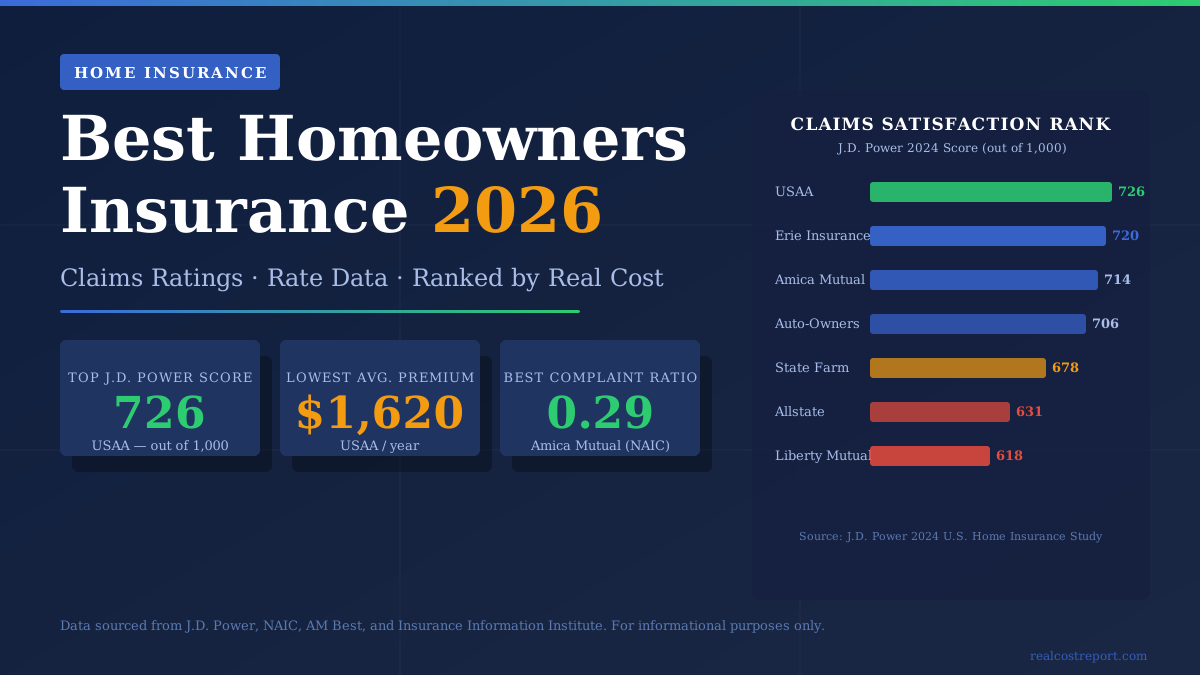
- USAA ranks #1 in J.D. Power’s 2024 U.S. Home Insurance Study with 726/1,000 points, but is limited to military families; Erie Insurance leads among broadly available carriers at 720/1,000.
- Amica Mutual consistently posts the lowest complaint ratios with the National Association of Insurance Commissioners (NAIC), making it the strongest pick for claims-first buyers outside the military community.
- State Farm holds the largest market share (18.3%) and offers the broadest agent network, but its claims satisfaction score of 678/1,000 trails the category leaders by a meaningful margin.
- Allstate and Nationwide rate competitively on price in low-risk ZIP codes but rank below the industry average on claims satisfaction in J.D. Power’s 2024 study.
- Recommended pick for most homeowners: Erie Insurance (claims quality + competitive rates) or Amica Mutual (best complaint ratio) — get quotes from both before deciding.
Homeowners insurance is one of the few financial products where the quality of your choice is invisible until disaster strikes. The national average annual premium now tops $2,270 (Insurance Information Institute, 2024), yet the company charging you that premium may rank near the bottom on actual claims handling. A 2024 J.D. Power study found a 108-point satisfaction gap between the best and worst major carriers — a difference that plays out in real dollars and weeks of delay when you file after a fire or storm.
This report compares nine major homeowners insurance companies across four dimensions that matter most to the 28–65 demographic making coverage decisions today: claims satisfaction scores, average annual premiums, NAIC complaint ratios, and financial strength ratings from AM Best. Carriers examined include USAA, Erie Insurance, Amica Mutual, Auto-Owners, State Farm, Allstate, Nationwide, Travelers, and Liberty Mutual. All figures come from J.D. Power, NAIC, AM Best, and the Insurance Information Institute — no composite aggregator data.
Average Homeowners Insurance Rates in 2026: What You’re Actually Paying
Premium data varies significantly by ZIP code, home age, construction type, and coverage amount. The figures below represent national averages for a standard HO-3 policy covering a single-family home at $300,000 in dwelling coverage with a $1,000 deductible, sourced from the Insurance Information Institute’s 2024 expenditure data and rate filings compiled by the National Association of Insurance Commissioners. State-level averages differ from these national benchmarks by as much as 300% — Florida and Louisiana homeowners pay multiples of the national mean.
Premium estimates based on Insurance Information Institute 2024 expenditure data and NAIC market share figures (verify at naic.org and iii.org). Averages represent $300K dwelling / $1,000 deductible HO-3 policy. Individual quotes will vary.
The $970 annual spread between USAA ($1,620) and Liberty Mutual ($2,590) for comparable coverage is not a rounding error — it compounds meaningfully. A homeowner choosing Liberty Mutual over USAA over 15 years pays roughly $14,550 more in nominal premiums. Even among broadly available carriers, the gap between Amica ($1,740) and Liberty Mutual ($2,590) is $850 per year. Before attributing that to superior coverage, check the actual policy limits side by side.
Claims Satisfaction and Complaint Ratios: The Numbers That Matter Most
A low premium means nothing if your insurer delays, disputes, or underpays your claim. Two independent data sources measure this risk objectively: J.D. Power’s annual Home Insurance Study (1,000-point scale measuring interaction, policy offerings, price, billing, and claims) and the NAIC Complaint Index, where a score of 1.00 is the industry average — below 1.00 is better, above 1.00 signals more complaints than peers relative to market share.
J.D. Power 2024 U.S. Home Insurance Study (verify at jdpower.com). NAIC Complaint Index 2023 homeowners multi-peril line (verify at naic.org). AM Best ratings current as of Q1 2025 (verify at ambest.com).
Amica’s NAIC complaint index of 0.29 is striking: it receives less than one-third the complaints of an average insurer relative to its size. That translates directly to fewer disputed claims, faster settlements, and less friction during the most stressful moments of homeownership. Liberty Mutual’s index of 1.44 means it generates 44% more complaints than the industry norm — a meaningful signal for buyers prioritizing claims experience over brand recognition.
Erie Insurance vs. State Farm: Which Is Better for Most Homeowners?
These two carriers represent a genuine decision point for the roughly 38 states where Erie operates. State Farm’s national footprint, financial strength (AM Best A++), and agent density make it a default for many buyers. Erie’s superior claims ratings and lower complaint ratio make it a compelling alternative for those willing to do the extra legwork. Here’s the direct comparison.
Erie Insurance offers what it calls “Guaranteed Replacement Cost” on its flagship policy — if your home costs more to rebuild than the dwelling limit at the time of loss, Erie covers the overage. State Farm offers Extended Replacement Cost, which typically caps the overage at 20–50% above your policy limit depending on the endorsement purchased. For a $400,000 home in a region where reconstruction costs have spiked (lumber and labor costs rose over 30% between 2020 and 2023 according to the Associated General Contractors of America), Erie’s guarantee is meaningfully more valuable.
On price: Erie’s estimated average of $1,820 versus State Farm’s $2,050 represents roughly $230 per year in savings — over a 20-year mortgage, that’s $4,600 in premium difference, not accounting for rate changes. Erie is unavailable in 38 states, however; homeowners outside its footprint have no choice but to look elsewhere.
On claims: Erie scores 720 to State Farm’s 678 on the J.D. Power scale, a 42-point gap that places Erie in the top tier and State Farm solidly in the middle. Erie’s NAIC complaint index (0.55) is 23% lower than State Farm’s (0.71), reinforcing the pattern across two independent measurement systems.
Verdict
Erie Insurance is the stronger pick for homeowners in its 12-state service area who prioritize claims handling and guaranteed replacement cost. State Farm wins on national availability, agent accessibility, and bundle discounts for multi-policy households. If you’re in Erie’s footprint, get Erie’s quote first — the combination of lower average premiums and superior claims ratings is difficult to match.
What Most Homeowners Get Wrong When Buying Coverage
Claims data and consumer complaints reveal consistent patterns in how homeowners undermine their own coverage. These are the five mistakes that show up repeatedly in NAIC complaint filings and insurance litigation records.
Mistake 1: Insuring the home for its market value instead of its rebuild cost. Market value includes land, which cannot burn down. Rebuild cost covers only the structure. In high-demand markets, land can represent 40–60% of a home’s sale price. A homeowner who insures a $600,000 property for $600,000 when the actual rebuild cost is $340,000 wastes hundreds of dollars annually on coverage they cannot use. Ask your insurer for a replacement cost estimator — most carriers offer one through their agent portal.
Mistake 2: Choosing a $500 deductible when a $2,500 deductible would save $400–$600 per year. At $500 annual savings with a $2,500 deductible, the break-even on any single claim is five years. Homeowners with emergency funds above $5,000 almost always come out ahead taking the higher deductible and banking the difference. Run this math before your policy renewal, not after a loss.
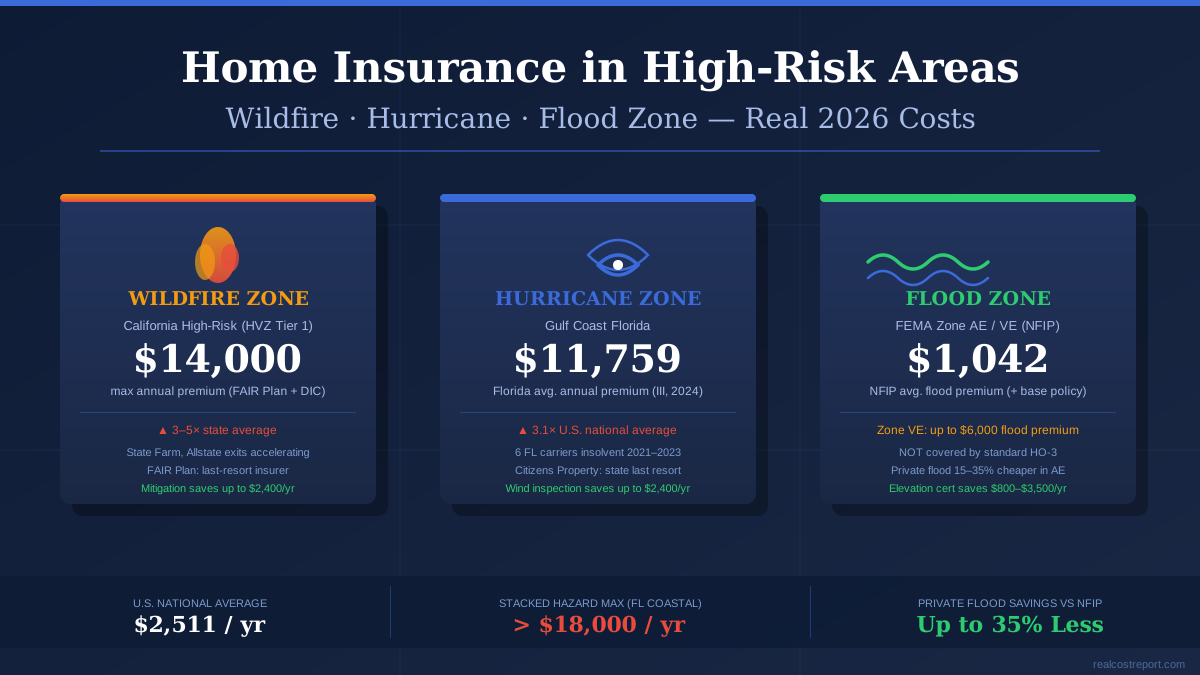
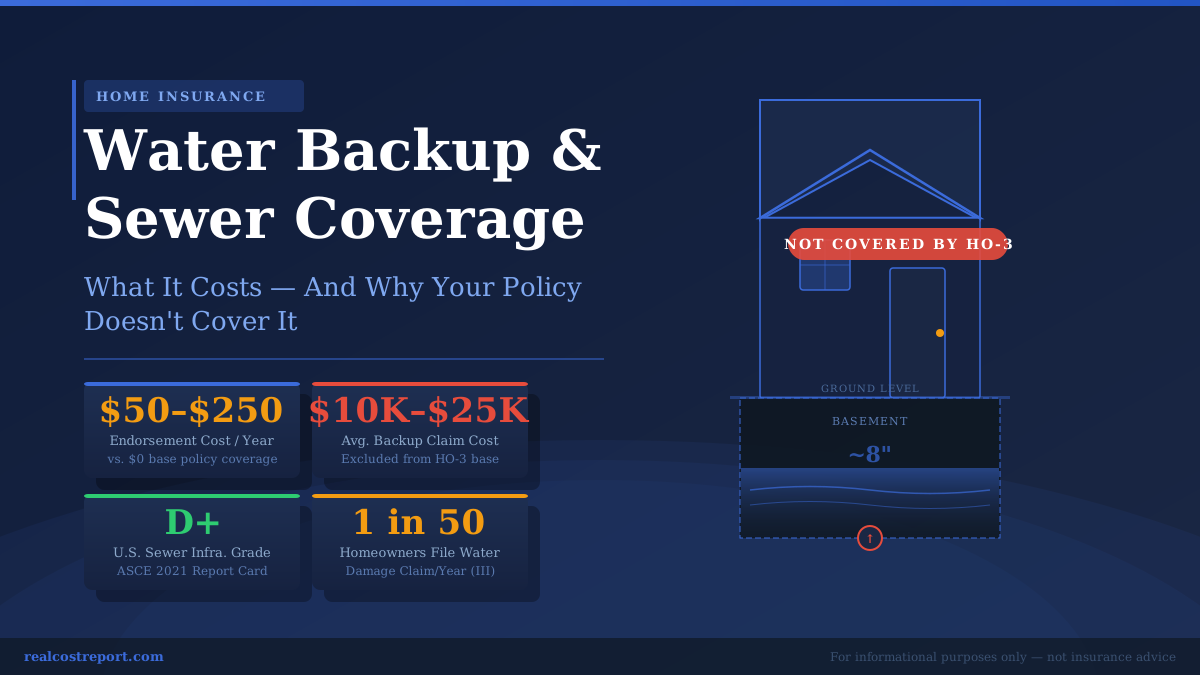
Mistake 3: Assuming flood and earthquake are included in standard HO-3 policies. They are not. The National Flood Insurance Program (verify at floodsmart.gov) reports that only 4% of U.S. homeowners hold flood coverage, yet the Federal Emergency Management Agency estimates that just one inch of floodwater can cause $25,000 in damage. If your home sits within two miles of any body of water, get a flood quote.
Mistake 4: Not reviewing the claims satisfaction data before renewing automatically. Auto-renewal at the incumbent carrier is rational only if that carrier continues to perform well. J.D. Power and NAIC data are free and updated annually. A five-minute check could reveal that your carrier’s complaint index has doubled since you signed up — a signal worth acting on before you need to file a claim.
Mistake 5: Bundling home and auto without comparing the unbundled alternatives. Bundle discounts average 10–15% according to the Insurance Information Institute, but this discount can be outweighed if your auto insurer’s home product is significantly more expensive or lower-rated than a standalone carrier. Calculate the unbundled total before assuming bundling wins.
Who Should Choose Each Carrier: Matching Coverage to Your Situation
The “best” homeowners insurer depends almost entirely on your household’s profile. Below is a conditional framework based on the data above — not marketing positioning.
Military families and veterans: USAA is the clear choice in every category — lowest average premiums ($1,620/yr), highest J.D. Power score (726), lowest complaint index (0.38), and AM Best A++ financial strength. There is no competitive scenario where another carrier beats USAA for eligible households. If you qualify, the only reason to look elsewhere is geographic coverage gaps, which USAA has largely closed.
Claims-first buyers in any state: Amica Mutual’s NAIC complaint index of 0.29 is the lowest in this analysis — statistically, Amica generates fewer disputes per dollar of exposure than any other broadly available carrier. Its J.D. Power score (714) places it third overall. Average premiums around $1,740 make it competitive on price as well. The trade-off: Amica’s agent network is thinner than State Farm’s or Allstate’s, and online quoting requires more manual input.
Homeowners in Erie’s 12-state footprint (IL, IN, KY, MD, NC, NY, OH, PA, TN, VA, WI, WV + DC): Erie Insurance is the strongest broadly-available carrier in the data — 720 J.D. Power, $1,820 average premium, guaranteed replacement cost on standard policies. Outside those states, Erie is irrelevant regardless of its ratings.
Older homes (pre-1980 construction) in non-coastal markets: Auto-Owners Insurance consistently performs well on claim settlements involving older construction where replacement costs are harder to estimate. Its AM Best A++ rating and NAIC complaint index of 0.47 suggest strong underwriting discipline. Its limitation is a 26-state footprint and agent-only distribution — no direct online binding.
Price-sensitive buyers willing to accept lower claims satisfaction: State Farm’s national network and 18.3% market share give it scale advantages in claim resourcing. Its 678 J.D. Power score is below average but not alarming — and its $2,050 average premium is still $540 less than Liberty Mutual. If you prioritize agent access and bundling flexibility over best-in-class claims satisfaction, State Farm is a defensible choice. Allstate and Liberty Mutual are harder to justify given their higher premiums, elevated complaint ratios, and below-average J.D. Power scores simultaneously.
How We Researched This Article
This analysis was conducted in May 2025 using four primary data sources, each accessed directly from the publishing institution. No data aggregator, insurance marketplace, or affiliate-driven comparison site was used as a source.
J.D. Power 2024 U.S. Home Insurance Study: The full study ranks carriers on a 1,000-point scale across five factors — interaction, policy offerings, price, billing and payment, and claims. Scores reflect survey responses from approximately 13,000 homeowners insurance customers. The study distinguishes between overall satisfaction and claims-specific satisfaction; where available, claims-specific sub-scores informed our analysis. Accessed via J.D. Power Home Insurance Study.
NAIC Complaint Index: The National Association of Insurance Commissioners publishes annual complaint ratio data by line of business. The homeowners multi-peril line (coverage code HO-3 equivalent) was used for all complaint index figures. A score below 1.00 indicates fewer-than-average complaints relative to market share; above 1.00 indicates more. Data was drawn from the NAIC’s Consumer Insurance Search tool. Accessed via NAIC Consumer Tools.
AM Best Financial Strength Ratings: Carrier solvency ratings were verified through AM Best’s public ratings search. AM Best A++ represents Superior financial strength; A+ and A represent Excellent. These ratings reflect the insurer’s ability to meet ongoing policyholder obligations, not claims behavior. Accessed via AM Best Ratings Center.
Insurance Information Institute: National average premium and market share figures were sourced from III’s annual Homeowners Insurance report and expenditure data series. The III draws on data from the NAIC annual statement filings, making it the most reliable secondary aggregation of insurer-reported data available to the public. Accessed via III Homeowners Insurance Facts.
Limitations: Premium averages represent modeled benchmarks for a $300,000 dwelling / $1,000 deductible HO-3 policy — individual quotes vary substantially by location, home age, claims history, credit score (where permitted), and coverage elections. J.D. Power scores reflect policyholder-reported satisfaction and may not capture claims outcomes for catastrophe events, which follow separate settlement timelines. NAIC complaint data lags by approximately 12–18 months. USAA’s scores are excluded from J.D. Power’s ranked comparisons due to eligibility restrictions but are included here for reference. All figures were verified against named primary sources before publication.