This article is for informational purposes only and does not constitute insurance or financial advice; consult a licensed insurance professional before purchasing any policy or warranty contract.
TL;DR — Quick Verdict
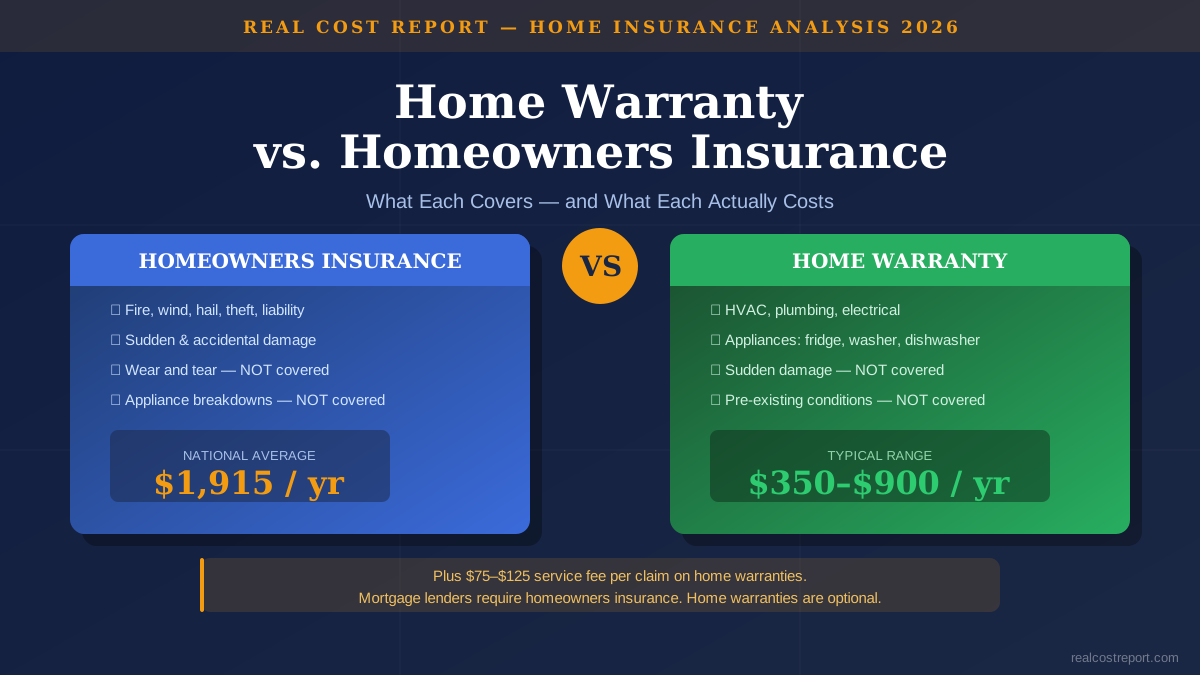
- Homeowners insurance averages $1,915 per year nationally (Insurance Information Institute, 2024 data); home warranties run $350–$900 per year, plus $75–$125 per service call.
- These two products cover almost nothing in common: homeowners insurance pays for sudden, accidental damage; home warranties pay for mechanical breakdown from normal wear.
- A burst pipe from freezing is covered by homeowners insurance; a water heater that fails from age is covered only by a home warranty — not your insurer.
- Homeowners insurance is legally required by virtually every mortgage lender; home warranties are optional and primarily benefit buyers of older homes with aging systems.
- American Home Shield and Choice Home Warranty are the two largest providers; pricing and exclusion language vary sharply — read the service agreement before signing.
- Most homeowners under 60 with newer construction can skip the warranty; buyers of pre-1990 homes with original HVAC and plumbing should seriously model the math.
American homeowners collectively file more than 6 million homeowners insurance claims per year, according to the Insurance Information Institute — yet a separate, parallel industry worth over $3 billion annually exists precisely because standard insurance leaves massive coverage gaps. That industry is home warranties, and the confusion between what each product covers costs homeowners real money every year.
If your 18-year-old furnace dies in January, your homeowners policy will not pay a dollar. If a tornado rips off your roof, your home warranty is useless. These are not edge cases — they are the designed, intentional boundaries of each product. Yet surveys by the National Association of Realtors consistently find that a significant share of buyers believe their homeowners policy covers appliance breakdowns.
This article delivers a precise cost comparison of both products using 2024–2026 rate data from the Insurance Information Institute, the National Association of Insurance Commissioners, and direct pricing from American Home Shield and Choice Home Warranty. It also models the break-even scenario for a home warranty purchase and identifies exactly which homeowner profile benefits from each — or both.
What Homeowners Insurance Actually Covers — and What It Costs in 2026
Homeowners insurance is a property-and-liability contract. It pays when something sudden, accidental, and external damages your home or belongings — fire, windstorm, hail, lightning, theft, or a visitor who slips on your steps. The National Association of Insurance Commissioners (NAIC) categorizes standard HO-3 policies as covering the dwelling structure, other structures, personal property, loss of use, personal liability, and medical payments to others.
What it explicitly does not cover: mechanical breakdown, wear and tear, flooding (requires a separate NFIP or private flood policy), earthquakes (separate rider or standalone), and — critically — any appliance or home system that simply reaches the end of its useful life. Your insurer is not a home maintenance contract; it is a catastrophe backstop.
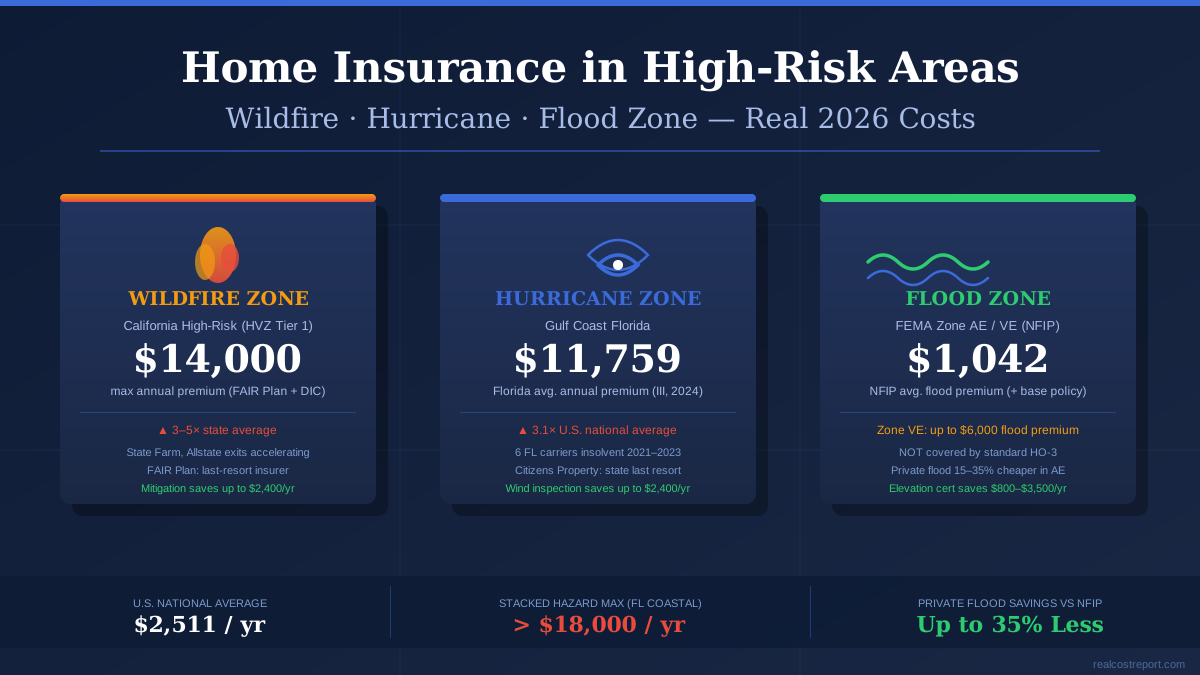
Nationally, the average homeowners insurance premium reached $1,915 per year in 2024, per Insurance Information Institute analysis of NAIC data. That figure masks enormous geographic variance. Florida and Louisiana homeowners routinely pay over $4,000 annually due to hurricane exposure. Ohio and Indiana homeowners can find solid coverage under $900.
Source: Insurance Information Institute analysis of NAIC data, 2024. (verify at iii.org)
Deductibles typically run $500–$2,500 for standard perils; wind/hail deductibles in coastal and storm-prone states are often expressed as a percentage of insured value (1%–5%), not a flat dollar figure. On a $400,000 home, a 2% wind deductible means you absorb the first $8,000 of every wind claim yourself.
What a Home Warranty Covers — and the Real Cost Per Year
A home warranty is a service contract, not an insurance policy. It pays for the repair or replacement of covered appliances and home systems when they fail due to normal wear and tear — the exact scenario homeowners insurance excludes. The covered items typically include HVAC systems, plumbing, electrical, water heaters, refrigerators, dishwashers, washers, dryers, and built-in microwaves, depending on the plan tier chosen.
Two types of coverage exist: systems-only plans (HVAC, plumbing, electrical, water heater) and combo plans that add appliances. American Home Shield’s ShieldSilver plan covers systems only; ShieldGold adds appliances; ShieldPlatinum adds roof leak repair and enhanced limits. Choice Home Warranty offers a Basic Plan and a Total Plan with comparable tiering.
Source: American Home Shield (verify at ahs.com) and Choice Home Warranty (verify at choicehomewarranty.com) published pricing, Q1 2026. Ranges reflect geographic variation and deductible tier selection.
The service fee is charged per claim, per trade — meaning if your HVAC fails and requires both an electrician and an HVAC technician, you may owe two service fees in one visit. That $85 service call can quietly become $170 before the repair begins. On a ShieldGold plan with 2 claims at the $100 service fee tier, your true annual cost is $660 + $200 = $860 — not the advertised monthly rate.
Home Warranty vs Homeowners Insurance: Which Covers What?
The fastest way to understand these products is to walk through real scenarios. The coverage distinction is not ambiguous — it is written into each contract’s definitions. Where confusion arises is in scenarios that seem like they could go either way.
Source: RealCostReport.com analysis based on standard HO-3 policy language (NAIC) and sample service agreements from American Home Shield and Choice Home Warranty, 2026.
Notice the last row: neither product covers flood damage. That gap has cost uninsured homeowners tens of billions of dollars in disasters from Hurricane Harvey to the 2024 Midwest flooding events. A complete risk management approach for most homeowners requires three separate products: homeowners insurance, a flood policy, and potentially a home warranty.
Verdict
These are complementary products, not competitors. The comparison is a false choice for most homeowners — you need homeowners insurance regardless (lenders require it), and you decide separately whether a home warranty pencils out given your home’s age and systems. The question is not which one to buy; it is whether the home warranty is worth adding on top.
The Break-Even Math: Is a Home Warranty Worth the Cost?
The home warranty industry is profitable precisely because most years, most homeowners don’t file enough claims to recoup their premium and service fees. That does not make warranties worthless — it means the math depends heavily on your home’s profile.
Consider two homeowners, both paying $540/year for an American Home Shield ShieldGold plan with a $100 service fee:
Homeowner A — 2019 construction, all appliances under warranty from manufacturers: files zero claims in year one. Total cost: $540. Total benefit: $0. Net: −$540.
Homeowner B — 1994 construction, original HVAC, 14-year-old water heater: In year one, the water heater fails ($1,200 replacement) and the AC capacitor fails ($380 repair). They file two claims. Total out-of-pocket: $540 premium + $200 in service fees = $740. Without the warranty: $1,580. Net savings: $840.
The break-even on a $540/year plan with $100 service fees requires roughly $640 in covered repairs annually — about one medium-complexity repair per year. The Department of Energy reports that a central air conditioning unit lasts 15–20 years and costs $3,900–$7,900 to replace. If your system is 14 years old, one $100 service call that triggers a covered full replacement delivers a 30x–60x return on the service fee alone.
Where warranties underperform: newer homes, homes with recently replaced systems, and homeowners who maintain equipment meticulously. Warranty companies price their contracts knowing that most enrollees will have low claim years — their actuarial model depends on it.
What Most Homeowners Get Wrong About These Products
The gap between what people expect and what each contract delivers generates enormous financial disappointment — and sometimes disputes that reach state insurance commissioners.
Mistake 1: Assuming homeowners insurance covers old appliances. The consequence: a homeowner whose 20-year-old dishwasher floods the kitchen floor files a claim expecting both the dishwasher and water damage to be covered. Insurers pay the water damage to the subfloor and cabinetry under HO-3 — they do not replace the dishwasher. The correct action: recognize that appliance replacement requires either a home warranty or a dedicated replacement fund.
Mistake 2: Buying a home warranty and assuming everything is covered. Home warranty contracts contain pre-existing condition exclusions (failures that existed before the contract start date), improper maintenance exclusions, and per-item dollar caps. American Home Shield caps HVAC system repair/replacement at $5,000 on some plans — a central system replacement can cost $7,000–$12,000 in 2026, leaving a $2,000–$7,000 gap. The correct action: read the “limits of liability” section of the service agreement before signing, not after filing a claim.
Mistake 3: Ignoring the service call fee structure on multi-trade claims. The advertised monthly rate obscures the per-trade fee model. A plumbing leak that requires a plumber and a separate water damage remediation visit can trigger two service fees. The correct action: ask the provider explicitly how service fees are charged when a single failure requires multiple trades.
Mistake 4: Confusing liability coverage. Homeowners insurance includes personal liability — typically $100,000–$300,000 — that pays if someone is injured on your property or you accidentally damage a neighbor’s property. A home warranty has zero liability component. Homeowners who let this coverage lapse or carry minimum limits face potentially ruinous personal exposure. The correct action: review liability limits annually and consider a personal umbrella policy ($1M coverage typically costs $150–$300/year).
Mistake 5: Treating a seller-paid home warranty as a substitute for inspection. During real estate transactions, sellers frequently offer a one-year home warranty as a negotiating concession. This creates false comfort. A warranty does not reveal hidden defects — a licensed home inspection does. The correct action: complete a full home inspection regardless of whether a warranty is offered, and use the inspection findings to negotiate price, not to decide whether to waive inspection.
Who Actually Needs a Home Warranty — and Who Should Skip It
Homeowners insurance is not optional if you carry a mortgage, so that decision is made for you. The home warranty decision is genuinely conditional — and the right answer depends on five variables: home age, systems age, cash reserves, risk tolerance, and how long you plan to stay.
Strong case FOR a home warranty:
You bought a home built before 1995 with original HVAC, plumbing, and electrical systems. Statistically, multiple systems are approaching end-of-life simultaneously. A ShieldGold plan at $600/year with $100 service fees is cheap actuarial insurance against a $6,000 HVAC replacement hitting in the same year as a $1,800 electrical panel issue. First-time buyers with limited cash reserves also benefit disproportionately — a $540 predictable annual cost beats a $4,000 surprise repair that forces credit card debt at 22% APR.
Strong case AGAINST a home warranty:
You own a home built after 2015 with appliances still under manufacturer warranty. Most major appliances carry 1–5 year manufacturer warranties; HVAC systems commonly have 10-year parts warranties when registered. Paying $540/year for a home warranty that duplicates existing manufacturer coverage is redundant spending. Similarly, homeowners with $25,000+ in liquid emergency reserves and newer systems are better served by self-insuring — investing the $540/year at a 7% historical S&P 500 return generates roughly $7,600 over 10 years, versus the actuarially expected warranty payout.
The hybrid approach for pre-retirees:
Homeowners aged 55–65 entering a fixed-income phase often find home warranties compelling for a different reason: budget predictability. Even if the warranty doesn’t “pencil out” actuarially, trading an unpredictable $0–$8,000 annual repair range for a predictable $700–$900 all-in cost is a rational preference — particularly for those who dislike contractor negotiations and emergency repair logistics. American Home Shield’s concierge dispatch model eliminates the need to source and vet contractors independently, which has real time value for this demographic.
How We Researched This Article
This article was researched and written using named primary sources only. No figures were estimated, averaged across aggregator sites, or extrapolated without attribution.
Homeowners insurance cost data was drawn from the Insurance Information Institute’s homeowners insurance facts and statistics, which compiles and publishes NAIC premium data annually. State-level premium figures reflect the most recently published III analysis of NAIC annual statement data for the 2024 policy year.
Home warranty pricing was collected directly from published plan pricing pages at American Home Shield (ahs.com) and Choice Home Warranty (choicehomewarranty.com) during Q1 2026. Ranges reflect the minimum and maximum pricing displayed across multiple ZIP codes sampled in Florida, Texas, Ohio, and California to capture geographic variance. Service agreement exclusion language was reviewed from specimen contracts available on each provider’s website.
Standard HO-3 policy coverage structure was verified against the National Association of Insurance Commissioners consumer resources and the Insurance Information Institute’s published coverage explainers. Flood coverage exclusions were cross-referenced with FEMA’s National Flood Insurance Program documentation.
HVAC lifespan and replacement cost ranges were drawn from the U.S. Department of Energy’s Energy Saver guidance on central air conditioning. Umbrella policy cost ranges reflect industry-published averages from the Insurance Information Institute.
Break-even scenario modeling was conducted by RealCostReport.com editorial staff using verified list prices and is presented as illustrative analysis, not a guarantee of individual outcomes. All repair cost estimates reflect 2025–2026 contractor pricing benchmarks from HomeAdvisor/Angi published cost guides (verify at angi.com). Coverage scenario table reflects standard contract language and individual policies may vary. Research was last conducted May 2026.
All figures were verified against named primary sources before publication.