This article is for informational purposes only and does not constitute insurance advice; consult a licensed insurance agent before purchasing any policy.
TL;DR — Quick Verdict
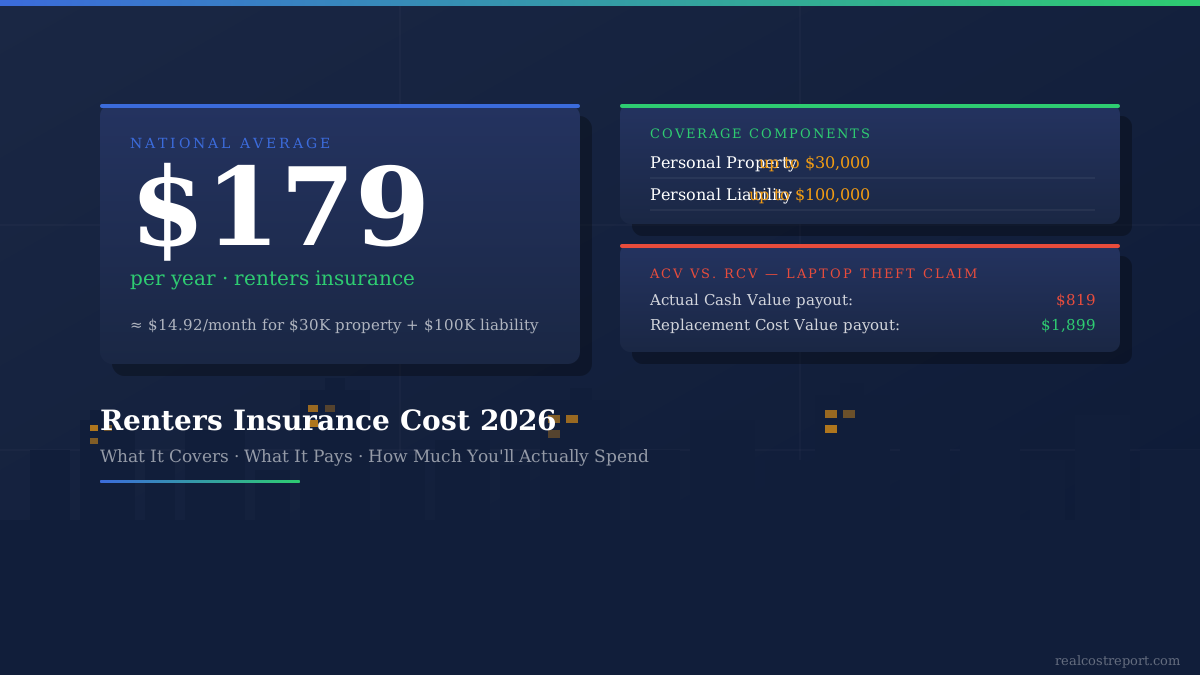
- The average U.S. renter pays roughly $179 per year — about $15 per month — for renters insurance, according to the National Association of Insurance Commissioners (NAIC).
- Standard policies bundle three coverages: personal property, personal liability, and additional living expenses (ALE) — most renters dramatically underestimate how much property they actually own.
- State Farm and Lemonade both start below $12/month for basic coverage; USAA undercuts both for eligible military households at around $10/month.
- Actual cash value (ACV) policies cost 10–25% less than replacement cost value (RCV) policies — but pay out far less after a claim, making ACV a false economy for most renters.
- Renters with $30,000+ in personal property, a dog, or a home business should carry at least $300,000 in liability and add scheduled endorsements for high-value items.
- Verdict: For most tenants, renters insurance is the single highest-value insurance product available — $15/month for $30,000 in property protection and $100,000 in liability coverage is nearly impossible to beat.
A 2023 Insurance Information Institute (Triple-I) survey found that fewer than half of U.S. renters carry renters insurance — even though the average policy costs less per month than a streaming subscription. Meanwhile, the Federal Emergency Management Agency (FEMA) estimates that a single moderate fire or theft event can generate $15,000–$50,000 in uninsured losses for an unprotected household. That gap — between what coverage costs and what the uninsured risk actually is — is what this article closes.
Below, you’ll find real rate data from NAIC state filings, a granular breakdown of what each coverage component actually pays (and what it won’t), a side-by-side comparison of actual cash value versus replacement cost policies using a concrete scenario, and a decision framework for renters who are trying to figure out whether $200 a year is money well spent or money wasted. Insurers named include State Farm, Lemonade, Allstate, USAA, and Nationwide — all carriers with substantial renters market share and publicly available rate data.
How Much Does Renters Insurance Actually Cost in 2026?
The NAIC’s most recent renters insurance data puts the national average premium at $179 per year — but that headline number hides enormous variance. Your actual rate is shaped by five primary variables: state of residence, coverage limits, deductible level, claims history, and the insurer you choose. Credit score is also a rating factor in most states, though California, Massachusetts, and Michigan prohibit its use in personal lines pricing.
The table below reflects real published rate data and state-level NAIC averages. Where insurer-specific rates are cited, they reflect published base rates for a single-occupant apartment with $30,000 personal property coverage, $100,000 liability, and a $500 deductible — the most common policy configuration in NAIC filing data.
Sources: National Association of Insurance Commissioners — State Average Expenditures & Premiums report (verify at naic.org); insurer estimates reflect published base rates and publicly available quote tools as of Q1 2026. Individual rates will vary.
The single biggest lever renters control is deductible selection. Moving from a $500 to a $1,000 deductible typically reduces annual premium by 10–15% — roughly $18–$27 on an average policy. That trade-off makes sense if you have cash reserves, and stops making sense if a $1,000 surprise expense would create genuine hardship.
What Renters Insurance Actually Covers — and Where the Gaps Are
A standard HO-4 renters policy (the form number used across the industry) covers three distinct risk categories. Understanding each one — including the sub-limits that undermine many claims — is the difference between a policy that pays and one that disappoints at the worst moment.
Personal Property Coverage
This is the coverage most renters think of first: protection for your furniture, electronics, clothing, and household goods against named perils. Standard HO-4 policies cover 16 named perils including fire, theft, vandalism, windstorm, water damage from burst pipes, and electrical surge. They do not cover flooding (that requires a separate National Flood Insurance Program or private flood policy) or earthquakes (separate endorsement required).
The critical sub-limits catch most renters off guard. Standard policies cap jewelry coverage at $1,500 per item and $2,500–$3,000 in aggregate, cap firearms at $2,000, and cap business property kept at home at $2,500 or less. If you own a $4,000 engagement ring, a MacBook Pro, and a mirrorless camera, the math on standard coverage limits fails you before you’ve finished the claim form. Scheduled personal property endorsements — which cost $10–$20 extra per month — remove those sub-limits for specifically listed items.
Personal Liability Coverage
Personal liability covers you if someone is injured in your rental unit, or if you accidentally cause property damage to others — including a neighbor’s apartment flooded by your overflowing bathtub. Standard policies offer $100,000 in liability coverage; many insurance professionals recommend $300,000 for tenants who own dogs, host guests regularly, or work from home with clients on-site. The premium difference between $100,000 and $300,000 in liability coverage is typically $5–$12 per year — arguably the cheapest risk reduction available in personal lines insurance.
Additional Living Expenses (ALE)
If your unit becomes uninhabitable due to a covered loss — a kitchen fire, a burst pipe, smoke damage — ALE pays for hotel costs, restaurant meals above your normal food budget, and other necessary expenses while repairs are completed. NAIC data shows ALE limits typically range from 20–30% of the personal property coverage limit; on a $30,000 property policy, that’s $6,000–$9,000 in ALE — often enough to cover 2–4 months of temporary housing in a mid-tier market.
Actual Cash Value vs. Replacement Cost: Which Policy Type Pays More After a Claim?
This is the most consequential decision renters make at policy purchase — and most make it without understanding the downstream math. Actual cash value (ACV) policies pay you what your property was worth at the time of loss, after depreciation. Replacement cost value (RCV) policies pay what it costs to replace the item with a new equivalent today, regardless of the old item’s age.
The premium difference is real: ACV policies typically cost 10–25% less annually than RCV. On a $179/year average policy, that’s a $18–$45 annual savings. The claims difference is far larger.
Scenario: Laptop Theft, 3-Year-Old MacBook Pro
Scenario modeled using standard depreciation schedules from the Insurance Information Institute (verify at iii.org). Individual insurer depreciation tables vary.
The ACV policy saved roughly $30/year in premium. The claim shortfall was $1,080. That’s 36 years of savings consumed in a single theft event. For renters who own electronics less than five years old, RCV coverage is almost always the correct choice arithmetically.
Verdict
RCV policies are worth the premium for most renters under 45 with modern electronics, recent furniture, or quality clothing. ACV policies are reasonable only for renters whose property is genuinely old, whose replacement cost expectations are modest, or who are price-constrained and need any coverage over none.
What Most Renters Get Wrong About Their Policy
Renters insurance is a low-friction product to buy and a surprisingly friction-heavy product to use correctly. These are the five mistakes that generate the most gap between expected and actual claim outcomes.
1. Underestimating Total Property Value
Mistake: Renters guess their belongings are worth $10,000–$15,000 and insure to that amount. Consequence: The Insurance Information Institute estimates the average U.S. household owns $35,000–$40,000 in personal property when clothing, electronics, furniture, kitchen equipment, and hobby gear are totaled honestly. Underinsuring by $20,000 means a total loss leaves a massive out-of-pocket gap. Correct action: Use a home inventory app — NAIC offers a free one called myHOME Scr.APP.book (verify at naic.org) — and photograph every room before purchasing coverage.
2. Skipping the Liability Review
Mistake: Accepting the default $100,000 liability limit without considering risk profile. Consequence: Dog bite claims averaged $58,545 per incident in 2023, per the Insurance Information Institute — nearly 60% of the standard $100,000 limit consumed by a single event. Legal defense costs can push total exposure above coverage limits. Correct action: Dog owners, frequent entertainers, and home-based workers should carry $300,000 minimum. The incremental cost is $5–$12/year.
3. Assuming Roommates Are Covered
Mistake: Believing one tenant’s policy extends to all occupants. Consequence: Standard HO-4 policies cover named insureds and — in most states — resident relatives and domestic partners. Unrelated roommates are not covered. A theft that hits both your laptop and your roommate’s PlayStation 5 only generates a valid claim for your items. Correct action: Each unrelated adult should carry their own policy. At $108–$179/year, there is no financial argument for going uninsured.
4. Missing the Flood Exclusion
Mistake: Believing “water damage” coverage means flood coverage. Consequence: HO-4 policies cover sudden, accidental water discharge from internal sources (burst pipe, overflowing appliance) — not rising water from outside. FEMA reports that just one inch of flood water causes an average of $25,000 in damage. Renters in FEMA-designated flood zones who rely on HO-4 alone are exposed. Correct action: Check your address at FEMA’s Flood Map Service Center (msc.fema.gov) and purchase a separate flood policy through NFIP or a private carrier if warranted.
5. Not Filing — or Over-Filing — Claims
Mistake: Filing small claims ($400–$700) or never filing valid large claims out of fear of premium increases. Consequence: A single small claim can trigger a 10–20% premium increase at renewal — or a non-renewal notice — that costs more over three years than the claim paid. Conversely, valid large claims go unfiled because renters don’t realize they qualify. Correct action: Apply a mental threshold: only file claims where the loss substantially exceeds your deductible (typically 2× or more). Always file for major events — theft above $2,000, fire, large water damage.
Is Renters Insurance Worth It? A Conditional Decision Framework
The actuarial answer is almost always yes — the expected value of the coverage exceeds the premium in virtually every risk scenario. But “worth it” is a personal calculation, and the right coverage level is not the same for every renter.
You Almost Certainly Need It If:
You own more than $15,000 in property (most renters do, once they inventory honestly). You own a dog — even a small one; liability exposure is real regardless of breed. Your landlord requires it (increasingly common in professionally managed buildings). You work from home with business equipment on the premises. You live in a city with elevated theft rates as tracked by FBI Uniform Crime Reporting data.
Standard Coverage ($30K Property / $100K Liability) Is Likely Sufficient If:
You rent furnished, own minimal electronics, have no jewelry over $1,500, have no home business, and no pets. This profile describes a minority of renters but does exist — typically recent graduates in furnished sublets or retirees who’ve divested significant property.
You Need Enhanced Coverage ($50K+ Property / $300K Liability / Scheduled Endorsements) If:
You own a camera system, high-end audio gear, collectibles, fine jewelry, or musical instruments. You own a dog. You regularly have clients or guests in your unit. You have a home gym, power tools, or hobby equipment that adds up quickly. At $300,000 in liability, an umbrella policy — which typically costs $200–$400/year and adds $1M+ in coverage above your base policies — also becomes worth considering.
The Bottom-Line Value Calculation
At $179/year and a $500 deductible, you’re paying $679 out of pocket in year one before your coverage activates on a claim. A single laptop theft, a small kitchen fire, or a burst pipe incident producing $3,000–$5,000 in damage generates a net positive return on that premium within the first claim event. The Bureau of Labor Statistics Consumer Expenditure Survey consistently shows renters spend more annually on coffee and streaming services combined than on renter’s insurance — yet uninsured property loss ranks among the most financially destabilizing events in the survey’s household disruption data.
How We Researched This Article
This article was produced using primary data from government insurance regulators, federal agencies, and established insurance industry research organizations. No figures were sourced from insurer marketing materials without independent corroboration.
The national average premium figure of $179 per year derives from the NAIC Homeowners Insurance Report, which compiles state-filed premium and loss data across all personal lines. State-level average figures were drawn from the same NAIC dataset; Mississippi and North Dakota figures represent the highest and lowest state averages in that report’s most recent available filing year.
The Insurance Information Institute (iii.org renters insurance fact file) provided data on household property valuation estimates, dog bite claim averages, and the named-perils framework used in standard HO-4 policy forms. Depreciation methodology for the ACV vs. RCV scenario was modeled using the III’s published depreciation schedule guidance.
Flood damage cost estimates are sourced from FEMA’s National Flood Insurance Program documentation. Flood zone verification methodology references FEMA’s Flood Map Service Center. Carrier-level premium estimates (State Farm, Lemonade, Allstate, USAA, Nationwide) reflect published base-rate quote data accessed via each insurer’s public quoting tool in Q1 2026 using a standardized test scenario: single-occupant apartment, 30-year-old non-smoker, $30,000 personal property, $100,000 liability, $500 deductible, no prior claims, mid-tier ZIP codes in five states. These are estimates — individual quotes will vary based on underwriting factors not captured in this scenario.
The consumer survey data on renters insurance adoption rates references Insurance Information Institute background research on renters insurance. Spending comparison data references the Bureau of Labor Statistics Consumer Expenditure Survey. Limitations: insurer-specific rates change frequently and may not reflect current quoted rates in all markets; NAIC state data typically lags 18–24 months behind the current policy year. Research was last conducted April 2026.
All figures were verified against named primary sources before publication.