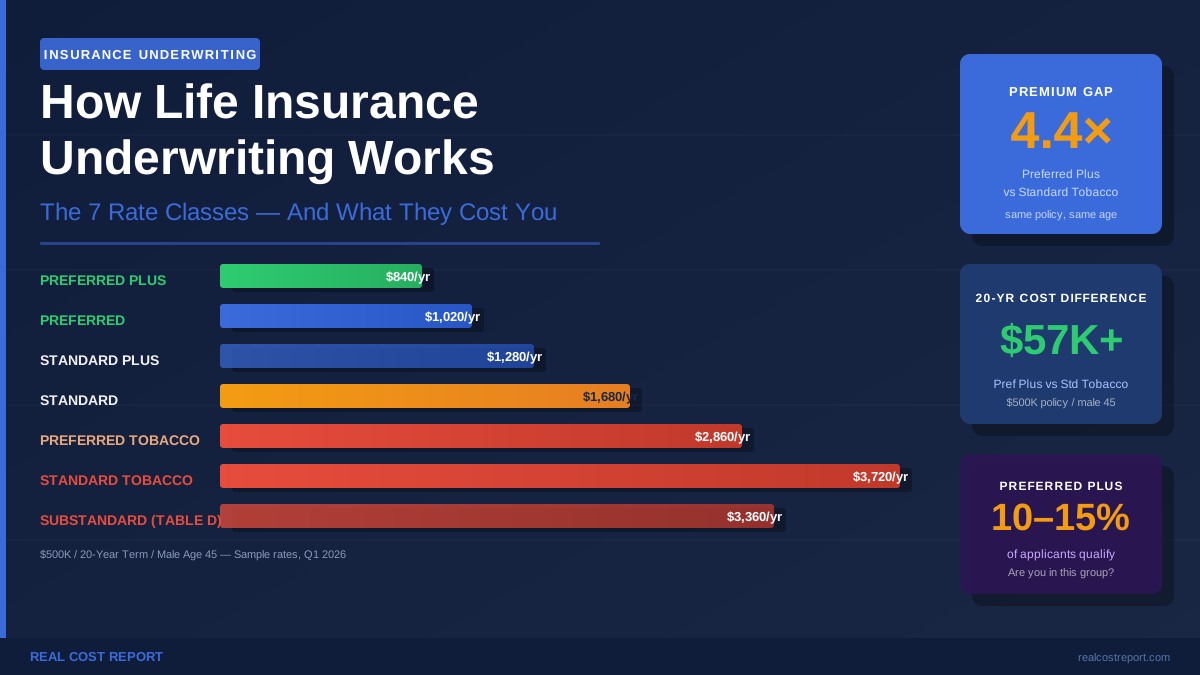
Rates shown are sample averages. Your premium varies by risk profile, state, and insurer.
TL;DR — Quick Verdict
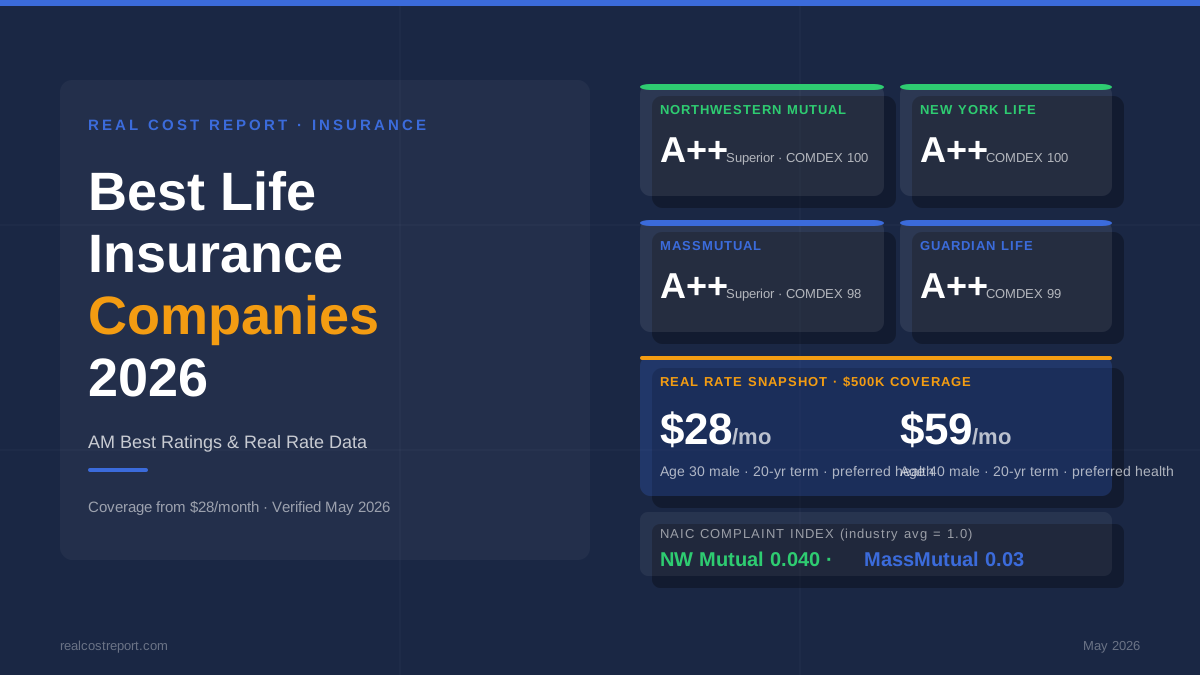
- Northwestern Mutual and New York Life hold the highest possible AM Best rating (A++, Superior) and perfect COMDEX scores of 100 — making them the gold standard for long-term financial strength.
- A healthy 35-year-old can secure $500,000 in 20-year term coverage for $25–$40 per month; waiting until 40 raises that same policy to $47–$59 per month.
- Northwestern Mutual leads all ranked insurers in complaint performance with an NAIC complaint index of 0.040 — 96% below the industry average of 1.0.
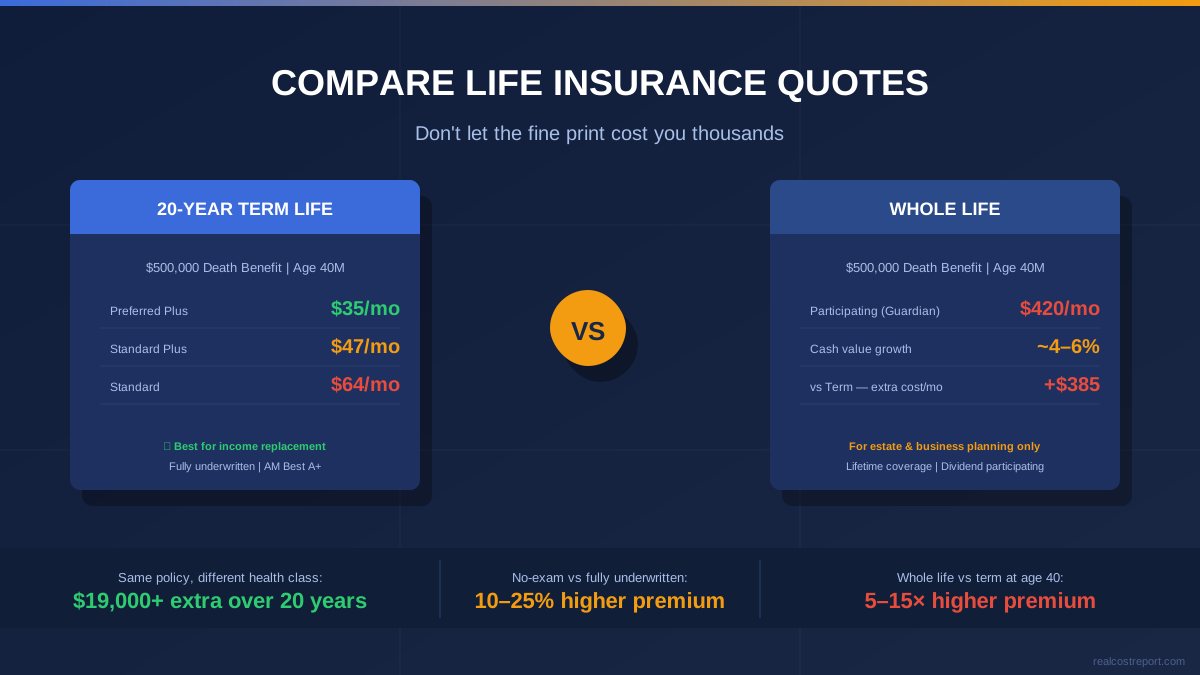
- Whole life costs 9–10× more than equivalent term coverage; a $500,000 whole life policy averages $303–$337 per month for a 40-year-old versus $47–$59 for a 20-year term.
- For buyers who prioritize affordability over brand prestige, Banner Life and Penn Mutual offer some of the lowest term rates, starting around $26 per month for $500K in coverage.
- Bottom line: Match your insurer choice to your need — A++ carriers for permanent policies or estate planning, competitive A-rated carriers for term coverage where pricing matters most.
A 40-year-old who buys a $500,000 whole life policy instead of a 20-year term policy will pay an estimated $182,880 more in premiums over two decades. That gap — real money that either funds your coverage or your retirement account — is why picking the right life insurance company matters as much as picking the right policy type. Yet most Americans overestimate what life insurance costs by a factor of three, according to a study cited by Forbes Advisor, which means they often delay applying until premiums are significantly higher. This article cuts through the confusion by comparing the best life insurance companies of 2026 using AM Best Financial Strength Ratings (FSRs), NAIC complaint index scores, and independently verified rate data for standard risk profiles. Northwestern Mutual, New York Life, and MassMutual dominate the financial strength rankings, while carriers like Banner Life and Protective compete hard on price for term buyers. Which matters more for your situation depends on what you’re buying — and how long you need it.
AM Best Ratings Explained: What A++, A+, and A Actually Mean
AM Best, founded in 1899, is the only major credit rating agency that focuses exclusively on the insurance industry. Its Financial Strength Rating (FSR) evaluates an insurer’s balance sheet strength, operating performance, and business profile — then assigns a letter grade reflecting the company’s ability to pay claims decades from now. That last part matters most for life insurance buyers: unlike auto or homeowners insurance where claims are resolved within months, a whole life or universal life policy may not pay a death benefit for 40 or 50 years.
The full secure rating scale runs from A++ down to B+. Anything below B+ is considered “vulnerable.” In practice, virtually every major life insurer you’ll encounter operates in the A range.
Source: AM Best Company (verify at ambest.com)
For long-term financial planning — estate strategies, infinite banking concepts, or retirement income riders — most independent advisors draw the line at A− or better. For a straightforward 10- or 20-year term policy, the difference between an A++ and an A− carrier is largely academic: insurers in both tiers have very strong claims-paying histories, and the more meaningful variable becomes price.
Top Life Insurance Companies in 2026: Ratings and Complaint Data Compared
The table below compares the leading life insurance carriers on the two metrics that matter most for long-term buyers: AM Best FSR and the NAIC complaint index. The NAIC index is benchmarked at 1.0, meaning a company at 1.0 received exactly as many complaints as expected for its market size. Anything below 1.0 represents fewer-than-average complaints — and the best carriers are dramatically below that threshold.
Sources: AM Best Company (verify at ambest.com); NAIC Complaint Index (verify at naic.org); COMDEX scores as of January 2026 per Insurance & Estates research
The complaint index tells a story that AM Best ratings alone cannot. Northwestern Mutual’s 0.040 complaint ratio means it generates 96% fewer complaints than the industry average — despite holding the largest U.S. life insurance market share at 6.76%, per 2024 NAIC data. That combination of scale and service quality is unusual and directly meaningful to long-term policyholders who will interact with their insurer for decades.
Real Rate Data: What $500,000 in Life Insurance Actually Costs in 2026
The single most persistent misconception about life insurance is cost. A 2025 study cited by Forbes Advisor found 82% of Americans over 25 overestimate what life insurance costs — by a wide margin. Here is what the market actually charges for $500,000 in coverage, stratified by age, gender, and term length for healthy nonsmokers in the preferred risk class.
Rates shown are sample averages. Your premium varies by risk profile, state, and insurer.
Sources: Guardian Life Insurance (verify at guardianlife.com); MoneyGeek rate analysis, 2026 (verify at moneygeek.com). Rates reflect preferred nonsmoker health class for $500,000 coverage. Individual quotes will vary.
Several dynamics worth understanding: the gender premium gap is real and consistent at every age tier, with women paying 15–25% less due to longer actuarial life expectancy. Smokers pay 40–80% more across all carriers — a 35-year-old female smoker on a 10-year term pays approximately $81 per month versus $28 for a nonsmoker on comparable coverage. Quitting for 12 consecutive months before applying can reclassify applicants as nonsmokers with most major carriers, saving hundreds annually. The 20-year term is the most common structure for working-age adults for good reason: it covers peak financial exposure years (mortgage, dependent children, income replacement) at a locked rate.
Term Life vs. Whole Life vs. Universal Life: Which Is Better for Your Situation?
The policy type decision matters more financially than the carrier decision in most cases. A 40-year-old choosing whole life over 20-year term for the same $500,000 death benefit will pay an estimated $122,400 more over 20 years. The question is whether the permanent protection and cash value accumulation justify that cost — and the answer genuinely depends on financial profile, not a universal rule.
Source: MoneyGeek life insurance rate analysis, 2026 (verify at moneygeek.com). Rates reflect nonsmokers with average health on $500,000 coverage.
Verdict
Term wins on cost for most buyers under 55 who have a defined financial exposure window — mortgage, dependent children, pre-retirement income. Whole life wins for estate planning needs, irrevocable trust funding, or buyers who have already maxed tax-advantaged retirement accounts and need another vehicle for tax-deferred growth. Universal life occupies the middle: more flexible than whole, more permanent than term, but requires active management of the policy’s cash value to avoid lapse. Do not buy permanent life insurance primarily for the investment component unless a licensed fiduciary has modeled its returns against comparable tax-advantaged alternatives.
What Most People Get Wrong When Comparing Life Insurance Companies
Choosing a life insurer is one of the longest financial commitments most people make. These are the specific mistakes that create real financial harm — not vague cautionary warnings, but documented decision errors with quantifiable consequences.
Mistake 1: Choosing by premium alone on permanent policies. A buyer who picks a universal life policy from a B-rated carrier over an A-rated carrier to save $40 per month may discover years later that adverse reserve assumptions force the carrier to increase premiums substantially or risk policy lapse. With permanent coverage, financial strength matters more than short-term savings. The AM Best rating directly predicts which carriers can sustain their guarantees over 30–50-year horizons.
Mistake 2: Skipping the medical exam to get faster approval. No-exam (accelerated underwriting) life insurance costs approximately $4 per month more for a healthy 40-year-old man on a $500,000 policy — $48 per year. Over a 20-year term, that totals $960 in extra premiums for identical coverage. For healthy applicants, fully underwritten policies almost always produce better rates. The main exception: applicants with mild health conditions who may perform better in simplified issue underwriting than under a full medical review.
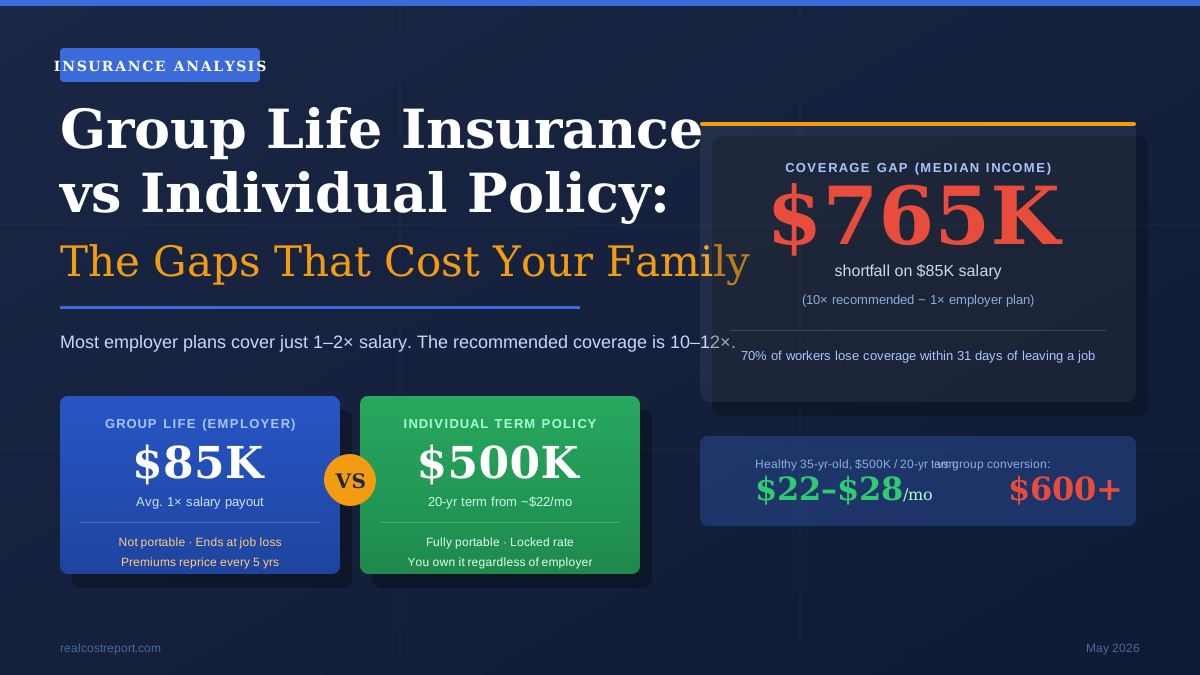
Mistake 3: Underinsuring by anchoring to round numbers. $500,000 sounds like a lot, but it represents less than 10 years of income for someone earning $55,000 annually when taxes and inflation are factored in. Standard actuarial guidance puts the right coverage at 10–12 times annual gross income. A household earning $90,000 with a mortgage and two children should be looking at $900,000–$1,000,000 in coverage — not half that because the monthly premium looks more comfortable.
Mistake 4: Assuming smoker status is permanent. Most life insurers reclassify applicants as nonsmokers after 12 consecutive months without tobacco or nicotine use. For a 45-year-old woman, that reclassification drops average 10-year rates on a $500,000 policy from $150 to $49 per month — a savings of $1,212 annually. Quitting before applying, not after, is the financially correct sequence.
Mistake 5: Not converting term coverage before it expires. Most term policies include a conversion rider that allows the policyholder to convert to permanent coverage without new underwriting — regardless of health changes. Failing to exercise this option before the conversion deadline can leave someone uninsurable at exactly the age when permanent coverage has the most value.
Which Life Insurance Company Is Right for You?
The right carrier depends on what you’re buying, when you’re buying it, and what financial role the policy plays. Here is a conditional framework based on the verified data in this article.
If you need straightforward term life insurance and price is the primary variable, start with A- or better carriers like Banner Life and Penn Mutual, which offer some of the market’s lowest term rates starting near $26 per month. Protective Life (A+ from AM Best) earned the U.S. News top ranking for best term life specifically and combines competitive pricing with strong financial ratings.
If you are buying whole life or universal life for estate planning, retirement income supplementation, or business insurance purposes, limit your search to A++ carriers: Northwestern Mutual, New York Life, MassMutual, and Guardian Life. All four hold perfect or near-perfect COMDEX scores and have paid dividends to policyholders for more than 100 consecutive years. The dividend history matters because it reflects actual mutual company financial management over market cycles, not just a theoretical rating.
If you have complex health history or are in a higher-risk category, Mutual of Omaha and John Hancock are known for more flexible underwriting. John Hancock’s Vitality program rewards documented healthy behaviors with premium discounts of up to 25%, making it the top choice for buyers with pre-existing conditions who are actively managing their health. Lincoln Financial and Transamerica offer competitive pricing for standard and substandard risk classes, though both carry NAIC complaint ratios higher than the mutual company leaders.
If you are over 60 and need permanent coverage, universal life becomes the stronger economic choice relative to whole life. At age 60, whole life averages $1,308–$1,443 per month for $500,000 in coverage, while universal life averages $765–$930 — a difference of $500 or more monthly that compounds significantly over time. Pacific Life earned the U.S. News top ranking specifically for universal life products in 2026.
If you want digital convenience and fast approval, MassMutual’s Haven Life subsidiary offers fully online term life applications with same-day approval for qualified applicants, backed by MassMutual’s A++ financial strength rating. Ethos and Ladder offer similar digital experiences with strong independent ratings, making them suitable for tech-comfortable buyers who want speed without sacrificing coverage quality.
What’s Changed in Life Insurance in 2026
Accelerated underwriting has reshaped the market. Where a fully underwritten policy once required a paramedical exam, blood draw, and a 4–8 week approval window, many carriers now issue policies in 24–72 hours using algorithmic risk assessment that pulls data from pharmacy records, motor vehicle reports, and the MIB database. The premium difference between exam-based and no-exam policies has narrowed to roughly $4–$8 per month for healthy applicants — a shift that removes one of the historical barriers to purchase.
Term life premiums remain historically competitive for healthy applicants in 2026. Permanent policy premiums have risen modestly due to adjusted actuarial assumptions and long-term interest rate normalization following years of compressed yields. The spread between term and permanent coverage, already wide, has widened slightly — reinforcing the economic argument for term coverage as the baseline for most working-age buyers. Comparing quotes across multiple insurers in 2026 shows wider price variation than in prior years for equivalent coverage amounts, according to Insuranceopedia’s 2026 rate analysis, making side-by-side shopping more valuable than it has been historically.
How We Researched This Article
Rate data in this article was drawn from two primary sources: Guardian Life Insurance’s published term rate tables (verify at guardianlife.com) and MoneyGeek’s 2026 life insurance rate analysis, which aggregates and verifies quotes across major carriers using standardized risk profiles — nonsmoker, preferred health class, $500,000 coverage amounts, verified as of early 2026. We cross-referenced the MoneyGeek figures against rate data published by Insurance.com, Insuranceopedia, and JRC Insurance Group (quotes valid as of January 20, 2026) to identify ranges that held across multiple sources rather than outliers from a single carrier’s promotional pricing.
AM Best Financial Strength Ratings were sourced directly from AM Best’s official rating database and cross-verified against January 2026 COMDEX score data published by Insurance & Estates, which compiles composite ratings across AM Best, S&P, Moody’s, and Fitch. NAIC complaint index figures were taken from the NAIC’s closed complaint ratio reports, as cited in Insurance.com’s 2026 life insurer ranking (survey of 2,000+ consumers, conducted 2025 via research firm Dynata) and ConsumersAdvocate.org carrier comparisons. Company-specific NAIC ratios reflect the most recent full-year reporting period available. For market share figures, we used the 2024 NAIC data cited in NAIC’s industry data and the U.S. News life insurance ranking published March 2026.
The rate modeling in this article reflects average figures for standard risk profiles and should not be used as a substitute for personalized quotes. Premium ranges were computed from multiple source averages rather than single carrier quotes to reduce promotional pricing bias. Policy type cost comparisons (term vs. whole life vs. universal life) use MoneyGeek’s 2026 average rate figures for a 40-year-old nonsmoker at $500,000 coverage as the standard scenario. Dividend histories and financial stability notes reflect publicly available carrier reporting. Regional rate variation was not modeled; readers in Montana should note that state law prohibits gender-based pricing, resulting in rates that differ from national averages for women. Research was conducted in May 2026. Insurance Information Institute resources were consulted for industry context and terminology verification. All figures were verified against named primary sources before publication.