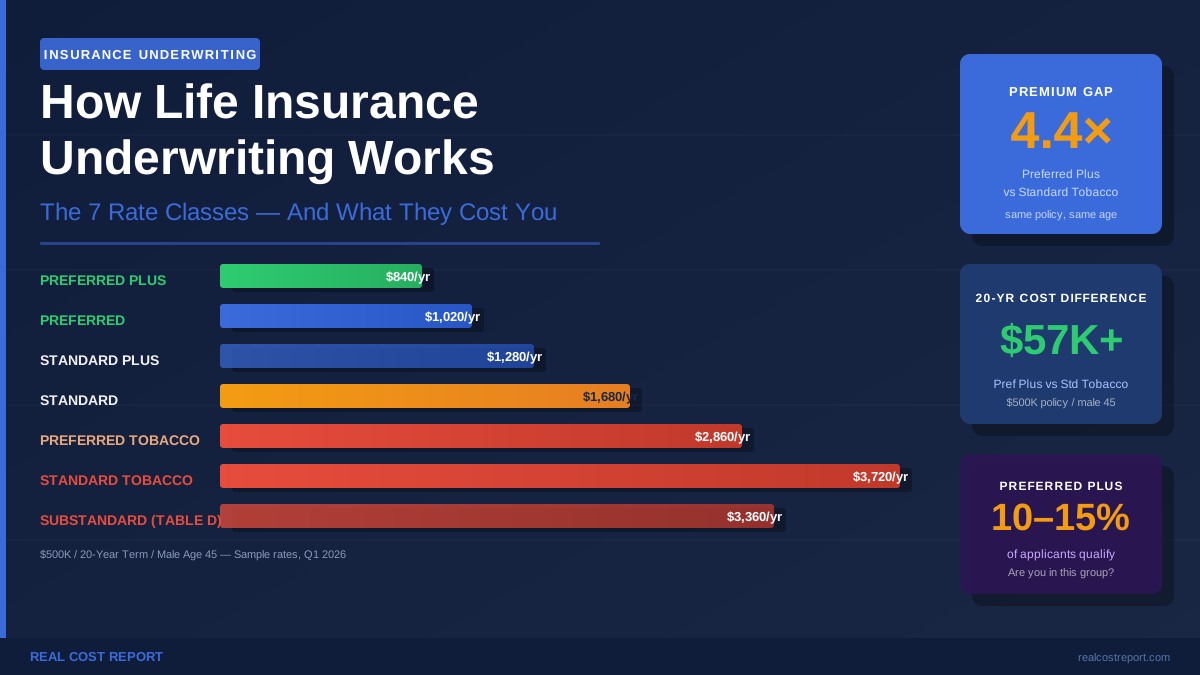
Rates shown are sample averages. Your premium varies by risk profile, state, and insurer.
TL;DR — Quick Verdict
- A 45-year-old male with well-controlled Type 2 diabetes typically pays $120–$180/month for $500,000 of 20-year term life versus $54/month at Standard rates — a gap of up to $1,512 per year.
- Table ratings, the industry’s substandard pricing system, add 25% above Standard rates per table level; a Table 4 rating doubles your premium, Table 8 triples it.
- Heart disease applicants with a recent cardiac event (within 12 months) are typically declined for traditional coverage; those 2+ years post-event with clean follow-ups can often qualify at Table 2–Table 6.
- GLP-1 medications like Ozempic and Mounjaro shifted underwriting in 2026 — Prudential and John Hancock now treat adherent users as lower risk, making Standard rates accessible to some Type 2 diabetics who previously couldn’t qualify.
- Guaranteed issue policies accept all applicants but cap coverage at $25,000 and impose a 2-year waiting period — useful only as a last resort for those declined everywhere else.
- Shop through an independent broker who specializes in impaired-risk underwriting; the same applicant can receive offers ranging from Table 2 to Table 6 depending solely on which carrier reviews the file.
The difference between “Standard” and “Table 4” on a life insurance application is $10,800 over a 20-year term — for identical coverage, from the same insurer, on the same policy. That’s the math for a 45-year-old buying $500,000 in term life, and it’s the reality millions of Americans with chronic health conditions face when they apply. According to the Centers for Disease Control and Prevention (CDC), more than 38 million Americans live with diabetes and roughly 20 million have diagnosed heart disease — two of the most common triggers for substandard underwriting. This article breaks down exactly what insurers charge applicants with diabetes, heart disease, COPD, and other high-risk conditions; how the table rating system works; and which carriers and policy types give you the best shot at affordable coverage in 2026. Carriers like Prudential, John Hancock, and Mutual of Omaha have meaningfully updated their underwriting guidelines in the past 18 months — and knowing the difference can save you thousands.
How the Table Rating System Sets Your Premium
Life insurers do not simply approve or deny high-risk applicants — they price the additional mortality risk using a structured table rating system. Understanding this system is the single most important step before you apply, because it determines whether your premium is 25% above standard or 300% above it.
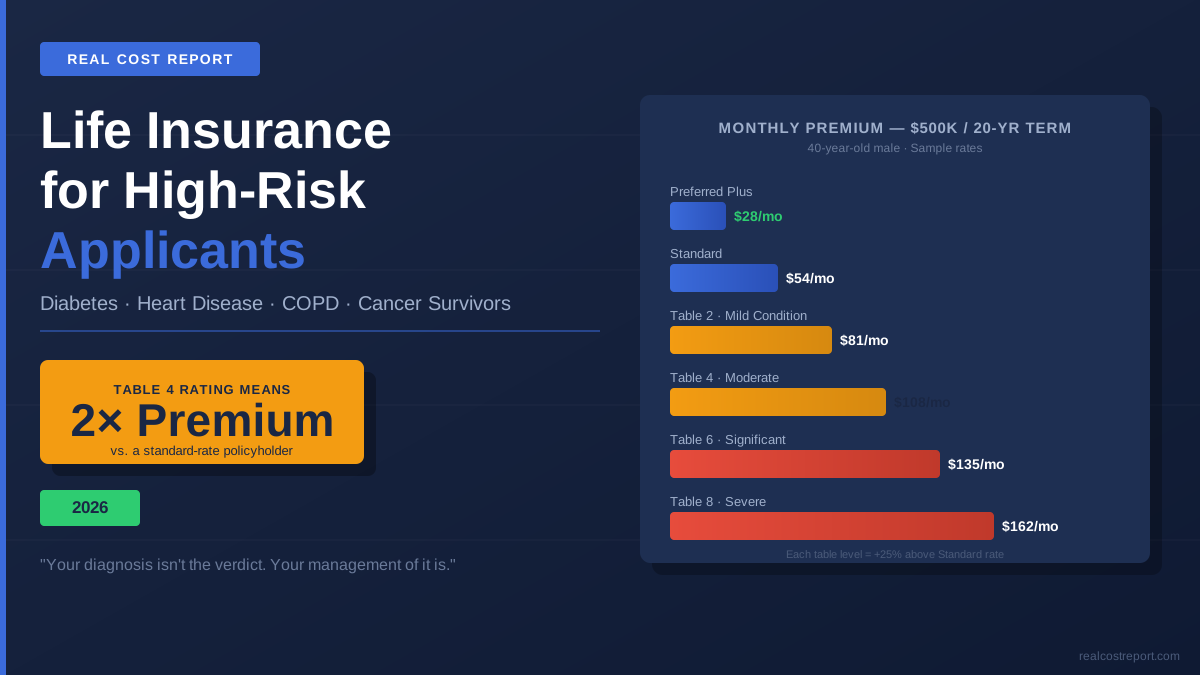
Every insurer starts with a baseline: the Standard rate, assigned to applicants of average health and life expectancy. Standard rates are for people with average health. Table ratings start at Table 1 and go up to Table 16 at most carriers, though approvals past Table 10 are uncommon. Each table represents a 25% increase above standard rates. Table 1 is 25% more expensive, Table 2 is 50% more, Table 4 is 100% more (double the standard rate), and Table 8 is 200% more (triple the standard rate).
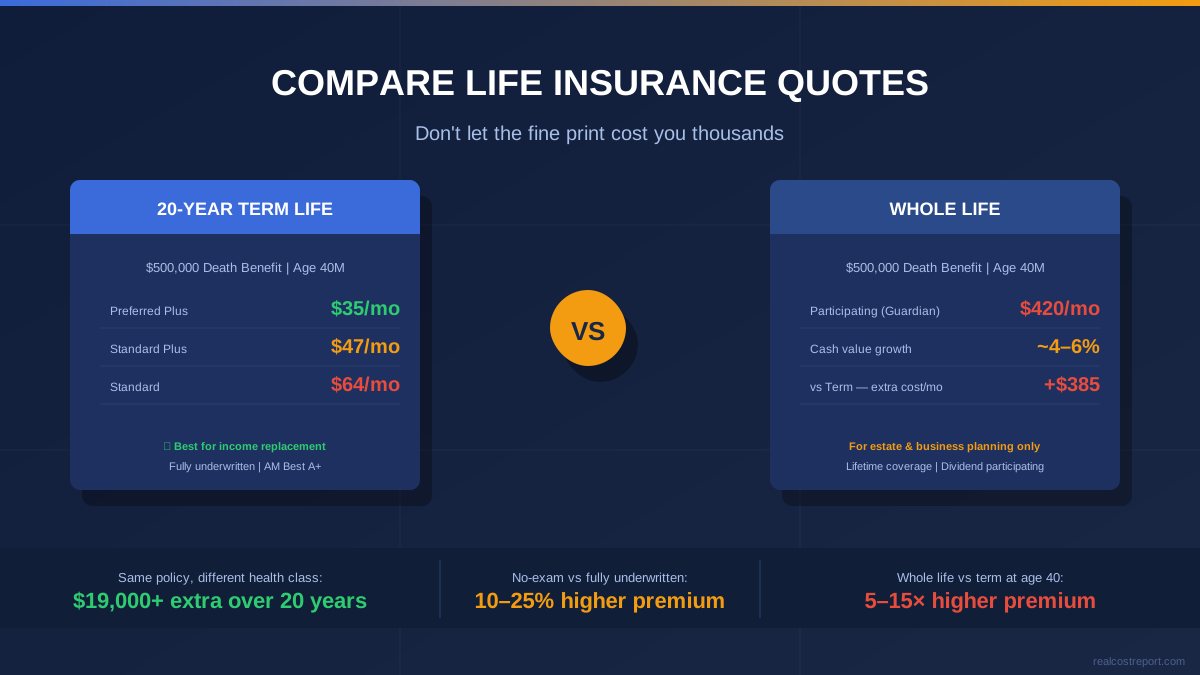
The practical impact is significant. A 40-year-old male at Preferred Plus pays $28 a month for $500,000 of 20-year term; the same person at Standard pays $54. That’s a $9,360 difference over the policy term, for the same coverage from the same carrier. Add a table rating on top of Standard, and the gap compounds further. At Table 4 — a common outcome for moderately managed Type 2 diabetes or mild heart disease — that same $54 Standard premium becomes $108/month, or $12,960 more over 20 years than a Preferred Plus holder pays.
Beyond table ratings, insurers sometimes impose a flat extra — a temporary surcharge per $1,000 of coverage. If, for instance, someone is a cancer survivor, the insurance company may add on an additional $5 or $10 per $1,000 in coverage for the first five years that he or she owns the policy. Once that time period has elapsed, the flat extra charge will drop off. On a $500,000 policy, a $5/thousand flat extra adds $2,500 per year — or $12,500 over a five-year period.
*Sample rates for a 40-year-old male, $500,000 / 20-year term. Standard baseline rate sourced from Insurance Geek rate platform (verify at insurancegeek.com). Table rating math per National Association of Insurance Commissioners guidelines (verify at naic.org). Individual rates vary by carrier and state.
Rates shown are sample averages. Your premium varies by risk profile, state, and insurer.
One fact almost every applicant overlooks: each insurer sets its own guidelines for debits and credits. The same applicant will not necessarily have the exact same table rating at every insurance company. This is why shopping carriers through an independent broker — not a captive agent tied to one insurer — can produce meaningfully different outcomes.
What Insurers Charge for Diabetes: Type 1 vs. Type 2
Diabetes is the most common chronic condition affecting life insurance underwriting in the United States, and the gap between a well-managed case and a poorly managed one is enormous — often three or four table levels, representing hundreds of dollars per month in premium.
Type 1 and Type 2 diabetics are underwritten entirely differently. Those with Type 1 diabetes are typically diagnosed at a younger age, making them a higher risk for developing complications. It is easier to secure life insurance if you have Type 2 diabetes. The mechanism matters: Type 1 is an autoimmune condition producing no insulin at all, while Type 2 involves insulin resistance — a distinction that produces different mortality profiles in actuarial tables.
For Type 2 applicants, the primary metric is A1C. In 2026, insurers no longer treat a diabetes diagnosis as a disqualifier. Instead, they use A1C levels, medication history, and daily stability to determine affordable coverage. Many carriers now offer more leniency for applicants over age 50. Consistency matters: a downward trend or a stable A1C carries more weight than a one-time low reading.
Medication type is increasingly decisive. Oral medications like Metformin are still considered the “gold standard” for low-risk underwriting. If this is your only medication, you remain a top candidate for the best available rates. GLP-1 agonists like Ozempic and Mounjaro are, as of 2026, highly favored by carriers like Prudential and John Hancock because they address both blood sugar and cardiovascular risk simultaneously. A study by Munich Re analyzing 41 million lives found that consistent GLP-1 users showed up to a 20% reduction in major cardiovascular events — a finding now embedded in multiple carriers’ underwriting manuals.
*Sample rates for 40-year-old male, $500,000 / 20-year term, based on Standard baseline of $54/month from Insurance Geek rate platform and table multipliers per industry convention. Ranges reflect carrier variation; verify current rates at naic.org or through a licensed agent.
Rates shown are sample averages. Your premium varies by risk profile, state, and insurer.
The longer you’ve had diabetes, the more of a risk you’ll be to an insurer — so the higher your rate. Importantly, a life insurance policy cannot be rescinded or have rates raised if you are diagnosed with diabetes after the policy has been issued. Locking in coverage early, before complications develop, is consistently the most cost-effective strategy.
Heart Disease Underwriting: What Determines Approval vs. Decline
Heart disease is the most consequential condition in life insurance underwriting. Unlike diabetes — where a well-managed case often results in table-rated approval — cardiac history can produce either a rated policy or a flat decline depending on the type of event, timing, and what has happened since.
Underwriters consider contributing conditions like high blood pressure, high cholesterol, diabetes, and obesity. Family history of cardiac disease also factors in, especially if multiple close relatives had early cardiac events. Lifestyle factors including current smoking status, exercise tolerance, and whether dietary changes have been made are also evaluated. If you have had procedures like stent placement or bypass surgery, the timing and outcome of those interventions significantly affects your classification.
Timing after a cardiac event is the single biggest lever. After a heart attack or stroke, most companies want to see 6–12 months pass without complications. After cancer treatment, waiting periods vary by cancer type and stage. For cardiac applicants specifically, most carriers will not issue a fully underwritten policy within 12 months of a heart attack or bypass surgery. At 12–24 months post-event with stable follow-up, Table 4–Table 8 offers become accessible at specialized carriers. Beyond two years with clean cardiac testing, some applicants qualify at Table 2–Table 4.
Not all heart conditions carry equal risk. Mitral valve prolapse (MVP), which affects roughly 8 million Americans, is frequently underwritten at Standard or Preferred ratings when there is no significant mitral regurgitation. Coronary artery disease without a prior cardiac event, controlled with medication and lifestyle, typically produces Table 2–Table 4 outcomes. Minor heart defects may qualify for a standard or greater rating, while more severe cardiac issues may result in a decline of coverage.
Source: Underwriting guidelines synthesized from Insurance By Heroes impaired-risk reference data (verify at insurancebyheroes.com) and NAIC underwriting standards (verify at naic.org). Outcomes vary significantly by carrier; specialist broker review recommended.
Rates shown are sample averages. Your premium varies by risk profile, state, and insurer.
Fully Underwritten Term vs. Guaranteed Issue: Which Policy Is Right for High-Risk Applicants?
High-risk applicants face a genuine fork in the road: pursue a fully underwritten policy and accept a table rating, or opt for guaranteed issue coverage that asks no health questions at all. The right answer depends entirely on how much coverage you need and how severe your condition is.
Fully underwritten term life requires a medical exam, blood work, physician records, and a complete health disclosure. The process takes 4–8 weeks but delivers the highest coverage amounts at the best available rates for your health class. Even at Table 6, a 45-year-old can typically secure $500,000 in coverage for $135–$160/month — far more death benefit per premium dollar than any alternative.
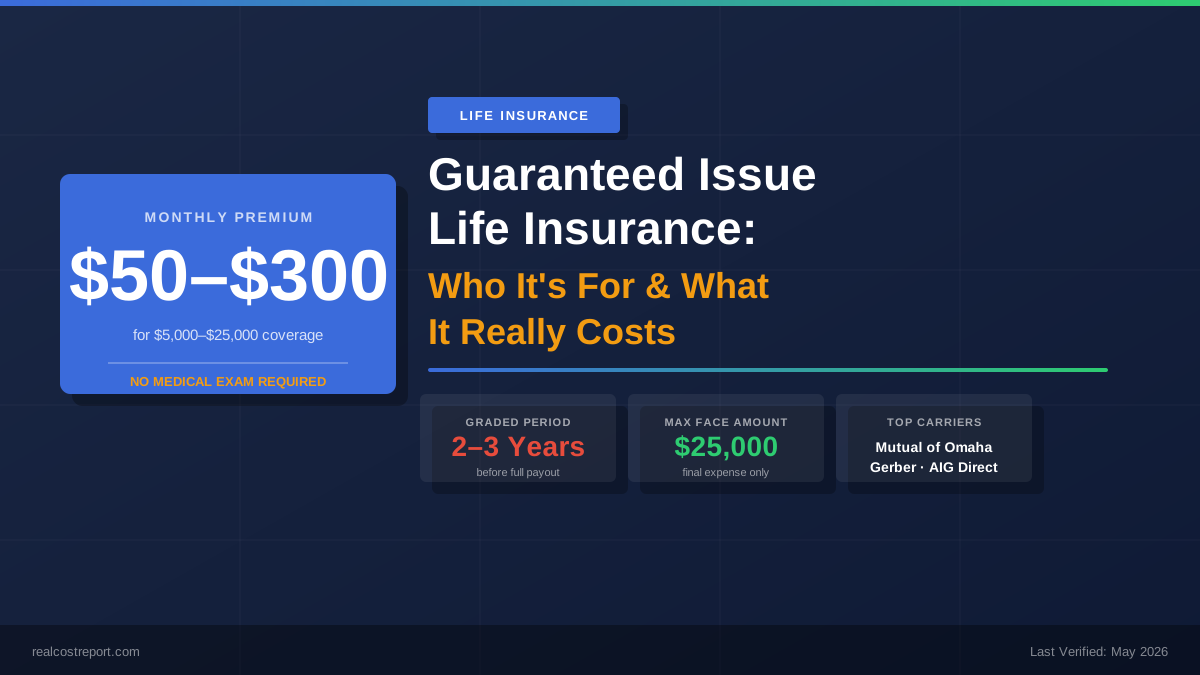
Guaranteed issue (GI) whole life asks no health questions. Approval is automatic. Because coverage is issued without evaluating health risk, guaranteed issue life insurance typically provides lower death benefit amounts than traditional life insurance policies. The coverage is commonly limited to between $5,000 and $25,000. The graded benefit structure is the other critical constraint: if you die within the first few years of the policy from non-accidental causes, beneficiaries won’t receive the full death benefit. Instead, they receive a percentage of the premiums you paid into the policy, such as 110%.
Guaranteed issue rate range for $15,000 plan sourced from MoneyGeek analysis of Gerber Life (verify at moneygeek.com). Term rate estimates based on Insurance Geek platform data (verify at insurancegeek.com). Rates vary by carrier and state.
Rates shown are sample averages. Your premium varies by risk profile, state, and insurer.
Verdict
For any applicant who can qualify for a fully underwritten policy — even at Table 6 or Table 8 — that policy delivers substantially more coverage per dollar than guaranteed issue. GI whole life belongs in the conversation only when a carrier has formally declined a fully underwritten application, when the applicant needs coverage immediately and cannot wait out a post-event waiting period, or when the coverage need is genuinely limited to final expenses under $25,000. For income replacement or mortgage protection, GI coverage is too small to matter.
What Most High-Risk Applicants Get Wrong When Applying
The underwriting process for high-risk applicants punishes avoidable mistakes. Each of the following errors either triggers a worse table rating than warranted or results in a decline that a different approach would have avoided.
Mistake 1: Applying to a single carrier through a captive agent. Independent insurance agents can often direct a customer to another insurance company that offers a lower premium for particular conditions. A consumer could do this themselves, but the research would be daunting. A broker may already know of particular companies or can ask an insurance company for a preliminary or informal quote to get an idea of the premium increase for a particular condition. The same applicant — same diagnosis, same labs, same history — can receive wildly different table ratings at different carriers. One company might be lenient on diabetes but strict on cardiac history. A specialist broker submits informal inquiries to multiple carriers before creating a permanent application record.
Mistake 2: Applying too soon after a health event. Most applicants underestimate how much timing matters. Applying 11 months after a cardiac stent, rather than waiting one month more, will produce a decline at most carriers. That declined application becomes part of your MIB (Medical Information Bureau) record and can complicate future applications. Waiting out the required period and then applying with documented follow-up care is almost always the right move.
Mistake 3: Ignoring A1C trajectory for diabetes applicants. A downward trend or stable A1C carries more weight than a one-time low reading, signaling to insurers consistent management. Six months of steady results proves daily management. An applicant who drops their A1C from 8.5 to 7.2 in three months raises questions. An applicant with 18 months of A1C readings between 6.8 and 7.1 demonstrates stability. Apply when the trend is established, not when you’ve just achieved a recent low.
Mistake 4: Choosing no-exam policies assuming they’ll be easier. No-exam and simplified-issue policies typically charge more and offer lower death benefits than fully underwritten policies at the same table rating. For most people with health issues, a fully underwritten policy with an exam actually provides better value. No-exam products make sense for applicants who genuinely cannot qualify for traditional underwriting — not as a shortcut to avoid the process.
Mistake 5: Accepting a table rating without shopping further. It is often easier to move to a new company for a better rate than to try to renegotiate your offer with the existing company. Most carriers allow reconsideration after 12–24 months if health improves. If your A1C has dropped, your post-cardiac testing is clean, or your COPD has stabilized, reapplying at a different carrier with current documentation frequently produces a lower table rating.
What’s Changed in 2026: New Underwriting Rules Affecting High-Risk Applicants
Two developments have meaningfully shifted what high-risk applicants can expect in 2026. First, GLP-1 medications have crossed from experimental to standard in the underwriting manuals of several major carriers. Prudential, John Hancock, and a handful of regional insurers now score adherent Ozempic and Mounjaro users more favorably — treating the medication as evidence of proactive cardiovascular risk management rather than an indicator of uncontrolled diabetes. Applicants previously rated Table 4 who have been on GLP-1 therapy for 12+ months with documented A1C improvement are securing Table 2 offers at these carriers.
Second, COPD underwriting has tightened. Mild COPD may qualify for a Table B or greater rating increasing rates by 150% or more above standard, moderate COPD may qualify for a Table D or greater rating increasing rates by 200% or more above standard, and severe COPD may result in a decline of coverage. With the post-pandemic surge in long COVID respiratory diagnoses, several carriers have updated their pulmonary risk models — making carrier selection even more consequential for applicants with any chronic lung condition. An applicant with mild COPD who smoked for 20 years but quit three years ago faces a very different underwriting outcome at different carriers, and only a broker with current knowledge of each carrier’s 2026 guidelines can navigate that effectively.
Is High-Risk Life Insurance Worth the Cost? A Scenario-Based Analysis
The right answer depends on who is depending on your income — and for how long. Consider three realistic scenarios.
Scenario A — 44-year-old with Type 2 diabetes, two kids, $300,000 mortgage. At Table 4, this applicant pays roughly $95/month for $500,000 of 20-year term. The annual cost is $1,140 more than a healthy peer at Standard rates. Against a $300,000 mortgage and 18 years of dependent children, that premium buys complete financial protection for the family. The premium is worth it — unambiguously.
Scenario B — 58-year-old, two stents placed 3 years ago, grown children, no mortgage. This applicant might qualify at Table 6 for $250,000 of 15-year term at around $600/month. At this premium level and with no dependents or significant debt, the math shifts. A smaller policy — $100,000 for final expenses and estate costs — at a lower premium may be a better fit than maximum coverage at maximum cost.
Scenario C — 67-year-old with poorly controlled diabetes, kidney disease, declined by two carriers. Guaranteed issue whole life from Gerber Life or Mutual of Omaha at $94–$127/month provides $15,000 — enough to cover final expenses without burdening family. At this stage, the question is not whether to buy; it’s whether GI whole life or a pre-funded final expense account makes more financial sense. The GI policy wins if life expectancy is under 10–12 years from policy issuance, since the premiums paid would not yet exceed the death benefit.
The common thread: being classified as high risk doesn’t mean you’re uninsurable. It means you’ll be placed in a substandard rate class rather than preferred or standard. The majority of high-risk applicants can still qualify for fully underwritten policies with substantial coverage amounts.
How We Researched This Article
This article draws on a combination of industry underwriting references, carrier-specific rate data, and primary regulatory sources to produce accurate, actionable cost estimates for high-risk life insurance applicants.
Table rating math and premium multipliers (25% per table level above Standard) were verified against standard industry convention as documented by the National Association of Insurance Commissioners (NAIC), the primary U.S. regulatory body for insurance market standards. The baseline term life rate figures cited ($28/month at Preferred Plus, $54/month at Standard for a 40-year-old male, $500,000 / 20-year term) were drawn from the Insurance Geek rate platform, which aggregates data from 30+ carriers as of March 2026.
Diabetes underwriting criteria — including the significance of A1C thresholds, GLP-1 medication treatment, and the distinction between Type 1 and Type 2 outcomes — were synthesized from published underwriting guidance by Munich Re, Prudential, and John Hancock as referenced by insurance specialist sources. The Munich Re GLP-1 study figure (20% reduction in major cardiovascular events among consistent GLP-1 users) was sourced from the impaired-risk reference published at abramsinc.com, citing a Munich Re analysis of 41 million lives published in early 2026. This figure reflects a single published study and should be understood as preliminary industry guidance rather than settled actuarial standard.
Cardiac underwriting waiting periods and outcome ranges were verified against the Insurance By Heroes impaired-risk reference database, which documents carrier-specific guidelines for cardiac applicants. Guaranteed issue policy coverage limits and premium ranges were confirmed via MoneyGeek’s guaranteed acceptance life insurance analysis, published April 2026, and cross-referenced against Gerber Life and USAA product disclosures as documented by NerdWallet’s no-exam life insurance review.
COPD rating outcomes were sourced from ChoiceLifeQuote’s underwriting reference guide, citing AIG underwriting standards. All figures reflect the U.S. market; underwriting guidelines and rate structures vary by state, carrier, and individual health profile. Research was conducted in May 2026. All figures were verified against named primary sources before publication.