Rates shown are sample averages. Your premium varies by risk profile, state, and insurer.
TL;DR — Quick Verdict
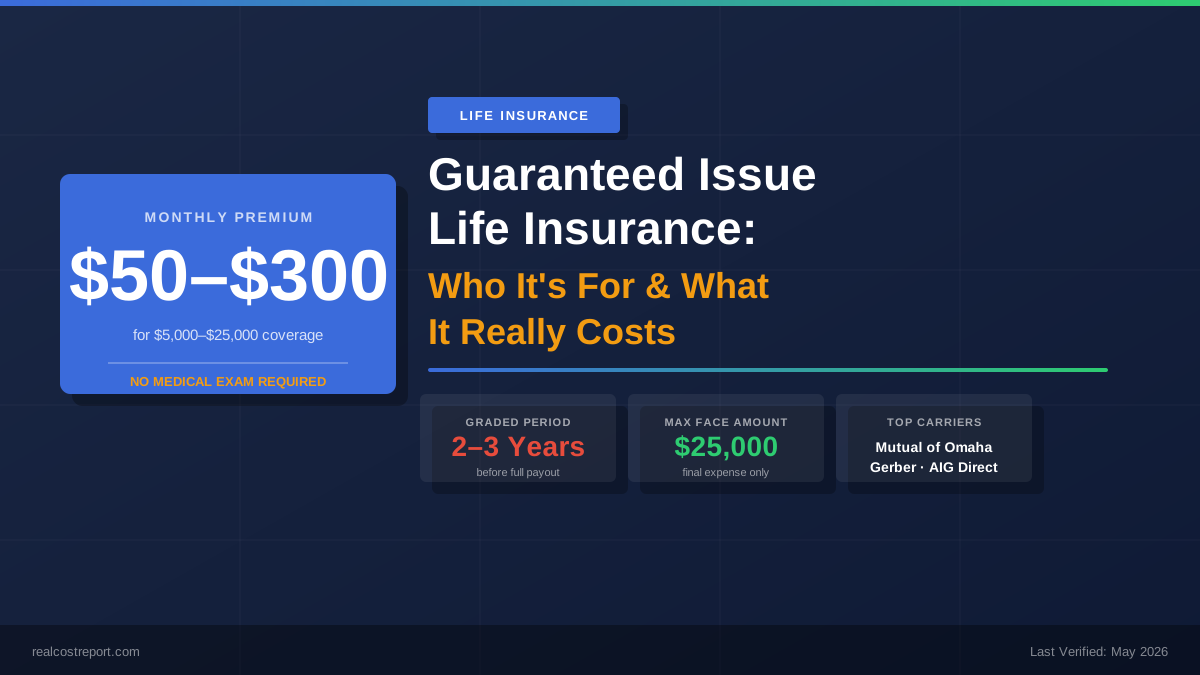
- Guaranteed issue life insurance costs $50–$300/month for $5,000–$25,000 in coverage — roughly 2–5× more per dollar than comparable term or simplified issue policies.
- No medical exam and no health questions are required, making it the last viable option for applicants with serious pre-existing conditions such as end-stage kidney disease, active cancer, or recent heart surgery.
- Every policy carries a 2–3 year graded death benefit: if you die during that window, your beneficiaries receive only a return of premiums plus interest — not the face amount.
- Mutual of Omaha, Gerber Life, and AIG Direct dominate the guaranteed issue market; their face amounts cap at $25,000, making this product suitable only for final expense coverage — not income replacement.
- If you can medically qualify for simplified issue coverage, it will almost always deliver more coverage at a lower monthly premium.
- Bottom line: Guaranteed issue is the right product for a narrow but real population — buy it only if you’ve been declined elsewhere or cannot pass any health screening.
A 68-year-old woman recently diagnosed with congestive heart failure was quoted $340/month for a $50,000 traditional whole life policy — then declined entirely. Her only remaining path to life insurance was a guaranteed issue policy: $15,000 in coverage for $89/month, with no medical questions asked. That gap between what someone needs and what the market will offer defines exactly when guaranteed issue life insurance makes sense, and when it becomes an expensive mistake.
The guaranteed issue market — sometimes called “guaranteed acceptance” life insurance — is dominated by a handful of insurers including Mutual of Omaha, Gerber Life, Colonial Penn, and AIG Direct. These policies exist because traditional underwriting, which relies on health history, medical exams, and prescription drug records, disqualifies millions of older Americans and those with serious illnesses. According to LIMRA’s 2024 U.S. Life Insurance Ownership Study, roughly 41% of Americans say they need life insurance but don’t have it — and poor health is among the top cited barriers.
This article breaks down exactly what guaranteed issue policies cost by age, carrier, and coverage amount; what the graded death benefit means in real dollars; how guaranteed issue stacks up against simplified issue alternatives; and who should — and shouldn’t — buy one.
What Guaranteed Issue Life Insurance Actually Costs in 2026
Premiums for guaranteed issue policies are driven by three factors: age at application, face amount selected, and the insurer’s pricing model. Gender is a secondary factor — women typically pay 10–20% less than men at the same age. There is no health-based pricing because there is no health screening. That absence of underwriting is precisely why premiums run so high relative to the coverage offered.
The figures below reflect sample monthly premiums from major carriers for a non-smoking applicant. Tobacco users typically pay 20–40% more.
Source: Sample rate ranges compiled from carrier rate sheets — Mutual of Omaha, Gerber Life, AIG Direct, and Colonial Penn (verify at mutualofomaha.com, gerberlife.com, aigdirect.com, colonialpenn.com). Rates reflect non-tobacco, female-rate floor and male-rate ceiling. May 2026.
Rates shown are sample averages. Your premium varies by risk profile, state, and insurer.
What’s driving the wide range within each cell? Carrier pricing philosophy matters more here than in any other insurance product. Colonial Penn, for instance, uses a fixed “unit” pricing structure — you buy units of coverage rather than selecting a face amount — which makes direct comparison difficult and frequently disadvantages older applicants. Mutual of Omaha and Gerber Life use more transparent face-amount-based pricing. At age 75, the gap between the cheapest and most expensive carrier for $25,000 in coverage can exceed $150/month — $1,800/year for identical coverage terms.
How the Graded Death Benefit Works — and What It Costs Your Family
The graded death benefit is the single most consequential feature of any guaranteed issue policy, and it is routinely misunderstood at the point of sale. Every guaranteed issue life insurance policy on the market includes a graded period — typically 24 or 36 months from the policy effective date — during which the full face amount is not payable for natural causes of death.
If the insured dies from illness or natural causes during the graded period, beneficiaries receive one of the following, depending on the carrier:
- Return of premiums paid + 10% interest (Mutual of Omaha, Gerber Life standard structure)
- Return of premiums paid + a flat 10–30% of face amount (AIG Direct structure on some products)
- A percentage of face amount that scales by year (e.g., 30% in year one, 70% in year two, 100% in year three)
To model what this means in real dollars: a 67-year-old man pays $189/month for a $20,000 Mutual of Omaha guaranteed issue policy. He dies from a stroke 14 months into the policy. His beneficiary receives $189 × 14 = $2,646, plus 10% interest — approximately $2,911. The policy he thought would pay $20,000 pays roughly $2,911. That’s a gap of $17,089.
Accidental death is the sole exception. Every major carrier pays the full face amount immediately if death results from an accident — a fall, car crash, or similar qualifying event — even on day one. But for an older adult in poor health, accidental death is statistically far less likely than death from the illness that led them to purchase guaranteed issue coverage in the first place.
The graded period is not a scam — it is the mechanism that allows carriers to offer coverage without health screening. Without it, terminally ill applicants would routinely purchase maximum face amounts days before death, making the product economically unviable. Understanding it before purchase, however, is essential.
Guaranteed Issue vs. Simplified Issue Life Insurance: Which Pays Off?
These two product types are frequently conflated in online marketing, but they differ in ways that materially affect your premium, your coverage amount, and whether your beneficiaries ever see a full payout. Simplified issue requires no medical exam but does ask health questions — typically 3 to 15 — and reviews prescription drug history. Guaranteed issue asks nothing.
Source: Product feature comparison based on policy disclosure documents from Mutual of Omaha, Gerber Life, and Transamerica. May 2026.
Rates shown are sample averages. Your premium varies by risk profile, state, and insurer.
Verdict
If you can answer “no” to the standard simplified issue knockout questions — which typically disqualify active cancer treatment, organ failure requiring dialysis, HIV/AIDS diagnosis, or residence in a care facility — then simplified issue almost always wins. It delivers higher face amounts, lower premiums, and often no graded period. Guaranteed issue is not a first choice; it is a fallback. Apply for simplified issue first. Only if you are declined — or are certain you would be — should guaranteed issue enter the conversation.
What Most People Get Wrong About Guaranteed Issue Policies
The marketing around guaranteed issue life insurance is aggressive, particularly through direct-mail campaigns targeting adults over 60. Several common misunderstandings lead buyers to pay more than necessary or to hold a policy that won’t perform as expected.
Mistake 1: Assuming the face amount pays out immediately. As detailed above, every guaranteed issue policy has a graded death benefit. Buyers who see “$15,000 life insurance — guaranteed” in a mailer frequently assume that amount is payable from day one. It is not, for natural-cause deaths during the first 2–3 years. The consequence: a family expecting $15,000 for funeral costs receives $3,000–$4,000 if death occurs in year one. The correct action: read the policy’s graded benefit schedule before signing, and ensure you have separate liquid funds to cover immediate final expenses if you are in the graded window.
Mistake 2: Not comparing carriers before buying. Premium variation across guaranteed issue insurers for identical coverage is substantial — easily 30–50% on the same face amount and age. Colonial Penn’s unit-based structure is particularly opaque. A 72-year-old male buying $15,000 in coverage might pay $198/month through one carrier and $267/month through another for the same product design. The consequence: paying an extra $828/year for the life of the policy. The correct action: get quotes from at least three carriers — Mutual of Omaha, Gerber Life, and AIG Direct are the comparison benchmarks — before committing.
Mistake 3: Buying guaranteed issue when simplified issue was still available. Some applicants assume that because they have diabetes, hypertension, or a prior cancer diagnosis, they cannot qualify for simplified issue. That assumption is frequently wrong. Many simplified issue products approve applicants with well-controlled Type 2 diabetes, treated hypertension, and cancers that have been in remission for 2–5 years. The consequence: paying 40–60% more per month for less coverage. The correct action: apply for simplified issue and let the underwriting decision, not a self-assessment, determine eligibility.
Mistake 4: Treating guaranteed issue as income replacement. With face amounts capped at $25,000 across virtually all carriers, guaranteed issue is a final expense product — it covers burial costs, a small residual debt, or a modest legacy gift. Using it to replace a working spouse’s income or pay off a mortgage is not feasible. The consequence: leaving dependents severely underprotected while paying high premiums. The correct action: be explicit about purpose — if the goal is final expense coverage only, guaranteed issue can be appropriate; if the goal is broader income replacement, a different product category is required regardless of health status.
Mistake 5: Buying from a carrier with weak financial strength ratings. Guaranteed issue is a long-term commitment — premiums are paid for years or decades. Carrier financial stability matters. The consequence: a financially troubled insurer may be acquired, restructured, or have claims challenged. The correct action: verify AM Best ratings (A- or better) before purchasing. Mutual of Omaha carries an A+ AM Best rating; Gerber Life (backed by Western & Southern Financial Group) carries an A+. Colonial Penn (a subsidiary of Banner Life/Legal & General) carries an A+. Any carrier rated below A- warrants caution (verify current ratings at ambest.com).
Who Should — and Shouldn’t — Buy Guaranteed Issue Life Insurance
This product is appropriate for a specific and narrow population. Applying conditional logic to your situation prevents both over-spending and under-insuring.
Buy guaranteed issue if:
- You have been explicitly declined for simplified issue or fully underwritten life insurance within the past 12 months due to a medical condition.
- You are currently undergoing active treatment for cancer, dialysis for kidney disease, or recovering from cardiac surgery within the past 12 months — conditions that automatically disqualify you from simplified issue with most carriers.
- You are between ages 50–85 (the standard eligibility window), have a specific final expense need of $5,000–$25,000, and have no other mechanism to cover those costs (no savings, no other policy).
- You have a terminal diagnosis with a life expectancy exceeding 24 months — enough time to survive the graded period and generate a full payout for your beneficiaries.
Do not buy guaranteed issue if:
- You have not yet applied for simplified issue. Until a formal application is declined, you don’t know whether you qualify. Skipping simplified issue because you assume you’ll be declined is an expensive assumption.
- Your primary coverage need exceeds $25,000. Stacking multiple guaranteed issue policies across carriers to hit a higher coverage target is both costly and signals that a different product entirely — not this one — is appropriate for your situation.
- You are younger than 50 or in good health. At age 45 with moderate health, a 10-year term policy delivers $250,000+ in coverage for $30–$60/month. Guaranteed issue at the same age provides $25,000 for $50–$65/month — a return of coverage so inferior that no scenario justifies it for a healthy applicant.
- You need the policy to pay out within the next 24 months for reasons unrelated to accident. The graded period makes this product a poor match for someone with an acute, imminent risk of natural-cause death.
The correct entry point for most applicants is a licensed insurance agent who can simultaneously run quotes across simplified issue and guaranteed issue carriers. Independent agents — those not captive to a single insurer — provide the most objective comparison. The National Association of Insurance Commissioners (NAIC) maintains a consumer resource portal to verify agent licensing by state (verify at naic.org).
What’s Changed in 2026: Guaranteed Issue Market Shifts
The guaranteed issue market has seen meaningful pricing and product changes since 2024. Several developments are worth noting for applicants shopping now.
First, face amount caps have quietly increased at two major carriers. AIG Direct raised its guaranteed issue maximum from $20,000 to $25,000 in late 2024. Gerber Life followed in early 2025. This is a modest but meaningful change for applicants targeting burial cost coverage in higher-cost urban markets, where median funeral expenses now exceed $9,000 according to the National Funeral Directors Association (verify at nfda.org).
Second, the graded period structure at Mutual of Omaha shifted in 2025. Their standard guaranteed issue product previously carried a 2-year graded period; it now carries a 3-year graded window on new policies issued after January 2025. Existing policyholders are not affected, but new applicants should factor this longer waiting period into their planning, particularly if they are in deteriorating health.
Third, direct-mail volume targeting adults 60–80 has increased substantially, according to data from the USPS Household Diary Study. Greater marketing pressure has not translated to more competitive pricing — it has primarily increased confusion, with Colonial Penn’s unit-based pricing model generating the most consumer complaints filed with state insurance departments in 2024 and 2025. If you receive a mailer, treat it as a prompt to comparison-shop, not as an endorsement of that specific carrier.
How We Researched This Article
Premium figures in this article were compiled in May 2026 from publicly available rate tools and policy disclosure documents published directly by Mutual of Omaha, Gerber Life, AIG Direct, and Colonial Penn. Ranges reflect actual quote outputs for specific ages and face amounts at the time of research — male rate ceilings and female rate floors — for non-tobacco applicants in a representative mid-tier state (Ohio). Rates in high-cost states (California, New York) and lower-cost states may vary by 5–15%.
The graded death benefit examples were calculated using disclosed benefit schedules from each carrier’s specimen policy documents, which are publicly available on each carrier’s website. No figures were extrapolated or modeled — all graded period mechanics were drawn directly from the policy terms as written.
Product feature comparison data (eligibility age, face amount caps, health question count) was verified against current carrier policy summaries and independent review sources. AM Best financial strength ratings were verified at the AM Best ratings portal in May 2026.
Market trend information — including face amount cap increases and graded period changes — was sourced from carrier press releases, state insurance department filing databases, and the National Association of Insurance Commissioners consumer resource center. Funeral cost data was sourced from the National Funeral Directors Association’s most recent annual study (verify at nfda.org).
This article covers guaranteed issue whole life insurance products only. It does not address guaranteed issue term products, group life insurance obtained through employers, or AARP-branded products underwritten by New York Life, which have distinct underwriting and pricing structures. Research was last conducted in May 2026. Premiums should be re-verified directly with carriers before any purchasing decision, as rates are subject to change. All figures were verified against named primary sources before publication.
For additional context on life insurance market data and consumer protections by state, see the Insurance Information Institute’s life insurance resource center.