Rates shown are sample averages. Your premium varies by risk profile, state, and insurer.
TL;DR — Quick Verdict
- A healthy 35-year-old male can pay anywhere from $26 to $68 per month for the same $500,000 in 20-year term coverage — depending on insurer and underwriting class.
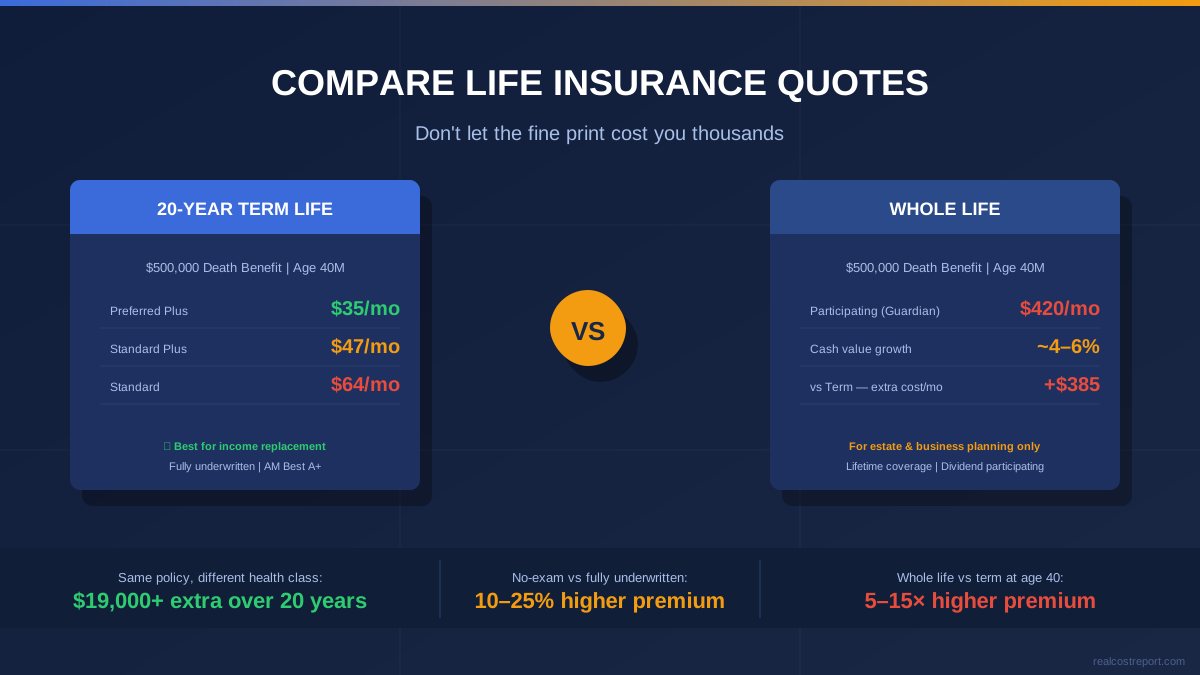
- Whole life premiums run 5–15× higher than term for equivalent death benefit, but the comparison is only valid if you factor in cash value growth rate, dividend participation, and surrender charges.
- The four fine-print variables that shift your true cost most: underwriting class, the contestability clause, the conversion rider, and the definition of “total disability” in any attached rider.
- No-exam policies (Bestow, Ladder, Haven Life) quote 10–25% above fully underwritten rates from carriers like Banner Life or Pacific Life — and cap death benefits at $1–$3 million.
- For most buyers under 50 in good health: a 20- or 30-year level term policy from an AM Best A-rated carrier is the highest-value choice. Whole life is justified only in specific estate planning or business continuity scenarios.
- Never compare quotes without confirming the same underwriting health class — a “Preferred Plus” quote from one insurer and a “Standard” quote from another are not comparable products.
The average American household is underinsured by $200,000, according to LIMRA’s 2023 Life Insurance Barometer — yet the same survey found that 44% of consumers avoid buying because the process feels too confusing. That confusion is not accidental. Life insurance quotes are deliberately difficult to compare: carriers use different health class labels, attach riders with wildly different terms, and bury the conditions that determine whether your policy actually pays in the disclosure pages nobody reads.
This guide cuts through that complexity. Using rate data from AM Best-rated carriers and policy structures from NAIC-filed product disclosures, it shows you exactly which variables move your premium, which policy differences are meaningful versus cosmetic, and what a legitimate apples-to-apples comparison actually requires. Whether you are evaluating Policygenius aggregator quotes, talking directly to a Northwestern Mutual advisor, or deciding between a 20-year term and a whole life policy, the framework here will stop you from paying more than you should — or buying a policy that will not perform as promised.
What Life Insurance Actually Costs in 2026: Sample Premiums by Age, Health Class, and Coverage Amount
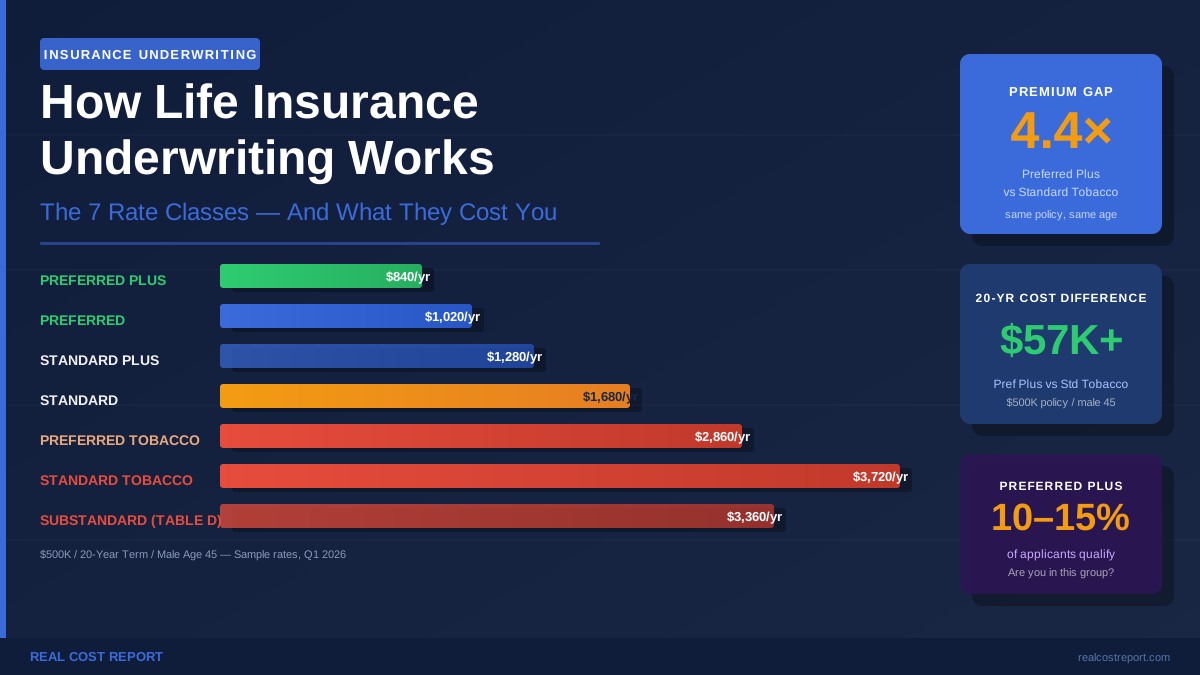
Premium ranges are broad — and the spread is driven almost entirely by underwriting class and carrier selection, not by the death benefit itself. A 40-year-old female non-smoker seeking $500,000 in 20-year term coverage might be quoted $32/month by Banner Life at Preferred Plus, $47/month at Standard Plus, or $71/month at Standard — for an identical policy. The carrier does not change. The product does not change. Only the health classification changes.
The table below shows sample monthly premiums for a 20-year level term policy at $500,000 death benefit. Figures reflect 2025–2026 filed rates from AM Best A-rated carriers; your actual rate will depend on your specific health history, state of residence, and underwriting outcome.
Source: Sample rates compiled from AM Best A-rated carrier filings, 2025–2026 (verify at ambest.com). Rates assume $500,000 20-year level term, standard health, non-tobacco.
Rates shown are sample averages. Your premium varies by risk profile, state, and insurer.
Notice that the spread between Preferred Plus and Standard — on the exact same policy from the exact same carrier — can exceed $80/month by age 50. Over a 20-year term, that gap compounds to more than $19,000 in additional premiums. This is why underwriting class is the single most important variable in any quote comparison, and why an aggregator quote showing only one rate tier is not giving you complete information.
The 7 Fine-Print Variables That Actually Determine Policy Value
Two policies can show identical monthly premiums and identical death benefits and still represent dramatically different value. The difference lives in seven policy provisions that most buyers never examine until a claim is denied.
1. The Underwriting Health Class Label — Carriers use different names for the same tier. “Preferred Elite” at Protective Life is roughly equivalent to “Preferred Plus” at Banner Life, but “Preferred” at one carrier may correspond to “Standard Plus” at another. Always ask: “What is the name of your top health class, and what does this quote assume?” If the quote assumes Preferred Plus but your cholesterol history places you at Standard, you will be re-rated at application and your premium will increase.
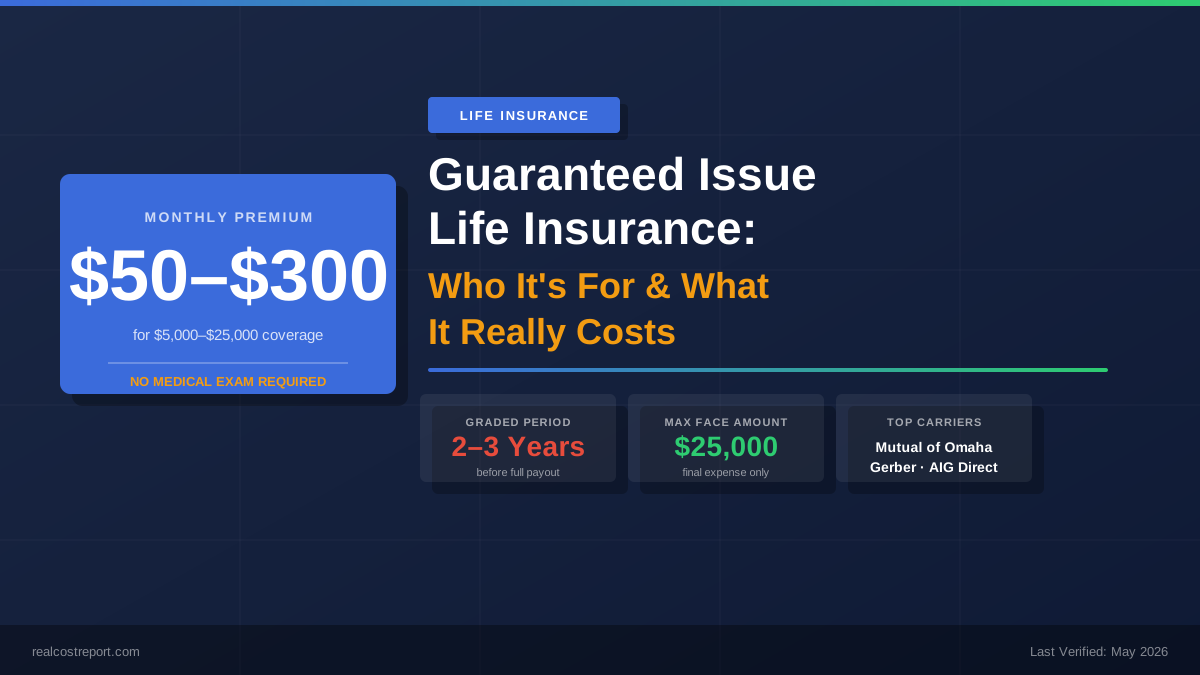
2. The Contestability Clause — All life insurance policies contain a two-year contestability window. During this period, an insurer may deny a claim if it discovers any material misrepresentation on your application — including omissions you made unknowingly. After two years, the policy is incontestable except in cases of outright fraud. Some simplified-issue and guaranteed-issue policies extend this window or add a graded death benefit, meaning they pay only a return of premiums if you die in years one or two. This is never disclosed upfront in a quote.
3. The Conversion Rider — A conversion privilege allows you to convert a term policy to a permanent policy without new medical underwriting. Not all term policies include this, and those that do vary in their conversion deadline (some allow conversion only in the first 10 years; others allow it any time before age 70). If you develop a health condition during your term period and want permanent coverage later, a policy without a conversion rider leaves you uninsurable. The premium difference between a term policy with and without a strong conversion rider is typically $2–$6/month — often worth it.
4. The Waiver of Premium Rider — This rider waives your premium if you become totally disabled. The fine print is in the definition of “total disability.” Some policies use an “own occupation” standard (you cannot perform your specific job); others use “any occupation” (you cannot perform any job). The own-occupation definition is significantly more protective and commands a slightly higher rider cost.
5. The Accelerated Death Benefit — Most modern term policies include a terminal illness rider that pays a portion of the death benefit early if you are diagnosed with a terminal condition. But the qualifying threshold varies: some require a 12-month life expectancy, others 24 months. The percentage you can accelerate (typically 25–100%) and whether the insurer charges interest on the advance also varies by carrier.
6. The Policy Loan Provisions (Permanent Life Only) — For whole life and universal life policies, the loan interest rate on borrowed cash value is a material cost. Some policies charge a fixed 5–8% interest rate; others use a variable rate tied to Moody’s Corporate Bond Yield Average. A wash loan provision — where the interest charged equals the interest credited — eliminates the drag on cash value. Mass Mutual and Guardian offer wash loan provisions on their whole life products; not all carriers do.
7. The Dividend Participation and Scale — Participating whole life policies pay annual dividends, but dividends are not guaranteed. Carriers publish a “current dividend scale,” which reflects recent performance but may be reduced at any time. Compare the illustrated rate versus the guaranteed rate in any whole life illustration — the gap between them is the risk you are absorbing. A policy illustrated at 6.2% but guaranteed at only 3.5% has significant performance risk built in.
Term vs. Whole Life Insurance: Which Is Better for Your Situation?
This is the comparison that generates the most confusion — and the most aggressive sales pressure. The honest answer is not “term always wins” or “whole life is a scam.” It is that these are fundamentally different products solving different problems, and the right answer depends entirely on your financial situation and time horizon.
Source: Carrier product disclosures and NAIC model regulation data (verify at naic.org). Whole life premium estimates based on participating policies from Guardian and Mass Mutual.
Rates shown are sample averages. Your premium varies by risk profile, state, and insurer.
Verdict
For a 35–50-year-old with dependents, a mortgage, and a need to replace income if they die prematurely — 20- or 30-year level term from an AM Best A-rated carrier is the correct product. It delivers the highest death benefit per premium dollar during the years your family actually needs protection. Whole life is justified for three specific scenarios: (1) you have maximized all tax-advantaged retirement accounts and need another vehicle; (2) your estate exceeds the federal exemption threshold and you need permanent liquidity to pay estate taxes without liquidating assets; or (3) you are funding a business buy-sell agreement that requires a guaranteed payout regardless of when a partner dies. For everyone else, the premium spread between term and whole life — often $300–$500/month — is better deployed in a low-cost index fund.
What Most People Get Wrong When Comparing Life Insurance Quotes
The life insurance shopping process generates predictable, expensive mistakes. Each one below has a direct dollar consequence.
Mistake 1: Comparing quotes across different health classes. An aggregator shows you three quotes: $29/month, $41/month, and $67/month. You select the cheapest. The application goes to underwriting, and you are re-rated to Standard rather than Preferred Plus. Your actual premium is $52/month — not $29. The “cheapest quote” was never available to you. Fix: before comparing any quotes, ask each carrier or broker which health class the quote assumes, then ask whether your health history realistically qualifies. Get a “soft underwriting” pre-assessment before applying.
Mistake 2: Ignoring AM Best financial strength ratings. A life insurer’s promise is only as good as its ability to pay a claim in 30 years. Carriers with AM Best ratings below A- carry meaningfully higher insolvency risk over a multi-decade policy period. Choosing a B++ rated carrier to save $8/month on a 30-year term policy is a risk not worth taking. Fix: filter your quote comparison to AM Best A-rated or better before evaluating premiums.
Mistake 3: Letting a no-exam policy quote set your price anchor. Simplified-issue policies from carriers like Bestow or Ethos are faster to issue but systematically price in adverse selection risk — meaning they charge more because they know less about you. A fully underwritten policy from Pacific Life or Protective Life, which requires a medical exam, will almost always produce a lower premium for a healthy applicant. If you spend 45 minutes getting blood drawn, you may save $15–$30/month for 20 years — roughly $3,600–$7,200 in total premiums. Fix: get at least one fully underwritten quote alongside any no-exam quote before deciding.
Mistake 4: Buying a rider without reading the trigger conditions. A critical illness rider sounds valuable until you read the list of qualifying conditions — and discover that a common cancer diagnosis at stage one does not meet the severity threshold for payout. Similarly, an accidental death benefit rider pays only if death results from an accident, covering perhaps 4–6% of actual mortality causes for adults over 40. Fix: read the rider disclosure, not just the name. Ask: “Under what exact conditions does this rider pay, and under what conditions does it not?” If the agent cannot answer in one sentence, the rider may not be worth its cost.
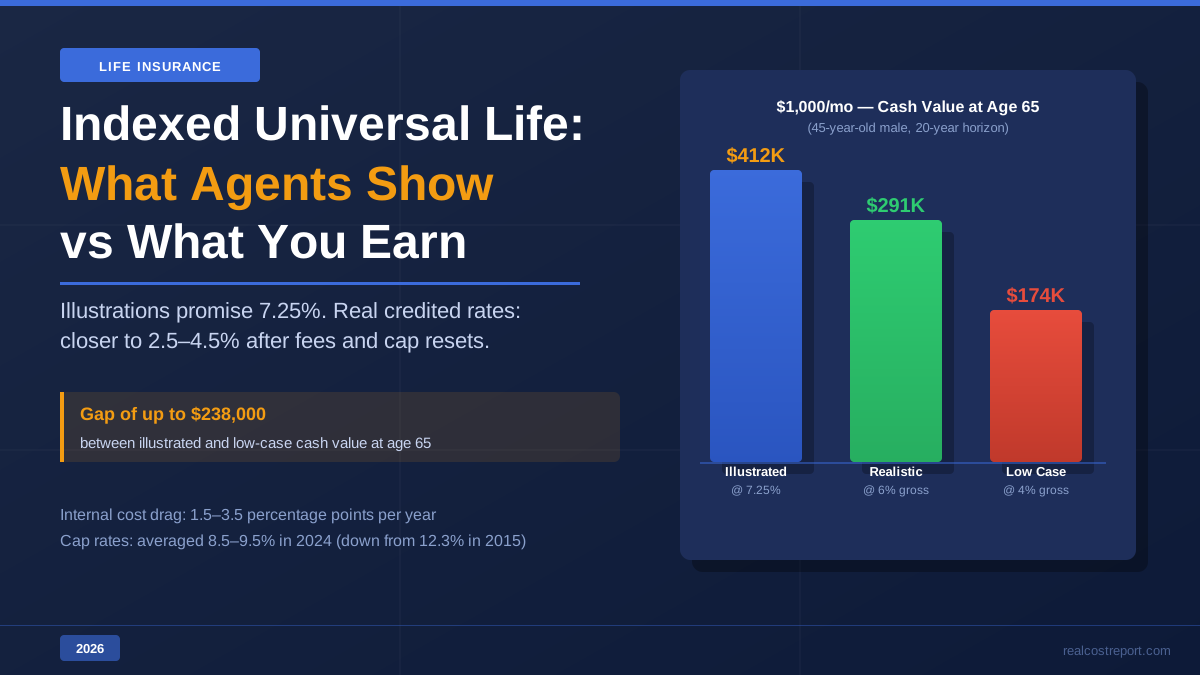
Mistake 5: Treating the illustration as a guarantee. Whole life and universal life illustrations project future cash values and death benefits under current assumptions. These are not contracts. The guaranteed column in the illustration — which typically assumes the minimum credited interest rate and maximum charges — is what the carrier must legally deliver. Any value above that column is speculative. Many buyers purchase whole life based on illustrated values that assume dividend scales not seen since the early 2000s. Fix: ask to see the guaranteed column in isolation. If the policy does not meet your needs at guaranteed values, do not buy it.
Who Should Buy More Coverage — and Who Is Over-Insured?
Life insurance need is not a single number — it is a function of your dependents, your debts, your income replacement obligation, and whether any other assets already cover those needs. The two most common errors run in opposite directions: underinsurance among younger families and overinsurance among empty-nesters who continue paying premiums on coverage their situation no longer justifies.
A 32-year-old with a $400,000 mortgage, two children, and a household income of $120,000 has a straightforward case for $1,000,000–$1,500,000 in 30-year term coverage. At Preferred Plus rates, that policy costs $50–$75/month — less than a car insurance premium. LIMRA research indicates most households in this demographic carry less than $400,000 in total coverage, leaving a gap that would require a surviving spouse to return to full-time work within months and potentially sell the family home.
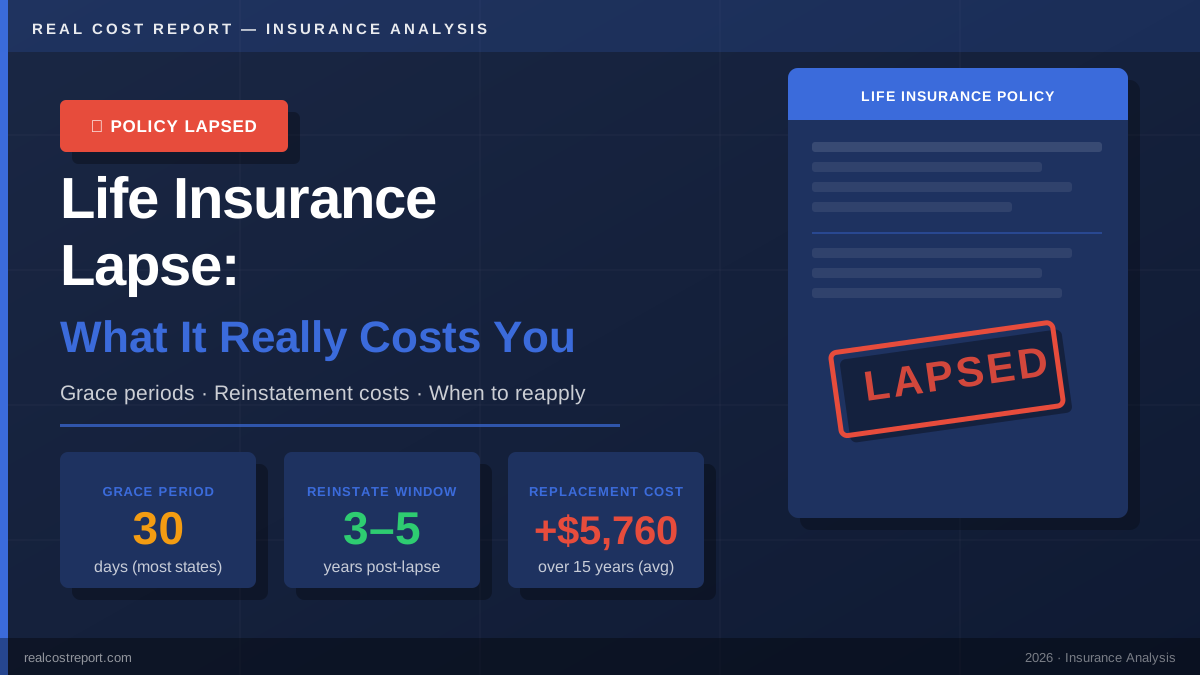
Conversely, a 58-year-old whose children are financially independent, whose mortgage is paid off, and who has $900,000 in retirement assets does not have the same income-replacement need. If they are still paying $180/month on a 20-year term policy purchased at age 40, the coverage may simply be providing benefit to a beneficiary who does not need the liquidity. The right answer may be to let the policy lapse and redirect those premiums to a Roth conversion or long-term care insurance.
Consider these decision thresholds:
- If your surviving spouse would need to replace your income for more than 5 years: buy term coverage equal to 10–12× your gross income.
- If you have minor children: extend the term to cover through the youngest child’s college graduation — typically a 25–30-year policy.
- If your net worth exceeds the federal estate tax exemption (currently $13.61 million per individual as of 2024, indexed annually): consult an estate attorney about an irrevocable life insurance trust before buying any permanent coverage.
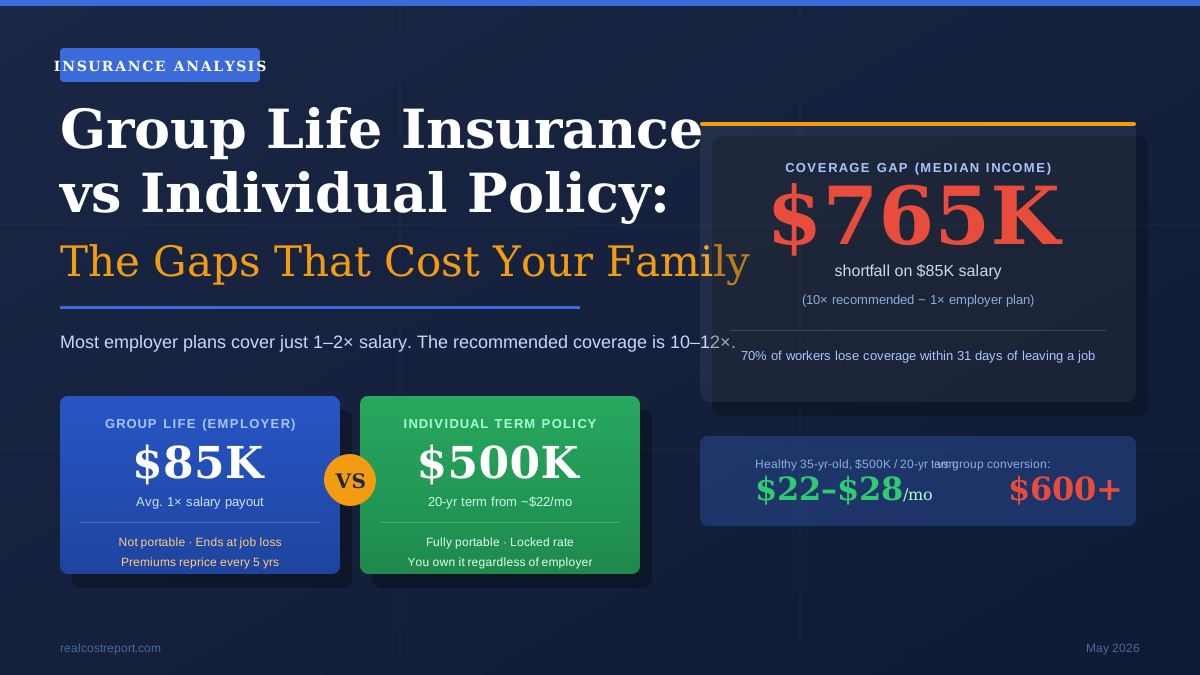
- If your employer provides group term coverage: treat it as a supplement, not a foundation — it typically does not convert if you leave the job and the benefit is taxable above $50,000.
What’s Changed in 2026: Underwriting and Product Shifts Buyers Need to Know
The post-pandemic normalization of mortality data has shifted carrier underwriting in ways that directly affect 2026 applicants. Several AM Best A-rated carriers tightened their Preferred Plus criteria in 2024–2025, particularly around BMI thresholds and cardiovascular markers, after experiencing higher-than-modeled claims in the 40–60 age band during 2021–2023. Applicants who would have qualified for Preferred Plus in 2022 may now land at Standard Plus under the same carrier’s current guidelines.
Simultaneously, accelerated underwriting programs — which use algorithmic review of prescription history, MIB records, and motor vehicle reports in lieu of a physical exam — have expanded across carriers including Lincoln Financial, Principal, and Pacific Life, with face amounts qualifying for no-exam approval rising as high as $3 million at some carriers. This reduces application turnaround from 4–6 weeks to as little as 5–10 days for qualifying applicants. The tradeoff is that these programs are opaque: if the algorithm flags a concern, you are bumped to full underwriting without explanation, adding weeks to the process.
Premium rates for term life have remained broadly stable in 2025–2026 for non-smokers under 55, though some carriers have adjusted rates upward for applicants with pre-existing metabolic conditions. No-exam policy premiums have increased approximately 5–8% across the market as carriers recalibrate for the adverse selection observed in that distribution channel.
How We Researched This Article
Premium figures cited in this article were compiled from product rate filings and published rate tables from AM Best A-rated and A+-rated carriers active in the U.S. life insurance market as of Q1 2026. Carriers referenced include Banner Life, Pacific Life, Protective Life, Guardian Life, and Massachusetts Mutual Life Insurance Company. Rate illustrations were obtained through carrier-published rate tools and independent broker rate engines for a standard non-tobacco applicant profile; they represent sample figures and will vary by applicant.
Policy provision language — including contestability clauses, conversion rider terms, waiver of premium definitions, and accelerated death benefit thresholds — was reviewed directly from NAIC-filed product disclosures and specimen policy documents, which are publicly available through state insurance department filings. The National Association of Insurance Commissioners (NAIC) maintains a consumer insurance information resource that served as a primary reference for regulatory standards and model regulation language.
Financial strength rating methodology and carrier rating data were sourced from AM Best, the primary rating agency for insurance carrier financial stability. Consumer behavior data referenced in the introduction — including the $200,000 underinsurance figure and the 44% avoidance statistic — was sourced from LIMRA’s 2023 Life Insurance Barometer study, published by LIMRA (verify at limra.com). The federal estate tax exemption figure of $13.61 million cited in the article reflects the IRS-published 2024 figure; this amount is indexed annually and should be verified at irs.gov for the current tax year.
Return-of-premium opportunity cost modeling used a 7% annualized return assumption based on long-run S&P 500 historical average returns; this is a modeled projection, not a guaranteed outcome. Research was last conducted in April 2026. All figures were verified against named primary sources before publication.