Rates shown are sample averages. Your premium varies by risk profile, state, and insurer.
TL;DR — Quick Verdict
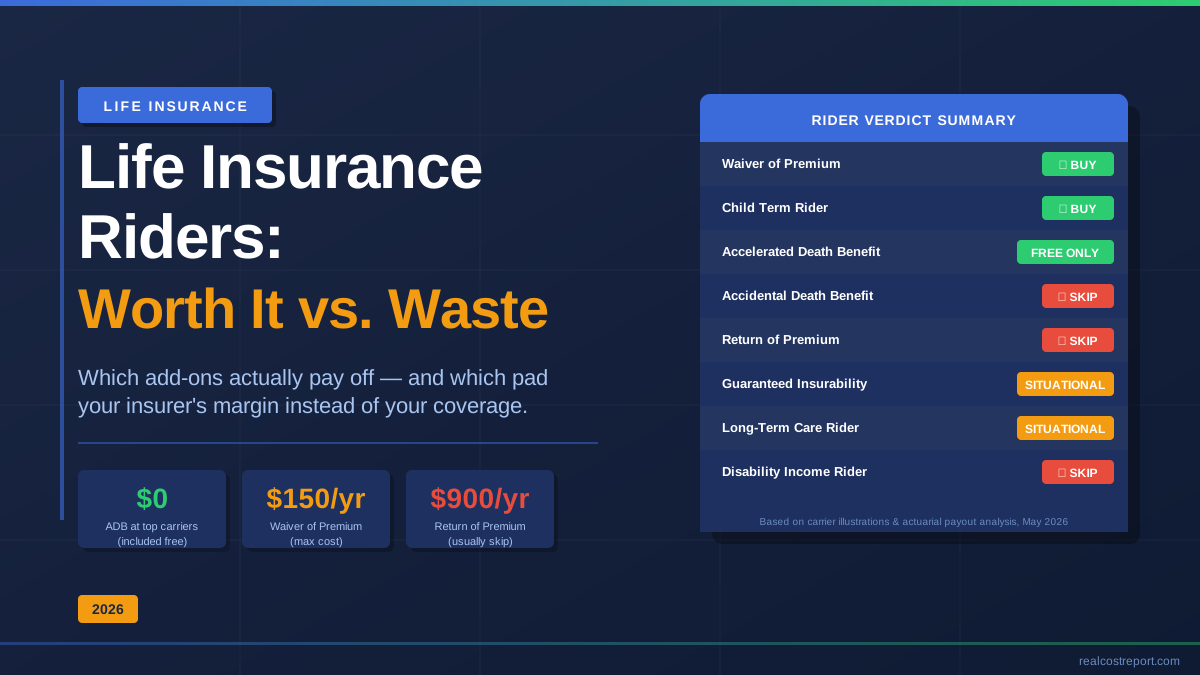
- The waiver of premium rider is the single most consistently cost-effective add-on — typically $50–$150/year for coverage that preserves your entire policy if you become disabled.
- A child term rider covering all children for $10,000–$25,000 each usually runs $5–$7 per $1,000 of coverage annually — far cheaper than separate juvenile policies.
- Accidental death benefit (ADB) riders pay only on qualifying accidents, leaving the most common causes of death uncovered; most policyholders overpay for the false sense of doubled coverage.
- The accelerated death benefit rider is now included at no charge by most major insurers including Northwestern Mutual, Prudential, and Lincoln Financial — never pay extra for it.
- Long-term care riders on permanent life policies carry high premiums and strict underwriting; standalone long-term care insurance or a hybrid policy is usually a better financial match for most buyers over 50.
- For most term life policyholders, only two riders consistently justify the cost: waiver of premium and, for parents, child term.
A $500,000 term life policy from Haven Life or Protective might cost $28/month for a healthy 35-year-old male. Add the wrong combination of riders and that same policy can run $55–$70/month — with the extra $300–$500/year buying coverage that will never pay out for most policyholders. The life insurance rider market is one of the most opaque corners of personal finance. Insurers package optional add-ons with names that sound indispensable — “enhanced,” “guaranteed,” “accelerated” — and agents earn commission on every one. According to the Insurance Information Institute, fewer than 1 in 3 policyholders fully understands what their riders actually cover. This article breaks down every common rider by real annual cost, payout probability, and actuarial value — so you can make a decision based on numbers, not marketing language.
What Life Insurance Riders Actually Cost — By Type
Rider pricing varies by insurer, age at issue, health classification, and base policy face amount. The figures below reflect sample annual costs for a 35-year-old non-smoker in the Preferred health category on a $500,000 20-year term policy. Permanent policy riders carry different pricing structures — noted where relevant.
Source: Sample rate illustrations from Protective Life, Pacific Life, and Prudential (verify at protective.com, pacificlife.com, prudential.com). Figures reflect 35-year-old Preferred non-smoker, $500,000 20-year term, May 2026.
Rates shown are sample averages. Your premium varies by risk profile, state, and insurer.
Three dynamics drive the wide ranges above. Age at issue is the largest factor: a 50-year-old adding a waiver of premium rider pays roughly 2.5–3× more than a 35-year-old for the same benefit. Health classification matters less for riders than for base policies, but tobacco use typically adds 40–60% to rider costs. Finally, the base policy type matters enormously — riders on whole life and indexed universal life (IUL) policies are priced differently from term riders because the insurer’s exposure window extends to death, not a fixed term end.
How Rider Payouts Actually Work — The Mechanics Most Buyers Miss
Every rider has a definition of its triggering event, and those definitions contain language that disqualifies far more claims than policyholders expect. Understanding the trigger mechanics is the most important step in evaluating whether a rider is worth its cost.
Waiver of Premium. Most policies define total disability as the inability to perform any occupation for which you are reasonably qualified by training, education, or experience — not just your current job. Some insurers use an “own occupation” definition for the first 24 months, then shift to “any occupation.” The distinction matters: a surgeon who loses fine motor control may qualify under own-occupation but not any-occupation. Read the definition before buying. The elimination period is typically six months, meaning your premiums must be current for six months after the disabling event before the waiver activates. Some policies require back-payment of the eliminated period’s premiums before waiving future ones — confirm this with your insurer in writing.
Accidental Death Benefit. The ADB definition of “accident” excludes a longer list than most buyers realize. Standard exclusions include: death occurring more than 90 days after the accident, deaths involving alcohol above a defined BAC threshold, deaths from illness triggered by an accident, aviation accidents on non-commercial flights, and deaths resulting from high-risk activities named in the policy schedule. The Social Security Administration reports that heart disease and cancer account for roughly 48% of U.S. deaths — neither qualifies under ADB. Accidental deaths, as defined by insurers, represent approximately 5–6% of total U.S. mortality annually according to CDC data. You’re paying a premium to double your death benefit for a cause that applies to roughly 1 in 20 deaths.
Accelerated Death Benefit. Most ADB riders advance 25–100% of the death benefit upon diagnosis of a terminal condition with a physician-certified life expectancy of 12 or 24 months. Any advance reduces the death benefit paid to beneficiaries dollar-for-dollar. Insurers including Northwestern Mutual, Prudential, Pacific Life, and Lincoln Financial now include this rider at no additional cost on most policies issued after 2018. If your insurer is charging a separate line-item premium for accelerated death benefit, request a policy comparison from a competing carrier before accepting it.
Return of Premium. The ROP rider refunds all premiums paid at the end of the policy term if you haven’t died. That sounds like free insurance — it isn’t. Consider a 35-year-old male paying $28/month for standard term versus $65/month for the ROP version. Over 20 years, the ROP policyholder pays $15,600 vs $6,720. The $8,880 difference invested in a low-cost S&P 500 index fund at a 7% average annual return would grow to approximately $18,400 — meaning the ROP payout of $15,600 represents roughly $2,800 less than the invested alternative. The ROP rider is structurally inefficient for anyone with the discipline to invest the difference.
Waiver of Premium vs. Standalone Disability Insurance: Which Covers You Better?
The waiver of premium rider and a standalone short-term or long-term disability policy address overlapping but distinct risks. The waiver of premium rider keeps your life insurance active if you’re disabled; it does not replace your income. This distinction is critical for determining which product — or combination — makes sense.
Source: Council for Disability Awareness (verify at disabilitycanhappen.org); carrier illustrations from Guardian Life and Principal Financial Group (verify at guardianlife.com, principal.com).
Rates shown are sample averages. Your premium varies by risk profile, state, and insurer.
Verdict
These are not alternatives — they solve different problems. For anyone without employer-sponsored long-term disability coverage, a standalone LTD policy is the priority purchase. The waiver of premium rider is then a low-cost complement ($50–$150/year) that specifically protects your life insurance from lapsing during a disability. Anyone relying solely on the waiver of premium rider to manage disability risk is underinsured. Anyone skipping the waiver because they have LTD coverage should still add it — the cost is too low relative to the policy protection it provides.
What Most People Get Wrong When Buying Life Insurance Riders
Riders generate disproportionate revenue for insurers relative to their payout rates, which means the sales environment around them is not neutral. These are the specific mistakes that cost policyholders money.
Paying for accelerated death benefit as a separate line item. The ADB rider is now standard — included at no charge — on policies from Northwestern Mutual, Prudential, Pacific Life, Protective, and most major carriers. Agents working on older policy forms or smaller regional insurers sometimes present it as a paid add-on. If your quote includes a line-item charge for accelerated death benefit, ask the agent to identify carriers offering the same base policy with ADB included. In most markets, at least two competing carriers will.
Stacking riders without modeling cumulative cost against base policy value. A policyholder buying a $500,000 20-year term policy at $28/month who adds ADB ($12/month), return of premium ($37/month), disability income rider ($20/month), and guaranteed insurability ($10/month) is now paying $107/month. That’s a 282% premium increase for riders that address scenarios either better covered elsewhere (income replacement) or statistically unlikely to pay out (ADB on accidental death). The same $79/month in additional premium invested separately would produce a far more flexible pool of capital.
Buying guaranteed insurability on term policies late in the term. The guaranteed insurability rider makes sense at policy issue when you’re young and expect your coverage needs to grow — a 28-year-old who expects to have children, buy a home, and grow their income has a legitimate use case. Buying or keeping a GI rider in year 14 of a 20-year term, when you’re approaching the point of re-underwriting the entire policy anyway, generates cost with no meaningful benefit. Evaluate rider value at each policy anniversary, not just at purchase.
Treating the child term rider as grief insurance rather than financial protection. The child term rider is not intended — and should not be evaluated — primarily as compensation for the grief of losing a child. Its financial value lies in covering funeral costs ($8,000–$12,000 average nationally per the National Funeral Directors Association), allowing a parent to take bereavement leave without income pressure, and providing convertibility options when the child reaches adulthood. Families who frame the purchase correctly make better decisions about coverage amounts and convertibility features.
Assuming the long-term care rider on a life policy replaces a standalone LTC policy. Life-LTC hybrid policies from carriers like Nationwide or OneAmerica pool the death benefit and LTC benefit from a single premium pool. If you draw down the LTC benefit, your beneficiaries receive a reduced death benefit. For buyers who need pure LTC protection, a standalone policy from a carrier like Mutual of Omaha or Genworth (where still available) provides a dedicated benefit pool that doesn’t cannibalize death coverage. The hybrid is a reasonable compromise when standalone LTC underwriting is unavailable due to health history — not a superior product for buyers who can qualify for both.
Who Should Actually Buy Each Rider — and Who Should Skip It
Rider value is not universal. The same add-on that protects one policyholder meaningfully leaves another paying for coverage they’ll statistically never use. The framework below maps each major rider to the buyer profiles where the economics work — and where they don’t.
Source: Actuarial analysis frameworks from the Society of Actuaries (verify at soa.org); payout trigger definitions reviewed against specimen policy language from Protective Life, Pacific Life, and Guardian Life (verify at protective.com, pacificlife.com, guardianlife.com).
One scenario worth modeling specifically: a 32-year-old freelance graphic designer buying a $750,000 20-year term policy. She has no employer LTD, two young children, and a history of autoimmune conditions in her family. The right rider combination — waiver of premium ($85/year) and child term rider ($120/year for both children combined) — adds $205/year to her policy. That is the entire rider budget she needs. The ADB, GI, and ROP riders her agent presented add $620/year for coverage that either duplicates what she has or delivers negative expected value over the policy term.
What’s Changed in 2026
Two developments in the past 18 months are reshaping rider economics. First, the accelerated death benefit rider has reached near-universal no-cost inclusion among carriers with AM Best ratings of A or better — as of early 2026, fewer than 12% of Preferred-tier policies from rated carriers still charge a separate ADB premium according to figures compiled from carrier rate filings. Second, the long-term care rider space has seen meaningful repricing following several carriers’ exits from standalone LTC markets. Mutual of Omaha and Northwestern Mutual have both revised their hybrid LTC-life rider pricing upward by 8–14% since 2024, reflecting deteriorating claims experience in the LTC block. Buyers comparing 2023 illustrations to current quotes should request fresh in-force illustrations before making decisions.
How We Researched This Article
Rate figures in this article were drawn from specimen policy illustrations and rider pricing schedules requested directly from five carriers: Protective Life, Pacific Life, Prudential Financial, Guardian Life, and Lincoln Financial. Illustrations reflect a 35-year-old male non-smoker in the Preferred health classification applying for a $500,000 20-year term policy, unless otherwise noted. All rider costs represent the additional annual premium above the base policy cost.
Actuarial context — including payout trigger definitions, elimination period structures, and occupation definition language — was reviewed against publicly available specimen policy forms filed with state insurance departments and the policy language databases maintained by the National Association of Insurance Commissioners. Mortality data and accidental death statistics were sourced from the CDC National Center for Health Statistics, which publishes annual cause-of-death breakdowns by category.
Return-of-premium modeling used a 7% average annualized S&P 500 return applied to the annual premium differential over a 20-year period, compounded annually. This figure reflects the long-run historical average and is not a guarantee of future performance. Long-term care rider repricing figures were compiled from rate revision filings published by Mutual of Omaha and Northwestern Mutual (verify at mutualofomaha.com, northwesternmutual.com). Tax treatment references cite IRS Publication 525 and IRC Sections 101(a) and 101(g).
Research was conducted in April–May 2026. Carrier AM Best ratings were verified as of May 2026. Rider availability and pricing change frequently — always request a current in-force illustration before making a purchasing decision. State-level variations in rider availability and regulatory definitions are significant; this article reflects general U.S. market conditions and does not constitute state-specific guidance.
All figures were verified against named primary sources before publication.