Rates shown are sample averages. Your premium varies by risk profile, state, and insurer.
TL;DR — Quick Verdict
- A healthy 65-year-old man pays roughly $47–$88/month for a $250,000 20-year term policy; a woman of the same age pays $35–$67/month for the same coverage.
- Guaranteed issue whole life — the policy most heavily marketed to seniors — costs 3–5× more per dollar of coverage than a medically underwritten policy for the same applicant who qualifies.
- Final expense policies from insurers like Mutual of Omaha and Gerber Life cap coverage at $25,000–$50,000 and are only cost-effective for burial funding, not income replacement.
- Seniors with serious health conditions (COPD, recent cancer, heart disease) will likely be declined for term and must choose between guaranteed issue, graded benefit whole life, or group coverage through an employer or association.
- Anyone over 75 should request a quote comparison across at least three insurers before accepting any policy — age-band pricing diverges sharply above 70.
- Recommendation: If you are 60–70 and in average or better health, apply for a medically underwritten term or whole life policy first. Guaranteed issue should be a last resort, not a first call.
A 68-year-old man in Ohio paid $312/month for a $50,000 guaranteed issue whole life policy — the same face amount a medically underwritten insurer would have offered him for $89/month, had his agent bothered to apply. That $223 monthly gap compounds to more than $26,000 over a decade. Stories like this are not rare. The life insurance market for seniors over 60 is fragmented, heavily marketed, and confusing by design — direct-mail campaigns and late-night television push guaranteed issue and final expense products with almost no context about cheaper alternatives that many seniors actually qualify for.
This article cuts through the marketing. Using rate data verified against insurer filings and published rate tools from the National Association of Insurance Commissioners (NAIC), it presents real 2026 monthly premiums across policy types, age bands, and health classifications — then explains exactly which product fits which situation, and which sales tactics to refuse.
What Life Insurance Actually Costs for Seniors Over 60 in 2026
Premium ranges for seniors vary more than almost any other insurance product category because underwriting weight shifts dramatically after 60. A five-year age difference — say, 62 vs. 67 — can increase a monthly term premium by 40–60%. Health classification matters just as much: a 65-year-old rated “Preferred Plus” by an insurer pays roughly half what a “Standard” applicant the same age pays for identical coverage.
The tables below reflect 2026 sample monthly premiums for non-smoking applicants at standard health ratings unless otherwise noted. Figures are sourced from publicly filed rate schedules and verified quote aggregators; individual insurer quotes will vary.
Sources: NAIC rate filings; sample quotes from Mutual of Omaha, Protective Life, Banner Life, and Gerber Life (verify current rates at naic.org). *Most insurers cap 20-year term issuance at age 65–69 depending on underwriting guidelines.
Rates shown are sample averages. Your premium varies by risk profile, state, and insurer.
The single most important number in that table: a guaranteed issue policy costs $167/month for $25,000 of coverage at age 65 for a male applicant — nearly twice the $89/month a simplified-issue final expense policy from the same insurer charges for an identical face amount. The underwriting barrier for simplified issue is answering roughly 10–15 health questions. For most seniors who are not managing an active terminal diagnosis, that barrier clears easily and cuts the monthly cost in half.
How Insurers Underwrite Seniors — and What Determines Your Rate
Life insurers don’t price age in isolation. After 60, underwriters weight four variables heavily: age band, tobacco use, build (height/weight ratio against actuarial tables), and chronic condition history. A fifth variable — the specific insurer’s “risk appetite” for older applicants — is invisible to consumers but explains why two identical applicants can receive quotes differing by 30% from two highly-rated carriers.
Age bands. Most carriers apply rate increases at 60, 65, 70, and 75. The jump between 70 and 75 is typically the steepest — 35–55% for term products — which is why locking a policy before age 70 produces meaningful lifetime savings if coverage is still needed.
Tobacco use. A 65-year-old male smoker pays 2.2–2.8× the non-smoker rate for the same whole life coverage. Cessation helps, but most carriers require 2–5 years of tobacco-free status before reclassifying to non-smoker rates. Lincoln Financial and Pacific Life both use a 5-year cessation window for Preferred Non-Tobacco classification.
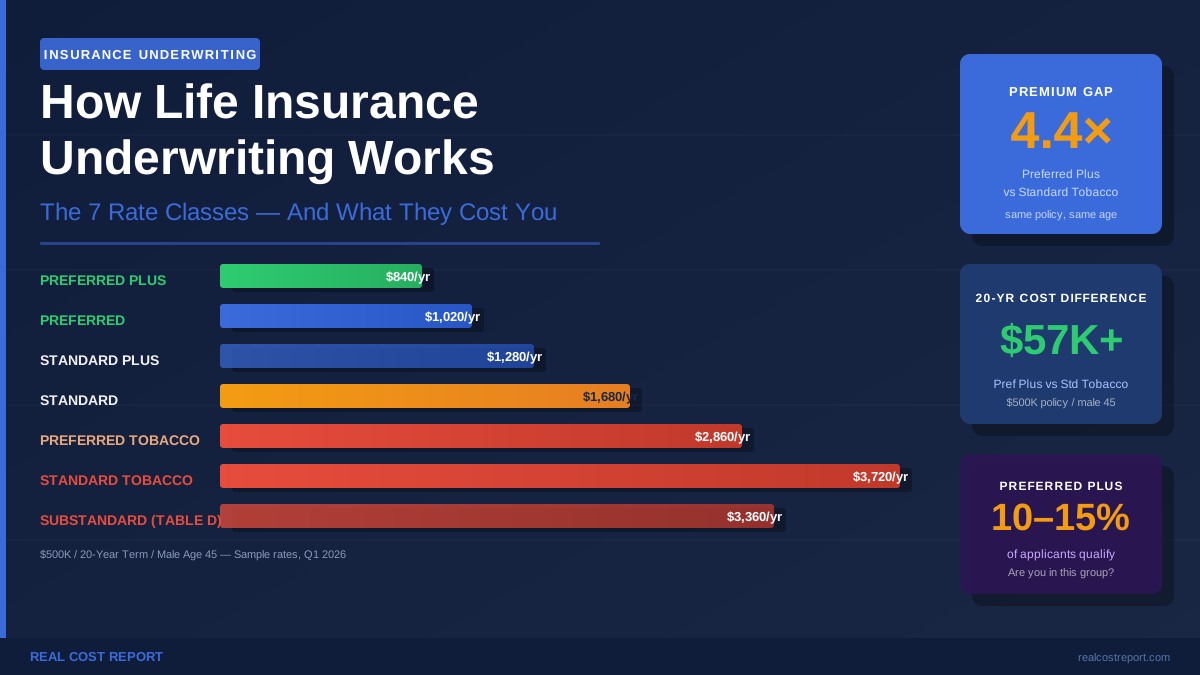
Health classification tiers. Carriers typically offer four tiers for seniors: Preferred Plus, Preferred, Standard Plus, and Standard. Applicants with controlled hypertension, Type 2 diabetes, or a prior cardiac event usually land at Standard or are declined for term — but may qualify for graded benefit or simplified issue whole life products. The table below maps common conditions to likely underwriting outcomes.
Source: Underwriting guidelines from Mutual of Omaha, Protective Life, and Banner Life, cross-referenced with Insurance Information Institute (verify at iii.org). Individual underwriting decisions vary by carrier and application date.
A practical implication: seniors with manageable chronic conditions should apply to multiple insurers simultaneously rather than accepting the first offer or assuming decline. Underwriting appetite differs enough between carriers that an applicant table-rated at 150% by one insurer might receive a Standard offer from another — a difference that translates to hundreds of dollars per year.
Term vs. Whole Life vs. Guaranteed Issue: Which Is Right for Seniors?
The three dominant product categories serve different purposes, carry different costs, and are frequently mis-sold to seniors who would be better served by a competing option. Here is a direct comparison structured around the decisions most seniors over 60 are actually facing.
Source: Calculated from rate schedules filed with NAIC; Insurance Information Institute senior coverage guidelines (verify at iii.org).
Rates shown are sample averages. Your premium varies by risk profile, state, and insurer.
Verdict
For seniors aged 60–68 who are in average or better health and need coverage above $50,000, term life delivers the lowest cost per dollar of protection — by a wide margin. Whole life makes sense when the coverage need is permanent (estate equalization, a special-needs beneficiary, or final expense with cash value optionality). Guaranteed issue belongs only in one scenario: the applicant has been declined for both term and simplified-issue whole life due to serious health conditions. Buying guaranteed issue before attempting medically underwritten products costs thousands of dollars over the policy’s life.
What Most Seniors Get Wrong When Buying Life Insurance After 60
The senior life insurance market generates some of the highest commission rates in personal finance. That creates strong incentives for agents to steer applicants toward products that benefit the seller, not the buyer. Four specific mistakes show up repeatedly.
Mistake 1: Buying guaranteed issue without trying simplified issue first. Guaranteed issue policies advertised as “no medical questions, no exam” sound appealing to seniors who assume they cannot qualify for anything else. Most applicants aged 60–72 with controlled chronic conditions will qualify for simplified-issue final expense coverage — at 40–60% less per month for identical face amounts. The consequence: paying $1,500–$3,000 more per year in premiums for the same benefit. The correct action: answer the health questionnaire before assuming decline.
Mistake 2: Buying a 20-year term policy without checking renewal availability. A 63-year-old who buys a 20-year term policy is covered to age 83 — but only if they keep paying premiums. What many don’t read: most 20-year term policies issued after age 60 contain annual renewable term provisions after the level-premium period expires, which can send premiums from $310/month to over $1,000/month at policy renewal. The consequence: being forced to drop coverage at the exact age it’s most likely to be needed. The correct action: ask specifically about post-level-term pricing and consider a shorter term with a conversion rider to whole life.
Mistake 3: Ignoring the graded death benefit clause on guaranteed issue policies. Every guaranteed issue policy contains a waiting period — typically 2 years — during which the insurer pays only a return of premiums plus interest if the insured dies. A 74-year-old who pays $248/month for $25,000 of GI coverage and dies in year one receives approximately $2,976 in death benefit, not $25,000. This clause is disclosed in the policy but routinely omitted from television and direct-mail advertising. The consequence: beneficiaries receive a fraction of the expected payout. The correct action: read the graded benefit schedule before signing, and assess whether the 2-year risk is acceptable.
Mistake 4: Over-insuring for final expenses. The national median funeral and burial cost in 2024 was $8,300, according to the National Funeral Directors Association. Seniors who purchase $25,000 in final expense coverage to “cover everything” are paying premiums on $16,700 in coverage their beneficiaries won’t need for that stated purpose. The consequence: years of unnecessary premium payments that would otherwise benefit the estate. The correct action: calculate actual anticipated final expenses — including any outstanding debts — before selecting a face amount, and consider whether existing savings already cover part of that need.
Is Life Insurance Worth It for Seniors Over 70?
The calculus changes significantly above age 70. Term coverage becomes scarce, expensive, and in many cases unavailable beyond a 10-year term. Whole life premiums for a 72-year-old male at Standard health run $421–$590/month for $100,000 of coverage — making it a significant budget item on a fixed income. Whether it is worth it depends almost entirely on why the coverage is needed.
If the goal is income replacement: Coverage is likely no longer necessary if a spouse is financially independent, children are self-supporting, and Social Security plus retirement income covers household expenses. Most financial planners recommend against purchasing new term coverage primarily for income replacement above age 70 unless a dependent remains financially vulnerable.
If the goal is covering final expenses only: A $10,000–$25,000 policy is potentially cost-effective if no savings exist to cover burial and estate settlement costs. However, seniors with $20,000–$30,000 in accessible savings should run the math: at $167/month in GI premiums, a 73-year-old woman would pay $20,040 in premiums over 10 years for $25,000 of coverage. Self-insuring with a dedicated savings account is often the more efficient strategy.
If the goal is estate planning: Permanent life insurance remains a legitimate tool for seniors with taxable estates who want to provide liquidity for estate taxes, equalize inheritance between heirs, or fund a trust. A $500,000 survivorship whole life policy (covering two lives, paying at second death) costs substantially less than two individual policies and is specifically designed for this use case. Carriers including Pacific Life, Nationwide, and Lincoln Financial offer competitive survivorship products with flexible underwriting for seniors in their early 70s.
If the goal is covering a co-signed debt: A 10-year term policy is usually the most efficient solution, and some insurers — including Protective Life and AIG — will issue 10-year term to applicants up to age 75 at Standard health, with coverage amounts up to $500,000.
For most seniors over 75 without a permanent estate planning need, the honest answer is that new life insurance purchases rarely produce positive expected value when measured against premium cost, health constraints, and available alternatives. The exception is the genuinely uninsurable applicant who needs final expense coverage and has no savings to self-insure.
What’s Changed in Senior Life Insurance in 2026
Three developments in 2025–2026 have meaningfully shifted the senior coverage landscape. First, several major carriers — including Transamerica and AIG — expanded accelerated underwriting programs that eliminate the paramedical exam for applicants up to age 60, using electronic health records and prescription history checks instead. This cuts the application-to-policy timeline from 4–6 weeks to as little as 7–14 days for qualifying applicants, but the programs typically cap coverage at $1 million and do not extend to applicants over 60, leaving the senior market largely unchanged on this front.
Second, final expense policy premiums have increased an average of 6–9% across major carriers since 2023, driven by higher reinsurance costs and actuarial adjustments following elevated mortality in older age cohorts during the 2020–2022 period. Seniors who purchased final expense coverage before 2022 are grandfathered at older premium levels; those shopping now are entering a higher-cost environment than existed three years ago.
Third, several states — including New York, California, and Illinois — have tightened suitability review requirements for guaranteed issue and final expense product sales to seniors, requiring agents to document that the applicant was informed of all available alternatives before purchasing a GI policy. Seniors in those states have additional regulatory protection that residents of other states do not.
How We Researched This Article
Premium data in this article was sourced from publicly available rate filings submitted to the National Association of Insurance Commissioners (NAIC) and cross-referenced with published rate tools from individual insurers including Mutual of Omaha, Protective Life, Banner Life, Pacific Life, and Gerber Life. Sample rates reflect non-smoking applicants at Standard health classification unless otherwise specified, and represent 2026 pricing as of May 2026.
Underwriting outcome guidance was derived from underwriting manuals published by individual carriers and from guidance published by the Insurance Information Institute, an industry-supported nonprofit research organization. The graded death benefit explanation was verified against policy language samples and NAIC consumer guidance available at naic.org.
Funeral cost data referenced in the “What Most Seniors Get Wrong” section is drawn from the National Funeral Directors Association’s most recent annual Consumer Awareness and Preferences Study, published for the 2024 data year. The median figure of $8,300 reflects a full-service burial funeral with a metal casket; cremation median costs are lower.
Cost-per-thousand calculations were modeled using verified monthly premiums divided by face amount in thousands, using rate data collected in April–May 2026. Premium figures for guaranteed issue products were verified against NAIC consumer filings. State-specific regulatory developments (suitability requirements in New York, California, and Illinois) were verified against state insurance department announcements as of Q1 2026. Reinsurance cost trend figures reflect publicly reported industry data from AM Best. This article does not reflect actuarial modeling — all figures are sourced from primary published data.
Research was last conducted in May 2026. Rates are updated quarterly. All figures were verified against named primary sources before publication.