Rates shown are sample averages. Your premium varies by risk profile, state, and insurer.
TL;DR — Quick Verdict
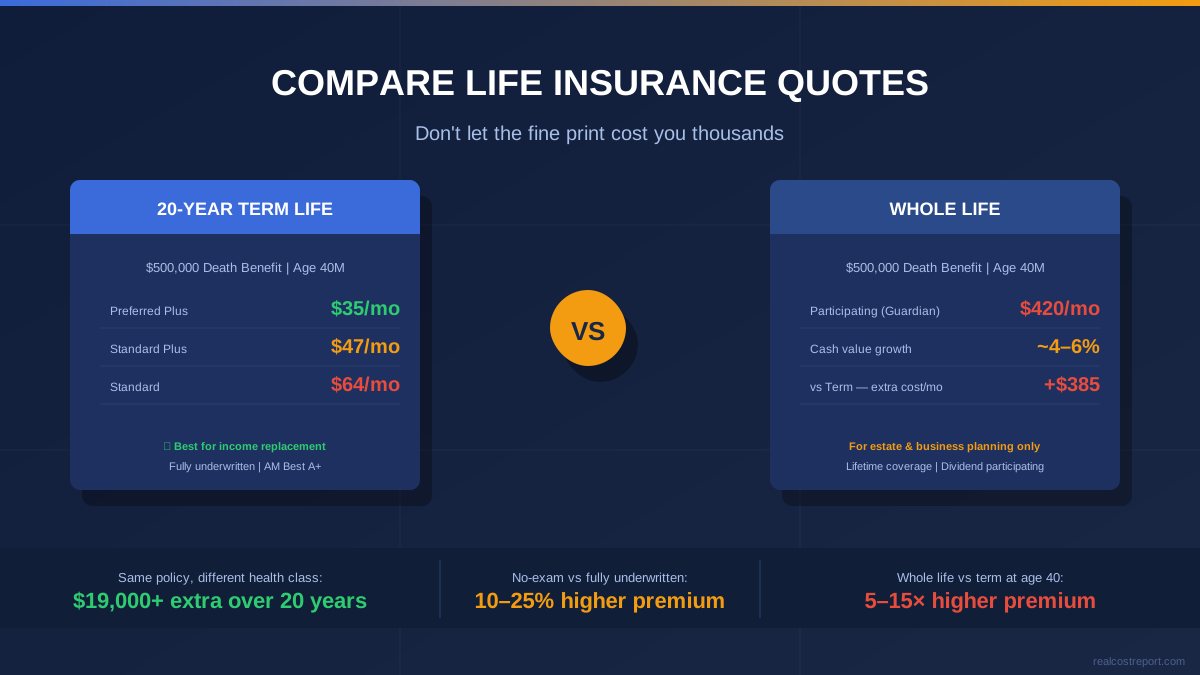
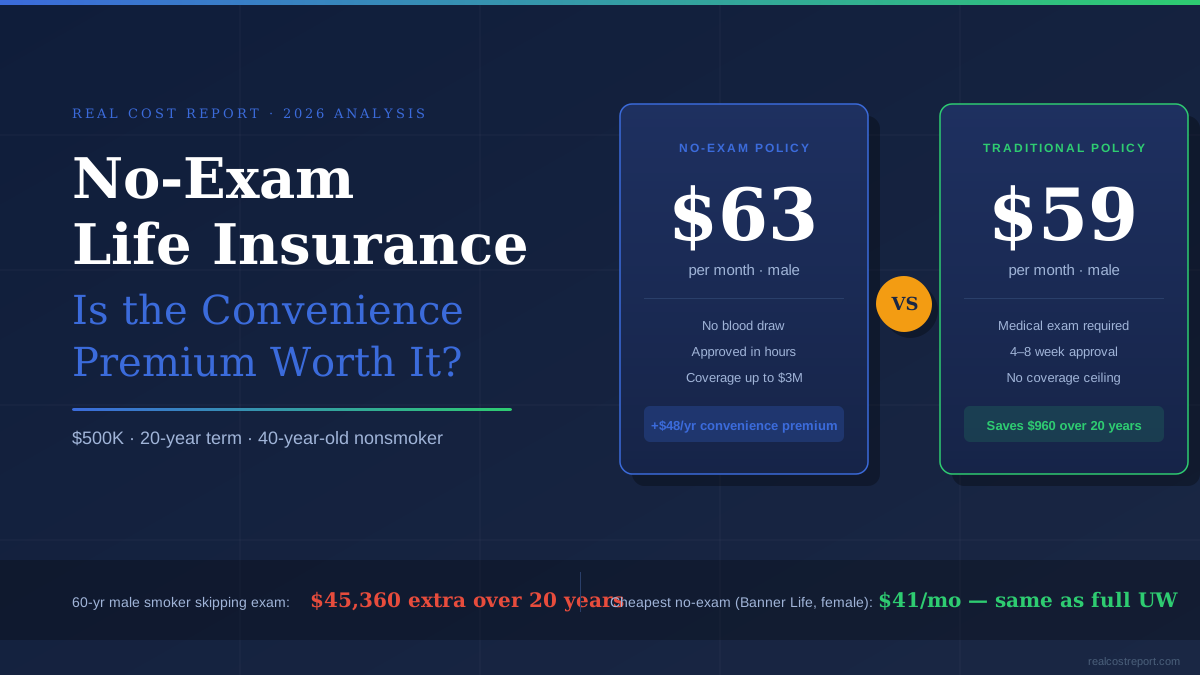
- For a healthy 40-year-old, no-exam life insurance costs $50–$63/month versus $41–$59/month with full underwriting — a convenience premium of roughly $12–$17/month on a $500,000, 20-year term policy.
- Over a 20-year term, that gap compounds to $2,880–$4,080 in extra premiums for the privilege of skipping the blood draw.
- Smokers and older applicants pay far more: a 60-year-old male smoker pays $1,274/month with no-exam versus $1,085 with a full medical exam — a $2,268 annual penalty for avoiding the exam.
- Accelerated underwriting — used by Nationwide, Banner Life, Penn Mutual, and others — now delivers approval in minutes using AI-driven data pulls, making it the sweet spot between speed and price.
- Guaranteed issue policies (no health questions, no exam) cost the most per dollar of coverage and cap benefits at $25,000 — suitable only for final expense coverage or uninsurable applicants.
- Verdict: Healthy adults under 50 should compare accelerated underwriting quotes alongside traditional policies before paying the no-exam markup. The exam pencils out unless you need coverage within days or have already been declined elsewhere.
Skip the needle, skip the nurse visit, get covered today. That pitch from no-exam life insurance carriers sounds straightforward — but the price tag attached to that convenience is rarely disclosed upfront. According to MoneyGeek’s 2026 rate analysis, a healthy 40-year-old male nonsmoker pays $63/month for a no-exam $500,000 term policy versus $59 with a standard medically underwritten policy. That $4 monthly gap — roughly $48 per year — sounds minor. But that math only holds for the healthiest, youngest buyers. For smokers, older applicants, or anyone buying a $1 million policy, the convenience premium balloons into thousands of dollars in unnecessary spending over the life of the policy. This article breaks down exactly what no-exam coverage costs by age, profile, and policy type; how accelerated underwriting — now used by carriers including Nationwide, Banner Life, and Penn Mutual — has fundamentally changed the trade-off; and precisely which buyers benefit from skipping the exam versus who should book the appointment.
What No-Exam Life Insurance Actually Costs in 2026
There is no single “no-exam rate.” The market divides into three distinct tiers, each with a different price structure and underwriting mechanism, and conflating them is the most common mistake buyers make.
Tier 1 — Accelerated Underwriting: No physical exam, but the insurer pulls prescription history, MIB records, and motor vehicle reports through automated data systems. Approval in hours. Pricing nearly identical to fully underwritten policies for healthy applicants. Coverage up to $3 million now available from select carriers.
Tier 2 — Simplified Issue: No exam, but applicants answer a health questionnaire. Insurer uses the questionnaire plus third-party data. Premiums run 8%–20% higher than fully underwritten equivalents. Coverage typically capped at $500,000–$1 million depending on carrier.
Tier 3 — Guaranteed Issue: No exam, no health questions. All applicants in the eligible age range (typically 50–85) are accepted. Premiums are the highest per dollar of coverage, and the death benefit is usually capped at $25,000, with a graded benefit clause that withholds the full payout if death occurs in the first two years from non-accidental causes.
Sources: MoneyGeek 2026 No-Exam Life Insurance Rate Analysis (verify at moneygeek.com); Penn Mutual rate data via MoneyGeek.
Rates shown are sample averages. Your premium varies by risk profile, state, and insurer.
The gap at age 40 for healthy nonsmokers is real but modest. Where the numbers become consequential is with smoker profiles and older buyers — covered in detail in the comparison section below. For now, note that the cheapest no-exam providers in 2026 — Banner Life and Transamerica — each price female nonsmokers at $41/month and male nonsmokers at $50/month, matching the floor of fully underwritten rates on identical profiles. The no-exam surcharge, in those cases, is zero.
How Accelerated Underwriting Works — and Why It Changed Everything
The traditional life insurance underwriting process could take four to eight weeks: schedule a paramedical exam, wait for lab results, submit to manual underwriter review, receive a decision. That timeline was a genuine barrier to purchase, particularly for young, healthy buyers who didn’t feel urgency and let the process lapse.
Accelerated underwriting eliminates the physical exam by substituting algorithmic analysis of external data sources. When a qualifying applicant submits an online application, the insurer’s system automatically pulls records from the Medical Information Bureau (MIB), prescription drug databases, motor vehicle reports, and in some cases, consumer financial data and behavioral health indicators. According to the National Association of Insurance Commissioners (NAIC), accelerated underwriting reduces the application-to-decision timeline from several weeks to just hours for eligible applicants (verify at naic.org). A 2025 technical analysis cited by BizTech Magazine found AI has reduced average underwriting decision time from three to five days to 12.4 minutes for standard policies, while maintaining a 99.3% accuracy rate in risk assessment.
That precision matters for pricing. Because accelerated underwriting still performs a full risk assessment — just through data pulls rather than a blood draw — qualifying healthy applicants can achieve the same preferred or super-preferred rate classes available under traditional underwriting. The insurer isn’t guessing at your health; it’s reading your prescription history directly.
Coverage limits have expanded substantially. Most major carriers with accelerated underwriting programs now offer $1 million to $3 million in no-exam coverage for eligible applicants ages 18–60. Penn Mutual extended its limit to $10 million. Nationwide’s Life Essentials platform covers up to $1.5 million for applicants aged 21–55, with instant digital decisions. A 2025 Gen Re survey found that 59% of individual life insurance applications now qualify for an accelerated underwriting path — up from roughly one-third just five years ago.
The key constraint: accelerated underwriting eligibility is health-gated. Applicants with a history of cancer, heart disease, cognitive disorders, or rheumatoid arthritis typically do not qualify and are routed to traditional underwriting — or declined. Accelerated underwriting is not a workaround for uninsurability. It is a speed mechanism for healthy buyers.
No-Exam vs. Traditional Life Insurance: Which Wins by Buyer Profile?
The right answer depends entirely on the applicant’s health, age, urgency, and coverage need. This is not a scenario where one option dominates.
Analysis based on MoneyGeek 2026 rate data and carrier underwriting guidelines (verify at moneygeek.com). 60-year-old smoker savings calculation from MoneyGeek Life Insurance Rates (verify at moneygeek.com).
Verdict
For healthy adults under 50 without urgent timeline pressure, traditional fully underwritten policies win on 20-year cost — the medical exam saves $1,000–$4,000+ over the term. No-exam wins decisively when speed is essential, when the applicant falls in the 50–70 senior window requiring guaranteed issue, or when accelerated underwriting from a top-tier carrier like Banner Life or Penn Mutual matches traditional pricing on the same profile.
What’s Changed in 2026: AI Underwriting and the Expanding No-Exam Market
The no-exam life insurance market of 2026 looks meaningfully different from what it was even three years ago, and buyers who haven’t revisited their assumptions may be working from outdated mental models.
Coverage ceilings have risen sharply. As recently as 2022, most no-exam policies capped at $500,000. By 2026, Nationwide offers up to $1.5 million, Transamerica and Banner Life reach $2 million or more through accelerated underwriting, Lincoln Financial’s TermAccel program covers up to $2.5 million for ages 18–60, and Penn Mutual has pushed to $10 million for qualifying applicants. Buyers who ruled out no-exam because they needed substantial coverage should re-price immediately.
AI has accelerated the process dramatically. According to LIMRA and UCT research, 87% of life insurance carriers are now using AI in at least one operational area. The NAIC’s ongoing Big Data and Artificial Intelligence (H) Working Group is actively developing AI oversight frameworks for accelerated underwriting, with an AI Systems Evaluation Tool piloted across 12 states as of March 2026 and formal adoption anticipated at the 2026 Fall National Meeting (verify at naic.org). That regulatory attention underscores how mainstream algorithmic underwriting has become.
GLP-1 medications — Ozempic, Wegovy, Mounjaro — are beginning to affect underwriting. Carriers are still calibrating how to treat applicants taking these drugs, since the long-term mortality data is incomplete. Some carriers flag GLP-1 use as a reason to route applicants through full underwriting regardless of overall health profile. If you’re currently on a GLP-1 medication, confirm with the carrier whether it affects your accelerated underwriting eligibility before applying.
What Most People Get Wrong When Buying No-Exam Life Insurance
Five specific mistakes cost buyers real money — or leave them underinsured at the moment coverage matters most.
Mistake 1: Assuming “no-exam” means “no health scrutiny.” Accelerated underwriting and simplified issue policies both pull your prescription history and MIB records. If you’ve been prescribed antidepressants, insulin, or specialty medications, the insurer sees them. Applicants who assume the absence of a blood draw means a blank slate are frequently surprised when their application is declined or rated. The correct action: disclose your full health history accurately on the application. Misrepresentation during the contestability period — the first two years of the policy — allows the carrier to deny a death benefit claim.
Mistake 2: Buying guaranteed issue when you would qualify for simplified or accelerated underwriting. Guaranteed issue policies cost significantly more per dollar of coverage and cap the death benefit at $25,000. A 65-year-old in average health who could qualify for a $100,000 simplified issue policy instead buys a $25,000 guaranteed issue policy thinking the process is easier. The correct action: always apply for the highest underwriting tier you’re likely to qualify for before settling for guaranteed issue.
Mistake 3: Not comparing the accelerated underwriting rate against the traditional rate before deciding. Many carriers now offer both. Nationwide, Banner Life, and Pacific Life all offer accelerated paths for qualifying applicants — but also maintain traditional underwritten products. Getting both quotes from the same carrier on the same profile is the only way to calculate the actual convenience premium you’re paying. Many buyers accept the no-exam quote without ever requesting the traditional alternative.
Mistake 4: Ignoring the coverage cap at large death benefit needs. A buyer who needs $2.5 million in coverage and selects a no-exam carrier capped at $1 million is underinsured by 60%. The correct action: verify the carrier’s maximum no-exam coverage limit before completing the application and confirm it covers your calculated need based on income replacement and debt obligations.
Mistake 5: Treating all no-exam carriers as interchangeable. MoneyGeek’s 2026 analysis shows a $31/month spread between the cheapest no-exam male rate (Banner Life: $50/month) and the most expensive (Ethos: $72/month) for identical 40-year-old nonsmoker profiles at $500,000 over 20 years. That $264 annual difference — $5,280 over the term — is the cost of not shopping. The correct action: quote at least three no-exam carriers before buying.
Who Should Skip the Exam — and Who Should Book the Appointment
No-exam life insurance is not universally a bad deal. It is the wrong product for specific buyers and the right product for others. Here is the conditional logic that determines which camp you’re in.
Buy no-exam if: You need coverage within days — closing on a home, adding a business partner, or facing a coverage gap after a job change. No-exam coverage activates in 24–72 hours versus four to eight weeks for traditionally underwritten policies. Time value is real.
Buy no-exam if: You are a healthy nonsmoker under 50 and an accelerated underwriting carrier such as Banner Life or Penn Mutual is quoting you a rate within $10/month of the fully underwritten equivalent. The convenience premium at that margin does not justify the inconvenience of a paramedical exam.
Buy no-exam if: You are 70 or older and need $10,000–$25,000 in final expense coverage. Traditional fully underwritten policies may not be available at that age or coverage size. Guaranteed issue from carriers like AARP (in partnership with New York Life) or USAA (through Mutual of Omaha) is often the only viable path.
Book the appointment if: You are a smoker or former smoker (less than 12 months tobacco-free). The exam allows underwriters to review additional health markers, and for some smoker profiles, fully underwritten policies can save thousands per year. A 60-year-old male smoker saves $2,268 annually — $45,360 over a 20-year term — by completing the medical exam, per MoneyGeek’s 2026 rate analysis.
Book the appointment if: You have a managed chronic condition — controlled hypertension, well-managed Type 2 diabetes, or a past cancer diagnosis with documented remission. Medical exam results accompanied by physician documentation often unlock standard or even preferred rates that algorithms would not assign based on prescription history alone.
Book the appointment if: You need more than $2 million in coverage. Most no-exam carriers cap eligibility below that threshold. Traditional underwriting has no ceiling.
How We Researched This Article
Rate data in this article draws primarily from MoneyGeek’s 2026 No-Exam Life Insurance Rate Analysis and MoneyGeek’s 2026 Life Insurance Cost by Age and Policy Type pages, which aggregate quotes across dozens of carriers for standardized demographic profiles. MoneyGeek collected quotes across multiple age, gender, health, tobacco, and coverage combinations — the specific benchmark used throughout this article is a 40-year-old nonsmoker seeking $500,000 in coverage on a 20-year term, unless otherwise noted.
Carrier-specific rate and underwriting data — including Penn Mutual’s $10 million no-exam limit, Nationwide’s Life Essentials eligibility criteria, and Transamerica’s NAIC complaint index — was sourced from MoneyGeek’s Best No-Exam Life Insurance Companies (2026) analysis (verify at moneygeek.com). The 60-year-old male smoker savings calculation ($45,360 over 20 years) was derived from MoneyGeek’s published monthly rate differential of $189/month and confirmed against the annual figure of $2,268 stated in the source data.
Accelerated underwriting mechanism and regulatory data came directly from the National Association of Insurance Commissioners (NAIC) Accelerated Underwriting topic page (verify at naic.org), including the NAIC’s characterization of the timeline reduction from weeks to hours and its ongoing oversight work through the Big Data and Artificial Intelligence (H) Working Group. The Gen Re 59% accelerated-path qualification figure was sourced via Penny Pincher’s March 2026 accelerated underwriting explainer, which cited Gen Re’s 2025 individual life insurance survey.
AI adoption statistics — including the 87% of carriers using AI in at least one operational area and the 12.4-minute average underwriting decision time — came from actuary.info’s Life Insurance Industry Trends 2026 analysis (verify at actuary.info), citing LIMRA, UCT, and BizTech Magazine sources. This article covers rate data and regulatory developments through May 2026. Coverage limits and carrier-specific underwriting rules change frequently; confirm current limits directly with the insurer or a licensed agent before purchasing. Regional rate variation was not modeled in this analysis — quotes in high-cost states may differ from national averages. All figures were verified against named primary sources before publication.