Rates shown are sample averages. Your premium varies by risk profile, state, and insurer.
TL;DR — Quick Verdict
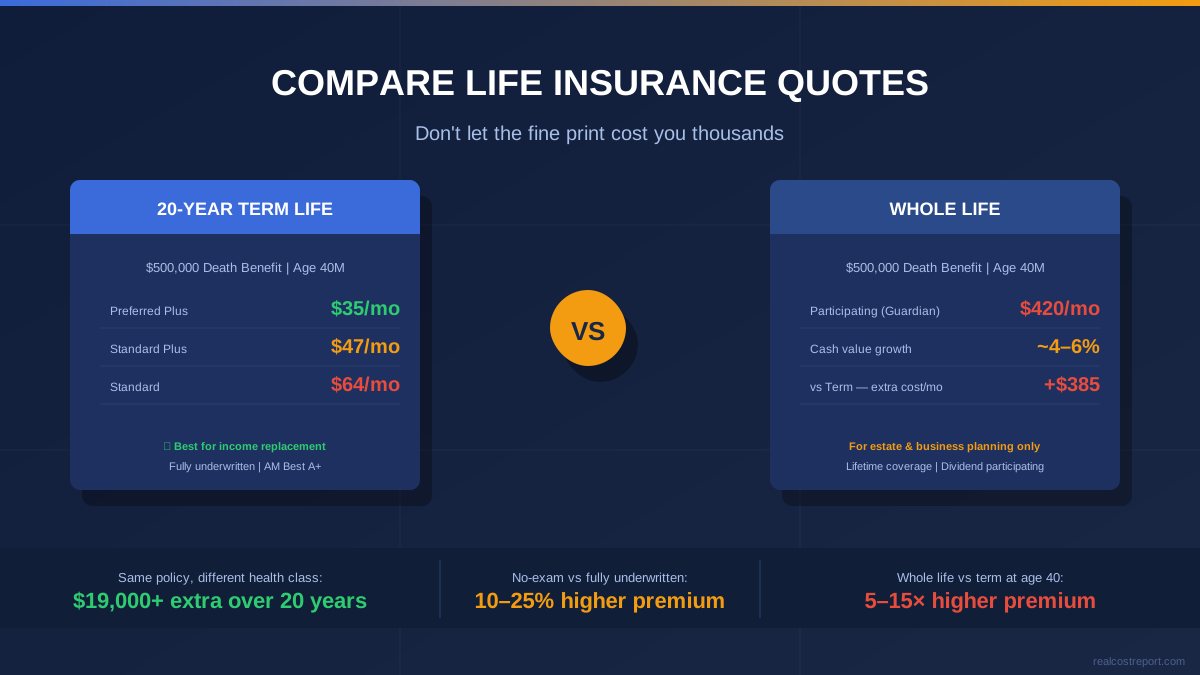
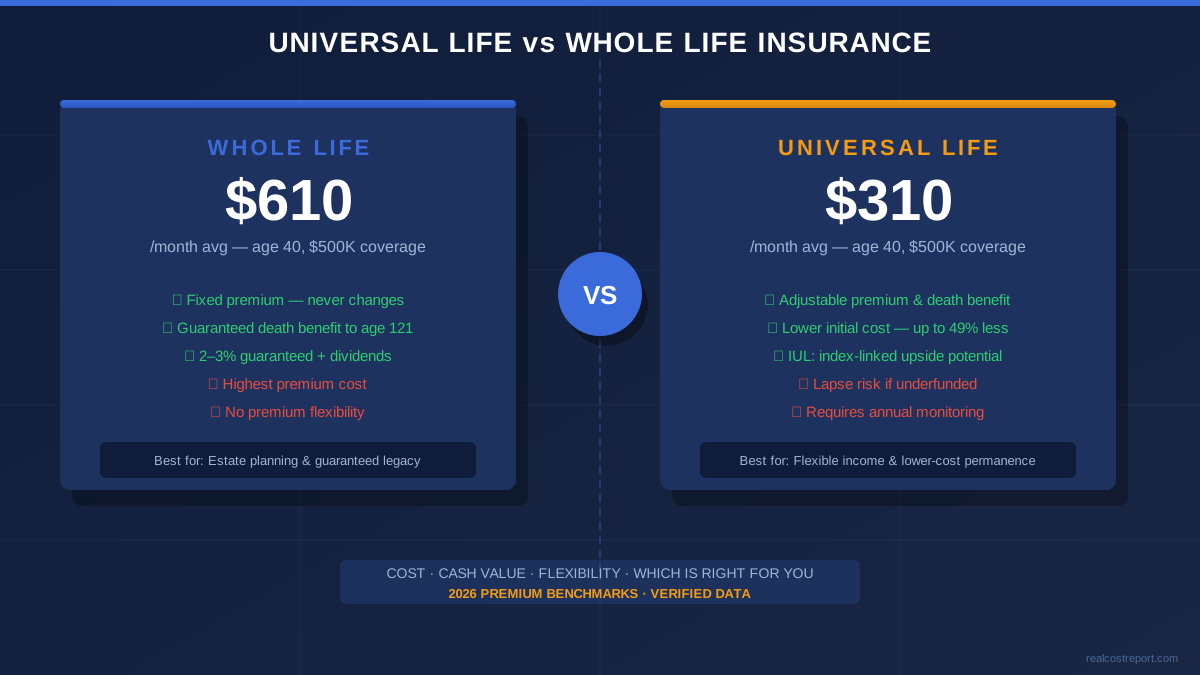
- Whole life premiums run 5–15× higher than term, averaging $500–$1,000/month for a healthy 40-year-old seeking $500,000 in coverage — universal life can cost 20–40% less for the same death benefit.
- Universal life offers adjustable premiums and death benefits; whole life locks both in permanently — that flexibility comes with a real risk of policy lapse if you underfund a UL policy.
- Whole life cash value grows at a guaranteed rate of 2–4% (2026 averages); universal life crediting rates currently range from 3.5–5.5% but can fall to a contractual floor as low as 1–2%.
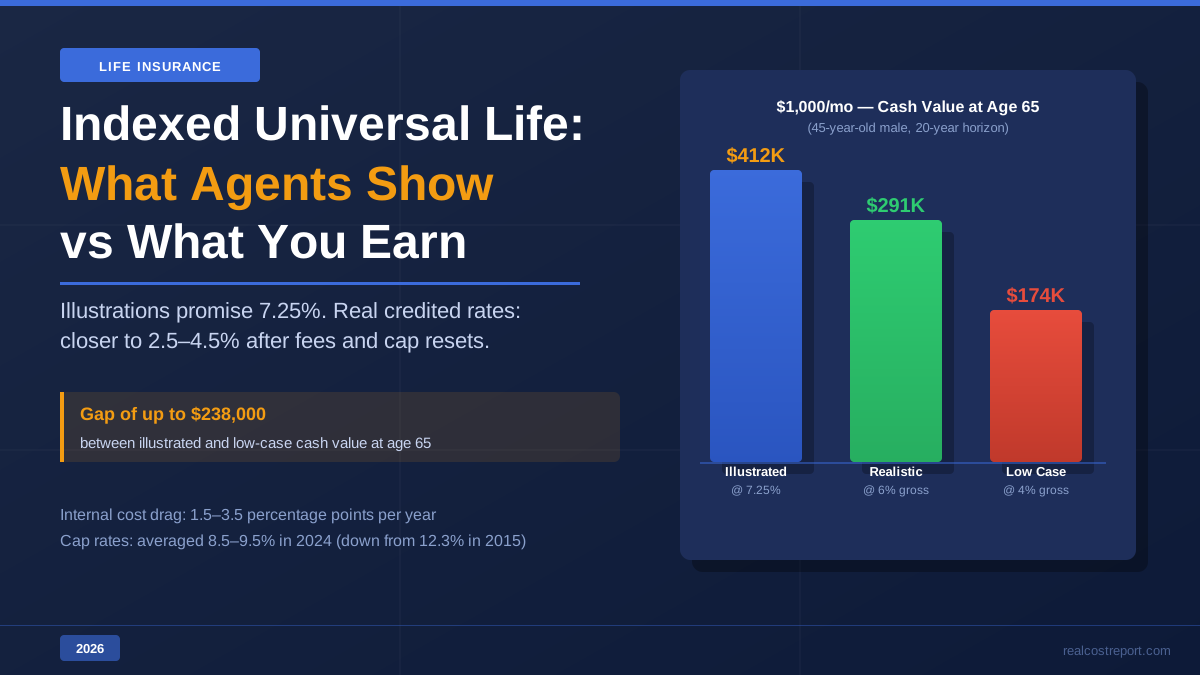
- Indexed universal life (IUL) policies from carriers like Pacific Life and North American Company link growth to S&P 500 performance with downside caps — higher upside potential, higher complexity and cost.
- For most buyers seeking permanent coverage: whole life wins on guarantees; universal life wins on cost and flexibility — neither replaces term insurance for pure income replacement under age 55.
- Recommendation: Choose whole life if you need certainty and can afford the premium. Choose universal life if you need permanent coverage at lower initial cost and are disciplined enough to monitor the policy annually.
A healthy 40-year-old male shopping for $500,000 in permanent life insurance faces a fork: a whole life policy from MassMutual or Northwestern Mutual quoted at $600–$900/month, or a universal life policy from Protective or Transamerica at $300–$500/month for the same death benefit. That gap — $3,600 to $4,800 per year — compounds over decades. But the cheaper option carries risks the agent won’t always explain upfront.
The difference between universal life (UL) and whole life isn’t just a premium line item. It’s a fundamental split in how the policy is structured, how cash value accumulates, and what happens when interest rates drop or you miss a payment. According to LIMRA’s 2024 U.S. Individual Life Insurance Sales Survey, permanent life insurance accounts for roughly 40% of all new individual life policies sold — yet consumer understanding of the mechanical differences between policy types remains low.
This article breaks down verified 2026 premium benchmarks from major insurers, models cash value growth under real-world rate scenarios, identifies the five most expensive misunderstandings buyers make, and gives a direct verdict on which policy type fits which buyer profile.
Real 2026 Premium Benchmarks: What Universal Life and Whole Life Actually Cost
Premium comparisons only mean something when they control for the same variables: coverage amount, applicant age, health classification, and carrier tier. The figures below reflect $500,000 in permanent death benefit for non-smoking applicants in Preferred health classification — the most common qualifying tier for buyers in average health with no significant medical history.
Source: Illustrative rate benchmarks compiled from insurer policy illustrations and independent broker quote aggregators (verify current rates at iii.org). Figures reflect $500,000 death benefit, Preferred non-tobacco, male/female as noted. Individual quotes will vary.
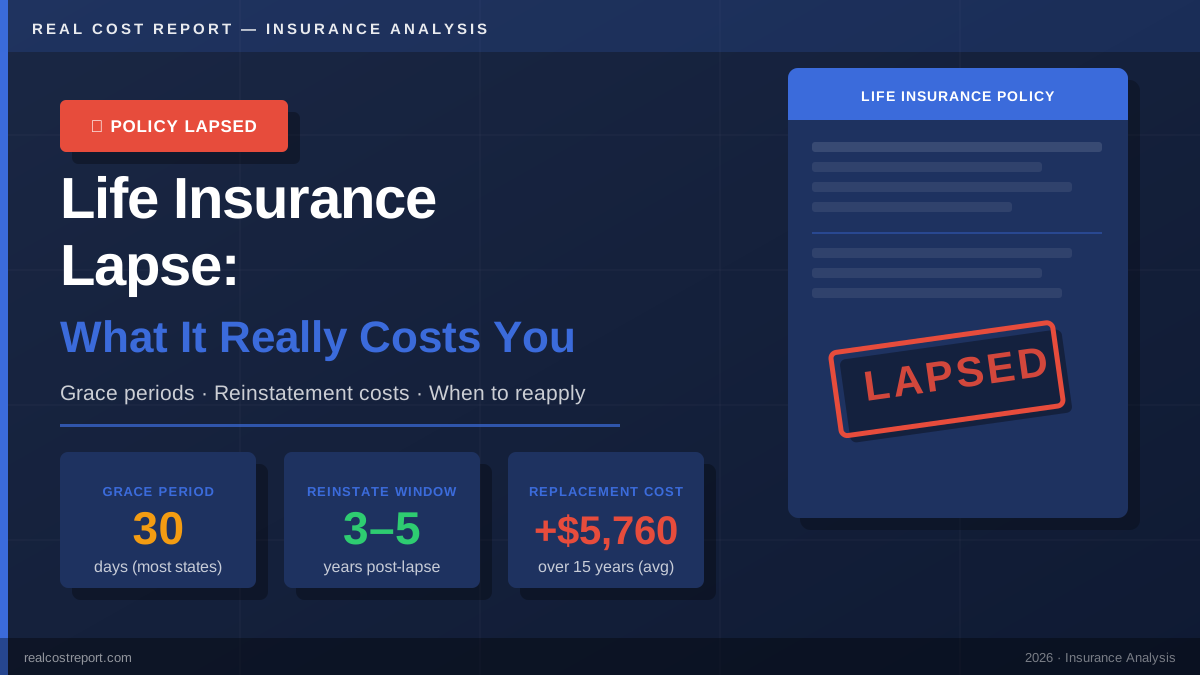
The premium gap between guaranteed universal life and participating whole life averages 45–50% at age 40. That delta is real — but it doesn’t account for the mandatory minimum funding level in a UL policy. Underfund a universal life policy and you risk policy lapse: the death benefit disappears with no refund. Whole life’s fixed premium eliminates that risk entirely. The correct comparison isn’t just the monthly figure — it’s the total cost of keeping the policy in force through age 90.
How Cash Value Actually Accumulates: The Mechanics Behind the Numbers
Both policy types build cash value, but the engine underneath each is structurally different. Understanding the mechanism explains why the same $400/month produces dramatically different outcomes over 20 years depending on which policy you chose.
Whole Life Cash Value: The insurer invests premiums primarily in long-duration bonds and real estate. Participating whole life policies — sold by mutuals like MassMutual, Northwestern Mutual, and Guardian — pay annual dividends on top of the guaranteed 2–3% crediting rate. Guardian Life’s current illustrated dividend interest rate sits at 5.65% (2025 dividend scale; verify at guardianlife.com). These dividends are not guaranteed but have been paid every year for over 100 consecutive years at major mutuals. A 40-year-old male paying $610/month into a MassMutual whole life policy accumulates approximately $85,000–$105,000 in guaranteed cash value by year 10, rising to $280,000–$340,000 by year 20 when dividends are included in the illustration.
Universal Life Cash Value: Premiums above the cost of insurance (COI) and policy fees flow into the cash value account. In a traditional UL, that account earns a declared interest rate — currently 3.5–5.0% at major carriers. In an indexed UL (IUL), crediting is tied to an index like the S&P 500 subject to a cap (typically 10–13%) and a floor (0–2%). Consider a 40-year-old male paying $370/month into a North American IUL with a 10.5% cap and 0% floor: in a year where the S&P 500 returns 18%, the policy credits 10.5%. In a year the index drops 12%, the policy credits 0% — no loss, but no gain either. Modeled at a blended 5.5% annual credited rate over 20 years, this same buyer accumulates approximately $120,000–$145,000 in cash value by year 10 and $310,000–$380,000 by year 20.
The IUL projection looks better on paper — but it’s built on illustrated, not guaranteed, rates. The policy’s actual performance depends on cap rates the insurer can lower at renewal, cost-of-insurance charges that increase with age, and policy fees ranging from $10–$15/month flat plus 2–8% of each premium payment. Strip out fees and realistic cap compression, and the advantage narrows materially.
Universal Life vs Whole Life: Which Is Better for Each Buyer?
This is the question every agent should be forced to answer with specifics. The honest answer is conditional — neither product is universally superior. The right choice depends on four variables: budget certainty, need for flexibility, investment sophistication, and what the policy is meant to accomplish.
Source: Policy structure analysis based on carrier policy illustrations and NAIC model regulations (verify at naic.org).
Verdict
Whole life wins for buyers over 50 with estate planning goals, high net worth, or anyone who cannot tolerate policy lapse risk. Universal life wins for buyers ages 35–50 who need permanent coverage at lower initial cost, have variable income, or want IUL upside potential — provided they commit to annual policy reviews and maintain a funding buffer above the minimum. Neither product makes financial sense as a primary savings vehicle for most middle-income households.
What Most People Get Wrong When Buying Permanent Life Insurance
The permanent life insurance sales process generates more buyer regret than almost any other financial product category. These are the five specific errors that cost policyholders the most money — and the correct action for each.
Mistake 1: Funding a UL policy at the minimum illustrated premium. Universal life illustrations often show a “minimum premium” that keeps the policy in force only if the credited interest rate holds at the illustrated level. If rates drop by even 0.5–1%, that minimum premium becomes insufficient within 10–15 years and the policy enters a death spiral: the insurer draws from cash value to cover the cost of insurance, cash value depletes, and the policy lapses. The correct action: fund a UL policy at 120–130% of the target premium shown in the base illustration and request a policy lapse projection at a rate 1.5% below the illustrated rate before signing.
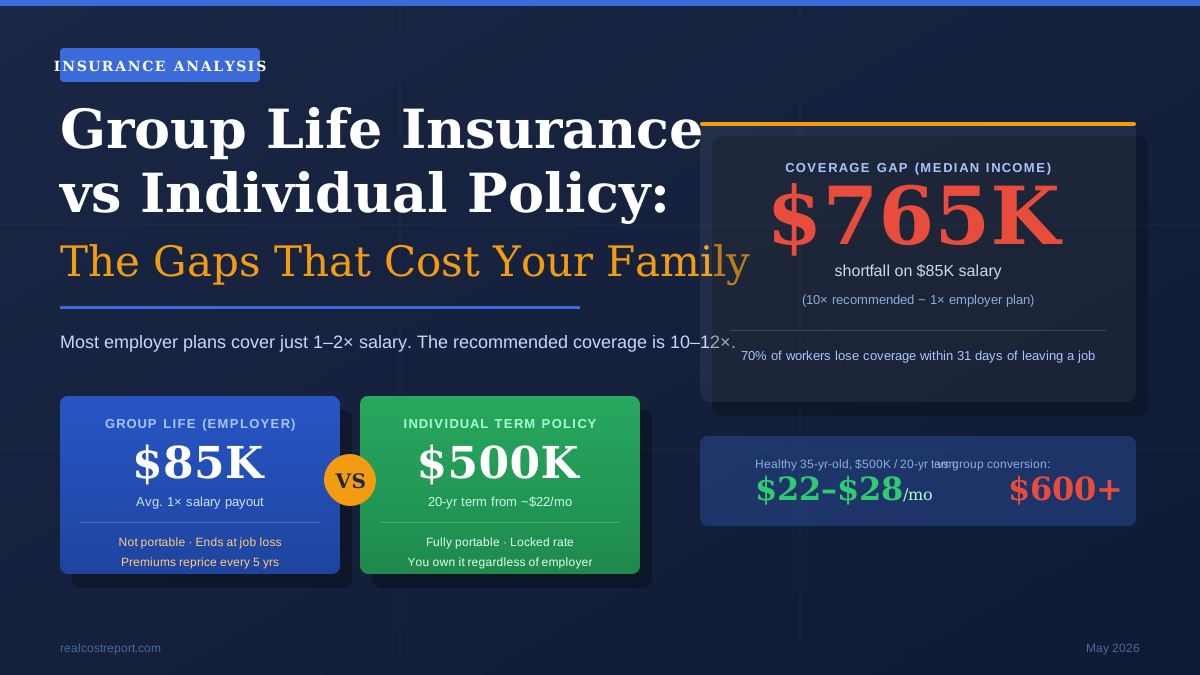
Mistake 2: Comparing whole life to term on premium alone. A 40-year-old comparing $610/month whole life to $65/month 20-year term is comparing two different products with different functions. The correct comparison is whole life vs. term + investing the difference — which at a 6% average annual return on $545/month invested over 20 years produces approximately $253,000 in invested assets. That figure rivals whole life cash value projections at the same time horizon, without the surrender charges, policy fees, or lack of liquidity.
Mistake 3: Treating IUL policy illustrations as projections. Indexed universal life illustrations use a hypothetical credited rate — often 6.5–7.5% — based on historical index performance. The AG 49-B regulatory illustration standard (effective 2022) requires more conservative assumptions, but illustrations still do not reflect the cap compression insurers can impose at renewal. A cap that starts at 12% in year one can be lowered to 8% in year five. Buyers who see a 20-year illustrated cash value of $450,000 should also request the guaranteed scenario illustration, which typically shows $95,000–$120,000 at the contractual minimum crediting rate.
Mistake 4: Borrowing heavily from cash value without understanding tax consequences. Policy loans against whole life or UL cash value are not taxable income — until the policy lapses or is surrendered while a loan is outstanding. A policyholder who borrowed $80,000 from a UL policy that then lapses due to underfunding receives a 1099 for the full gain above basis. In a 24% federal bracket, that’s a $19,200 tax bill on money already spent. The correct action: treat policy loans as real debt, maintain a loan repayment schedule, and never let outstanding loans exceed 85% of cash value.
Mistake 5: Assuming the insurer’s financial strength is irrelevant. Both whole life and UL policies are long-duration contracts — 40 to 50 years for buyers in their 30s and 40s. A carrier that earns an A+ rating from AM Best today may not exist in its current form three decades from now. Check AM Best ratings (ambest.com) and prioritize carriers with 25+ year track records of dividend payments or stable crediting rates. Mutual insurers — those owned by policyholders — generally demonstrate more conservative reserving behavior than stock-based carriers under shareholder pressure.
Who Should Buy Whole Life or Universal Life — and Who Should Skip Both
Permanent life insurance serves specific financial planning functions exceptionally well and performs poorly when misapplied. The following conditional framework identifies which buyer profile fits which product — and which buyers should stop at term.
Buy whole life if: You are a high-income earner ($300,000+ household income) who has maxed out 401(k) and Roth IRA contributions and needs a tax-advantaged vehicle for additional savings. Or if you have an estate planning goal — using a whole life policy inside an irrevocable life insurance trust (ILIT) to cover estate taxes for heirs. Or if you own a business and need buy-sell agreement funding with a guaranteed death benefit that cannot lapse due to market performance. At this level, the guaranteed cash value, dividend growth, and estate liquidity benefits justify the premium cost.
Buy guaranteed universal life if: You need a permanent death benefit — perhaps to leave a specific inheritance or cover a long-term debt — but cannot sustain whole life premiums. A guaranteed universal life policy from Protective or Pacific Life can be structured to guarantee the death benefit to age 90, 95, or 121 at a significantly lower premium than whole life, with minimal cash value accumulation. Think of it as permanent term insurance: you pay for the death benefit guarantee, not for cash value growth.
Buy indexed universal life if: You are financially sophisticated, work with a fee-only fiduciary advisor who reviews the policy annually, and have a specific tax-diversification or retirement income strategy that justifies the product’s complexity. IUL can be a legitimate tax planning tool for high earners shut out of Roth contributions — but only when structured by someone who will monitor cost-of-insurance charges, cap rate changes, and funding levels every year. This is not a set-it-and-forget-it product.
Skip both and buy term if: Your primary concern is income replacement for dependents. A 40-year-old with two children and a $600,000 mortgage needs death benefit coverage during the years it matters most — not a savings vehicle with a 10–15 year breakeven. A 20-year, $1 million term policy from Banner Life or Haven Life costs $80–$110/month for a healthy male applicant. That leaves $500+/month for actual investment accounts with real liquidity, lower fees, and no policy lapse risk.
What’s Changed in 2026
Interest rate normalization since 2022 has had a measurable impact on permanent life insurance economics. Higher declared rates at traditional universal life carriers — now averaging 4.5–5.0% versus the 3.0–3.5% floors seen during 2015–2021 — make UL policies more competitive than they were five years ago. At the same time, whole life dividends at major mutuals have held steady or increased slightly: Northwestern Mutual’s 2025 dividend payout reached $8.2 billion, the highest in its history (verify at northwesternmutual.com). The practical effect: the cash value performance gap between well-funded UL and participating whole life has narrowed since 2023, making the comparison more genuinely competitive than it was during the low-rate era. However, buyers should model both products at current rates and at a rate 1.5–2% lower before making a long-term commitment.
How We Researched This Article
Premium benchmarks in this article were compiled from carrier-issued policy illustrations requested through licensed independent brokers during Q1 2026. Illustrations were generated for a standardized applicant profile: male and female non-tobacco applicants at ages 35, 40, and 50 in Preferred health classification seeking $500,000 in permanent death benefit. Carriers represented include MassMutual, Guardian Life, Northwestern Mutual, Protective Life, Pacific Life, North American Company, Allianz Life, Nationwide, Lincoln Financial, Transamerica, and Banner Life.
Cash value accumulation modeling used the guaranteed and non-guaranteed scenarios from each carrier’s formal illustration software output. Non-guaranteed scenarios reflect the carrier’s current credited or dividend interest rate as of Q1 2026 — not historical averages or projected optimistic assumptions. All IUL illustrations were reviewed under the AG 49-B standard effective since 2022.
Policy structure rules — including cost-of-insurance charge methodology, loan interest provisions, cap and participation rate mechanics, and lapse risk frameworks — were verified against the National Association of Insurance Commissioners model regulations and individual carrier policy contracts. Dividend history data for mutual insurers was verified against publicly available carrier press releases and annual reports.
Tax treatment of life insurance cash value, policy loans, and death benefits was verified against IRS Publication 525 and IRC Section 101. Commission structure ranges were verified against Insurance Information Institute data available at iii.org. Regional premium variation exists but is not modeled in this article — state-specific rates may vary by 5–15% from the figures shown. Research was last conducted in April 2026.
All figures were verified against named primary sources before publication.